


Search results
Search for "dynamic stiffness" in Full Text gives 5 result(s) in Beilstein Journal of Nanotechnology.
Calculation of the dynamic stiffness of a cantilever under torsional oscillation
Beilstein J. Nanotechnol. 2026, 17, 303–308, doi:10.3762/bjnano.17.21
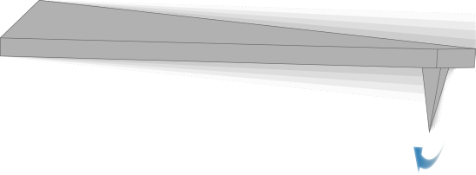
- interactions in the vertical and lateral directions between the tip and the sample. An accurate evaluation of the dynamic stiffness of the cantilever is indispensable in the quantitative analyses of the interactions. We calculated the dynamic stiffness of cantilevers under torsional oscillation based on the
- strain energy. Without tips, the torsional dynamic stiffness is approximately 23% larger than the static stiffness. The modification decreases to 21–23% with tips. Applying the present correction is essential for achieving quantitatively accurate stiffness values in dynamic measurements. Keywords
- : atomic force microscopy; dynamic stiffness; energy dissipation; friction; torsional oscillation mode; Introduction Friction serves as a fundamental mechanism of energy dissipation [1]. While friction typically arises from direct mechanical contact between surfaces, energy dissipation can also occur even

Multifrequency AFM integrating PeakForce tapping and higher eigenmodes for heterogeneous surface characterization
Beilstein J. Nanotechnol. 2025, 16, 2077–2085, doi:10.3762/bjnano.16.142
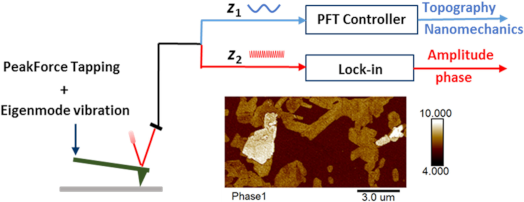
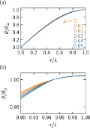
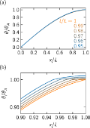
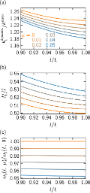
- interaction forces, as supported by studies on multimodal AFM [26]. The higher dynamic stiffness of the third eigenmode, compared to the second, makes it less susceptible to damping by long-range surface forces (e.g., van der Waals forces). This allows it to sense the sharper gradients of short-range


Electrostatically actuated encased cantilevers
Beilstein J. Nanotechnol. 2018, 9, 1381–1389, doi:10.3762/bjnano.9.130
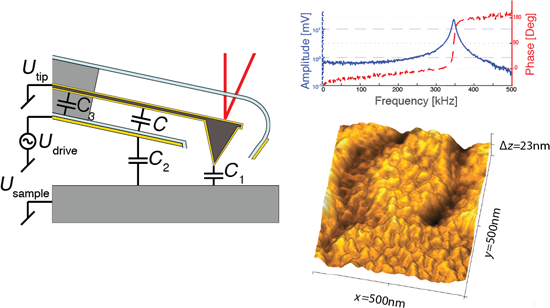
- contrast to static deflection, resonant excitation benefits from the mechanical gain resulting in an amplification by the quality factor (Q). We use the modeled capacitance gradient C′ = −105 pF·m−1, and the measured dynamic stiffness (kdyn = 18.0 N·m−1) and Q = 50 found by the thermal method (see Figure
- the dynamic modes (7.2% and 8%) can be explained by an underestimation of the dynamic stiffness by the Sader method [25][37]. The method leads to , where Γi is the imaginary part of the hydrodynamic function that depends on the Reynolds number, a function of the width of the cantilever, the frequency




High-frequency multimodal atomic force microscopy
Beilstein J. Nanotechnol. 2014, 5, 2459–2467, doi:10.3762/bjnano.5.255
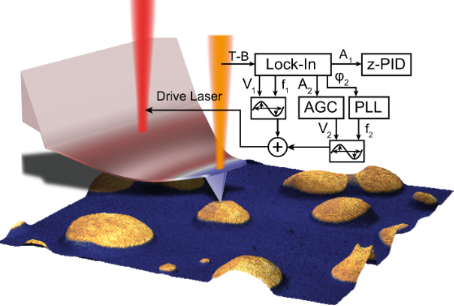
- in water [40]. One issue of note is that higher eigenmodes have an inherently higher dynamic stiffness that can be up to two orders of magnitude larger than the fundamental mode. This can be problematic for softer samples, as the power dissipated into the sample increases linearly with the spring


Dynamic calibration of higher eigenmode parameters of a cantilever in atomic force microscopy by using tip–surface interactions
Beilstein J. Nanotechnol. 2014, 5, 1899–1904, doi:10.3762/bjnano.5.200
- of an eigenmode shape is significantly bigger than the tip–cantilever contact area. Any other force acting on the whole cantilever, e.g., of thermal or electromagnetic nature, should be convoluted with the eigenmode shape, leading to a different definition of the effective dynamic stiffness. Thus
- model, e.g., the Euler–Bernoulli beam theory. Such a reduced system of coupled harmonic oscillators in the Fourier domain has the following form where the caret denotes the Fourier transform, ω is the frequency, kn is the effective dynamic stiffness of the nth eigenmode (n = 1, … , N), αn is the optical


![[Graphic 25]](/bjnano/content/inline/2190-4286-5-200-i35.png?max-width=637&scale=1.18182) , using Equation 9 for two different cantilevers: ...
, using Equation 9 for two different cantilevers: ...
Other Beilstein-Institut Open Science Activities



