Search results
Search for "ferromagnetic properties" in Full Text gives 21 result(s) in Beilstein Journal of Nanotechnology.
Modeling magnetic properties of cobalt nanofilms used as a component of spin hybrid superconductor–ferromagnetic structures
Beilstein J. Nanotechnol. 2025, 16, 1557–1566, doi:10.3762/bjnano.16.110
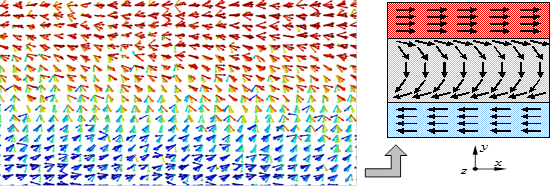
- thin films and the formation of Neel domain walls. Keywords: ferromagnetic properties; LAMMPS; mathematical modeling; MEAM; molecular dynamics; spin dynamics; Introduction Thin film structures [1][2] are increasingly employed each year in a wide range of applications, serving as functional [3][4


Synthesis and magnetic transitions of rare-earth-free Fe–Mn–Ni–Si-based compositionally complex alloys at bulk and nanoscale
Beilstein J. Nanotechnol. 2025, 16, 823–836, doi:10.3762/bjnano.16.62
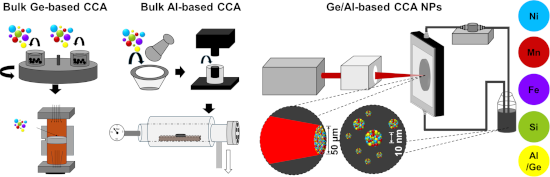
- magnetization Ms (5 K, 9 T) of 68.2 A·m2·kg−1, indicating strong ferromagnetic properties (Table 3). At 300 K, the loop becomes narrower, and Hc drops significantly to 1.2 kA·m−1, while Ms decreases to 18 A·m2·kg−1. This behavior suggests that the material becomes easier to demagnetize, which is generally good


Exfoliation of titanium nitride using a non-thermal plasma process
Beilstein J. Nanotechnol. 2024, 15, 631–637, doi:10.3762/bjnano.15.53
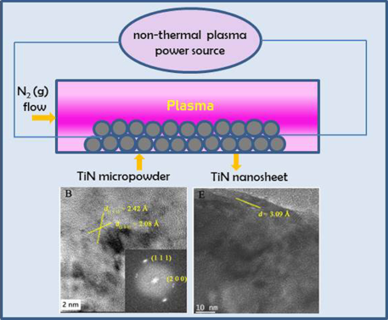
- ferromagnetic properties and demonstrated high visible-light photocatalytic activity when loaded onto titania nanotube arrays. Titanium nitride (TiN) has gained recognition as an advanced engineering material because of its outstanding chemical and thermal stability, extreme hardness, and electrical



Photocatalytic degradation of methylene blue under visible light by cobalt ferrite nanoparticles/graphene quantum dots
Beilstein J. Nanotechnol. 2024, 15, 475–489, doi:10.3762/bjnano.15.43
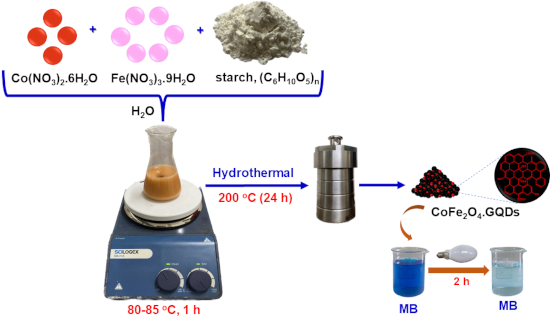
- the most important soft-magnetic ferrite materials because of its ferromagnetic properties, high magnetic and thermal stability, low conductivity, and anisotropy [6]. The controllable synthesis of spherical CF nanoparticles from corresponding salts and Arabic gum as surfactant agent using a




Bismuth-based nanostructured photocatalysts for the remediation of antibiotics and organic dyes
Beilstein J. Nanotechnol. 2023, 14, 291–321, doi:10.3762/bjnano.14.26
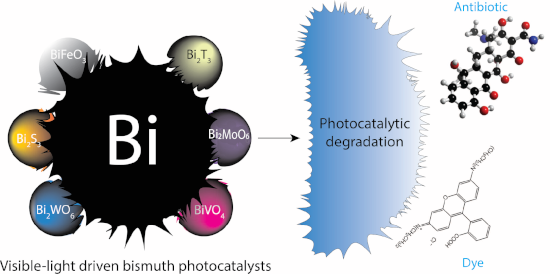
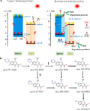
- absorption range. In addition to improving the photocatalytic properties of the Bi-based host materials, doping them with rare earth elements may also give them special ferroelectric and ferromagnetic properties, as well as electrochemical and luminescent properties. To produce an Er-doped Bi2WO6


A review of defect engineering, ion implantation, and nanofabrication using the helium ion microscope
Beilstein J. Nanotechnol. 2021, 12, 633–664, doi:10.3762/bjnano.12.52
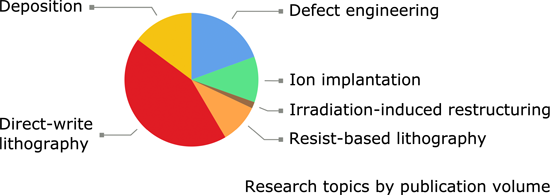
- junctions by the HIM method has again been demonstrated [48]. Ferromagnetic properties The first demonstration of defect engineering using the HIM was actually for a magnetic device by Franken and co-authors [49]. In this work, ferromagnetic microstrips comprising Pt(4 nm)/Co(0.6 nm)/Pt(2 nm) layers on an


Spontaneous shape transition of MnxGe1−x islands to long nanowires
Beilstein J. Nanotechnol. 2021, 12, 366–374, doi:10.3762/bjnano.12.30
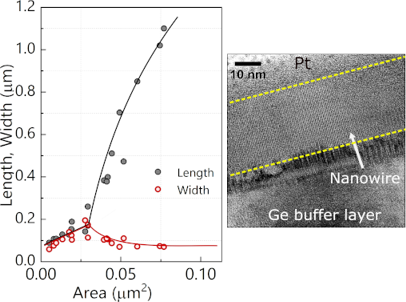
- ]. The growth of MnxGe1−x alloys on Ge wafers, and in particular of Mn5Ge3, has been studied extensively in recent years [18][19][20][21][22][23][24]. The high Curie temperature of Mn5Ge3 (≈296 K), in particular, can make it suitable to exploit ferromagnetic properties in everyday applications [25][26
- ≃1.5 μm in length. Considering that several Mn-rich Ge–Mn phases are usually ferromagnetic at room temperature, our results offer an alternative route to a simple and fast fabrication process of novel nanodevices, capable to exploit ferromagnetic properties. SEM images of the morphological evolution of
- literature for other heteroepitaxial systems. Our study gives experimental evidence for the spontaneous formation of spatially uniform and compositionally homogeneous Mn-rich GeMn nanowires on Ge(111). The reliable and simple synthesis approach allows one to exploit the room-temperature ferromagnetic


Nanocasting synthesis of BiFeO3 nanoparticles with enhanced visible-light photocatalytic activity
Beilstein J. Nanotechnol. 2020, 11, 1822–1833, doi:10.3762/bjnano.11.164
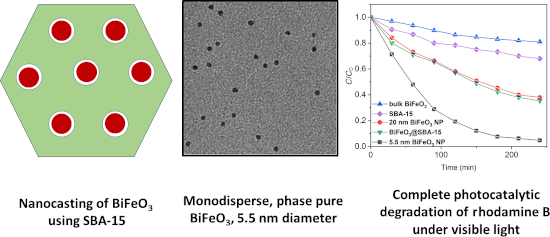
- visible-light region (2.1–2.8 eV), high chemical stability, and ferroelectric and ferromagnetic properties at room temperature [19][20][21][22][23][24][25][26][27]. Furthermore, slow electron–hole recombination as a result of efficient separation of the charge carriers has yielded an enhancement of its




Proximity effect in [Nb(1.5 nm)/Fe(x)]10/Nb(50 nm) superconductor/ferromagnet heterostructures
Beilstein J. Nanotechnol. 2020, 11, 1254–1263, doi:10.3762/bjnano.11.109
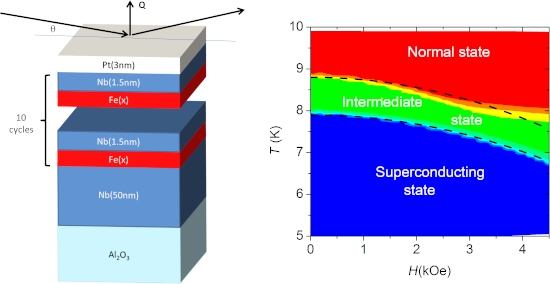
- ferromagnetic properties. The proximity of this weak ferromagnetic layer to a thick superconductor leads to an intermediate phase that is characterized by a suppressed but still finite resistance of structure in a temperature interval of about 1 K below the superconducting transition of thick Nb. By increasing


![[Graphic 13]](/bjnano/content/inline/2190-4286-11-109-i17.svg?max-width=637&scale=1.18182) ) substrate, (b) the Pt cap layer, and the Nb buffer layer grown at...
) substrate, (b) the Pt cap layer, and the Nb buffer layer grown at...


![[Graphic 16]](/bjnano/content/inline/2190-4286-11-109-i20.svg?max-width=637&scale=1.18182) (T) for the samples s4 (black) and s3 (red) in the vicinity of the superconducting transition m...
(T) for the samples s4 (black) and s3 (red) in the vicinity of the superconducting transition m...
Applications of superparamagnetic iron oxide nanoparticles in drug and therapeutic delivery, and biotechnological advancements
Beilstein J. Nanotechnol. 2020, 11, 1092–1109, doi:10.3762/bjnano.11.94


Wet-spinning of magneto-responsive helical chitosan microfibers
Beilstein J. Nanotechnol. 2020, 11, 991–999, doi:10.3762/bjnano.11.83
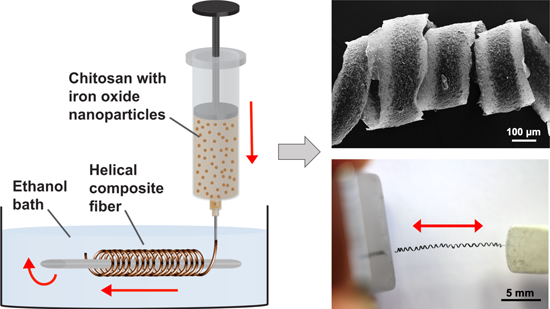
- nanoparticles agglomerated into clusters inside the fiber matrix. The helical constructs exhibited a diameter of approximately 500 µm with one to two windings per millimeter. Due to their ferromagnetic properties they are easily attracted to a permanent magnet. The results from the tensile testing show that the
- , resulting in strong ferromagnetic properties of the fibers. Since the generated fibers had magnetic properties they could be attracted to and stretched by a permanent magnet. The dried chitosan helices had a spring-like elastic behavior. The composite fibers exhibited a Young’s modulus of approximately 14


Targeted therapeutic effect against the breast cancer cell line MCF-7 with a CuFe2O4/silica/cisplatin nanocomposite formulation
Beilstein J. Nanotechnol. 2019, 10, 2217–2228, doi:10.3762/bjnano.10.214
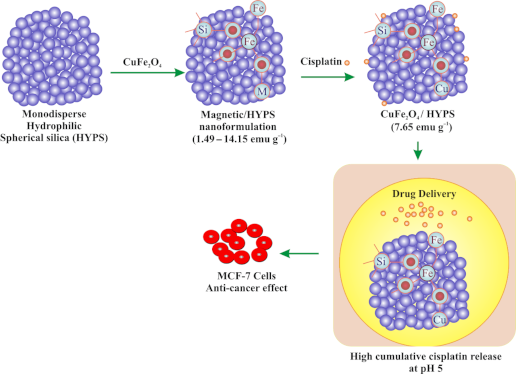
- presence of small-sized nanoclusters at the walls of hexagonal-shaped MCM-41 tends to form superparamagnetic interactions among Fe3+ species, while large nanoclusters contribute to ferromagnetic properties [17]. In our study, paramagnetic behavior with narrow hysteresis demonstrates the formation of small


Oblique angle deposition of nickel thin films by high-power impulse magnetron sputtering
Beilstein J. Nanotechnol. 2019, 10, 1914–1921, doi:10.3762/bjnano.10.186
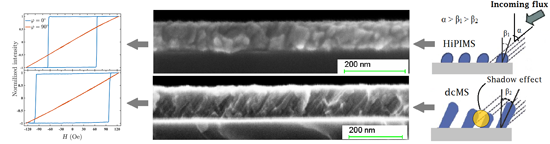
- ], corrosion-resistant coatings [3][4], optically transparent conductive electrodes [5], contact devices [6], Li-storage materials [7], and as selective absorbers in solar thermal energy conversion [8]. Moreover, a number of nickel-containing alloys exploit the ferromagnetic properties of nickel such as NiTi


Atomic layer deposition and properties of ZrO2/Fe2O3 thin films
Beilstein J. Nanotechnol. 2018, 9, 119–128, doi:10.3762/bjnano.9.14
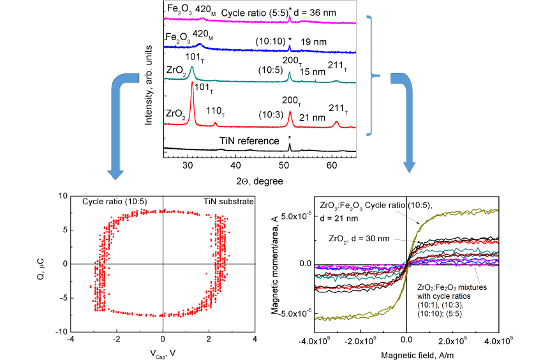
- processes have been employed to prepare the samples. Ca- and Mg-stabilized cubic zirconia, prepared by pulsed laser deposition (PLD), has shown ferromagnetic properties [3]. Magnetic properties of PLD-synthesized ZrO2, doped with Co, Fe, Mn or Ni, have been studied [4], showing that doping ZrO2 with Mn
- reactive DC magnetron sputtering [7], also exhibited ferromagnetic properties. The undoped ZrO2 exhibited ferromagnetic properties mainly driven by oxygen vacancies. Monoclinic and tetragonal phases with similar amounts of oxygen vacancies were compared and ferromagnetism was only observed in the case of
- ferromagnetic properties. The ferroelectric properties of ALD-grown undoped zirconia have also been investigated [20]. ZrO2 thin films were deposited by remote plasma ALD from tetrakis(dimethylamido)zirconium(IV) and oxygen plasma, and were found to exhibit ferroelectric behavior. ALD and physical vapor


Ferrocholesteric–ferronematic transitions induced by shear flow and magnetic field
Beilstein J. Nanotechnol. 2017, 8, 2552–2561, doi:10.3762/bjnano.8.255
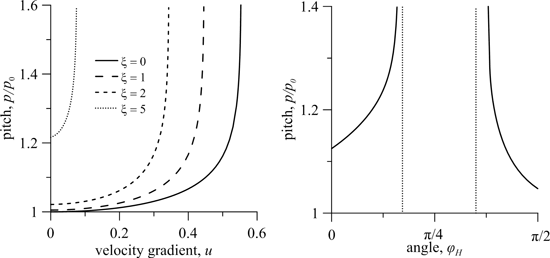
- mechanism of interaction between the LC and an external magnetic field, the addition of magnetic particles into the LC leads to the appearance of an additional dipole mechanism of the influence on the system. Some types of synthesized ferroliquid crystals have ferromagnetic properties and are highly


Formation of ferromagnetic molecular thin films from blends by annealing
Beilstein J. Nanotechnol. 2017, 8, 1469–1475, doi:10.3762/bjnano.8.146
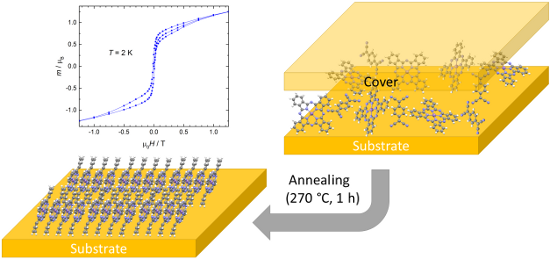
- remarkable ferromagnetic properties with a substantial coercivity of up to 13 mT at 2 K and a Curie temperature of 11.5 K. These findings are significant for a future implementation of magnetic molecular thin films in spintronic devices, especially on flexible substrates that are commonly sensitive to high



Ferromagnetic behaviour of ZnO: the role of grain boundaries
Beilstein J. Nanotechnol. 2016, 7, 1936–1947, doi:10.3762/bjnano.7.185
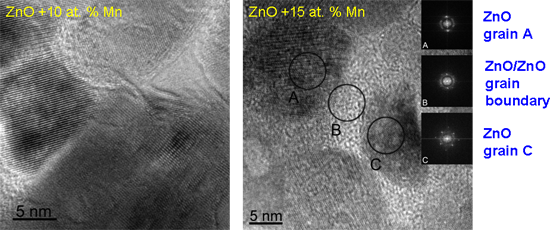
- Materials Science, Russian Academy of Sciences, Leninsky prospect 49, 117991 Moscow, Russia 10.3762/bjnano.7.185 Abstract The possibility to attain ferromagnetic properties in transparent semiconductor oxides such as ZnO is very promising for future spintronic applications. We demonstrate in this review
- . Indeed, pure ZnO possesses ferromagnetic properties at sGB > sth = 5.3 × 10⁷ m2/m3 [7], in other words at grain sizes below 20 nm (Figure 1a). However, the addition of manganese, cobalt, iron and nickel positively influences the FM of ZnO polycrystals. Such additions decrease the amount of GBs needed for
- FM behaviour. This fact somehow coincides with the prediction of Dietl et al. [1]. For example, in a number of works where sGB fell between sth for pure and manganese-doped ZnO, paramagnetic properties were observed in pure zinc oxide and ferromagnetic properties in manganese-doped samples [18][19


Properties of Ni and Ni–Fe nanowires electrochemically deposited into a porous alumina template
Beilstein J. Nanotechnol. 2016, 7, 1709–1717, doi:10.3762/bjnano.7.163
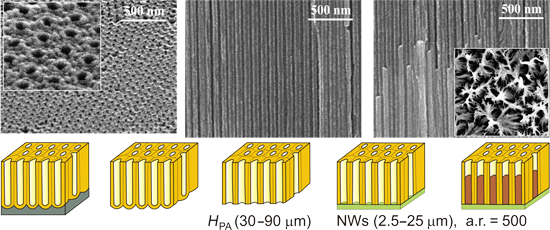
- of 50 ± 5 nm in diameter and 25 μm in length, i.e., with an aspect ratio of 500. XRD data demonstrate the polycrystalline nature of Ni and Ni–Fe in a face-centered cubic close-packed lattice. Both fabricated materials, Ni and Ni–Fe, have shown ferromagnetic properties. The specific magnetization
- preferred growth orientation of (220) and Ni–Fe NWs with preferred (111) orientation have shown ferromagnetic properties. The value of specific magnetization of Ni–Fe NWs in the alumina template is higher than that of the Ni sample and bulk Ni. The Curie temperature of Ni–Fe sample (790 K) is higher than


Microwave solvothermal synthesis and characterization of manganese-doped ZnO nanoparticles
Beilstein J. Nanotechnol. 2016, 7, 721–732, doi:10.3762/bjnano.7.64
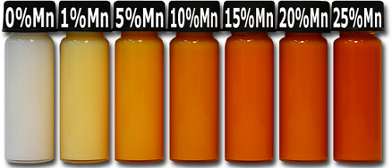
- + [22]. Numerous scholars have described obtaining Mn2+-doped zinc oxide, which displays ferromagnetic properties at room temperature, in their papers [23][24][25][26]. However, there are many contradicting or even controversial publications on this topic [27][28][29][30]. Depending on the method of
- ]. But when a reducing environment was selected for sample calcination, also precipitations of ZnMnO3 and ZnMn2O4 phase emerged in Zn1−xMnxO and the material displayed only ferromagnetic properties [36]. Ferromagnetic properties of Zn1−xMnxO are explained by the presence of oxygen vacancies, manganese in


Influence of the shape and surface oxidation in the magnetization reversal of thin iron nanowires grown by focused electron beam induced deposition
Beilstein J. Nanotechnol. 2015, 6, 1319–1331, doi:10.3762/bjnano.6.136
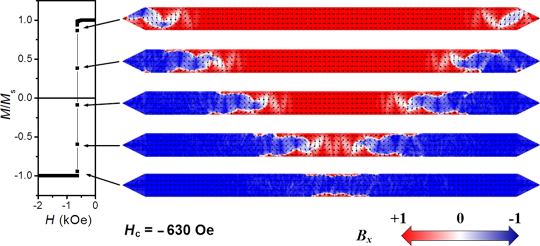
- valve in the GIS and had to be optimized in order to obtain deposits exhibiting ferromagnetic properties with suitable shape anisotropy. In these experiments, the nominal turbopump speed is 260 L/s for nitrogen gas. When the leak valve is opened, the chamber pressure increases. The chamber pressure is


Enhancement of photocatalytic H2 evolution of eosin Y-sensitized reduced graphene oxide through a simple photoreaction
Beilstein J. Nanotechnol. 2014, 5, 801–811, doi:10.3762/bjnano.5.92
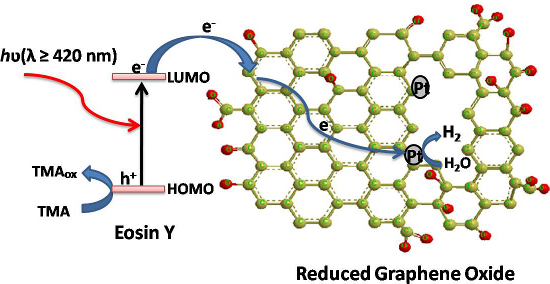
- holes occur in the RGO24 sheet (Figure 9B), which is consistent with the model shown in Scheme 1. The model is similar to the one reported in [51]. The ferromagnetic properties [51] of RGO obtained by a photoreaction and its paramagnetic resonance (EPR) spectra [38] indicate that there are some radicals