


Search results
Search for "material discrimination" in Full Text gives 3 result(s) in Beilstein Journal of Nanotechnology.
Multifrequency AFM integrating PeakForce tapping and higher eigenmodes for heterogeneous surface characterization
Beilstein J. Nanotechnol. 2025, 16, 2077–2085, doi:10.3762/bjnano.16.142
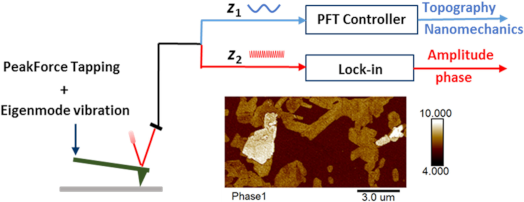
- environments such as liquids [18][19]. As demonstrated by force–distance curve analyses [19], PFT enables direct extraction of quantitative mechanical properties (e.g., Young’s modulus and adhesion) for material discrimination. However, this capability is constrained by the requirement for precise probe
- insufficient contact deformation, retain efficacy in material discrimination via eigenmode phase contrast. In contrast, stiff probes (e.g., NSC15/Al BS) not only enable reliable mechanical quantification but also achieve high-contrast phase imaging. Additionally, synchronized signal processing algorithms and


Material discrimination and mixture ratio estimation in nanocomposites via harmonic atomic force microscopy
Beilstein J. Nanotechnol. 2017, 8, 2771–2780, doi:10.3762/bjnano.8.276
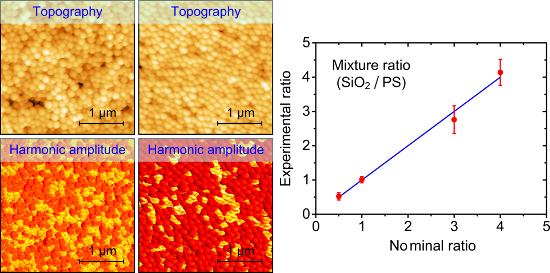
- applications in various fields of nanoscience and nanotechnology. Keywords: atomic force microscopy; harmonic imaging; material discrimination; mixture ratio; nanocomposites; Introduction Because of its extreme importance and widespread applications, nanocomposites have received more and more attention [1
- , the better the material discrimination. The corresponding contrast values are 0.9, 3.4, 9.8, 11.5, 10.2, 6.5 and 5.5. It is obvious that the harmonic image has the largest contrast and amplitude difference at the set-point of approximately 0.25. To interpret and ascertain the experimental dependence
- almost no sensitivity to material differences. Material discrimination and mixture ratio estimation After systematic investigations on the influencing factors, we turn to the application of harmonic imaging in material discrimination and mixture ratio estimation of nanocomposite components. The samples




Multiple regimes of operation in bimodal AFM: understanding the energy of cantilever eigenmodes
Beilstein J. Nanotechnol. 2013, 4, 385–393, doi:10.3762/bjnano.4.45
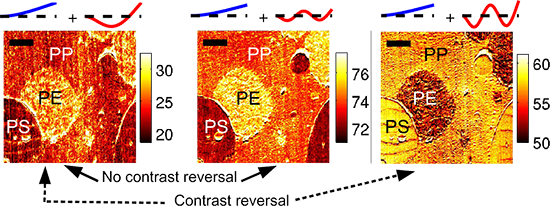
- bimodal AFM operation (or even multiple higher eigenmodes simultaneously [9]). In this work, we wish to examine the choice of specific higher order eigenmodes for bimodal operation in order to understand if they provide any practical advantages in terms of material discrimination and identification. There


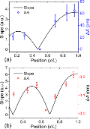
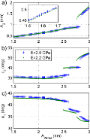
![[Graphic 3]](/bjnano/content/inline/2190-4286-4-45-i5.png?max-width=637&scale=1.18182) . In the top row (a, b) the first eigen...
. In the top row (a, b) the first eigen...



Other Beilstein-Institut Open Science Activities



