


Search results
Search for "microfibrils" in Full Text gives 10 result(s) in Beilstein Journal of Nanotechnology.
Cellulose as a photocatalyst support material: extraction, structural features, and environmental applications
Beilstein J. Nanotechnol. 2026, 17, 635–652, doi:10.3762/bjnano.17.44
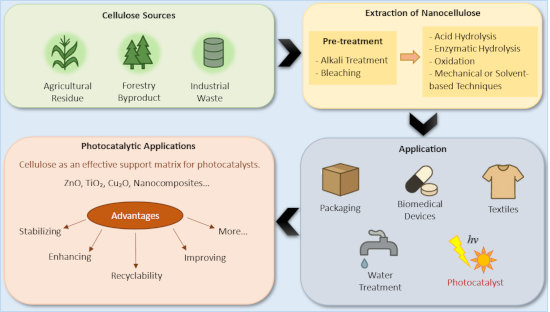
- formation of nanofibers. These nanofibers further assemble into larger cellulose microfibrils [4]. With the global cellulose production now exceeding hundreds of billions of tons annually and continuing to grow steadily, this abundant biopolymer stands out for its exceptional mechanical, physical, and
- chemical modifications that enable diverse functionalization of cellulose materials [21]. Cellulose is available in several commercial forms, including microfibrillated cellulose (MFC) and microcrystalline cellulose (MCC); other important variants include CNCs, microfibrils, and bacterial cellulose (BC
- ). Manufacturers produce cellulose at both the microscale and the nanoscale, where materials such as MCC consist of microscopic particles up to 1 µm in length and over 1 µm in width; MFC is typically obtained through mechanical or chemical treatment of wood, and microfibrils appear as individual fibers measuring


Subdigital integumentary microstructure in Cyrtodactylus (Squamata: Gekkota): do those lineages with incipiently expressed toepads exclusively exhibit adhesive setae?
Beilstein J. Nanotechnol. 2026, 17, 38–56, doi:10.3762/bjnano.17.4
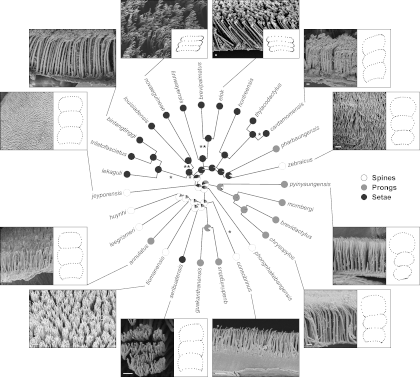
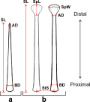
- significantly among both microstructure types and ecotypes. Keywords: ecomorphology; evolution; habitat-specific adaptations; microfibrils; microornamentation; reptiles; toepad evolution; Introduction How a species’ habitat influences its mode of locomotion and how species adapt to effectively traverse and


Beyond the bilayer: multilayered hygroscopic actuation in pine cone scales
Beilstein J. Nanotechnol. 2025, 16, 1695–1710, doi:10.3762/bjnano.16.119
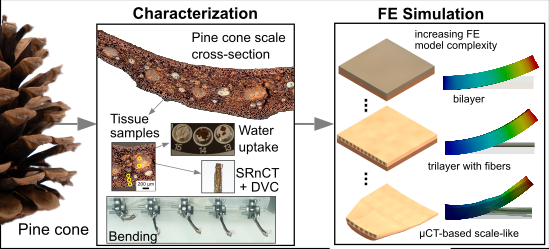
- radial shrinkage is highest for the sclerenchyma fibers and lowest for the sclereids, which can be explained by the microfibril angle. The angle of the microfibrils can not only limit cell expansion along its longitudinal direction, but also constrict radial shrinkage like a belt [46][47]. Since the


Polyurethane/silk fibroin-based electrospun membranes for wound healing and skin substitute applications
Beilstein J. Nanotechnol. 2025, 16, 591–612, doi:10.3762/bjnano.16.46
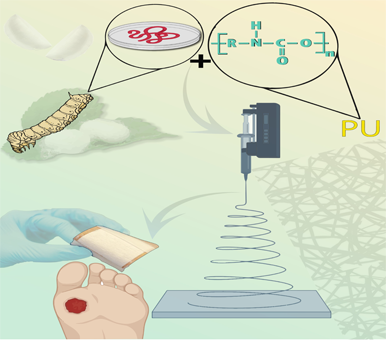
- -sheets are found in various silks [82]. These types of proteins often exhibit remarkable mechanical characteristics, in contrast to globular proteins. SF nanofibrils are the building blocks of SF filament and have a diameter of around 3.5 nm. These nanofibrils originate from SF microfibrils, which



Enhancing mechanical properties of chitosan/PVA electrospun nanofibers: a comprehensive review
Beilstein J. Nanotechnol. 2025, 16, 286–307, doi:10.3762/bjnano.16.22

- conductivity. Finally, environmental parameters include relative humidity and temperature [15]. Chitosan, a widely utilized material in electrospun nanofiber membranes, is derived from the crystalline microfibrils of crustaceans, including crabs and prawns. It is biodegradable and exhibits a high capacity for


Natural nanofibers embedded in the seed mucilage envelope: composite hydrogels with specific adhesive and frictional properties
Beilstein J. Nanotechnol. 2024, 15, 1603–1618, doi:10.3762/bjnano.15.126
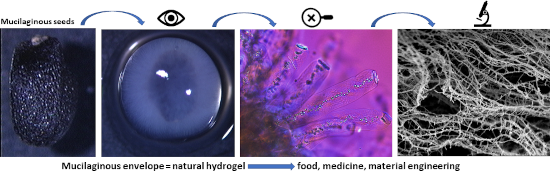
- microfibrils, whose diameter can vary across species from 2.2–3.6 nm [48][49][50][51], over 3–4 nm [52], to even 30 nm of average width [53]. Microfibrils are typical of primary cell walls, while the next higher level of organisation are macrofibrils [54], specific for secondary cell walls [47][55][56]. Cell
- wall architecture has been studied in many cases on the primary cell wall of parenchymatous, root tip, or epidermal cells [54][57][58][59]. Visualisation of the secondary cell wall was previously carried out for tracheary elements of xylem [60][61][62]. The microfibrils of the primary cell wall are
- rather thin (2–3 nm), which makes their differentiation from other polysaccharides (pectins and hemicelluloses) rather difficult. The size of the microfibrils of the secondary cell wall (20–30 nm) [53] makes their observation easier, particularly using high-resolution microscopy techniques, such as


Sulfur nanocomposites with insecticidal effect for the control of Bactericera cockerelli
Beilstein J. Nanotechnol. 2023, 14, 1106–1115, doi:10.3762/bjnano.14.91
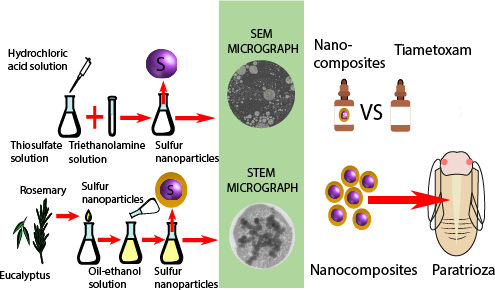
- to improve the insecticidal efficacy because the higher surface area and specificity provide stronger contact of the active substance with the insects [45]. The working mechanism of the nanocomposites may be the effective penetration through pores and microfibrils of the insects’ cuticle [45] and the


Nanocellulose: Recent advances and its prospects in environmental remediation
Beilstein J. Nanotechnol. 2018, 9, 2479–2498, doi:10.3762/bjnano.9.232
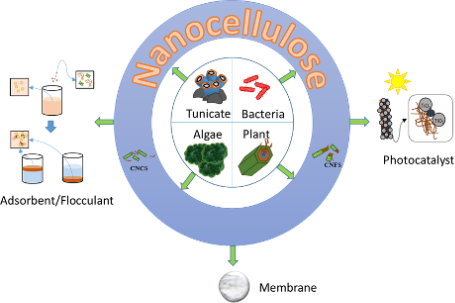
- common technique used to extract CNC from cellulose. Unlike mechanical disintegration, this technique destroys the amorphous region (non-crystalline region) in microfibrils, leaving the crystalline regions intact. Liu et al. [76] have demonstrated that CNC obtained through sulphuric acid hydrolysis (with
- –SO3− functional group) (Figure 3b) showed superior Ag(I) adsorption capacity over CNC obtained via mechanical grinding. Similar to CNC extraction from cellulose, acid hydrolysis is commonly used to fabricate bacteria nanocrystals from BC microfibrils [77]. To aid in the delamination of nanofibrils in
- of 40–70 nm, high mechanical strength and super-hydrophilicity properties [123]. Its ultrafine three-dimensional network provides bacterial cellulose with a high specific surface area, owing to the well-separated nano- and microfibrils. Besides, the presence of –OH binding sites and a fibrous network


“Sticky invasion” – the physical properties of Plantago lanceolata L. seed mucilage
Beilstein J. Nanotechnol. 2016, 7, 1918–1927, doi:10.3762/bjnano.7.183
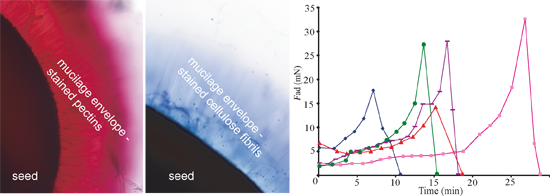
- homopolymer of 1,4-ß-D-glucan units [25]. Cellulose chains are linked together to form elementary fibril, the size of which can vary depending on the cell-wall type (primary, secondary) and the presence of other components (hemicelluloses) coating the surface. The size of microfibrils, estimated for the
- wall, as well as for the wall of MSCs [17][41]. In P. lanceolata, pectins could be attached to the cellulose fibrils leading to a decrease in adhesive force as, most likely, not all pectin side chains can be involved in the adhesion processes on the surface. The cellulose microfibrils also provide


Functional diversity of resilin in Arthropoda
Beilstein J. Nanotechnol. 2016, 7, 1241–1259, doi:10.3762/bjnano.7.115
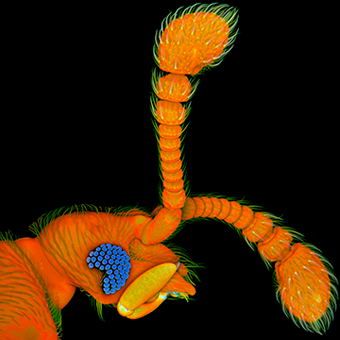
- -bearing microfibrils is clearly visible (Figure 3F,G). Legged locomotion Mechanisms of fast leg movements with an acceleration that can surpass the limitations of muscle contraction have been found in different insect groups including fleas [15][70], locusts [71], beetles [72][73] and true bugs [16][17





