


Search results
Search for "tetrathiafulvalene" in Full Text gives 9 result(s) in Beilstein Journal of Nanotechnology.
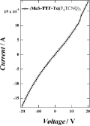
Supramolecular one-dimensional conducting nanofibers from a C3-symmetric tetrathiafulvalene derivative
Beilstein J. Nanotechnol. 2026, 17, 872–881, doi:10.3762/bjnano.17.63
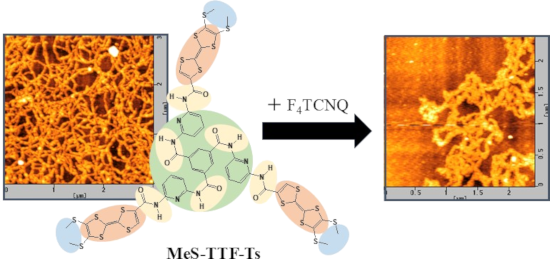
- Tokyo, 4-6-1 Komaba, Meguro-ku, Tokyo 153-8505, Japan 10.3762/bjnano.17.63 Abstract This study reports the design and synthesis of a C3-symmetric discotic tetrathiafulvalene (TTF) derivative, MeS-TTF-Ts, as a molecular platform for the self-assembly of one-dimensional conductive nanostructures. The
- nanofibers; one-dimensional nanostructures; supramolecular self-assembly; tetrathiafulvalene; Introduction Supramolecular gels have been developed as organized soft materials that form anisotropic nanostructures such as ribbons and fibers within their networks [1][2]. These materials have attracted
- promising platforms for the development of functional nanomaterials [9][10]. In particular, when electroactive molecules are employed, one-dimensional structures formed through self-assembly are expected to be applicable as nanowire materials in molecular electronic devices. Among them, tetrathiafulvalene


Charge-transfer interactions between fullerenes and a mesoporous tetrathiafulvalene-based metal–organic framework
Beilstein J. Nanotechnol. 2019, 10, 1883–1893, doi:10.3762/bjnano.10.183
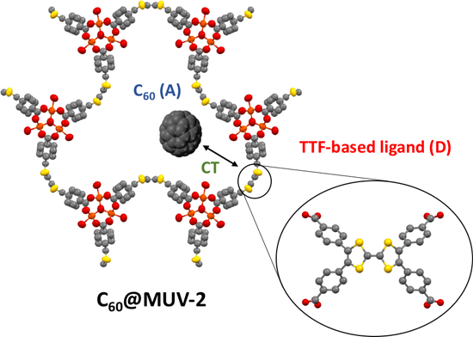
- (CT) process between the framework and the guest molecules is a crucial step towards the design of new electroactive MOFs. Herein, we present the encapsulation of fullerenes (C60) in a mesoporous tetrathiafulvalene (TTF)-based MOF. The CT process between the electron-acceptor C60 guest and the
- increased by two orders of magnitude due to the CT interactions between C60 and the TTF-based framework. Keywords: charge transfer; donor–acceptor; fullerene; metal–organic frameworks (MOFs); tetrathiafulvalene (TTF); Introduction Metal–organic frameworks (MOFs), which are crystalline porous materials
- (donor) and fullerene (acceptor) without a significant decrease in the porosity [36]. Tetrathiafulvalene (TTF) and its numerous derivatives are redox-active electron-donor molecules with unique electronic properties that have been widely used as important building units in the field of molecular




Pure and mixed ordered monolayers of tetracyano-2,6-naphthoquinodimethane and hexathiapentacene on the Ag(100) surface
Beilstein J. Nanotechnol. 2019, 10, 1188–1199, doi:10.3762/bjnano.10.118
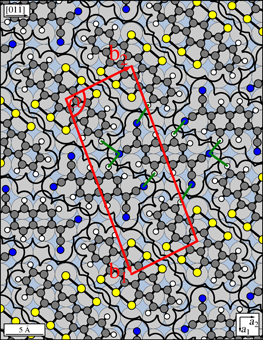
- constituents of CT crystals thus form a specific subset. We name a few examples. On the Au(111) surface, ordered monolayers were observed for following donor/acceptor pairs: tetrathiafulvalene (TTF)/7,7,8,8-tetracyanoquinodimethane (TCNQ) [11][12], tetramethyltetrathiafulvalene (TMTTF)/TCNQ [13], α
- combination with tetrathiafulvalene (TTF) on Au(111). TNAP is a flat planar molecule (C2h) with the ability to delocalize unpaired electrons in a charge-transfer complex [26]. We note that the crystal structure of TNAP is unknown and, as a consequence, we cannot compare the packing of TNAP on the Ag(100


Parylene C as a versatile dielectric material for organic field-effect transistors
Beilstein J. Nanotechnol. 2017, 8, 1532–1545, doi:10.3762/bjnano.8.155
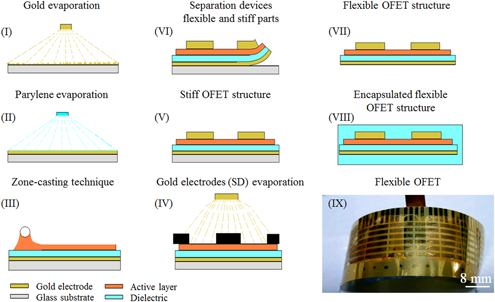
- only used as a gate dielectric material but it also serves as device flexible substrate. Such a flexible substrate allows one to investigate the influence of mechanical bending on charge carrier transport in the zone-cast layer of tetrakis(alkylthio)tetrathiafulvalene [18]. Bending tests carried out
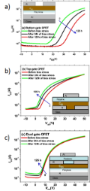
- decrease of bending radius. While amounting to 0.1 cm2/Vs for unbent structures, its magnitude decreases to ca. 0.06 cm2/Vs for r = 25 mm and to 0.04 cm2/Vs for r = 5 mm [18]. This effect has been attributed to the influence of stress induced in the tetrathiafulvalene (TTF) semiconductor crystalline films
- has on the performance of the single-crystal transistor. Of two crystalline forms of dithiophene-tetrathiafulvalene, the monoclinic alpha polymorph substantially outperformed the hexagonal beta polymorph [45]. The influence of the surface roughness of a dielectric film on the molecular arrangement of




From lithium to sodium: cell chemistry of room temperature sodium–air and sodium–sulfur batteries
Beilstein J. Nanotechnol. 2015, 6, 1016–1055, doi:10.3762/bjnano.6.105
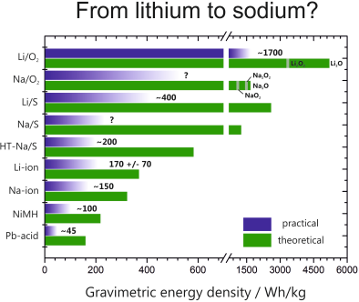
- tetrathiafulvalene (TTF) as RM with redox potentials, TTF/TTF+ and TTF+/TTF2+, of 3.4 to 3.7 V. With TTF in a DMSO:LiClO4 electrolyte the Li/O2 cells showed a Type 1C hysteresis and significantly improved kinetics for the charge process. In addition e−/O2 ratios very close to two, as expected for Li2O2 oxidation


Characterization of 10,12-pentacosadiynoic acid Langmuir–Blodgett monolayers and their use in metal–insulator–metal tunnel devices
Beilstein J. Nanotechnol. 2014, 5, 2240–2247, doi:10.3762/bjnano.5.233
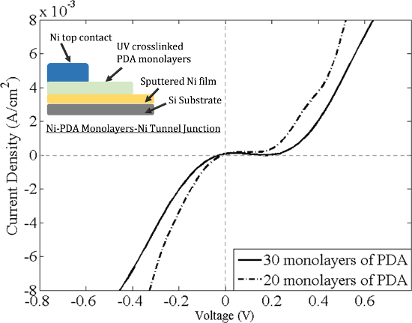
- –Mg structure was studied by Geddes et al [5]. Mochizuki et al. also explored the use of the LB technique in MIM tunnel diodes by deposition of conductive LB films of bis(ethylenedioxy)tetrathiafulvalene which served as a top electrode [6]. Iwamoto reported on the electrical properties of MIM
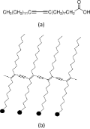


Non-covalent and reversible functionalization of carbon nanotubes
Beilstein J. Nanotechnol. 2014, 5, 1675–1690, doi:10.3762/bjnano.5.178
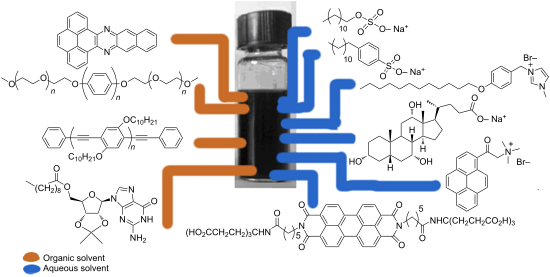
- , basically due to a protonation or deprotonation step. Thus, Liang et al. [88][89] have recently studied a conjugated tetrathiafulvalene vinylogue-fluorene copolymer able to selectively disperse low-diameter semiconducting SWCNTs in organic solvents. Upon addition of trifluoroacetic acid to the dispersion a



Donor–acceptor graphene-based hybrid materials facilitating photo-induced electron-transfer reactions
Beilstein J. Nanotechnol. 2014, 5, 1580–1589, doi:10.3762/bjnano.5.170
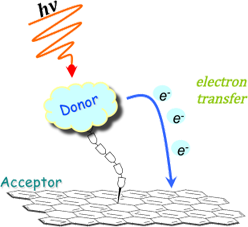
- transient absorption spectroscopy, verified that electron transfer occurs from graphene to ZnPc. Beyond the coupling of porphyrin and phthalocyanine dyes to graphene, other photo- and/or electro-active units have been also introduced. In this context, an extended tetrathiafulvalene (exTTF) was grafted to
- pendant phenylcarboxylic acid units present as substituents of pyrrolidine rings on pre-modified graphene sheets [60]. Sulfonyl-substituted zinc phthalocyanine covalently bound to pre-modified graphene via “click” chemistry [61]. Extended tetrathiafulvalene units covalently attached to exfoliated graphene


Terthiophene on Au(111): A scanning tunneling microscopy and spectroscopy study
Beilstein J. Nanotechnol. 2011, 2, 561–568, doi:10.3762/bjnano.2.60
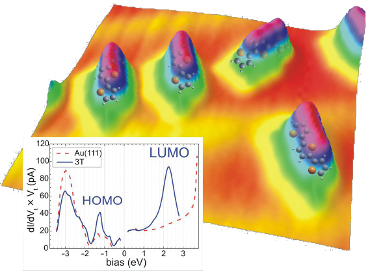
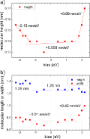
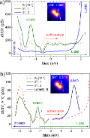
- lowest unoccupied molecular orbital (LUMO) of 3T. A preferential adsorption of the aromatic molecules in the fcc regions has also been observed for azobenzene [14], 1-nitronaphthalene [15][16], tetrathiafulvalene [17], and 9-aminoanthracene [18]. The tendency of the molecules to maximize the



Other Beilstein-Institut Open Science Activities



