


Search results
Search for "topological insulators" in Full Text gives 11 result(s) in Beilstein Journal of Nanotechnology.
Competitive helical bands and highly efficient diode effect in F/S/TI/S/F hybrid structures
Beilstein J. Nanotechnol. 2026, 17, 15–23, doi:10.3762/bjnano.17.2
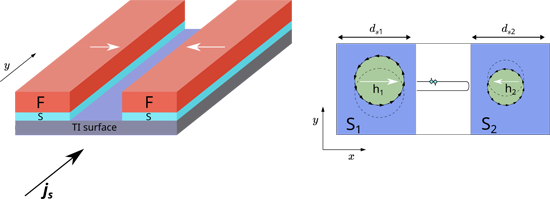
- based on topological insulators (TIs) are interesting since they offer strongest SOC rendering linear spin-polarized dispersion for the surface states [73]. The diode effect in TI-based structures has been reported in Josephson junctions, as well as in hybrid structures. In practice, when producing
- the diode efficiency is due to competing contributions of the two superconducting islands to the supercurrent with single helical bands linked through the topological insulator surface. Keywords: hybrid structures; proximity effect; superconducting diode effect; superconductivity; topological
- insulators; Introduction Superconducting nonreciprocal phenomena have been attracting a lot of attention over the last several years [1]. Particularly, the diode effect in superconducting systems has been widely discussed due to its interesting underlying physics and potential application in nondissipative


![[Graphic 16]](/bjnano/content/inline/2190-4286-17-2-i31.svg?max-width=637&scale=1.18182)
![[Graphic 17]](/bjnano/content/inline/2190-4286-17-2-i32.svg?max-width=637&scale=1.18182)


The influence of structure and local structural defects on the magnetic properties of cobalt nanofilms
Beilstein J. Nanotechnol. 2023, 14, 23–33, doi:10.3762/bjnano.14.3
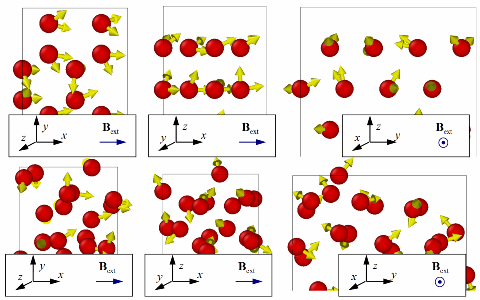
- [22][23], giant magnetic resistance effects in data storage items and hard drives [24][25], ultrafast magneto-optical switches and optically induced ferromagnetic materials [26]. The discovery and implementation of topological insulators in Josephson contacts make spintronics devices excellent


Fe3O4 nanoparticles as a saturable absorber for giant chirped pulse generation
Beilstein J. Nanotechnol. 2019, 10, 1065–1072, doi:10.3762/bjnano.10.107
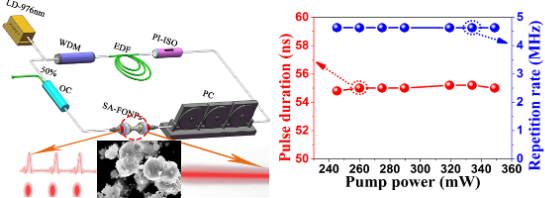
- InGaAs/GaAs-on-GaAs superlattice as a SA to realize 1557 nm, 1.2 ps, transformation-limited pulse generation [9]. Following this, carbon nanotubes (CNTs), graphene, topological insulators (TIs), transition metal disulfides (TMDs) and black phosphorus (BP) were used as SAs to realize passively mode-locked


Oriented zinc oxide nanorods: A novel saturable absorber for lasers in the near-infrared
Beilstein J. Nanotechnol. 2018, 9, 2730–2740, doi:10.3762/bjnano.9.255
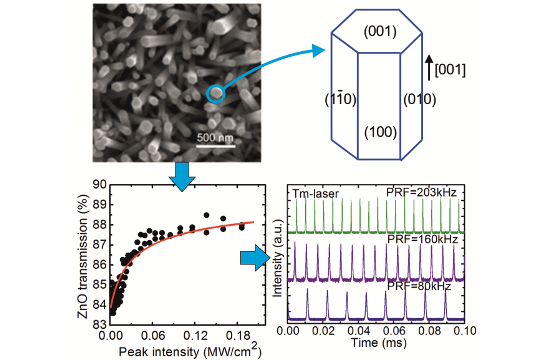
- , e.g., MoS2, WS2 [16][17], black phosphorus (BP) [18]), and topological insulators (TIs, e.g., Bi2Te3, Sb2Te3 [19][20], graphitic carbon nitride (g-C3N4) [21]). In the PQS regime, such structures enable the generation of nanosecond pulses at high repetition rates (up to MHz) and they are attractive for


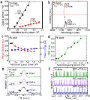

Robust midgap states in band-inverted junctions under electric and magnetic fields
Beilstein J. Nanotechnol. 2018, 9, 1405–1413, doi:10.3762/bjnano.9.133
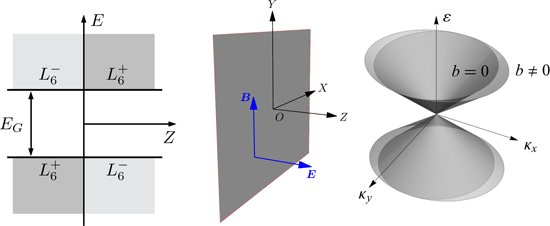
- semiconductor bands can be tailored by the electric field. Tunable devices are thus likely to be realizable, exploiting the properties studied herein. Keywords: crystalline topological insulators; electric and magnetic fields; Landau levels; midgap states; Introduction In 1982, Thouless et al. [1] made a
- -dimensional topological insulators, such as Bi2Se3, in contact with a trivial insulator [21][22]. In the former case, mirror symmetry makes it possible to define mirror Chern numbers, which determine the topological crystalline phase [8]. In the latter, time-reversal symmetry, parity and particle–hole

![[Graphic 1]](/bjnano/content/inline/2190-4286-9-133-i26.svg?max-width=637&scale=1.18182) and
and ![[Graphic 2]](/bjnano/content/inline/2190-4286-9-133-i27.svg?max-width=637&scale=1.18182) band-edge profile of an abrupt band-inverted junction with aligned and same-sized gaps, l...
band-edge profile of an abrupt band-inverted junction with aligned and same-sized gaps, l...


![[Graphic 35]](/bjnano/content/inline/2190-4286-9-133-i60.svg?max-width=637&scale=1.18182) and b = 0.5 as a function of the electric field. It is important...
and b = 0.5 as a function of the electric field. It is important...

Predicting the strain-mediated topological phase transition in 3D cubic ThTaN3
Beilstein J. Nanotechnol. 2018, 9, 1399–1404, doi:10.3762/bjnano.9.132
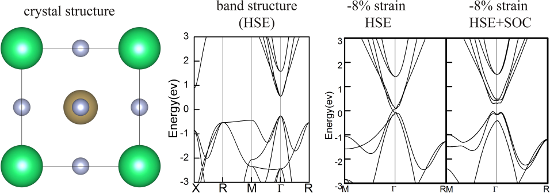
- limited and mainly focused on pressure-induced phase transition [3]. Therefore, a systematic study of the electron structure of ThTaN3 in a certain phase is highly desired. Topological insulators (TIs) have attracted much attention due to their distinct quantum mechanical properties, which makes them


Circular dichroism of chiral Majorana states
Beilstein J. Nanotechnol. 2018, 9, 1194–1199, doi:10.3762/bjnano.9.110
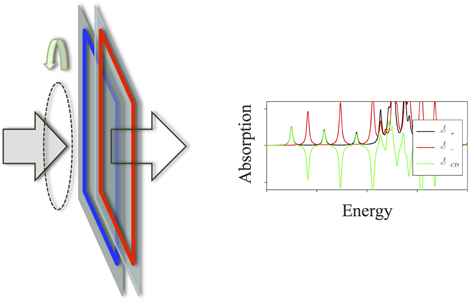
- quasiparticles, a class of hybrid systems where Majorana states appear around 2D vortex cores in the bulk and on the external edges of the sample [16]. Another class of 2D materials with propagating Majorana modes are the topological insulators based on the quantum-anomalous Hall effect. We refer, specifically


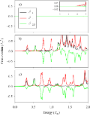
![[Graphic 14]](/bjnano/content/inline/2190-4286-9-110-i18.svg?max-width=637&scale=1.18182) . Panels a) and b) correspond to the phases in Figure 1d with one (ΔB = 2...
. Panels a) and b) correspond to the phases in Figure 1d with one (ΔB = 2...
![[Graphic 15]](/bjnano/content/inline/2190-4286-9-110-i19.svg?max-width=637&scale=1.18182) ,
, ![[Graphic 16]](/bjnano/content/inline/2190-4286-9-110-i20.svg?max-width=637&scale=1.18182) and
and ![[Graphic 17]](/bjnano/content/inline/2190-4286-9-110-i21.svg?max-width=637&scale=1.18182) defined in the main text. The shown results correspond to the spe...
defined in the main text. The shown results correspond to the spe...

![[Graphic 19]](/bjnano/content/inline/2190-4286-9-110-i23.svg?max-width=637&scale=1.18182) ,
, ![[Graphic 20]](/bjnano/content/inline/2190-4286-9-110-i24.svg?max-width=637&scale=1.18182) and
and ![[Graphic 21]](/bjnano/content/inline/2190-4286-9-110-i25.svg?max-width=637&scale=1.18182) for (a) a square of Lx = Ly = 20 LU), and for (b) a rectangle of L...
for (a) a square of Lx = Ly = 20 LU), and for (b) a rectangle of L...
Thermoelectric current in topological insulator nanowires with impurities
Beilstein J. Nanotechnol. 2018, 9, 1156–1161, doi:10.3762/bjnano.9.107
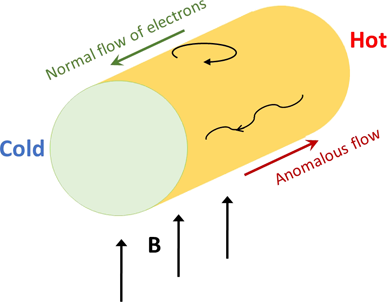
- impurity concentration the sign reversal persists. Keywords: topological insulators, nanowires, thermoelectric current; Introduction It has been known for quite some time now that the efficiency of thermoelectric devices can be increased by reducing the system size. The size reduction can improve


Non-equilibrium electron transport induced by terahertz radiation in the topological and trivial phases of Hg1−xCdxTe
Beilstein J. Nanotechnol. 2018, 9, 1035–1039, doi:10.3762/bjnano.9.96
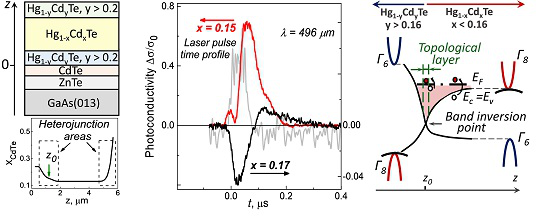
- topological insulator materials [3][4]. Noteworthy, the ARPES technique, being a well-developed method to probe topological surface states, is a challenge in the case of HgTe-based topological insulators due to its zero-gap energy spectrum in the bulk. Nevertheless, formation of topological surface states in
- contrast to most of the 3D topological insulators, Hg1−xCdxTe solid solutions are characterized by relatively low free carrier concentration values in the bulk, and may be therefore considered as good candidates for a case study focused on determination of the topological state contribution to the charge
- carrier transport. Laser terahertz probing is known to be a powerful tool that may provide an insight into the electron dynamics in semiconductors, particularly, in topological insulators [9][10][11]. Study of non-equilibrium processes in Hg1−xCdxTe in the terahertz spectral range is additionally


An implementation of spin–orbit coupling for band structure calculations with Gaussian basis sets: Two-dimensional topological crystals of Sb and Bi
Beilstein J. Nanotechnol. 2018, 9, 1015–1023, doi:10.3762/bjnano.9.94
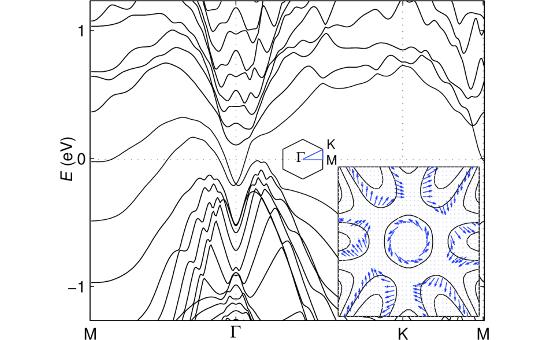
- method is obviously restricted to a limited set of problems. TB parameters are available for most elemental materials [9], but not in general for all compound materials (which is the case of most topological insulators). The versatility of this model is also limited by the sensitivity of the TB


Electron energy relaxation under terahertz excitation in (Cd1−xZnx)3As2 Dirac semimetals
Beilstein J. Nanotechnol. 2017, 8, 167–171, doi:10.3762/bjnano.8.17
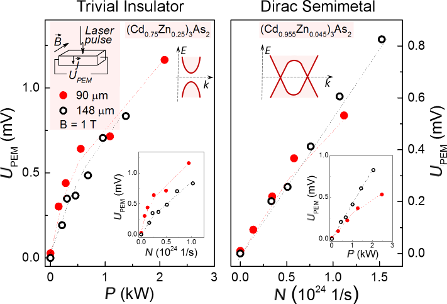
- -electromagnetic effect; terahertz radiation; topological insulator; Findings The theoretical prediction of the existence of topological insulators [1][2] and their further experimental observation [3][4][5][6][7] have led to the significant growth of scientific interest in this area of research. Topological
- difference in the case of topological insulators (Bi1−xInx)2Se3 is due to the different relation between the characteristic thermalization τth and diffusion τdif times of free electrons excited by the incident terahertz radiation. In the trivial insulator case, τth << τdif, so the excited electrons first
- electrons excited by the incident terahertz radiation occurs mainly via the interelectron interaction since the optical phonon energy is higher than the laser quantum energy used. Consequently, the strong enhancement of the thermalization time in topological insulators compared to the trivial insulators is





