Search results
Search for Nick Young broadcast journalist thesis French Battalion Drum in Full Text gives 220 result(s) in Beilstein Journal of Nanotechnology. Showing first 200.
Tattoo ink nanoparticles in skin tissue and fibroblasts
Beilstein J. Nanotechnol. 2015, 6, 1183–1191, doi:10.3762/bjnano.6.120
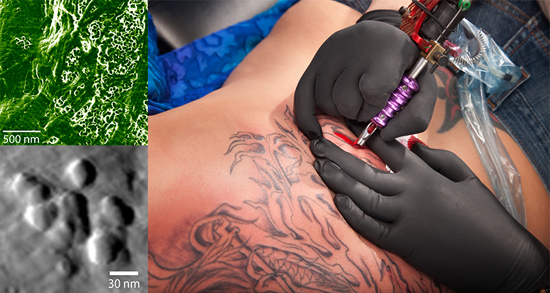
- and could pose other health risks to the skin [4]. Further, it was recently reported that tattooed young individuals can exhibit adverse reactions, especially with black or red ink tattoos, including photosensitivity, skin elevation and itching [5]. Nanoparticle research is currently receiving a great


Electronic interaction in composites of a conjugated polymer and carbon nanotubes: first-principles calculation and photophysical approaches
Beilstein J. Nanotechnol. 2015, 6, 1138–1144, doi:10.3762/bjnano.6.115
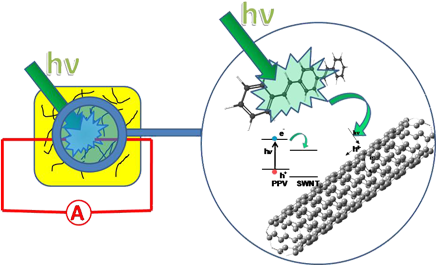
- action MP0901 ”NanoTP” and French ANR-2010-BLAN-0819-04 ”SPRINT” is gratefully acknowledged.


Optimization of phase contrast in bimodal amplitude modulation AFM
Beilstein J. Nanotechnol. 2015, 6, 1072–1081, doi:10.3762/bjnano.6.108
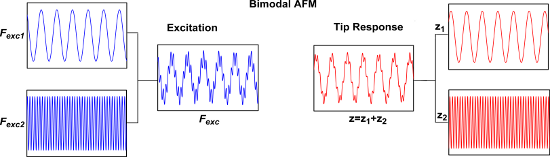
- tip–surface force (Hamaker constant and Young modulus) and the operational values of the microscope are summarized in Table 1 and Table 2. For trimodal AFM simulations we have used the parameters shown in Table 3. To minimize some complex non-linear dynamic effects we restrict our study to situations
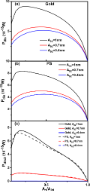
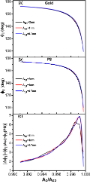
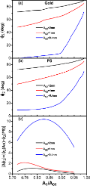
- and 7b). The decrease depends on the Young modulus and on the value of A02. For the same A1/A01-ratio lower phase shift values are observed on the stiffer material. The dependence on A02 follows the trend observed in the attractive regime. For the same A1/A01-ratio by reducing the value from 2 to 0.4
- amplitude ratio of the first mode for different values of A02. The value of the Young modulus corresponds to Au. (b) Phase shift dependence on the amplitude ratio of the first mode for different values of A02. The value of the Young modulus corresponds to PS. (c) Phase contrast between Au and PS as a



Automatic morphological characterization of nanobubbles with a novel image segmentation method and its application in the study of nanobubble coalescence
Beilstein J. Nanotechnol. 2015, 6, 952–963, doi:10.3762/bjnano.6.98
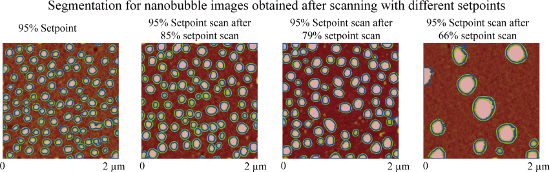
- explanation for the increased total volume could be the deceased inner pressure with increasing size. According to the Laplace–Young equation, the pressure difference ∆p across a NB can be given as [47]: The inner pressure p can be given as: where p0 is the ambient pressure. With a decreasing setpoint, NB


Experimental determination of the light-trapping-induced absorption enhancement factor in DSSC photoanodes
Beilstein J. Nanotechnol. 2015, 6, 886–892, doi:10.3762/bjnano.6.91
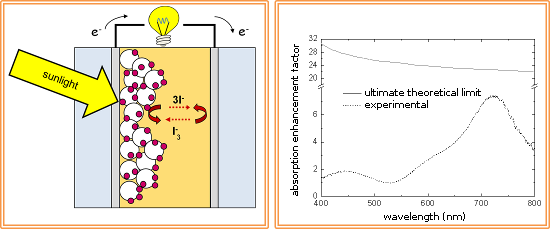
- The authors thank the personnel at the UTRINN-FVC ENEA Laboratory for the J–V characteristic measurements. Part of this research was performed in fulfillment of SG’s PhD thesis work.


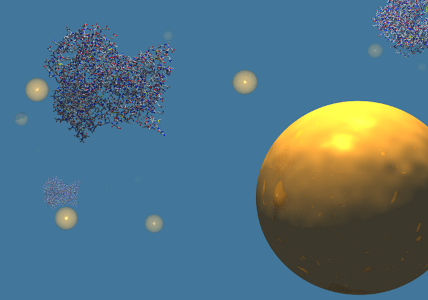
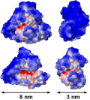
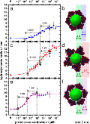
Protein corona – from molecular adsorption to physiological complexity
Beilstein J. Nanotechnol. 2015, 6, 857–873, doi:10.3762/bjnano.6.88



Magnetic properties of self-organized Co dimer nanolines on Si/Ag(110)
Beilstein J. Nanotechnol. 2015, 6, 777–784, doi:10.3762/bjnano.6.80
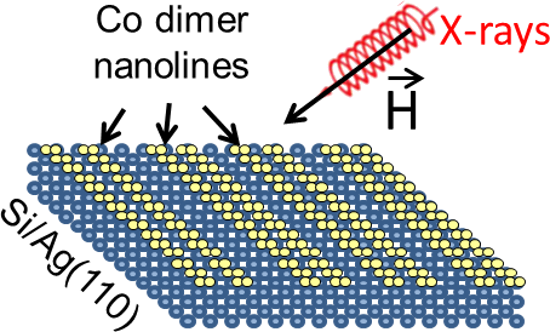
- Nanotechnology STM, working at 77 K and RT. XMCD experiments were performed at the DEIMOS [43] beamline at the French national synchrotron facility (SOLEIL), which operates in the soft X-ray range. XAS was performed in total electron yield mode at the Co L2,3 edges. The spectra were recorded at 4 K, under a


A versatile strategy towards non-covalent functionalization of graphene by surface-confined supramolecular self-assembly of Janus tectons
Beilstein J. Nanotechnol. 2015, 6, 632–639, doi:10.3762/bjnano.6.64
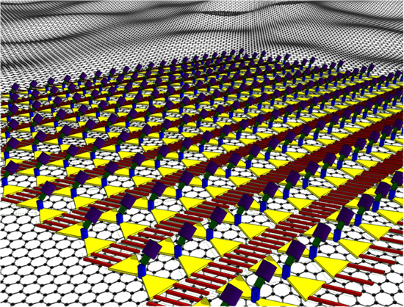
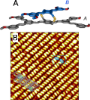
- = 64°) is highlighted in (B) by green arrows. Figure adapted with permission from [25], copyright 2014 Wiley-VCH Verlag GmbH & Co. Acknowledgements We thank the French Research National Agency (ANR) (NOMAD project ANR-08-NAN O-013-02; NANOCRISNET project ANR-11 BS-1001801), the Ministère de la




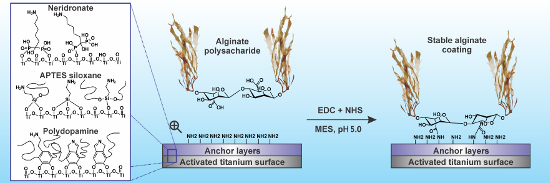
Self-assembled anchor layers/polysaccharide coatings on titanium surfaces: a study of functionalization and stability
Beilstein J. Nanotechnol. 2015, 6, 617–631, doi:10.3762/bjnano.6.63
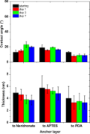
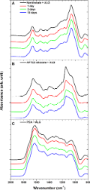
- angle measurement: The wettability of the organic surfaces on flat, titanium reference surfaces was examined by a static sessile water drop method using a DataPhysics OCA 20 contact angle system. Each sample was characterized using four 3 μL drops of material. The data were evaluated using the Young


Entropy effects in the collective dynamic behavior of alkyl monolayers tethered to Si(111)
Beilstein J. Nanotechnol. 2015, 6, 583–594, doi:10.3762/bjnano.6.60
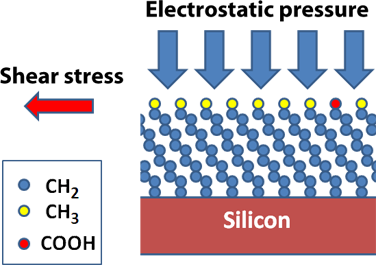
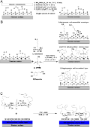
- depend on the spring constant k = (P/E·I)1/2 where I is the moment of inertia of the rod, E its Young modulus, and P the normal compression load. In the context of a molecular layer submitted to compression, conformational changes of the molecules must be taken into account (Figure 1). A gauche defect




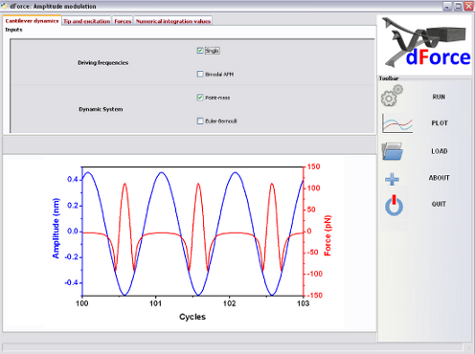
Dynamic force microscopy simulator (dForce): A tool for planning and understanding tapping and bimodal AFM experiments
Beilstein J. Nanotechnol. 2015, 6, 369–379, doi:10.3762/bjnano.6.36
- , where E is the Young modulus of the cantilever, I the area moment of inertia, α1 the internal damping coefficient of the cantilever, ρ the cantilever mass density, b, h and L are the width, thickness and length of the cantilever, respectively, α0 is the hydrodynamic damping of the medium, and w(x,t) is
- the effective Young modulus of the interface defined by where Et and Es are the Young’s modulus of the tip and sample, respectively, and υt and υs are the Poisson coefficients of the tip and sample, respectively. Derjaguin–Mueller–Toporov contact mechanics (DMT) The DMT model is valid for describing
- applied to describe contacts characterized by a relatively small Young modulus, and large adhesion and contact area [48]. In this model the force is calculated as an implicit equation of the indentation where and Tatara contact mechanics The Tatara contact mechanics are applied to describe a sample with a




Exploiting the hierarchical morphology of single-walled and multi-walled carbon nanotube films for highly hydrophobic coatings
Beilstein J. Nanotechnol. 2015, 6, 353–360, doi:10.3762/bjnano.6.34
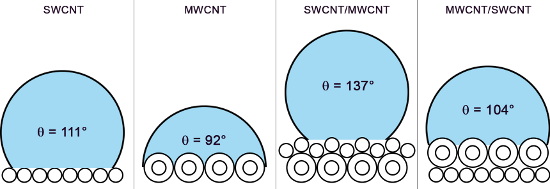
- ImageJ was exploited to estimate the contact angle values. This plugin exploits an algorithm based on a small-perturbation solution of the Young–Laplace equation [22]. Furthermore, the presented method is applied to a continuous image of the droplet by using cubic B-Spline interpolation of the drop


Nanoporous Ge thin film production combining Ge sputtering and dopant implantation
Beilstein J. Nanotechnol. 2015, 6, 336–342, doi:10.3762/bjnano.6.32
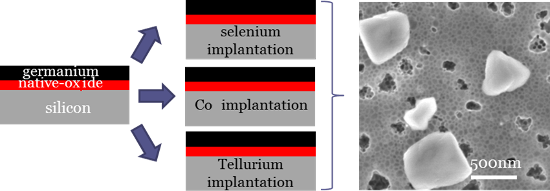
- implantation-induced defects versus implanted species. Thermal annealing conditions (temperature and time), and corresponding thermal budgets. Acknowledgements The authors thank Marion Descoins for technical support. This work was supported by the French National Agency for Research (ANR) through the Program


Strain distribution due to surface domains: a self-consistent approach with respect to surface elasticity
Beilstein J. Nanotechnol. 2015, 6, 321–326, doi:10.3762/bjnano.6.30
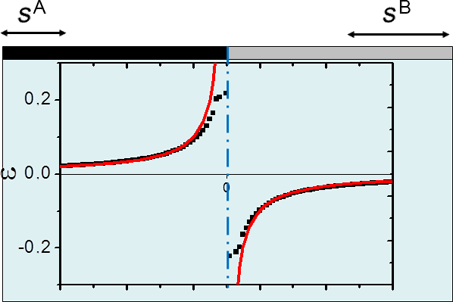
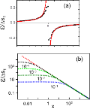
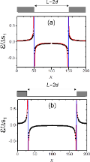
- at the boundary between the two surface domains. The Green tensor valid for a semi-infinite isotropic substrate can be found in many text books [1][2][9] so that the deformation at the surface ε1(x,z = 0) finally reads: where with Esubs and νsubs being the Young modulus and the Poisson coefficient


Mechanical properties of MDCK II cells exposed to gold nanorods
Beilstein J. Nanotechnol. 2015, 6, 223–231, doi:10.3762/bjnano.6.21
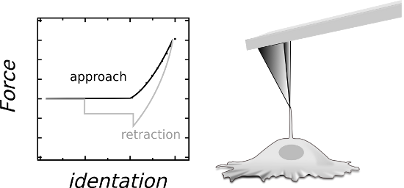
- area at a given indentation depth and A0 the surface area prior to indentation. Static equilibrium can be expressed by the Young–Laplace equation, which describes the pressure difference across the fluid interface as a function of surface tension T and mean curvature. The task is to determine the


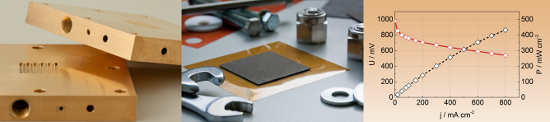
Materials and characterization techniques for high-temperature polymer electrolyte membrane fuel cells
Beilstein J. Nanotechnol. 2015, 6, 68–83, doi:10.3762/bjnano.6.8




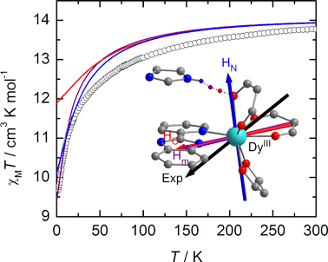
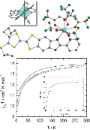
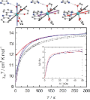
Influence of the supramolecular architecture on the magnetic properties of a DyIII single-molecule magnet: an ab initio investigation
Beilstein J. Nanotechnol. 2014, 5, 2267–2274, doi:10.3762/bjnano.5.236
- Recherche (No. ANR-13-BS07-0022-01). B. L. G. thanks the French GENCI-CINES center for high-performance computing resources (grant x2014080649).


Rapid degradation of zinc oxide nanoparticles by phosphate ions
Beilstein J. Nanotechnol. 2014, 5, 2007–2015, doi:10.3762/bjnano.5.209
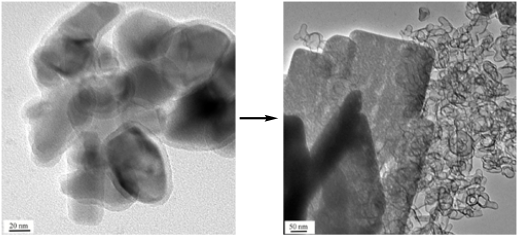
- tendency to form agglomerates in water is higher for the labelled sample (DLS size 144 and 309 nm, respectively). Sample 3 was commercial ZnO prepared by gas phase oxidation of zinc at high temperature, the so-called French process. It is a highly irregular mixture of particles with very different


High speed e-beam lithography for gold nanoarray fabrication and use in nanotechnology
Beilstein J. Nanotechnol. 2014, 5, 1918–1925, doi:10.3762/bjnano.5.202
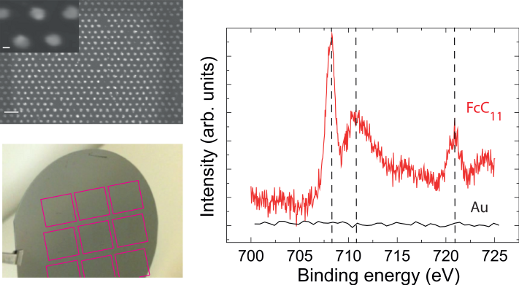
- funding by a Marie curie grant, EU-FP7 Nanomicrowave project and Renatech (the French Network of major Technology Central).


Mechanical properties of sol–gel derived SiO2 nanotubes
Beilstein J. Nanotechnol. 2014, 5, 1808–1814, doi:10.3762/bjnano.5.191
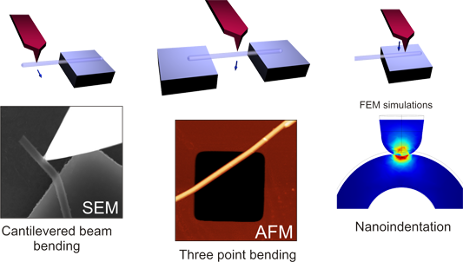
- NT end. The knowledge of the geometry of the NT and its force–displacement response is sufficient for determining Young modulus: where kBT = F/δ is the stiffness of the beam measured during the bending test. Three-point beam bending The elastic beam theory is commonly applied for the analysis of the
- Poisson ratio ν1 = 0.22; and the shell: Young modulus E2 is to be found and Poisson ν2 = 0.17 [28]. For a reference we have also applied the thin-shell and Hertz models. The thin-shell approach allows one to neglect the indentation of the surface and the tip geometry by taking into account only the
- therefore the experimental values can be compared to the fully elastic result from FEM simulations. A parametric sweep over the Young modulus of the shell was used to calculate the elastic force acting on the indentation tip and was then compared to the experimental force–displacement curve. Geometrical


Equilibrium states and stability of pre-tensioned adhesive tapes
Beilstein J. Nanotechnol. 2014, 5, 1725–1731, doi:10.3762/bjnano.5.182
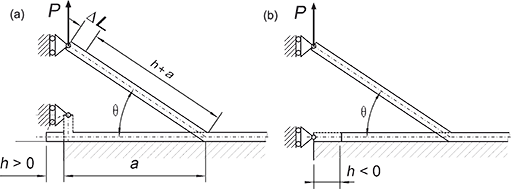
- the length of the tape by a quantity where N = P/sinθ − P0 is the normal force acting along the tape axis, P0 is the pre-tension and E is the Young modulus. The change of the elastic energy stored in the system is and the potential energy, which is the opposite of the work done by the external force P

![[Graphic 5]](/bjnano/content/inline/2190-4286-5-182-i14.png?max-width=637&scale=1.18182) as a function of the peeling angle θeq at equilibrium (a); the tot...
as a function of the peeling angle θeq at equilibrium (a); the tot...


![[Graphic 11]](/bjnano/content/inline/2190-4286-5-182-i20.png?max-width=637&scale=1.18182) as a function of the peeling angle θeq at equilibrium, for differen...
as a function of the peeling angle θeq at equilibrium, for differen...
Growth and structural discrimination of cortical neurons on randomly oriented and vertically aligned dense carbon nanotube networks
Beilstein J. Nanotechnol. 2014, 5, 1575–1579, doi:10.3762/bjnano.5.169
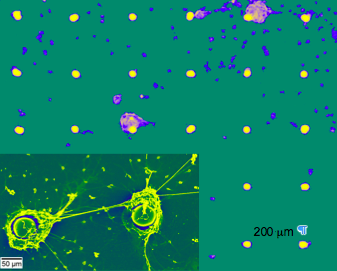
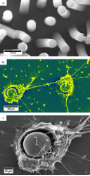
- Christoph Nick Sandeep Yadav Ravi Joshi Christiane Thielemann Jorg J. Schneider University of Applied Sciences Aschaffenburg, Department of Engineering, BioMEMS lab, Würzburger Strasse 45, 64743 Aschaffenburg, Germany Technische Universität Darmstadt, Fachbereich Chemie, Eduard-Zintl-Institut für


Influence of the PDMS substrate stiffness on the adhesion of Acanthamoeba castellanii
Beilstein J. Nanotechnol. 2014, 5, 1393–1398, doi:10.3762/bjnano.5.152
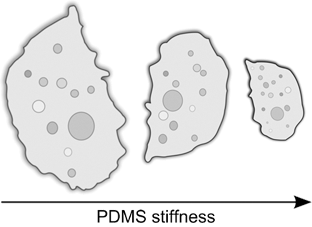
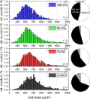
- substrate. The increase of adhesion area with decreasing Young`s modulus is opposite to the behavior of human mesenchymal stem cells [33] but is in good agreement with the trend observed in studies on neural stem cell cultures [34]. This result is reasonable, as during the infection process, A. castellanii



Nanocavity crossbar arrays for parallel electrochemical sensing on a chip
Beilstein J. Nanotechnol. 2014, 5, 1137–1143, doi:10.3762/bjnano.5.124
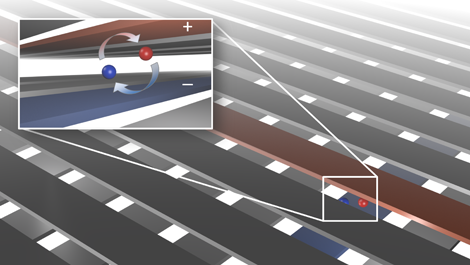
- sacrificial chromium layer. The scale bars for the images in (b), (c), and (d) are 100 μm, 400 nm, and 400 nm, respectively. Acknowledgements We gratefully acknowledge funding by the Helmholtz Young Investigators program.


The study of surface wetting, nanobubbles and boundary slip with an applied voltage: A review
Beilstein J. Nanotechnol. 2014, 5, 1042–1065, doi:10.3762/bjnano.5.117
- so called electrowetting [10][11][64][65]. The surface tension between solid and liquid decreases with increasing applied voltage, leading to a decrease of the CA. The change of the CA with the applied voltage V can be expressed by the Young–Lippmann equation [64][66] as: where θ0 is the original CA
- in the absence of an voltage, C is the capacitance of the dielectric layer, and γlv is the surface tension between liquid and vapor. In 1875, Lippmann found the electrowetting phenomenon and presented the Young–Lippmann equation, which is acknowledged as the basic of the electrowetting theory. In
- of the sample, the applied AC voltage was biased with a minimum value of 0 V. 1.2 Model for the DC electrowetting As mentioned earlier, when a voltage V is applied between the substrate and the droplet, the decreased CA of the droplet can be expressed by the Young–Lippmann equation (Equation 1). The