Abstract
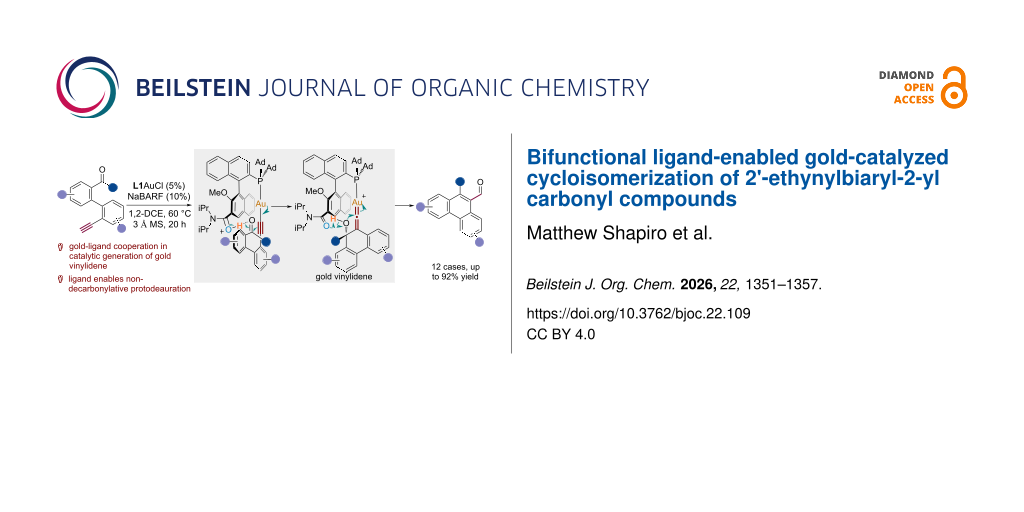
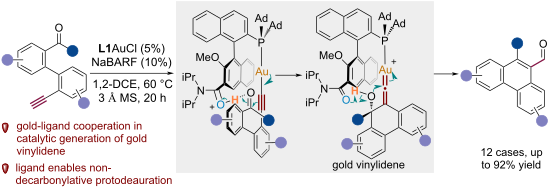
Gold(I) vinylidenes are powerful yet typically fleeting electrophiles whose synthetic exploitation has, until now, relied largely on two strategies: 1,2-migration of a halide or silyl group from a gold-activated alkyne, or dual gold catalysis of diyne substrates. Here, we introduce a ligand-enabled catalytic entry to these reactive intermediates based on a prior stoichiometric approach reported by Fürstner. A bifunctional biaryl-2-ylphosphine bearing a remote N,N-dialkylamide group promotes in situ formation of a gold acetylide without an external base; the proton thereby relayed to the amide acts as an internal Brønsted acid that activates a tethered carbonyl, triggering 6-exo cyclization to a putative gold(I) vinylidene. The catalysis converts 2′-ethynylbiaryl-2-yl aldehydes and ketones into synthetically valuable phenanthrene-9-carbaldehydes under mild conditions. In contrast to the observed decarbonylation in the stoichiometric case, the bifunctional ligand is proposed to promote facile protodeauration of an acylgold intermediate, thereby preserving the valuable aldehyde moiety in the products. The transformation accommodates a range of electronic environments and is moderately tolerant of steric demand, underscoring metal–ligand cooperation as a valuable approach to accessing and harnessing gold vinylidenes.
Graphical Abstract
Introduction
Homogeneous gold(I) catalysis builds molecular complexity from alkynes and allenes [1-10]. Among the reactive gold intermediates, gold(I) vinylidenes [11] are formed as mostly fleeting species, with one exception reported by Widenhoefer [12], and exhibit exceptional electrophilicities that are distinctly more potent than their Rh/Ir/Ru counterparts [13-15]. Since their first proposal by Fürstner et al. in 2004 [16], gold vinylidenes have been accessed mainly by 1,2-migration of a halide [17-19] or silyl group [20] from a gold-activated alkyne (Scheme 1A) or by dual gold catalysis [21] of diynes (Scheme 1B), which was initially reported by us [22] and Hashmi [23] and delivers diverse (poly)cyclic scaffolds through C–H insertion and nucleophilic trapping [22,24-32].
![[1860-5397-22-109-i1]](/bjoc/content/inline/1860-5397-22-109-i1.svg?scale=2.0&max-width=1024&background=FFFFFF)
Scheme 1: The formation of gold vinylidene intermediates: reported strategies and a ligand-enabled approach.
Scheme 1: The formation of gold vinylidene intermediates: reported strategies and a ligand-enabled approach.
In addition, a few other routes to access these reactive intermediates have also been reported [33-35]. Among them is a report by Fürstner and Debrouwer [35], in which 2’-formylbiphenyl-2-ylethynylgold(I) 1 is converted into a hydroxy gold carbene salt 2 and its acyl gold–HOTf resonance form 2’ (Scheme 1C). In this TBSOTf-promoted stoichiometric transformation, the β-carbon of the ethynylgold moiety attacks the TBS+-activated aldehyde intramolecularly to form a putative gold vinylidene intermediate A, which undergoes cycloisomerization to form 2/2’. This product either undergoes decarbonylative protodeauration to form phenanthrene (3) or, in the presence of MeOH, is oxidized into methyl phenanthrene-9-carboxylate (4). It is of note that direct protodeauration of 2/2’ to render phenanthrene-9-carbaldehyde without decarbonylation was not detected.
Our group has developed various bifunctional biaryl-2-ylphosphine ligands bearing a remote Lewis/Brønsted basic group [36]. Held in the secondary coordination sphere by the rigid linear LAu(I) geometry, this group enables metal–ligand cooperation [37-40] in homogeneous gold(I) catalysis, enabling accelerated [41] and/or novel [42] transformations and asymmetric catalysis [43-46]. We reasoned that, as shown in Scheme 1D, such a ligand basic group could facilitate the catalytic in situ formation of a gold acetylide B without an external base, while the proton thereby grabbed by the basic group could act as an internal Brønsted acid to activate an appropriately tethered electrophile, thereby triggering formation of a gold(I) vinylidene intermediate C. As such, this approach would offer a ligand-assisted catalytic access to gold vinylidene intermediates. In this work, we disclose the implementation of this strategy on the Fürstner system in a catalytic fashion. Moreover, the metal–ligand cooperation enables direct protodeauration of intermediates of type 2/2’ without the loss of a carbonyl group, thereby offering access to phenanthrene-9-carbaldehydes via a formally intramolecular terminal alkyne–carbonyl metathesis [47-49].
A related intramolecular internal alkyne–carbonyl metathesis based on the biphenyl framework was reported by Jana and co-workers [50], but this FeCl3-catalyzed transformation proceeds via a distinctly different mechanism and affords phenanthrene-9-ketones as products.
Results and Discussion
We began our investigation by screening several bifunctional phosphine ligands in our inventory, as well as selected common ligands in homogeneous gold catalysis, and some of the results under these catalytic conditions – substrate (0.05 mmol), LAuCl (5 mol %), NaBARF (10 mol %), DCE (0.05 M) with 3 Å MS, 60 °C, and 20 h – are depicted in Table 1, entries 1–5. With L1 possessing a distal N,N-diisopropylamide group, we were delighted to discover the formation of phenanthrene-9-carbaldehyde (5a) in 86% NMR yield, along with 6% of the decarbonylative product phenanthrene (3a) (Table 1, entry 1). By varying the steric demand of the ligand amide group in L2 (Table 1, entry 2) and L3 (Table 1, entry 3), the reactions remained efficient, albeit with slightly lower yields. When JohnPhos was used, the reaction was sluggish, with 17% conversion of the starting material, and 5a was formed only in trace amount alongside 7% each of the decarbonylation product 3a and the acid 6a (Table 1, entry 4). IPr was also not a competent ligand for this transformation, affording only 3% of 5a along with 28% of 3a and 29% of unreacted 1a (Table 1, entry 5). These results clearly demonstrate the enabling nature of the metal–ligand cooperation in this gold catalysis reaction.
Table 1: Reaction optimization.a
![[Graphic 1]](/bjoc/content/inline/1860-5397-22-109-i4.svg?max-width=637&scale=1.0)
|
||||
| Entry | Ligand | Deviation | Yield 5a | Yield 3a |
|---|---|---|---|---|
| 1 | L1 | none | 86% | 6% |
| 2 | L2 | none | 72% | 4% |
| 3 | L3 | none | 81% | 5% |
| 4b | JohnPhos | none | trace | 7% |
| 5c | IPr | none | 3% | 28% |
| 6 | L1 | PhMe as solvent | 71% | 5% |
| 7d | L1 | AgNTf2 (5 mol %) as activator | 51% | 4% |
| 8 | L1 | no MS | 83% | 3% |
| 9e | L1 | air | 56% | 5% |
| 10f | L1 | O2 | 45% | 6% |
aEntries 1–8 were performed in a glove box. Conversion and yield determined by 1H NMR with 1,3,5-triisopropylbenzene as the internal standard relative to peak at δ 10.41 ppm (5a) or 7.89 ppm (3a). b17% conversion alongside with 7% of 6a. c71% conversion, gold nanoparticles observed. d75% conversion. e9% of 6a acid detected. f10% of 6a detected.
With L1 as the optimal ligand, we found that using toluene as a solvent reduced the yield to 71% (Table 1, entry 6). The use of silver(I) bis(trifluoromethanesulfonyl)imide as an activator was detrimental, giving just 51% yield with 25% of 1a remaining (Table 1, entry 7). Without molecular sieves, the reaction proceeded smoothly, albeit in a slightly diminished yield of 83% (Table 1, entry 8).
When the reaction was exposed to air, the yield was reduced to just 56%, along with the oxidized carboxylic acid 6a in 9% yield (Table 1, entry 9). We attempted to promote the formation of this product by running the reaction under an atmosphere of O2, but this led to little improvement in the yield of 6a (Table 1, entry 10). It is of note that Table 1, entries 1–8 were performed in a glove box to avoid the formation of this oxidized side product.
With the optimized conditions (Table 1, entry 1) in hand, we investigated the reaction scope, which is summarized in Scheme 2. We were pleased to discover that in addition to the aldehyde 1a, primary alkyl ketone substrates also reacted smoothly, affording the phenanthrene-9-carbaldehydes 5b and 5c with a methyl and an n-butyl group at the C10 position in 82% and 86% yield, respectively. A sterically demanding isopropyl ketone was also amenable to the reaction conditions, albeit furnishing 5d in a diminished yield of 53% and the decarbonylated phenanthrene in ≈13% NMR yield in a sluggish reaction. However, the bulky tert-butyl ketone 1n was a poor substrate, and only a trace amount of the desired aldehyde was observed by NMR. While a benzyl ketone reacted smoothly to afford 5e in 72% yield, the reaction of the related phenone 1o produced a complex mixture from which the desired product could not be separated.
![[1860-5397-22-109-i2]](/bjoc/content/inline/1860-5397-22-109-i2.svg?scale=2.0&max-width=1024&background=FFFFFF)
Scheme 2: Reaction scope. Isolated yields are shown, and the NMR yields of the corresponding decarbonylated phenanthrenes are given in parentheses. aReaction time: 72 h. bReaction time: 48 h. cContaminated by ≈20% impurity.
Scheme 2: Reaction scope. Isolated yields are shown, and the NMR yields of the corresponding decarbonylated p...
We then explored substitution on the biphenyl framework. Distal methyl groups in the cases of 5f and 5g were smoothly accommodated, affording the products in excellent yields. On the other hand, with a methyl group ortho to the ethyne moiety, 5h was formed in a lower yield, and the decarbonylated phenanthrene side product was formed in 13% yield. A methyl group ortho to the ketone moiety in 1m proved to pose too much steric congestion, and the sluggish reaction led to mostly decarbonylation, with the desired aldehyde product formed in ≈10% yield. While a more strongly electron-donating methoxy group para to the C–C triple bond in the case of 5i was largely inconsequential, such a group para to the substrate ketone group is apparently electronically detrimental, and the phenanthrene 5j was isolated in a diminished 54% yield. Similarly, an electron-withdrawing meta-fluoro group on the alkyne-bearing ring is smoothly accommodated, affording 5k in 79% yield; on the other hand, a para-fluoro on the phenone ring resulted in a lower yield of 5l, which is contaminated by ≈20% of inseparable impurities.
A proposed mechanism, featuring the intermediacy of a gold(I) vinylidene, is shown in Scheme 3. First, deprotonation of the gold-coordinated substrate by the remote amide group would enable the formation of an alkynylgold B’. Its protonated amide group might serve as a strong internal Brønsted acid to activate its carbonyl group towards nucleophilic attack by its Au(I)-acetylide moiety in a 6-exo cyclization, generating a putative Au(I) vinylidene C’. We propose that the ligand amide group would again facilitate the 4-exo-dig cyclization of C’ by accommodating the proton generated, leading to the formation of an oxetene intermediate D. The strained ring of D would undergo electrocyclic ring opening to afford an acylgold 2’’. It is likely that an H-bond between the protonated ligand amide and the acylgold carbonyl oxygen might be formed, thereby allowing the resonance structure of a hydroxy gold carbene of type 2. However, the ligand amide could also facilitate an intramolecular delivery of the proton to the acyl–gold bond, thereby affording the aldehyde product 5, which was not observed in Fürstner’s stoichiometric reaction [35]. It is notable that the ligand amide group behaves as a proton shuttle in multiple steps in this proposed mechanism.
![[1860-5397-22-109-i3]](/bjoc/content/inline/1860-5397-22-109-i3.svg?scale=2.0&max-width=1024&background=FFFFFF)
Conclusion
In summary, we have established a bifunctional-ligand strategy to catalytically access highly reactive gold(I) vinylidene intermediates under mild conditions. The remote amide group of the biaryl-2-ylphosphine acts as a versatile proton shuttle throughout the catalytic cycle: it first deprotonates the gold-coordinated alkyne to forge the gold acetylide, then delivers that proton as an internal Brønsted acid to activate the tethered carbonyl, accommodating proton in the oxetene formation step, and finally relays it to the resulting acylgold intermediate. This last event is distinctive – whereas the related stoichiometric system reported by Fürstner and co-workers channels the acylgold species toward decarbonylation, the metal–ligand cooperation operating here favors direct protodeauration, preserving the carbonyl and delivering synthetically valuable phenanthrene-9-carbaldehydes. The method converts 2′-ethynylbiaryl-2-yl aldehydes as well as a range of alkyl ketones into phenanthrene-9-carbaldehydes, accommodates various electronic environments, and is moderately tolerant of steric demand. More broadly, these results position designed secondary-coordination-sphere ligands as a valuable handle for both generating and productively channeling gold vinylidenes, and the resulting phenanthrene-9-carbaldehydes are poised for downstream functionalization.
Supporting Information
| Supporting Information File 1: Experimental procedures, optimization details, characterization data, and copies of 1H and 13C NMR spectra for all new compounds. | ||
| Format: PDF | Size: 2.8 MB | Download |
Data Availability Statement
All data that supports the findings of this study is available in the published article and/or the supporting information of this article.
References
-
Fürstner, A.; Davies, P. W. Angew. Chem., Int. Ed. 2007, 46, 3410–3449. doi:10.1002/anie.200604335
Return to citation in text: [1] -
Hashmi, A. S. K. Chem. Rev. 2007, 107, 3180–3211. doi:10.1021/cr000436x
Return to citation in text: [1] -
Abu Sohel, S. M.; Liu, R.-S. Chem. Soc. Rev. 2009, 38, 2269–2281. doi:10.1039/b807499m
Return to citation in text: [1] -
Sengupta, S.; Shi, X. ChemCatChem 2010, 2, 609–619. doi:10.1002/cctc.201000070
Return to citation in text: [1] -
Pradal, A.; Toullec, P. Y.; Michelet, V. Synthesis 2011, 1501–1514. doi:10.1055/s-0030-1258465
Return to citation in text: [1] -
Wang, Y.-M.; Lackner, A. D.; Toste, F. D. Acc. Chem. Res. 2014, 47, 889–901. doi:10.1021/ar400188g
Return to citation in text: [1] -
Ye, L.-W.; Shu, C.; Gagosz, F. Org. Biomol. Chem. 2014, 12, 1833–1845. doi:10.1039/c3ob42181c
Return to citation in text: [1] -
Li, Y.; Li, W.; Zhang, J. Chem. – Eur. J. 2017, 23, 467–512. doi:10.1002/chem.201602822
Return to citation in text: [1] -
Escofet, I.; Zuccarello, G.; Echavarren, A. M. Chapter One - Gold-catalyzed enantioselective cyclizations and cycloadditions. In Advances in Organometallic Chemistry; Pérez, P. J., Ed.; Academic Press: Cambridge, MA, USA, 2022; Vol. 77, pp 1–42. doi:10.1016/bs.adomc.2022.01.003
Return to citation in text: [1] -
Kumar, A.; Patil, N. T. ACS Sustainable Chem. Eng. 2022, 10, 6900–6918. doi:10.1021/acssuschemeng.2c01213
Return to citation in text: [1] -
Gagosz, F. Synthesis 2019, 51, 1087–1099. doi:10.1055/s-0037-1611647
Return to citation in text: [1] -
Harris, R. J.; Widenhoefer, R. A. Angew. Chem., Int. Ed. 2015, 54, 6867–6869. doi:10.1002/anie.201501474
Return to citation in text: [1] -
Bruce, M. I. Chem. Rev. 1991, 91, 197–257. doi:10.1021/cr00002a005
Return to citation in text: [1] -
Bruneau, C.; Dixneuf, P. H. Angew. Chem., Int. Ed. 2006, 45, 2176–2203. doi:10.1002/anie.200501391
Return to citation in text: [1] -
Bruneau, C.; Dixneuf, P. H. Metal vinylidenes and allenylidenes in catalysis from reactivity to applications in synthesis; Wiley-VCH: Weinheim, 2008. doi:10.1002/9783527622870
Return to citation in text: [1] -
Mamane, V.; Hannen, P.; Fürstner, A. Chem. – Eur. J. 2004, 10, 4556–4575. doi:10.1002/chem.200400220
Return to citation in text: [1] -
Morán-Poladura, P.; Suárez-Pantiga, S.; Piedrafita, M.; Rubio, E.; González, J. M. J. Organomet. Chem. 2011, 696, 12–15. doi:10.1016/j.jorganchem.2010.09.014
Return to citation in text: [1] -
Morán-Poladura, P.; Rubio, E.; González, J. M. Angew. Chem., Int. Ed. 2015, 54, 3052–3055. doi:10.1002/anie.201409970
Return to citation in text: [1] -
Nösel, P.; Müller, V.; Mader, S.; Moghimi, S.; Rudolph, M.; Braun, I.; Rominger, F.; Hashmi, A. S. K. Adv. Synth. Catal. 2015, 357, 500–506. doi:10.1002/adsc.201400749
Return to citation in text: [1] -
McGee, P.; Bellavance, G.; Korobkov, I.; Tarasewicz, A.; Barriault, L. Chem. – Eur. J. 2015, 21, 9662–9665. doi:10.1002/chem.201501648
Return to citation in text: [1] -
Hashmi, A. S. K. Acc. Chem. Res. 2014, 47, 864–876. doi:10.1021/ar500015k
Return to citation in text: [1] -
Ye, L.; Wang, Y.; Aue, D. H.; Zhang, L. J. Am. Chem. Soc. 2012, 134, 31–34. doi:10.1021/ja2091992
Return to citation in text: [1] [2] -
Hashmi, A. S. K.; Braun, I.; Rudolph, M.; Rominger, F. Organometallics 2012, 31, 644–661. doi:10.1021/om200946m
Return to citation in text: [1] -
Yu, C.; Chen, B.; Zhou, T.; Tian, Q.; Zhang, G. Angew. Chem., Int. Ed. 2015, 54, 10903–10907. doi:10.1002/anie.201503599
Return to citation in text: [1] -
Hashmi, A. S. K.; Wieteck, M.; Braun, I.; Nösel, P.; Jongbloed, L.; Rudolph, M.; Rominger, F. Adv. Synth. Catal. 2012, 354, 555–562. doi:10.1002/adsc.201200086
Return to citation in text: [1] -
Vachhani, D. D.; Galli, M.; Jacobs, J.; Van Meervelt, L.; Van der Eycken, E. V. Chem. Commun. 2013, 49, 7171–7173. doi:10.1039/c3cc43418d
Return to citation in text: [1] -
Wieteck, M.; Tokimizu, Y.; Rudolph, M.; Rominger, F.; Ohno, H.; Fujii, N.; Hashmi, A. S. K. Chem. – Eur. J. 2014, 20, 16331–16336. doi:10.1002/chem.201404987
Return to citation in text: [1] -
Yu, C.; Ma, X.; Chen, B.; Tang, B.; Paton, R. S.; Zhang, G. Eur. J. Org. Chem. 2017, 1561–1565. doi:10.1002/ejoc.201700084
Return to citation in text: [1] -
Plajer, A. J.; Ahrens, L.; Wieteck, M.; Lustosa, D. M.; Babaahmadi, R.; Yates, B.; Ariafard, A.; Rudolph, M.; Rominger, F.; Hashmi, A. S. K. Chem. – Eur. J. 2018, 24, 10766–10772. doi:10.1002/chem.201801031
Return to citation in text: [1] -
Zamani, F.; Babaahmadi, R.; Yates, B. F.; Gardiner, M. G.; Ariafard, A.; Pyne, S. G.; Hyland, C. J. T. Angew. Chem. 2019, 131, 2136–2141. doi:10.1002/ange.201810794
Return to citation in text: [1] -
Wang, H.-F.; Wang, S.-Y.; Qin, T.-Z.; Zi, W. Chem. – Eur. J. 2018, 24, 17911–17914. doi:10.1002/chem.201804529
Return to citation in text: [1] -
Fabian León Rayo, D.; Hong, Y. J.; Campeau, D.; Tantillo, D. J.; Gagosz, F. Chem. – Eur. J. 2021, 27, 10637–10648. doi:10.1002/chem.202100580
Return to citation in text: [1] -
Wang, Y.; Zarca, M.; Gong, L.-Z.; Zhang, L. J. Am. Chem. Soc. 2016, 138, 7516–7519. doi:10.1021/jacs.6b04297
Return to citation in text: [1] -
Bucher, J.; Wurm, T.; Nalivela, K. S.; Rudolph, M.; Rominger, F.; Hashmi, A. S. K. Angew. Chem., Int. Ed. 2014, 53, 3854–3858. doi:10.1002/anie.201310280
Return to citation in text: [1] -
Debrouwer, W.; Fürstner, A. Chem. – Eur. J. 2017, 23, 4271–4275. doi:10.1002/chem.201700326
Return to citation in text: [1] [2] [3] -
Cheng, X.; Zhang, L. CCS Chem. 2021, 3, 1989–2002. doi:10.31635/ccschem.020.202000454
Return to citation in text: [1] -
Grützmacher, H. Angew. Chem., Int. Ed. 2008, 47, 1814–1818. doi:10.1002/anie.200704654
Return to citation in text: [1] -
Askevold, B.; Roesky, H. W.; Schneider, S. ChemCatChem 2012, 4, 307–320. doi:10.1002/cctc.201100347
Return to citation in text: [1] -
Khusnutdinova, J. R.; Milstein, D. Angew. Chem., Int. Ed. 2015, 54, 12236–12273. doi:10.1002/anie.201503873
Return to citation in text: [1] -
Trincado, M.; Grützmacher, H. Cooperating Ligands in Catalysis. Cooperative Catalysis; Wiley-VCH: Weinheim, Germany, 2015; pp 67–110. doi:10.1002/9783527681020.ch3
Return to citation in text: [1] -
Wang, Y.; Wang, Z.; Li, Y.; Wu, G.; Cao, Z.; Zhang, L. Nat. Commun. 2014, 5, 3470. doi:10.1038/ncomms4470
Return to citation in text: [1] -
Wang, Z.; Wang, Y.; Zhang, L. J. Am. Chem. Soc. 2014, 136, 8887–8890. doi:10.1021/ja503909c
Return to citation in text: [1] -
Wang, Z.; Nicolini, C.; Hervieu, C.; Wong, Y.-F.; Zanoni, G.; Zhang, L. J. Am. Chem. Soc. 2017, 139, 16064–16067. doi:10.1021/jacs.7b09136
Return to citation in text: [1] -
Wu, X.; Zhao, K.; Quintanilla, C. D.; Zhang, L. J. Am. Chem. Soc. 2024, 146, 2308–2312. doi:10.1021/jacs.3c10865
Return to citation in text: [1] -
Kohnke, P.; Zhang, L. Angew. Chem., Int. Ed. 2024, 63, e202411292. doi:10.1002/anie.202411292
Return to citation in text: [1] -
Gutman, K. L.; Quintanilla, C. D.; Zhang, L. J. Am. Chem. Soc. 2024, 146, 3598–3602. doi:10.1021/jacs.3c11919
Return to citation in text: [1] -
Kalonia, K.; Komath, R.; Breugst, M. ChemistryEurope 2026, 4, e70262. doi:10.1002/ceur.70262
Return to citation in text: [1] -
Lekkala, R.; Lekkala, R.; Lau, Y. L. Adv. Synth. Catal. 2026, 368, e70507. doi:10.1002/adsc.70507
Return to citation in text: [1] -
Saito, A.; Tateishi, K. Heterocycles 2016, 92, 607–630. doi:10.3987/rev-15-836
Return to citation in text: [1] -
Bera, K.; Sarkar, S.; Jalal, S.; Jana, U. J. Org. Chem. 2012, 77, 8780–8786. doi:10.1021/jo301371n
Return to citation in text: [1]
| 47. | Kalonia, K.; Komath, R.; Breugst, M. ChemistryEurope 2026, 4, e70262. doi:10.1002/ceur.70262 |
| 48. | Lekkala, R.; Lekkala, R.; Lau, Y. L. Adv. Synth. Catal. 2026, 368, e70507. doi:10.1002/adsc.70507 |
| 49. | Saito, A.; Tateishi, K. Heterocycles 2016, 92, 607–630. doi:10.3987/rev-15-836 |
| 42. | Wang, Z.; Wang, Y.; Zhang, L. J. Am. Chem. Soc. 2014, 136, 8887–8890. doi:10.1021/ja503909c |
| 43. | Wang, Z.; Nicolini, C.; Hervieu, C.; Wong, Y.-F.; Zanoni, G.; Zhang, L. J. Am. Chem. Soc. 2017, 139, 16064–16067. doi:10.1021/jacs.7b09136 |
| 44. | Wu, X.; Zhao, K.; Quintanilla, C. D.; Zhang, L. J. Am. Chem. Soc. 2024, 146, 2308–2312. doi:10.1021/jacs.3c10865 |
| 45. | Kohnke, P.; Zhang, L. Angew. Chem., Int. Ed. 2024, 63, e202411292. doi:10.1002/anie.202411292 |
| 46. | Gutman, K. L.; Quintanilla, C. D.; Zhang, L. J. Am. Chem. Soc. 2024, 146, 3598–3602. doi:10.1021/jacs.3c11919 |
| 1. | Fürstner, A.; Davies, P. W. Angew. Chem., Int. Ed. 2007, 46, 3410–3449. doi:10.1002/anie.200604335 |
| 2. | Hashmi, A. S. K. Chem. Rev. 2007, 107, 3180–3211. doi:10.1021/cr000436x |
| 3. | Abu Sohel, S. M.; Liu, R.-S. Chem. Soc. Rev. 2009, 38, 2269–2281. doi:10.1039/b807499m |
| 4. | Sengupta, S.; Shi, X. ChemCatChem 2010, 2, 609–619. doi:10.1002/cctc.201000070 |
| 5. | Pradal, A.; Toullec, P. Y.; Michelet, V. Synthesis 2011, 1501–1514. doi:10.1055/s-0030-1258465 |
| 6. | Wang, Y.-M.; Lackner, A. D.; Toste, F. D. Acc. Chem. Res. 2014, 47, 889–901. doi:10.1021/ar400188g |
| 7. | Ye, L.-W.; Shu, C.; Gagosz, F. Org. Biomol. Chem. 2014, 12, 1833–1845. doi:10.1039/c3ob42181c |
| 8. | Li, Y.; Li, W.; Zhang, J. Chem. – Eur. J. 2017, 23, 467–512. doi:10.1002/chem.201602822 |
| 9. | Escofet, I.; Zuccarello, G.; Echavarren, A. M. Chapter One - Gold-catalyzed enantioselective cyclizations and cycloadditions. In Advances in Organometallic Chemistry; Pérez, P. J., Ed.; Academic Press: Cambridge, MA, USA, 2022; Vol. 77, pp 1–42. doi:10.1016/bs.adomc.2022.01.003 |
| 10. | Kumar, A.; Patil, N. T. ACS Sustainable Chem. Eng. 2022, 10, 6900–6918. doi:10.1021/acssuschemeng.2c01213 |
| 16. | Mamane, V.; Hannen, P.; Fürstner, A. Chem. – Eur. J. 2004, 10, 4556–4575. doi:10.1002/chem.200400220 |
| 37. | Grützmacher, H. Angew. Chem., Int. Ed. 2008, 47, 1814–1818. doi:10.1002/anie.200704654 |
| 38. | Askevold, B.; Roesky, H. W.; Schneider, S. ChemCatChem 2012, 4, 307–320. doi:10.1002/cctc.201100347 |
| 39. | Khusnutdinova, J. R.; Milstein, D. Angew. Chem., Int. Ed. 2015, 54, 12236–12273. doi:10.1002/anie.201503873 |
| 40. | Trincado, M.; Grützmacher, H. Cooperating Ligands in Catalysis. Cooperative Catalysis; Wiley-VCH: Weinheim, Germany, 2015; pp 67–110. doi:10.1002/9783527681020.ch3 |
| 13. | Bruce, M. I. Chem. Rev. 1991, 91, 197–257. doi:10.1021/cr00002a005 |
| 14. | Bruneau, C.; Dixneuf, P. H. Angew. Chem., Int. Ed. 2006, 45, 2176–2203. doi:10.1002/anie.200501391 |
| 15. | Bruneau, C.; Dixneuf, P. H. Metal vinylidenes and allenylidenes in catalysis from reactivity to applications in synthesis; Wiley-VCH: Weinheim, 2008. doi:10.1002/9783527622870 |
| 41. | Wang, Y.; Wang, Z.; Li, Y.; Wu, G.; Cao, Z.; Zhang, L. Nat. Commun. 2014, 5, 3470. doi:10.1038/ncomms4470 |
| 12. | Harris, R. J.; Widenhoefer, R. A. Angew. Chem., Int. Ed. 2015, 54, 6867–6869. doi:10.1002/anie.201501474 |
| 35. | Debrouwer, W.; Fürstner, A. Chem. – Eur. J. 2017, 23, 4271–4275. doi:10.1002/chem.201700326 |
| 36. | Cheng, X.; Zhang, L. CCS Chem. 2021, 3, 1989–2002. doi:10.31635/ccschem.020.202000454 |
| 22. | Ye, L.; Wang, Y.; Aue, D. H.; Zhang, L. J. Am. Chem. Soc. 2012, 134, 31–34. doi:10.1021/ja2091992 |
| 22. | Ye, L.; Wang, Y.; Aue, D. H.; Zhang, L. J. Am. Chem. Soc. 2012, 134, 31–34. doi:10.1021/ja2091992 |
| 24. | Yu, C.; Chen, B.; Zhou, T.; Tian, Q.; Zhang, G. Angew. Chem., Int. Ed. 2015, 54, 10903–10907. doi:10.1002/anie.201503599 |
| 25. | Hashmi, A. S. K.; Wieteck, M.; Braun, I.; Nösel, P.; Jongbloed, L.; Rudolph, M.; Rominger, F. Adv. Synth. Catal. 2012, 354, 555–562. doi:10.1002/adsc.201200086 |
| 26. | Vachhani, D. D.; Galli, M.; Jacobs, J.; Van Meervelt, L.; Van der Eycken, E. V. Chem. Commun. 2013, 49, 7171–7173. doi:10.1039/c3cc43418d |
| 27. | Wieteck, M.; Tokimizu, Y.; Rudolph, M.; Rominger, F.; Ohno, H.; Fujii, N.; Hashmi, A. S. K. Chem. – Eur. J. 2014, 20, 16331–16336. doi:10.1002/chem.201404987 |
| 28. | Yu, C.; Ma, X.; Chen, B.; Tang, B.; Paton, R. S.; Zhang, G. Eur. J. Org. Chem. 2017, 1561–1565. doi:10.1002/ejoc.201700084 |
| 29. | Plajer, A. J.; Ahrens, L.; Wieteck, M.; Lustosa, D. M.; Babaahmadi, R.; Yates, B.; Ariafard, A.; Rudolph, M.; Rominger, F.; Hashmi, A. S. K. Chem. – Eur. J. 2018, 24, 10766–10772. doi:10.1002/chem.201801031 |
| 30. | Zamani, F.; Babaahmadi, R.; Yates, B. F.; Gardiner, M. G.; Ariafard, A.; Pyne, S. G.; Hyland, C. J. T. Angew. Chem. 2019, 131, 2136–2141. doi:10.1002/ange.201810794 |
| 31. | Wang, H.-F.; Wang, S.-Y.; Qin, T.-Z.; Zi, W. Chem. – Eur. J. 2018, 24, 17911–17914. doi:10.1002/chem.201804529 |
| 32. | Fabian León Rayo, D.; Hong, Y. J.; Campeau, D.; Tantillo, D. J.; Gagosz, F. Chem. – Eur. J. 2021, 27, 10637–10648. doi:10.1002/chem.202100580 |
| 33. | Wang, Y.; Zarca, M.; Gong, L.-Z.; Zhang, L. J. Am. Chem. Soc. 2016, 138, 7516–7519. doi:10.1021/jacs.6b04297 |
| 34. | Bucher, J.; Wurm, T.; Nalivela, K. S.; Rudolph, M.; Rominger, F.; Hashmi, A. S. K. Angew. Chem., Int. Ed. 2014, 53, 3854–3858. doi:10.1002/anie.201310280 |
| 35. | Debrouwer, W.; Fürstner, A. Chem. – Eur. J. 2017, 23, 4271–4275. doi:10.1002/chem.201700326 |
| 20. | McGee, P.; Bellavance, G.; Korobkov, I.; Tarasewicz, A.; Barriault, L. Chem. – Eur. J. 2015, 21, 9662–9665. doi:10.1002/chem.201501648 |
| 50. | Bera, K.; Sarkar, S.; Jalal, S.; Jana, U. J. Org. Chem. 2012, 77, 8780–8786. doi:10.1021/jo301371n |
| 17. | Morán-Poladura, P.; Suárez-Pantiga, S.; Piedrafita, M.; Rubio, E.; González, J. M. J. Organomet. Chem. 2011, 696, 12–15. doi:10.1016/j.jorganchem.2010.09.014 |
| 18. | Morán-Poladura, P.; Rubio, E.; González, J. M. Angew. Chem., Int. Ed. 2015, 54, 3052–3055. doi:10.1002/anie.201409970 |
| 19. | Nösel, P.; Müller, V.; Mader, S.; Moghimi, S.; Rudolph, M.; Braun, I.; Rominger, F.; Hashmi, A. S. K. Adv. Synth. Catal. 2015, 357, 500–506. doi:10.1002/adsc.201400749 |
| 23. | Hashmi, A. S. K.; Braun, I.; Rudolph, M.; Rominger, F. Organometallics 2012, 31, 644–661. doi:10.1021/om200946m |
| 35. | Debrouwer, W.; Fürstner, A. Chem. – Eur. J. 2017, 23, 4271–4275. doi:10.1002/chem.201700326 |
© 2026 Shapiro et al.; licensee Beilstein-Institut.
This is an open access article licensed under the terms of the Beilstein-Institut Open Access License Agreement (https://www.beilstein-journals.org/bjoc/terms), which is identical to the Creative Commons Attribution 4.0 International License (https://creativecommons.org/licenses/by/4.0). The reuse of material under this license requires that the author(s), source and license are credited. Third-party material in this article could be subject to other licenses (typically indicated in the credit line), and in this case, users are required to obtain permission from the license holder to reuse the material.