


Abstract
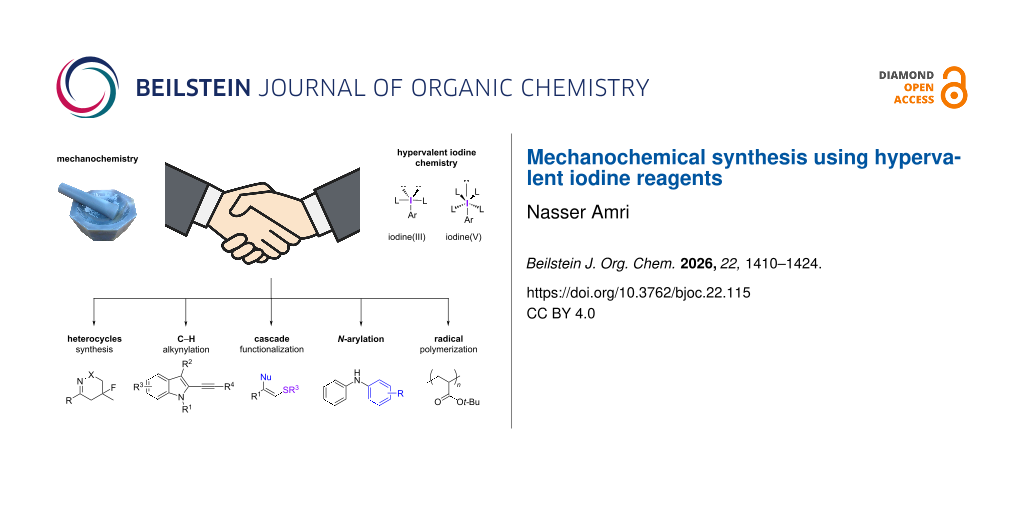
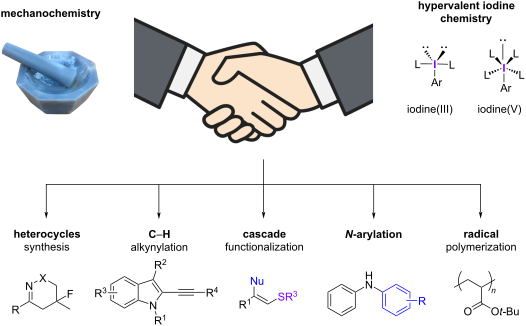
Mechanochemical activation offers a powerful means of expanding the reactivity of hypervalent iodine reagents while advancing solvent-free synthetic methodologies. This review surveys the evolution of iodine(III) and iodine(V) chemistry in the solid state, from foundational solvent-free oxidations to mechanochemical approaches that enable efficient heterocycle construction, C–H functionalization, cascade dioxygenation, fluoroiodane-mediated fluorocyclization, and redox-initiated polymerization. Mechanical energy alters aggregation, enhances reagent–substrate contact, and promotes transformation pathways not readily accessible in solution. These developments showcase the distinctive advantages of mechanochemical hypervalent iodine chemistry and its growing impact on sustainable synthetic methodology development.
Graphical Abstract
Introduction
Growing environmental awareness over recent decades has highlighted the unsustainability of many traditional chemical processes and intensified the demand for cleaner, safer, and more efficient methodologies, particularly in light of global challenges such as climate change. In this context, chemistry has come under scrutiny, driving the search for alternative modes of activation that reduce solvent use, energy consumption, and waste [1]. Alongside thermochemistry, photochemistry, and electrochemistry, mechanochemistry represents a fourth, yet historically underappreciated, mode of chemical activation, offering significant potential to align chemical synthesis with the principles of green chemistry [2,3].
Mechanochemistry, broadly defined as chemical reactivity induced by the direct absorption of mechanical energy, has roots dating back to simple grinding practices but has re-emerged in recent decades as a powerful tool for modern synthesis [4]. Enabled by technologies such as ball milling and single- or twin-screw extrusion, mechanochemical methods facilitate solvent-free or solvent-minimized reactions, often under mild conditions and without external heating, while delivering high efficiencies and unique reactivity profiles inaccessible in solution. The enhanced performance arises from improved reactant contact, increased surface area, and reduced mass-transfer limitations [5]. Although mechanochemistry is well established in fields such as crystal engineering, materials science, and formulation, its broader application in complex chemical syntheses remains in an early stage, presenting substantial opportunities to access new reaction space and advance sustainable chemical manufacturing [5-11].
Hypervalent iodine reagents have become essential tools in modern synthetic methodology due to their strong oxidative ability, versatility, diversity, low toxicity, and mild reaction profiles [12-14]. Traditionally employed in solution-phase chemistry, iodine(III) and iodine(V) reagents offer a diverse range of reactions involving oxidations, halogenations, aminations, oxidative functionalization, in addition to their unique C–C and C–heteroatom-bond-forming capabilities, including catalytic and stereoselective processes [14-16], in addition to their valuable applications as group-transfer reagents [17-19] and carbene and nitrene precursors [14,20]. In recent years, mechanochemical and solvent-free approaches have emerged as highly attractive alternatives to solution-based synthesis using hypervalent iodine reagents [21,22]. Mechanical activation through milling facilitates intimate solid–solid contact, accelerates reaction rates, and in many cases enables reactivity patterns not accessible in solution.
This review expands upon foundational solvent-free hypervalent iodine chemistry and traces its evolution through mechanochemical heterocycle synthesis, C–H functionalization, fluorination, and polymer chemistry. A very recent report on mechanochemical synthesis using hypervalent iodine reagents has emerged during the preparation of this work for submission [23].
Review
Combination of mechanochemistry and hypervalent iodine chemistry
Despite the tremendous growth of interest in hypervalent iodine chemistry and the resurgence of mechanochemistry over the past two decades, as reflected by the surge in publications in both fields, the integration of mechanochemistry with hypervalent iodine chemistry remains largely underexplored, even though this approach offers substantial advantages [22].
Over the long history of hypervalent iodine chemistry, a wide range of preparation methods of hypervalent iodine reagents has been developed [13,24]. These methods comprise two main strategies: 1) oxidation of low-valent iodine species with chemical oxidants [25-27] or via anodic oxidation [28-30] and 2) ligand exchange of premade hypervalent iodine reagents. The vast majority of these methods are solution-based. One of the early accounts on combining the benefits of hypervalent iodine chemistry and mechanochemistry was reported by Yusubov and Wirth in the year 2005 [31]. The authors reported a solvent-free synthesis of Koser’s-type reagents 3, simply by grinding commercially available hypervalent iodine reagents 1 such as (diacetoxyiodo)benzene (PIDA) with the corresponding sulfonic acids 2 (Scheme 1). The reactions are fast, and the yields are generally comparable or higher than those for previously reported solution-based syntheses.
![[1860-5397-22-115-i1]](/bjoc/content/inline/1860-5397-22-115-i1.svg?scale=2.0&max-width=1024&background=FFFFFF)
Scheme 1: Mechanochemical synthesis of Koser’s-type reagents 3.
Scheme 1: Mechanochemical synthesis of Koser’s-type reagents 3.
α-Tosyloxylation of carbonyl compounds is a well-established model reaction in hypervalent iodine chemistry [32,33]. Using this transformation as a representative example the authors also reported one-pot mechanochemical generation, and reaction of hypervalent iodine reagents as exemplified by successful tosyloxylation of 1,3-dicarbonyl compounds [31].
Recently, Olofsson and co-workers shed more light on the topic by looking at translating various typical solution-based hypervalent iodine-mediated transformations into the realm of mechanochemistry (Scheme 2) [22]. They studied the arylation of various nucleophiles including alcohols, thiols, and nitroalkanes using diaryliodonium salts 4 and a wide range of products 5 were produced in high yields. Alkene products of type 7 were efficiently synthesized via mechanochemical vinylation of thiols and nitroalkanes using vinylbenziodoxolones (VBX, 6). The authors also demonstrated the feasibility of catalytic hypervalent iodine-mediated oxidative transformations under mechanochemical conditions as exemplified by the successful α-tosyloxylation of carbonyl compounds (products 9) using catalytic amounts of 2,4-dimethylphenyl iodide (8) and m-chloroperbenzoic acid (mCPBA) as a terminal oxidant.
![[1860-5397-22-115-i2]](/bjoc/content/inline/1860-5397-22-115-i2.svg?scale=2.0&max-width=1024&background=FFFFFF)
Scheme 2: Translation of various solution-phase hypervalent iodine-mediated oxidative transformations to mechanochemistry.
Scheme 2: Translation of various solution-phase hypervalent iodine-mediated oxidative transformations to mech...
This study demonstrated the successful conversion of hypervalent iodine-mediated, solution-phase arylation, vinylation, and tosyloxylation reactions into efficient mechanochemical processes, supported by benchmarking and sustainability analyses. Several reagents showed notably different reactivity and regioselectivity under mechanochemical conditions. In addition, the first catalytic hypervalent iodine protocol using mechanochemistry was developed. Further, the study revealed that liquid-assisted grinding (LAG) [34,35] was beneficial in most cases. Scope studies identified multiple cases where the solid-phase methods outperformed traditional solution-based procedures, and E-factor comparisons confirmed that the mechanochemical protocols offer significantly enhanced sustainability. Some selected examples are depicted in Scheme 3 [22].
![[1860-5397-22-115-i3]](/bjoc/content/inline/1860-5397-22-115-i3.svg?scale=2.0&max-width=1024&background=FFFFFF)
Scheme 3: Selected examples of mechanochemical transformations using different hypervalent iodine reagents. a) 4 (0.3 mmol), alcohol (1.0 equiv), K2CO3 (1.0 equiv), LAG (EtOAc or MeCN), ball mill (35 Hz, 30–150 min). b) 6 (0.3 mmol), thiol or nitroalkane (1.0 equiv), K2CO3 (1.0 equiv), ball mill (30 Hz, 120 min). c) Carbonyl substrate (0.3 mmol), ArI 8 (20 mol %), mCPBA (1.0 equiv), TsOH·H2O (1.0 equiv), LAG (HFIP, 20 µL), ball mill (25 Hz, 5–30 min).
Scheme 3: Selected examples of mechanochemical transformations using different hypervalent iodine reagents. a...
It is noteworthy that under mechanochemical conditions, VBX reagents 6 reacted smoothly with nitrocyclopentane and nitrocyclohexane, affording the corresponding alkene derivatives 7c and 7d, respectively, in excellent yields and selectivity. In contrast, the same transformation under conventional solution-phase conditions required substantially longer reaction times and was sluggish giving a mixture of products with poor yields and selectivity (Scheme 4) [36,37]. This comparison clearly demonstrates the enhanced reactivity, selectivity, and reaction kinetics under milling conditions, in addition to their environmental and sustainability benefits.
![[1860-5397-22-115-i4]](/bjoc/content/inline/1860-5397-22-115-i4.svg?scale=2.0&max-width=1024&background=FFFFFF)
Scheme 4: Reactivity of VBX reagent 6 towards nitrocyclohexane under solution-phase conditions.
Scheme 4: Reactivity of VBX reagent 6 towards nitrocyclohexane under solution-phase conditions.
Mechanochemical synthesis of heterocycles and oxidations
Nitrogen-containing heterocycles are highly prevalent in modern pharmaceuticals, being present in approximately 82% of new U.S. FDA-approved small-molecule drugs between 2013 and 2023 [38,39], while around a quarter of small-molecule drugs contain at least one fluorine atom [40,41]. Therefore, developing synthetic methods for fluorinated heterocycles is of utter importance to the pharmaceutical industry and human health.
Riley et al. [42] established an efficient fluorocyclization strategy for the rapid synthesis of two classes of fluorinated heterocycles: tetrahydropyridazines 11 and dihydrooxazines 13 via the reaction of β,γ-unsaturated hydrazones 10 and oximes 12, respectively, with the readily available fluoroiodane reagent 14. Comparable excellent yields of fluorinated tetrahydropyridazines 11 were obtained under both solution and mechanochemical conditions, while ball milling markedly enhanced the yield and selectivity for dihydrooxazine 13 formation (Scheme 5).
![[1860-5397-22-115-i5]](/bjoc/content/inline/1860-5397-22-115-i5.svg?scale=2.0&max-width=1024&background=FFFFFF)
Scheme 5: Mechanochemical intramolecular fluorocyclization of β,γ-unsaturated hydrazones 10 and oximes 12 using fluoroiodane reagent 14. Conditions: a) Hydrazone 10 (0.25 mmol), 14 (1.5 equiv), HFIP (52 µL), ball mill (30 Hz), 15 min. b) Oxime 12 (0.25 mmol), 14 (1.5 equiv), AgBF4 (2.8 equiv), ball mill (30 Hz), 1 h.
Scheme 5: Mechanochemical intramolecular fluorocyclization of β,γ-unsaturated hydrazones 10 and oximes 12 usi...
This work highlights the distinct reactivity relative to conventional electrophilic fluorinating agents, such as Selectfluor and demonstrates that fluoroiodane reagents such as 14 offer a complementary approach to fluorination, with mechanochemistry further revealing its capacity to efficiently enable mechanistically complex transformations.
Direct mixing of various arylamines with hypervalent iodine(V) reagents is generally impractical due to the highly exothermic nature of the reaction, which can lead to hazardous outcomes, including explosions. During their attempt to develop a mechanochemical synthesis of quinazolin-4(3H)-ones, Alam et al. [43] found that grinding of a mixture of 2-iodoxybenzoic acid (IBX), aniline, and benzaldehyde is explosive. A similar result was observed when Dess–Martin periodinane (DMP) was used instead of IBX. However, introducing an ortho-amido substituent on anilines enables these reactions to proceed safely, as the intramolecular interaction provides effective control over reactivity. Under solvent-free mechanochemical conditions where the reactants are at maximal contact, 2-aminobenzamides 15, aryl- or alkylaldehydes 16, and the iodine(V) reagent O-iodoxybenzoic acid (IBX, 17) undergo smooth transformation to give substituted quinazolin-4(3H)-ones in moderate to high yields (Scheme 6). The reaction tolerated a wide variety of aromatic, aliphatic, and heterocyclic aldehydes with various substitution patterns and varied electronic and steric effects.
![[1860-5397-22-115-i6]](/bjoc/content/inline/1860-5397-22-115-i6.svg?scale=2.0&max-width=1024&background=FFFFFF)
Scheme 6: IBX-mediated mechanochemical synthesis of quinazolin-4(3H)-one derivatives 18.
Scheme 6: IBX-mediated mechanochemical synthesis of quinazolin-4(3H)-one derivatives 18.
Similarly, a straightforward, eco-friendly, one-pot approach for synthesizing 2-aryl and 2-heteroarylbenzothiazoles 21 from 2-aminothiophenol (19) and aryl/heteroarylaldehydes 20, using hypervalent iodine(III) reagents under solvent-free conditions was reported by Kumar et al. [44]. The transformation is carried out simply by grinding the reactants with the iodine(III) oxidant using a mortar and pestle. Both [bis(trifluoroacetoxy)iodo]benzene (PIFA, 22), and (diacetoxyiodo)benzene (PIDA, 23) delivered the desired products (Scheme 7) in comparable yields with shorter reaction times in case of PIFA (22). The heterocyclization/oxidation process proceeds smoothly under grinding conditions, in few minutes (2–10 min).
![[1860-5397-22-115-i7]](/bjoc/content/inline/1860-5397-22-115-i7.svg?scale=2.0&max-width=1024&background=FFFFFF)
Scheme 7: Iodine(III)-mediated solvent-free synthesis of benzothiazoles 21.
Scheme 7: Iodine(III)-mediated solvent-free synthesis of benzothiazoles 21.
Furthermore, a mechanochemical synthesis of annulated 1,2,4-triazoles 27 from hydralazine hydrochloride derivatives 24 was developed using a Pulverisette 7 planetary ball mill (P7) [45]. The authors identified conditions that enable complete conversion to hydrazone intermediates 26 within minutes when pyrogenic silica (HDK® S13) is employed as a grinding auxiliary, primarily facilitating efficient energy transfer. Optimal cyclization of hydrazones 26 to the triazoles 27 was achieved with (diacetoxyiodo)benzene (PIDA, 23) for nonphenolic hydrazones (Scheme 8). Interestingly, the one-pot, two-step mechanochemical protocol was successfully demonstrated for the first time, and evaluation through green metrics confirmed its advantages over conventional solution-based syntheses.
![[1860-5397-22-115-i8]](/bjoc/content/inline/1860-5397-22-115-i8.svg?scale=2.0&max-width=1024&background=FFFFFF)
Scheme 8: One-pot two-step mechanochemical synthesis of triazoles 27. aOverall yields of the corresponding products 27a–h.
Scheme 8: One-pot two-step mechanochemical synthesis of triazoles 27. aOverall yields of the corresponding pr...
In the same context, the hypervalent iodine-mediated oxidative aromatization of 1,4-dihydropyridine derivatives 28 (Scheme 9) was achieved mechanochemically furnishing the aromatized products 29 in good yields. The study [46] found that Koser’s reagent 30 – [hydroxy(tosyloxy)iodo]benzene (HTIB) – is a more efficient oxidant than PIDA and PIFA in terms of yield and time.
![[1860-5397-22-115-i9]](/bjoc/content/inline/1860-5397-22-115-i9.svg?scale=2.0&max-width=1024&background=FFFFFF)
Scheme 9: Mechanochemical oxidative aromatization of 1,4-dihydropyridines 28 using Koser’s reagent (30, HTIB).
Scheme 9: Mechanochemical oxidative aromatization of 1,4-dihydropyridines 28 using Koser’s reagent (30, HTIB)....
Canale et al. [47] reported a mechanochemical synthetic approach for the multitarget serotonin and dopamine receptor ligand PZ-1190, offering substantial advantages over the conventional solution-phase synthesis. The mechanochemical route reduced the synthesis from five to four steps, increased the overall yield from 32% to 56%, and shortened the reaction time from 42 h to 4 h. Reduced solvent use and elimination of column chromatography also lowered the E-factor more than tenfold, from 2578 to 228, demonstrating markedly improved efficiency and sustainability (Figure 1).
![[1860-5397-22-115-1]](/bjoc/content/figures/1860-5397-22-115-1.svg?scale=2.0&max-width=1024&background=FFFFFF)
Figure 1: Comparison of mechanochemical and conventional solution-phase routes to PZ-1190. CC = column chromatography; EF = E-factor.
Figure 1: Comparison of mechanochemical and conventional solution-phase routes to PZ-1190. CC = column chroma...
Of particular interest is the mechanochemical oxidation of the aliphatic primary alcohol 31 to aldehyde 32, reported as the first example of this transformation under milling conditions. Milling of 31 with IBX (0.5 equiv) gave 88% conversion after 45 min, whereas DMP (0.5 equiv) afforded complete conversion within 30 min. The optimized DMP protocol was successfully performed on a 1.5 g scale, providing aldehyde 32 in 76% yield (Scheme 10).
![[1860-5397-22-115-i10]](/bjoc/content/inline/1860-5397-22-115-i10.svg?scale=2.0&max-width=1024&background=FFFFFF)
Scheme 10: Mechanochemical oxidation of primary alcohol 31 into aldehyde 32.
Scheme 10: Mechanochemical oxidation of primary alcohol 31 into aldehyde 32.
Mechanochemical C–H and cascade functionalization
Indoles are a fundamental heterocyclic scaffold due to their widespread presence in natural products, pharmaceuticals, agrochemicals, and advanced materials [48-50]. Although highly C2- and C3-selective transition-metal-catalyzed C–H alkynylations of indoles using ethynylbenziodoxolone (EBX) reagents are well established [47-50], their sustainability is limited by the need for large amounts of often hazardous solvents, long reaction times, and relatively high catalyst loadings.
In this context, the selective mechanochemical C–H alkynylation of indoles 33 has been achieved under Rh(III) and Au(I) catalysis using ethynylbenziodoxolone (EBX) reagents 34, enabling complementary access to C2 and C3-alkynylated products 35 and 36, respectively, under solvent-free conditions (Scheme 11).
![[1860-5397-22-115-i11]](/bjoc/content/inline/1860-5397-22-115-i11.svg?scale=2.0&max-width=1024&background=FFFFFF)
Scheme 11: Mechanochemical C–H-bond alkynylations of indoles.
Scheme 11: Mechanochemical C–H-bond alkynylations of indoles.
These mixer-mill protocols operate without external heating, tolerate a wide range of functional groups, and deliver high yields under ambient atmosphere. Relative to conventional solution-phase methods, the mechanochemical approach significantly reduces reaction times and catalyst loadings, leading to enhanced turnover frequencies, highlighting its efficiency for metal-catalyzed C–H functionalization reactions [51].
Under Rh(III) catalysis, the reaction is C2-selective leading to C2-alkynylated indole products 35 in generally excellent yields using low catalyst loading (0.5 mol %). Some selected examples are presented in Scheme 12.
![[1860-5397-22-115-i12]](/bjoc/content/inline/1860-5397-22-115-i12.svg?scale=2.0&max-width=1024&background=FFFFFF)
Scheme 12: Selected scope of mechanochemical Rh(III)-catalyzed C–H alkynylation. TIPS = triisopropylsilyl, TBDMS = tert-butyldimethylsilyl.
Scheme 12: Selected scope of mechanochemical Rh(III)-catalyzed C–H alkynylation. TIPS = triisopropylsilyl, TBD...
While under Au(I) catalysis, the reaction is C3-selective, producing C3-alkynylated indole products 36 in generally good yields (Scheme 13).
![[1860-5397-22-115-i13]](/bjoc/content/inline/1860-5397-22-115-i13.svg?scale=2.0&max-width=1024&background=FFFFFF)
Scheme 13: Scope of mechanochemical Au(I)-catalyzed C–H alkynylation. TIPS = triisopropylsilyl, TBDMS = tert-butyldimethylsilyl.
Scheme 13: Scope of mechanochemical Au(I)-catalyzed C–H alkynylation. TIPS = triisopropylsilyl, TBDMS = tert-b...
Highly substituted alkenes are versatile intermediates for molecular diversification, and recent advances have shown that nucleophilic addition to vinylbenziodoxol(on)es (VBX/VBO) enables their synthesis with excellent regio- and stereocontrol. Building on this, Olofsson and co-workers [21] recently reported a transition-metal-free mechanochemical strategy that directly converts ethynylbenziodoxol(on)es (EBX/EBO) 37 and 38 into 1,2-heteroatom-substituted (Z)-alkenes 41 in a one-pot process under solvent-free conditions, bypassing the isolation of VBX/VBO 39 and 40 intermediates. This approach delivers a broad range of N-, O-, and S-VBX reagents in high yields and, through a telescoped nucleophilic addition, provides access to numerous novel and complex (Z)-alkenes with excellent functional group tolerance, including bioactive motifs such as glucose and cysteine, some of which are depicted in Scheme 14. Benchmarking against solution-phase methods demonstrates that this tandem transformation is inefficient or inaccessible in solution, underscoring the unique capability of mechanochemistry to enable otherwise impractical synthetic pathways.
![[1860-5397-22-115-i14]](/bjoc/content/inline/1860-5397-22-115-i14.svg?scale=2.0&max-width=1024&background=FFFFFF)
Scheme 14: Mechanochemical synthesis of complex alkenes.
Scheme 14: Mechanochemical synthesis of complex alkenes.
Furthermore, a mechanochemical strategy for the cascade functionalization/dimerization of styrene derivatives 42 using PIFA (22) has been established [52], providing efficient access to 1,3-dioxygenated products 45. Under closely related conditions, the inclusion of molecular iodine enables the formation of 1,4-iodoalcohols 46. These synthetically valuable motifs are difficult to obtain using conventional solution-phase methodologies, that usually deliver the 1,2-difunctionalization products 43 and 44 (Scheme 15).
![[1860-5397-22-115-i15]](/bjoc/content/inline/1860-5397-22-115-i15.svg?scale=2.0&max-width=1024&background=FFFFFF)
Scheme 15: Mechanochemical PIFA-mediated cascade functionalization of styrene derivatives.
Scheme 15: Mechanochemical PIFA-mediated cascade functionalization of styrene derivatives.
To understand the different reaction outcomes under mechanochemical and solution-phase conditions, the authors performed several control experiments and mechanistic studies. They attributed the divergent selectivity to the possible preferential formation of PIFA dimer under mechanical force (Figure 2). This association is proposed to alter the availability of reactive PIFA species and favour a cascade pathway that ultimately delivers the 1,3-disubstituted product. By contrast, in solution, the greater availability of free trifluoroacetate is proposed to direct the reaction through a substitution pathway, accounting for the conventional 1,2-dioxygenation selectivity.
![[1860-5397-22-115-2]](/bjoc/content/figures/1860-5397-22-115-2.svg?scale=2.0&max-width=1024&background=FFFFFF)
Figure 2: Mechanochemical dimerization of PIFA.
Figure 2: Mechanochemical dimerization of PIFA.
Mechanochemical N-functionalization reactions
Diaryliodonium salts are air- and moisture-stable solids that have been extensively studied since the late 19th century, with rapid growth in their synthesis and applications over the past decade. Their low toxicity and high reactivity make them excellent electrophilic arylation reagents, enabling cross-coupling with arenes, alkynes, alkenes, carbonyl compounds, and heteroatoms [53-58]. However, traditional methods often require long reaction times, and sometimes complex ligands which limits their broader use. Therefore, developing more efficient methods is of great interest.
As mechanochemical methods are known to improve reaction kinetics relative to their solution counterparts, Jiang and Li [59] studied the mechanochemical N-arylation of amino compounds 47 using diaryliodonium salts 48 (Scheme 16). They demonstrated that diaryliodonium salts are highly effective for N-arylation under mechanochemical conditions. When combined with Cu(I) catalysts (method A), the reaction proceeded smoothly without solvent, achieving high yields in case of aromatic amines but suffered from diminished yields in the case of aliphatic amines. The authors also developed a Cu-free version of the reaction. In the absence of the Cu catalyst, liquid-assisted grinding (LAG) was necessary to achieve yields comparable to the Cu-catalyzed protocol, therefore the reaction benefitted from the addition of small amounts of water (method B). Mechanistic investigations revealed that the reaction proceeds via a radical mechanism in the absence of the metal catalyst (method B) as depicted in Figure 3.
![[1860-5397-22-115-i16]](/bjoc/content/inline/1860-5397-22-115-i16.svg?scale=2.0&max-width=1024&background=FFFFFF)
Scheme 16: Mechanochemical arylation of amines with diaryliodonium salts. Yields correspond to method A and B, respectively.
Scheme 16: Mechanochemical arylation of amines with diaryliodonium salts. Yields correspond to method A and B,...
![[1860-5397-22-115-3]](/bjoc/content/figures/1860-5397-22-115-3.svg?scale=2.0&max-width=1024&background=FFFFFF)
Figure 3: Proposed radical mechanism for the formation of diarylamines (method B).
Figure 3: Proposed radical mechanism for the formation of diarylamines (method B).
Guha et al. [60] developed an operationally simple, metal-free mechanochemical protocol for the N-sulfonyl transfer from various iminoiodinanes 50 to a range of cyclic secondary amines 51 affording N-sulfonylamidines 52 in yields ranging from low to high (Scheme 17). The reactions were carried out in a ball mill with minimal amounts of 2-methyltetrahydrofuran (2-MeTHF) as LAG additive. The transformations proceeded efficiently at ambient temperature, typically reaching completion within 3 hours, and required no metal catalysts or bases. As N-sulfonylamidines are valuable building blocks in natural products and drug intermediates [61,62], this method provides a practical and scalable (gram-scale demonstrated) approach to their synthesis.
![[1860-5397-22-115-i17]](/bjoc/content/inline/1860-5397-22-115-i17.svg?scale=2.0&max-width=1024&background=FFFFFF)
Scheme 17: Mechanochemical synthesis of N-sulfonylamidines.
Scheme 17: Mechanochemical synthesis of N-sulfonylamidines.
Mechanochemical polymerization
The ability of iodonium salts to generate radicals under thermal, photochemical, or redox conditions found various applications in organic synthesis. Diaryliodonium salts are extensively studied as photoinitiators in photopolymerization: a process that is essential for 3D-printing and various other applications.
In 2022, Zeitler et al. [63] explored the potential of mechanochemical activation of diaryliodonium salts as initiators for free radical polymerization (FRP). The authors investigated the activation of diaryliodonium salts by both solution-based ultrasonication and liquid-assisted grinding (LAG) [34,35] in a ball mill. The study revealed that grinding a mixture of tert-butyl acrylate (t-BA, 54), diphenyliodonium hexafluorophosphate (DPIHP, 53), BaTiO3, and a minimal amount of DMF (0.030 v/w) leads to the formation of the desired polymer 55 with high efficiency: >95% conversion of the monomer (t-BA) after 3 hours only (Scheme 18) compared to 20 hours needed to achieve the same level of conversion in solution under ultrasonication. The polymerization of other monomers such as methyl acrylate (MA), ethyl acrylate (EA), butyl acrylate (BA), and methyl methacrylate (MMA) was successful in all cases under the developed mechanochemical conditions.
![[1860-5397-22-115-i18]](/bjoc/content/inline/1860-5397-22-115-i18.svg?scale=2.0&max-width=1024&background=FFFFFF)
Scheme 18: DPIHP as initiator for the FRP of acrylate monomers.
Scheme 18: DPIHP as initiator for the FRP of acrylate monomers.
Azo-linked porous organic polymers (POPs) are an important class of materials, yet their preparation traditionally depends on metal-catalyzed, high-temperature, liquid-phase methods. Recently, Zhang et al. [64] developed a mechanochemical, oxidative and metal-free strategy for their solid-phase synthesis, using increased steric hindrance in the monomers to prevent explosive interactions between the hypervalent iodine oxidants and primary amines. The oxidative coupling of 4,4’-(9H-fluorene-9,9-diyl)dianiline (56) via ball milling proceeds smoothly using 2-iodoxybenzoic acid (IBX), without explosion or hazardous exothermic interactions to produce the desired polymer 57 (Scheme 19).
![[1860-5397-22-115-i19]](/bjoc/content/inline/1860-5397-22-115-i19.svg?scale=2.0&max-width=1024&background=FFFFFF)
Scheme 19: Mechanochemical synthesis of Diazo-POP-Mec 57.
Scheme 19: Mechanochemical synthesis of Diazo-POP-Mec 57.
This process produced the target polymer diazo-POP-Mec 57 in just 20 minutes, which is highly efficient compared to 72 hours under solution conditions. This approach also offers soluble azo-based POPs that can be cast into an organic membrane. Overall, the results highlight the stabilizing effect of steric hindrance during azopolymer formation and demonstrate mechanochemistry as a safe and effective alternative to conventional synthesis routes.
Conclusion
Across all classes of reactivity – oxidation, cyclization, C–H activation, fluorination, and polymerization – mechanochemistry has proven to be a powerful platform for hypervalent iodine chemistry. These solid-state transformations are not merely solvent-free analogues of solution reactions; instead, they often display enhanced reaction kinetics, selectivity, modified mechanistic pathways, and the ability to access otherwise inaccessible transformations. The body of work summarized here demonstrates how mechanical force enables new reactivity modes, simplifies operations, improves sustainability metrics, and expands the reach of iodine(III) and iodine(V) reagents into new domains such as materials chemistry. Continued development in mechanistic understanding, reactor design, and scalable processing will further unlock the potential of hypervalent iodine chemistry under mechanochemical conditions.
Acknowledgements
The author gratefully acknowledges Jazan University for providing the resources necessary to prepare this review. The photo of the mortar depicted in the graphical abstract was adapted from https://de.wikipedia.org/wiki/Datei:Mortar_achat_hg.jpg (“Mortar achat hg“, © 2000 H. Grobe, distributed under the terms of the Creative Commons Attribution-ShareAlike 2.5 Generic license, https://creativecommons.org/licenses/by-sa/2.5/deed.en). This content is not subject to CC BY 4.0.
Data Availability Statement
Data sharing is not applicable, as no new data were generated or developed in this study.
References
-
Arfelis, S.; Martín-Perales, A. I.; Nguyen, R.; Pérez, A.; Cherubin, I.; Len, C.; Malpartida, I.; Bala, A.; Fullana-i-Palmer, P. Heliyon 2024, 10, e34655. doi:10.1016/j.heliyon.2024.e34655
Return to citation in text: [1] -
Baig, R. B. N.; Varma, R. S. Chem. Soc. Rev. 2012, 41, 1559–1584. doi:10.1039/c1cs15204a
Return to citation in text: [1] -
Ardila‐Fierro, K. J.; Hernández, J. G. ChemSusChem 2021, 14, 2145–2162. doi:10.1002/cssc.202100478
Return to citation in text: [1] -
Takacs, L. Chem. Soc. Rev. 2013, 42, 7649. doi:10.1039/c2cs35442j
Return to citation in text: [1] -
Liu, X.; Li, Y.; Zeng, L.; Li, X.; Chen, N.; Bai, S.; He, H.; Wang, Q.; Zhang, C. Adv. Mater. (Weinheim, Ger.) 2022, 34, 2108327. doi:10.1002/adma.202108327
Return to citation in text: [1] [2] -
Dong, L.; Li, L.; Chen, H.; Cao, Y.; Lei, H. Adv. Sci. 2025, 12, 2403949. doi:10.1002/advs.202403949
Return to citation in text: [1] -
Howard, J. L.; Cao, Q.; Browne, D. L. Chem. Sci. 2018, 9, 3080–3094. doi:10.1039/c7sc05371a
Return to citation in text: [1] -
Do, J.-L.; Friščić, T. ACS Cent. Sci. 2017, 3, 13–19. doi:10.1021/acscentsci.6b00277
Return to citation in text: [1] -
Beyer, M. K.; Clausen-Schaumann, H. Chem. Rev. 2005, 105, 2921–2948. doi:10.1021/cr030697h
Return to citation in text: [1] -
Bolt, R. R. A.; Leitch, J. A.; Jones, A. C.; Nicholson, W. I.; Browne, D. L. Chem. Soc. Rev. 2022, 51, 4243–4260. doi:10.1039/d1cs00657f
Return to citation in text: [1] -
Pagola, S. Crystals 2023, 13, 124. doi:10.3390/cryst13010124
Return to citation in text: [1] -
Zhdankin, V. V. Hypervalent Iodine Chemistry: Preparation, Structure and Synthetic Applications of Polyvalent Iodine Compounds; John Wiley & Sons: Chichester, UK, 2013. doi:10.1002/9781118341155
Return to citation in text: [1] -
Wirth, T., Ed. Hypervalent Iodine Chemistry; Topics In Current Chemistry, Vol. 373; Springer International Publishing: Cham, Switzerland, 2016. doi:10.1007/978-3-319-33733-3
Return to citation in text: [1] [2] -
Yoshimura, A.; Zhdankin, V. V. Chem. Rev. 2024, 124, 11108–11186. doi:10.1021/acs.chemrev.4c00303
Return to citation in text: [1] [2] [3] -
Kumar, R.; Zhdankin, V. V. ARKIVOC 2025, No. 4, 199912370. doi:10.24820/ark.5550190.p012.370
Return to citation in text: [1] -
Mahanti, M.; Bhaskar Pal, K.; Wallentin, C. J.; Galan, M. C. Chem. – Eur. J. 2024, 30, e202400087. doi:10.1002/chem.202400087
Return to citation in text: [1] -
Mironova, I. A.; Noskov, D. M.; Yoshimura, A.; Yusubov, M. S.; Zhdankin, V. V. Molecules 2023, 28, 2136. doi:10.3390/molecules28052136
Return to citation in text: [1] -
Le Du, E.; Waser, J. Chem. Commun. 2023, 59, 1589–1604. doi:10.1039/d2cc06168f
Return to citation in text: [1] -
Ghosh, M.; Rajkiewicz, A.; Kalek, M. Synthesis 2019, 51, 359–370. doi:10.1055/s-0037-1609639
Return to citation in text: [1] -
Kumar, S.; Borkar, V.; Mujahid, M.; Nunewar, S.; Kanchupalli, V. Org. Biomol. Chem. 2023, 21, 24–38. doi:10.1039/d2ob01644c
Return to citation in text: [1] -
Doobary, S.; Braunreuther, J.; Inge, A. K.; Olofsson, B. Angew. Chem., Int. Ed. 2026, 65, e19049. doi:10.1002/anie.202519049
Return to citation in text: [1] [2] -
Doobary, S.; de Vries Ibáñez, M. M.; Olofsson, B. Green Chem. 2024, 26, 11518–11523. doi:10.1039/d4gc04903a
Return to citation in text: [1] [2] [3] [4] -
Öberg, P.; Doobary, S.; Olofsson, B. Green Chem. 2026, 28, 5896–5909. doi:10.1039/d6gc00367b
Return to citation in text: [1] -
Zhdankin, V. V. Preparation, Structure and Properties of Polyvalent Iodine Compounds. Hypervalent Iodine Chemistry: Preparation, Structure and Synthetic Applications of Polyvalent Iodine Compounds; John Wiley & Sons: Chichester, UK, 2013; pp 21–143. doi:10.1002/9781118341155.ch2
Return to citation in text: [1] -
Maity, A.; Hyun, S.-M.; Powers, D. C. Nat. Chem. 2018, 10, 200–204. doi:10.1038/nchem.2873
Return to citation in text: [1] -
Malmedy, F.; Wirth, T. Chem. – Eur. J. 2016, 22, 16072–16077. doi:10.1002/chem.201603022
Return to citation in text: [1] -
Ren, J.; Jia, M.-C.; Du, F.-H.; Zhang, C. Chin. Chem. Lett. 2022, 33, 4834–4837. doi:10.1016/j.cclet.2022.01.070
Return to citation in text: [1] -
Elsherbini, M.; Winterson, B.; Alharbi, H.; Folgueiras‐Amador, A. A.; Génot, C.; Wirth, T. Angew. Chem., Int. Ed. 2019, 58, 9811–9815. doi:10.1002/anie.201904379
Return to citation in text: [1] -
Elsherbini, M.; Wirth, T. Chem. – Eur. J. 2018, 24, 13399–13407. doi:10.1002/chem.201801232
Return to citation in text: [1] -
Doobary, S.; Poole, D. L.; Lennox, A. J. J. J. Org. Chem. 2021, 86, 16095–16103. doi:10.1021/acs.joc.1c01946
Return to citation in text: [1] -
Yusubov, M. S.; Wirth, T. Org. Lett. 2005, 7, 519–521. doi:10.1021/ol047363e
Return to citation in text: [1] [2] -
Beaulieu, S.; Legault, C. Y. Chem. – Eur. J. 2015, 21, 11206–11211. doi:10.1002/chem.201501177
Return to citation in text: [1] -
Elsherbini, M.; Moran, W. J. J. Org. Chem. 2023, 88, 1424–1433. doi:10.1021/acs.joc.2c02309
Return to citation in text: [1] -
Howard, J. L.; Brand, M. C.; Browne, D. L. Angew. Chem. 2018, 130, 16336–16340. doi:10.1002/ange.201810141
Return to citation in text: [1] [2] -
Allenbaugh, R. J.; Shaw, A. Results Chem. 2023, 5, 100827. doi:10.1016/j.rechem.2023.100827
Return to citation in text: [1] [2] -
Declas, N.; Pisella, G.; Waser, J. Helv. Chim. Acta 2020, 103, e2000191. doi:10.1002/hlca.202000191
Return to citation in text: [1] -
Stridfeldt, E.; Seemann, A.; Bouma, M. J.; Dey, C.; Ertan, A.; Olofsson, B. Chem. – Eur. J. 2016, 22, 16066–16070. doi:10.1002/chem.201603955
Return to citation in text: [1] -
Marshall, C. M.; Federice, J. G.; Bell, C. N.; Cox, P. B.; Njardarson, J. T. J. Med. Chem. 2024, 67, 11622–11655. doi:10.1021/acs.jmedchem.4c01122
Return to citation in text: [1] -
Heravi, M. M.; Zadsirjan, V. RSC Adv. 2020, 10, 44247–44311. doi:10.1039/d0ra09198g
Return to citation in text: [1] -
Rittner, A.; Joppe, M.; Schmidt, J. J.; Mayer, L. M.; Reiners, S.; Heid, E.; Herzberg, D.; Sherman, D. H.; Grininger, M. Nat. Chem. 2022, 14, 1000–1006. doi:10.1038/s41557-022-00996-z
Return to citation in text: [1] -
Han, J.; Kiss, L.; Mei, H.; Remete, A. M.; Ponikvar-Svet, M.; Sedgwick, D. M.; Roman, R.; Fustero, S.; Moriwaki, H.; Soloshonok, V. A. Chem. Rev. 2021, 121, 4678–4742. doi:10.1021/acs.chemrev.0c01263
Return to citation in text: [1] -
Riley, W.; Jones, A. C.; Singh, K.; Browne, D. L.; Stuart, A. M. Chem. Commun. 2021, 57, 7406–7409. doi:10.1039/d1cc02587b
Return to citation in text: [1] -
Alam, M. T.; Maiti, S.; Mal, P. Beilstein J. Org. Chem. 2018, 14, 2396–2403. doi:10.3762/bjoc.14.216
Return to citation in text: [1] -
Kumar, P.; Meenakshi; Kumar, S.; Kumar, A.; Hussain, K.; Kumar, S. J. Heterocycl. Chem. 2012, 49, 1243–1249. doi:10.1002/jhet.962
Return to citation in text: [1] -
Gonnet, L.; André-Barrès, C.; Guidetti, B.; Chamayou, A.; Menendez, C.; Baron, M.; Calvet, R.; Baltas, M. ACS Sustainable Chem. Eng. 2020, 8, 3114–3125. doi:10.1021/acssuschemeng.9b05886
Return to citation in text: [1] -
Kumar, P.; Hussain, K.; Kumar, A. Curr. Chem. Lett. 2014, 3, 75–84. doi:10.5267/j.ccl.2014.1.002
Return to citation in text: [1] -
Canale, V.; Kamiński, M.; Trybała, W.; Abram, M.; Marciniec, K.; Bantreil, X.; Lamaty, F.; Parkitna, J. R.; Zajdel, P. ACS Sustainable Chem. Eng. 2023, 11, 16156–16164. doi:10.1021/acssuschemeng.3c04023
Return to citation in text: [1] [2] -
Zeng, W.; Han, C.; Mohammed, S.; Li, S.; Song, Y.; Sun, F.; Du, Y. RSC Med. Chem. 2024, 15, 788–808. doi:10.1039/d3md00677h
Return to citation in text: [1] [2] -
Babalola, B. A.; Malik, M.; Olowokere, O.; Adebesin, A.; Sharma, L. Eur. J. Med. Chem. Rep. 2025, 13, 100252. doi:10.1016/j.ejmcr.2025.100252
Return to citation in text: [1] [2] -
Brand, J. P.; Chevalley, C.; Scopelliti, R.; Waser, J. Chem. – Eur. J. 2012, 18, 5655–5666. doi:10.1002/chem.201200200
Return to citation in text: [1] [2] -
Hermann, G. N.; Unruh, M. T.; Jung, S.-H.; Krings, M.; Bolm, C. Angew. Chem., Int. Ed. 2018, 57, 10723–10727. doi:10.1002/anie.201805778
Return to citation in text: [1] -
Pan, L.; Zheng, L.; Chen, Y.; Ke, Z.; Yeung, Y.-Y. Angew. Chem., Int. Ed. 2022, 61, e202207926. doi:10.1002/anie.202207926
Return to citation in text: [1] -
Yusubov, M. S.; Maskaev, A. V.; Zhdankin, V. V. ARKIVOC 2011, No. i, 370–409. doi:10.3998/ark.5550190.0012.107
Return to citation in text: [1] -
Zhu, D.; Wu, Z.; Liang, L.; Sun, Y.; Luo, B.; Huang, P.; Wen, S. RSC Adv. 2019, 9, 33170–33179. doi:10.1039/c9ra07288h
Return to citation in text: [1] -
Ochiai, M.; Kitagawa, Y.; Takayama, N.; Takaoka, Y.; Shiro, M. J. Am. Chem. Soc. 1999, 121, 9233–9234. doi:10.1021/ja992236c
Return to citation in text: [1] -
Stuart, D. Synlett 2016, 28, 275–279. doi:10.1055/s-0036-1588683
Return to citation in text: [1] -
Elsherbini, M.; Moran, W. J. Org. Biomol. Chem. 2021, 19, 4706–4711. doi:10.1039/d1ob00457c
Return to citation in text: [1] -
Mamgain, R.; Sakthivel, K.; Singh, F. V. Beilstein J. Org. Chem. 2024, 20, 2891–2920. doi:10.3762/bjoc.20.243
Return to citation in text: [1] -
Jiang, J.; Li, J. ChemistrySelect 2020, 5, 542–548. doi:10.1002/slct.201904188
Return to citation in text: [1] -
Guha, S.; Maheshwari, S.; Ravva, M. K.; Jacob, J. M.; Yadav, S.; Sen, S. Asian J. Org. Chem. 2023, 12, e202300348. doi:10.1002/ajoc.202300348
Return to citation in text: [1] -
Liu, A.-R.; Zhang, L.; Li, J.; Wusiman, A. RSC Adv. 2021, 11, 15161–15166. doi:10.1039/d1ra00772f
Return to citation in text: [1] -
Kaboudin, B.; Torabi, S.; Kazemi, F.; Aoyama, H. RSC Adv. 2020, 10, 26701–26708. doi:10.1039/d0ra04545d
Return to citation in text: [1] -
Zeitler, S. M.; Chakma, P.; Golder, M. R. Chem. Sci. 2022, 13, 4131–4138. doi:10.1039/d2sc00313a
Return to citation in text: [1] -
Hou, S.; Xu, J.; Wang, J.; Wang, H.; Zhang, P. Chem. – Eur. J. 2024, 30, e202303126. doi:10.1002/chem.202303126
Return to citation in text: [1]
| 45. | Gonnet, L.; André-Barrès, C.; Guidetti, B.; Chamayou, A.; Menendez, C.; Baron, M.; Calvet, R.; Baltas, M. ACS Sustainable Chem. Eng. 2020, 8, 3114–3125. doi:10.1021/acssuschemeng.9b05886 |
| 46. | Kumar, P.; Hussain, K.; Kumar, A. Curr. Chem. Lett. 2014, 3, 75–84. doi:10.5267/j.ccl.2014.1.002 |
| 47. | Canale, V.; Kamiński, M.; Trybała, W.; Abram, M.; Marciniec, K.; Bantreil, X.; Lamaty, F.; Parkitna, J. R.; Zajdel, P. ACS Sustainable Chem. Eng. 2023, 11, 16156–16164. doi:10.1021/acssuschemeng.3c04023 |
| 1. | Arfelis, S.; Martín-Perales, A. I.; Nguyen, R.; Pérez, A.; Cherubin, I.; Len, C.; Malpartida, I.; Bala, A.; Fullana-i-Palmer, P. Heliyon 2024, 10, e34655. doi:10.1016/j.heliyon.2024.e34655 |
| 5. | Liu, X.; Li, Y.; Zeng, L.; Li, X.; Chen, N.; Bai, S.; He, H.; Wang, Q.; Zhang, C. Adv. Mater. (Weinheim, Ger.) 2022, 34, 2108327. doi:10.1002/adma.202108327 |
| 6. | Dong, L.; Li, L.; Chen, H.; Cao, Y.; Lei, H. Adv. Sci. 2025, 12, 2403949. doi:10.1002/advs.202403949 |
| 7. | Howard, J. L.; Cao, Q.; Browne, D. L. Chem. Sci. 2018, 9, 3080–3094. doi:10.1039/c7sc05371a |
| 8. | Do, J.-L.; Friščić, T. ACS Cent. Sci. 2017, 3, 13–19. doi:10.1021/acscentsci.6b00277 |
| 9. | Beyer, M. K.; Clausen-Schaumann, H. Chem. Rev. 2005, 105, 2921–2948. doi:10.1021/cr030697h |
| 10. | Bolt, R. R. A.; Leitch, J. A.; Jones, A. C.; Nicholson, W. I.; Browne, D. L. Chem. Soc. Rev. 2022, 51, 4243–4260. doi:10.1039/d1cs00657f |
| 11. | Pagola, S. Crystals 2023, 13, 124. doi:10.3390/cryst13010124 |
| 28. | Elsherbini, M.; Winterson, B.; Alharbi, H.; Folgueiras‐Amador, A. A.; Génot, C.; Wirth, T. Angew. Chem., Int. Ed. 2019, 58, 9811–9815. doi:10.1002/anie.201904379 |
| 29. | Elsherbini, M.; Wirth, T. Chem. – Eur. J. 2018, 24, 13399–13407. doi:10.1002/chem.201801232 |
| 30. | Doobary, S.; Poole, D. L.; Lennox, A. J. J. J. Org. Chem. 2021, 86, 16095–16103. doi:10.1021/acs.joc.1c01946 |
| 59. | Jiang, J.; Li, J. ChemistrySelect 2020, 5, 542–548. doi:10.1002/slct.201904188 |
| 5. | Liu, X.; Li, Y.; Zeng, L.; Li, X.; Chen, N.; Bai, S.; He, H.; Wang, Q.; Zhang, C. Adv. Mater. (Weinheim, Ger.) 2022, 34, 2108327. doi:10.1002/adma.202108327 |
| 60. | Guha, S.; Maheshwari, S.; Ravva, M. K.; Jacob, J. M.; Yadav, S.; Sen, S. Asian J. Org. Chem. 2023, 12, e202300348. doi:10.1002/ajoc.202300348 |
| 13. | Wirth, T., Ed. Hypervalent Iodine Chemistry; Topics In Current Chemistry, Vol. 373; Springer International Publishing: Cham, Switzerland, 2016. doi:10.1007/978-3-319-33733-3 |
| 24. | Zhdankin, V. V. Preparation, Structure and Properties of Polyvalent Iodine Compounds. Hypervalent Iodine Chemistry: Preparation, Structure and Synthetic Applications of Polyvalent Iodine Compounds; John Wiley & Sons: Chichester, UK, 2013; pp 21–143. doi:10.1002/9781118341155.ch2 |
| 52. | Pan, L.; Zheng, L.; Chen, Y.; Ke, Z.; Yeung, Y.-Y. Angew. Chem., Int. Ed. 2022, 61, e202207926. doi:10.1002/anie.202207926 |
| 2. | Baig, R. B. N.; Varma, R. S. Chem. Soc. Rev. 2012, 41, 1559–1584. doi:10.1039/c1cs15204a |
| 3. | Ardila‐Fierro, K. J.; Hernández, J. G. ChemSusChem 2021, 14, 2145–2162. doi:10.1002/cssc.202100478 |
| 25. | Maity, A.; Hyun, S.-M.; Powers, D. C. Nat. Chem. 2018, 10, 200–204. doi:10.1038/nchem.2873 |
| 26. | Malmedy, F.; Wirth, T. Chem. – Eur. J. 2016, 22, 16072–16077. doi:10.1002/chem.201603022 |
| 27. | Ren, J.; Jia, M.-C.; Du, F.-H.; Zhang, C. Chin. Chem. Lett. 2022, 33, 4834–4837. doi:10.1016/j.cclet.2022.01.070 |
| 53. | Yusubov, M. S.; Maskaev, A. V.; Zhdankin, V. V. ARKIVOC 2011, No. i, 370–409. doi:10.3998/ark.5550190.0012.107 |
| 54. | Zhu, D.; Wu, Z.; Liang, L.; Sun, Y.; Luo, B.; Huang, P.; Wen, S. RSC Adv. 2019, 9, 33170–33179. doi:10.1039/c9ra07288h |
| 55. | Ochiai, M.; Kitagawa, Y.; Takayama, N.; Takaoka, Y.; Shiro, M. J. Am. Chem. Soc. 1999, 121, 9233–9234. doi:10.1021/ja992236c |
| 56. | Stuart, D. Synlett 2016, 28, 275–279. doi:10.1055/s-0036-1588683 |
| 57. | Elsherbini, M.; Moran, W. J. Org. Biomol. Chem. 2021, 19, 4706–4711. doi:10.1039/d1ob00457c |
| 58. | Mamgain, R.; Sakthivel, K.; Singh, F. V. Beilstein J. Org. Chem. 2024, 20, 2891–2920. doi:10.3762/bjoc.20.243 |
| 14. | Yoshimura, A.; Zhdankin, V. V. Chem. Rev. 2024, 124, 11108–11186. doi:10.1021/acs.chemrev.4c00303 |
| 20. | Kumar, S.; Borkar, V.; Mujahid, M.; Nunewar, S.; Kanchupalli, V. Org. Biomol. Chem. 2023, 21, 24–38. doi:10.1039/d2ob01644c |
| 23. | Öberg, P.; Doobary, S.; Olofsson, B. Green Chem. 2026, 28, 5896–5909. doi:10.1039/d6gc00367b |
| 51. | Hermann, G. N.; Unruh, M. T.; Jung, S.-H.; Krings, M.; Bolm, C. Angew. Chem., Int. Ed. 2018, 57, 10723–10727. doi:10.1002/anie.201805778 |
| 17. | Mironova, I. A.; Noskov, D. M.; Yoshimura, A.; Yusubov, M. S.; Zhdankin, V. V. Molecules 2023, 28, 2136. doi:10.3390/molecules28052136 |
| 18. | Le Du, E.; Waser, J. Chem. Commun. 2023, 59, 1589–1604. doi:10.1039/d2cc06168f |
| 19. | Ghosh, M.; Rajkiewicz, A.; Kalek, M. Synthesis 2019, 51, 359–370. doi:10.1055/s-0037-1609639 |
| 22. | Doobary, S.; de Vries Ibáñez, M. M.; Olofsson, B. Green Chem. 2024, 26, 11518–11523. doi:10.1039/d4gc04903a |
| 21. | Doobary, S.; Braunreuther, J.; Inge, A. K.; Olofsson, B. Angew. Chem., Int. Ed. 2026, 65, e19049. doi:10.1002/anie.202519049 |
| 14. | Yoshimura, A.; Zhdankin, V. V. Chem. Rev. 2024, 124, 11108–11186. doi:10.1021/acs.chemrev.4c00303 |
| 15. | Kumar, R.; Zhdankin, V. V. ARKIVOC 2025, No. 4, 199912370. doi:10.24820/ark.5550190.p012.370 |
| 16. | Mahanti, M.; Bhaskar Pal, K.; Wallentin, C. J.; Galan, M. C. Chem. – Eur. J. 2024, 30, e202400087. doi:10.1002/chem.202400087 |
| 48. | Zeng, W.; Han, C.; Mohammed, S.; Li, S.; Song, Y.; Sun, F.; Du, Y. RSC Med. Chem. 2024, 15, 788–808. doi:10.1039/d3md00677h |
| 49. | Babalola, B. A.; Malik, M.; Olowokere, O.; Adebesin, A.; Sharma, L. Eur. J. Med. Chem. Rep. 2025, 13, 100252. doi:10.1016/j.ejmcr.2025.100252 |
| 50. | Brand, J. P.; Chevalley, C.; Scopelliti, R.; Waser, J. Chem. – Eur. J. 2012, 18, 5655–5666. doi:10.1002/chem.201200200 |
| 12. | Zhdankin, V. V. Hypervalent Iodine Chemistry: Preparation, Structure and Synthetic Applications of Polyvalent Iodine Compounds; John Wiley & Sons: Chichester, UK, 2013. doi:10.1002/9781118341155 |
| 13. | Wirth, T., Ed. Hypervalent Iodine Chemistry; Topics In Current Chemistry, Vol. 373; Springer International Publishing: Cham, Switzerland, 2016. doi:10.1007/978-3-319-33733-3 |
| 14. | Yoshimura, A.; Zhdankin, V. V. Chem. Rev. 2024, 124, 11108–11186. doi:10.1021/acs.chemrev.4c00303 |
| 21. | Doobary, S.; Braunreuther, J.; Inge, A. K.; Olofsson, B. Angew. Chem., Int. Ed. 2026, 65, e19049. doi:10.1002/anie.202519049 |
| 22. | Doobary, S.; de Vries Ibáñez, M. M.; Olofsson, B. Green Chem. 2024, 26, 11518–11523. doi:10.1039/d4gc04903a |
| 47. | Canale, V.; Kamiński, M.; Trybała, W.; Abram, M.; Marciniec, K.; Bantreil, X.; Lamaty, F.; Parkitna, J. R.; Zajdel, P. ACS Sustainable Chem. Eng. 2023, 11, 16156–16164. doi:10.1021/acssuschemeng.3c04023 |
| 48. | Zeng, W.; Han, C.; Mohammed, S.; Li, S.; Song, Y.; Sun, F.; Du, Y. RSC Med. Chem. 2024, 15, 788–808. doi:10.1039/d3md00677h |
| 49. | Babalola, B. A.; Malik, M.; Olowokere, O.; Adebesin, A.; Sharma, L. Eur. J. Med. Chem. Rep. 2025, 13, 100252. doi:10.1016/j.ejmcr.2025.100252 |
| 50. | Brand, J. P.; Chevalley, C.; Scopelliti, R.; Waser, J. Chem. – Eur. J. 2012, 18, 5655–5666. doi:10.1002/chem.201200200 |
| 22. | Doobary, S.; de Vries Ibáñez, M. M.; Olofsson, B. Green Chem. 2024, 26, 11518–11523. doi:10.1039/d4gc04903a |
| 32. | Beaulieu, S.; Legault, C. Y. Chem. – Eur. J. 2015, 21, 11206–11211. doi:10.1002/chem.201501177 |
| 33. | Elsherbini, M.; Moran, W. J. J. Org. Chem. 2023, 88, 1424–1433. doi:10.1021/acs.joc.2c02309 |
| 61. | Liu, A.-R.; Zhang, L.; Li, J.; Wusiman, A. RSC Adv. 2021, 11, 15161–15166. doi:10.1039/d1ra00772f |
| 62. | Kaboudin, B.; Torabi, S.; Kazemi, F.; Aoyama, H. RSC Adv. 2020, 10, 26701–26708. doi:10.1039/d0ra04545d |
| 63. | Zeitler, S. M.; Chakma, P.; Golder, M. R. Chem. Sci. 2022, 13, 4131–4138. doi:10.1039/d2sc00313a |
| 34. | Howard, J. L.; Brand, M. C.; Browne, D. L. Angew. Chem. 2018, 130, 16336–16340. doi:10.1002/ange.201810141 |
| 35. | Allenbaugh, R. J.; Shaw, A. Results Chem. 2023, 5, 100827. doi:10.1016/j.rechem.2023.100827 |
| 43. | Alam, M. T.; Maiti, S.; Mal, P. Beilstein J. Org. Chem. 2018, 14, 2396–2403. doi:10.3762/bjoc.14.216 |
| 44. | Kumar, P.; Meenakshi; Kumar, S.; Kumar, A.; Hussain, K.; Kumar, S. J. Heterocycl. Chem. 2012, 49, 1243–1249. doi:10.1002/jhet.962 |
| 40. | Rittner, A.; Joppe, M.; Schmidt, J. J.; Mayer, L. M.; Reiners, S.; Heid, E.; Herzberg, D.; Sherman, D. H.; Grininger, M. Nat. Chem. 2022, 14, 1000–1006. doi:10.1038/s41557-022-00996-z |
| 41. | Han, J.; Kiss, L.; Mei, H.; Remete, A. M.; Ponikvar-Svet, M.; Sedgwick, D. M.; Roman, R.; Fustero, S.; Moriwaki, H.; Soloshonok, V. A. Chem. Rev. 2021, 121, 4678–4742. doi:10.1021/acs.chemrev.0c01263 |
| 42. | Riley, W.; Jones, A. C.; Singh, K.; Browne, D. L.; Stuart, A. M. Chem. Commun. 2021, 57, 7406–7409. doi:10.1039/d1cc02587b |
| 36. | Declas, N.; Pisella, G.; Waser, J. Helv. Chim. Acta 2020, 103, e2000191. doi:10.1002/hlca.202000191 |
| 37. | Stridfeldt, E.; Seemann, A.; Bouma, M. J.; Dey, C.; Ertan, A.; Olofsson, B. Chem. – Eur. J. 2016, 22, 16066–16070. doi:10.1002/chem.201603955 |
| 38. | Marshall, C. M.; Federice, J. G.; Bell, C. N.; Cox, P. B.; Njardarson, J. T. J. Med. Chem. 2024, 67, 11622–11655. doi:10.1021/acs.jmedchem.4c01122 |
| 39. | Heravi, M. M.; Zadsirjan, V. RSC Adv. 2020, 10, 44247–44311. doi:10.1039/d0ra09198g |
| 34. | Howard, J. L.; Brand, M. C.; Browne, D. L. Angew. Chem. 2018, 130, 16336–16340. doi:10.1002/ange.201810141 |
| 35. | Allenbaugh, R. J.; Shaw, A. Results Chem. 2023, 5, 100827. doi:10.1016/j.rechem.2023.100827 |
| 64. | Hou, S.; Xu, J.; Wang, J.; Wang, H.; Zhang, P. Chem. – Eur. J. 2024, 30, e202303126. doi:10.1002/chem.202303126 |
| 22. | Doobary, S.; de Vries Ibáñez, M. M.; Olofsson, B. Green Chem. 2024, 26, 11518–11523. doi:10.1039/d4gc04903a |
© 2026 Amri; licensee Beilstein-Institut.
This is an open access article licensed under the terms of the Beilstein-Institut Open Access License Agreement (https://www.beilstein-journals.org/bjoc/terms), which is identical to the Creative Commons Attribution 4.0 International License (https://creativecommons.org/licenses/by/4.0). The reuse of material under this license requires that the author(s), source and license are credited. Third-party material in this article could be subject to other licenses (typically indicated in the credit line), and in this case, users are required to obtain permission from the license holder to reuse the material.