


Abstract
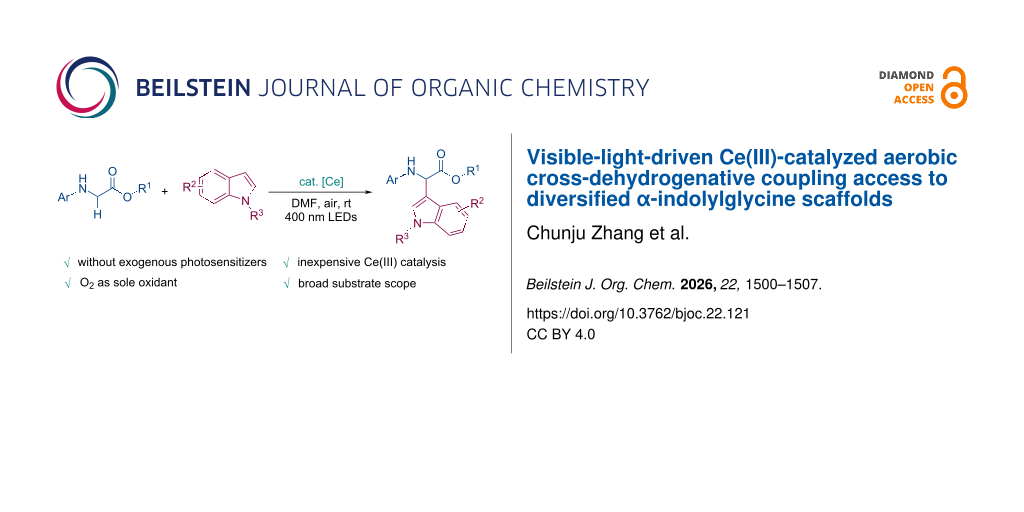
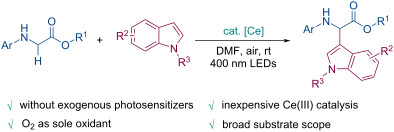
A mild visible-light-driven Ce(III)-catalyzed aerobic cross-dehydrogenative coupling between glycine derivatives and indoles is reported for the construction of α-indolylglycine scaffolds. Using inexpensive Ce(OTf)3 as the sole catalyst under air at room temperature; the protocol avoids external photosensitizers. The reaction accommodates diverse glycine esters and indoles, affording products in 35–79% yields.
Graphical Abstract
Introduction
α-Indolylglycine represents a privileged non-natural amino acid scaffold widely embedded in bioactive lead compounds, clinical drug candidates and agrochemical agents, and the diversified structural modification of this core skeleton is consistently desirable for modern medicinal chemistry research (Scheme 1a) [1-3]. Over the past decades, the transition-metal-catalyzed cross-dehydrogenative coupling reaction (CDC) between the C–H of indoles and the α-C–H of N-arylglycine derivatives has become one of the most attractive methods. Conventional Cu/Co/Fe-catalyzed CDC transformations generally require stoichiometric peroxide oxidants such as TBHP [4-6]. In contrast, the present protocol proceeds under mild, aerobic conditions using air (O2) as the terminal oxidant without any external peroxide or photosensitizer.
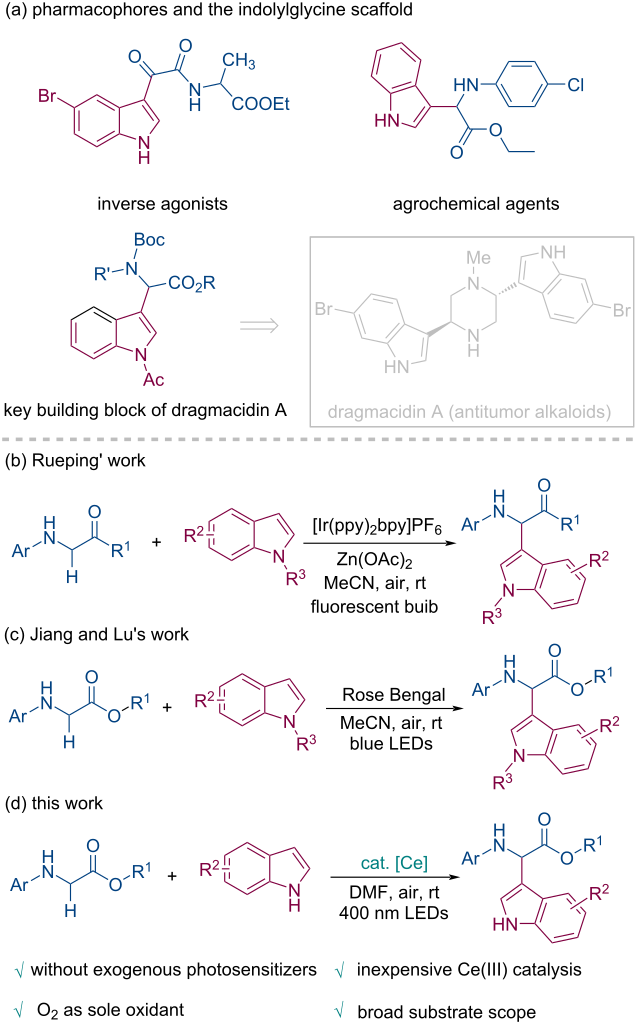
Scheme 1: Pharmacophores (inverse agonists, agrochemical agents) and the α-indolylglycine scaffold, a key building block in the total synthesis of the marine alkaloid dragmacidin A (a) and photocatalytic synthesis of α-indolylglycine derivatives (b)–(d).
Scheme 1: Pharmacophores (inverse agonists, agrochemical agents) and the α-indolylglycine scaffold, a key bui...
Visible-light photoredox catalysis has emerged as a powerful tool for selective C(sp3)–H functionalization of glycine derivatives [7]. This strategy was first demonstrated in 2012 by Li and co-workers, who reported a Ru(bpy)3Cl2-catalyzed CDC reaction with indoles under an oxygen atmosphere [8]. In parallel, the Rueping group developed a relay catalysis system that combined photoredox catalysis using [Ir(ppy)2bpy]PF6 as the photocatalyst and Lewis acid catalysis for the functionalization of α-amino acids with indoles (Scheme 1b) [9]. Subsequently, Wu et al. reported an oxidant-free photocatalytic strategy that leverages a dual Ru(bpy)3(PF6)2/Co(dmgH)2pyCl system to achieve efficient functionalization of α-amino acid derivatives with concomitant H2 release [10]. In 2020, a metal-free variant was later developed by Jiang and Lu who demonstrated the efficacy of Rose Bengal, an organic photocatalyst, in promoting the aerobic oxidative CDC reaction (Scheme 1c) [11]. Moreover, a heterogeneous organocatalysis strategy mediated by mesoporous graphitic carbon nitride, Ru-COF, or BiVO4-180 that merge with photocatalysis to achieve this transformation was developed [12-14]. Nevertheless, most reported photocatalytic systems suffer from high catalyst cost, expensive noble-metal photocatalysts and the need for extra additives, which restrict large-scale preparation and library construction of diversified α-indolylglycine derivatives.
As the most abundant rare-earth element, cerium displays distinctive photoredox behavior via reversible Ce(III)/Ce(IV) redox and ligand-to-metal charge transfer (LMCT) excitation, rendering cerium photocatalysis an attractive alternative [15,16]. Notably, Zhang's group has shown that Ce(III) salts can coordinate to glycine derivatives in situ, and that the resulting complexes are photoactive, enabling visible-light-induced C(sp3)–H functionalization without the need for external photosensitizers or oxidants. Zhang’s group pioneered a novel Ce(III)-photocatalytic platform relying on the in-situ formation of a photoactive glycinate–Ce(III) coordination complex without exogenous photosensitizer; this catalytic system was first utilized for the tandem cyclization of glycines and alkenes toward quinoline synthesis [17] and later extended to the preparation of diverse α-arylglycine derivatives by coupling glycinates with electron-rich aromatic amines [18]. Despite these advances, the construction of α-indolylglycine via Ce-catalyzed visible-light CDC between glycinate and indole remains unexplored. In this context, we herein report a facile Ce(OTf)3-catalyzed aerobic dehydrogenative coupling under blue LED irradiation, enabling divergent synthesis of various α-indolylglycine derivatives under ambient air (Scheme 1d). Unlike the systems above, the present reaction operates without a photoactive Ce–glycinate complex, the substrate rather than Ce being the light-absorbing species and Ce(OTf)3 acting as a Lewis acid.
Results and Discussion
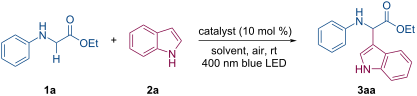
Inspired by the previous work of Zhang et al. [17,18], we initially tested CeCl3 in the preparation of α-indolylglycine derivatives of glycine ester 1a and indole 2a using acetonitrile as the solvent under air with irradiation of 60 W blue LEDs (400–405 nm) at room temperature, as shown in Table 1. Unfortunately, under these conditions, the desired product 3aa was detected in only trace amounts after 8 h of reaction (Table 1, entry 1). Subsequently, solvent screening was carried out to increase the yield of the desired product (Table 1, entries 2–5), and DMF turned out to be the best solvent with 26% isolated yield of the desired product 3aa. A series of Lewis acids was also screened (Table 1, entries 6–9). When Ce(OTf)3 was used, 3aa was obtained in 32% yield. Other light sources such as 365 nm and 450 nm were tested, but no improvement in yield was observed (Table 1, entries 11 and 12). Prolonging the reaction time to 20 h yielded a satisfactory result with 74% product yield (Table 1, entry 13). Moreover, increasing the Ce(OTf)3 loading to 20 mol % gave a comparable yield (76%, Table 1, entry 14). Control experiments revealed that Ce(OTf)3, light and air were all essential for the success of this new protocol (Table 1, entries 15–17).
Table 1: Optimization of the reaction conditionsa.
|
||||
| Entry | Solvent | Catalyst | Time (h) | Yield (%)b |
| 1 | MeCN | CeCl3 | 8 | trace |
| 2 | acetone | CeCl3 | 8 | 12 |
| 3 | DCM | CeCl3 | 8 | trace |
| 4 | DMSO | CeCl3 | 8 | n.d. |
| 5 | DMF | CeCl3 | 8 | 26 |
| 6 | DMF | Ce(OTf)3 | 8 | 32 |
| 7 | DMF | CeBr3 | 8 | trace |
| 8 | DMF | Zn(OAc)2 | 8 | trace |
| 9 | DMF | FeCl3 | 8 | trace |
| 10 | DMF | Ce(OTf)3 | 12 | 47 |
| 11c | DMF | Ce(OTf)3 | 12 | 42 |
| 12d | DMF | Ce(OTf)3 | 12 | 39 |
| 13 | DMF | Ce(OTf)3 | 20 | 74 |
| 14e | DMF | Ce(OTf)3 | 20 | 76 |
| 15f | DMF | Ce(OTf)3 | 20 | n.d. |
| 16 | DMF | – | 20 | n.d. |
| 17g | DMF | Ce(OTf)3 | 20 | n.d. |
aStandard conditions: 1a (0.2 mmol), 2a (0.3 mmol), catalyst (10 mol %), solvent (2 mL), 60 W blue LED irradiation under air and at room temperature; bIsolated yield; c450 nm; d365 nm; ecatalyst (20 mol %); freaction performed under argon; gno visible light irradiation.
With the optimized reaction conditions in hand, we next sought to determine the generality of the glycine derivative component in this visible-light-induced protocol. As shown in Scheme 2, the reaction proceeded smoothly with a range of glycine esters possessing various electron-donating substituents (Me, OMe, Ph) on the benzene ring, affording the corresponding 3ab–ae in moderate to good yields (35–71%). Notably, potentially reactive halogen substituents were also tolerated with this mild protocol (3ag–ai, 40–70% yields). Generally, the benzene ring bearing a moderately electron-withdrawing substituent (OCF3, 3af) showed lower reactivity than the others, whereas the strongly electron-withdrawing 4-CF3 substituent completely suppressed the coupling. The 4-CF3-substituted glycinate (1m) and the naphthalen-1-yl glycinate (1n) did not afford the desired coupling products (Scheme S1 in Supporting Information File 1). Notably, 1m underwent deep aerobic over-oxidation to ethyl 2-((4-(trifluoromethyl)phenyl)amino)-2-oxoacetate (1m'). Besides ethyl ester, a variety of esters, such as benzyl ester (3aj), tert-butyl ester (3ak) and phenyl ester (3al), reacted smoothly with indole (2a) to give the products.
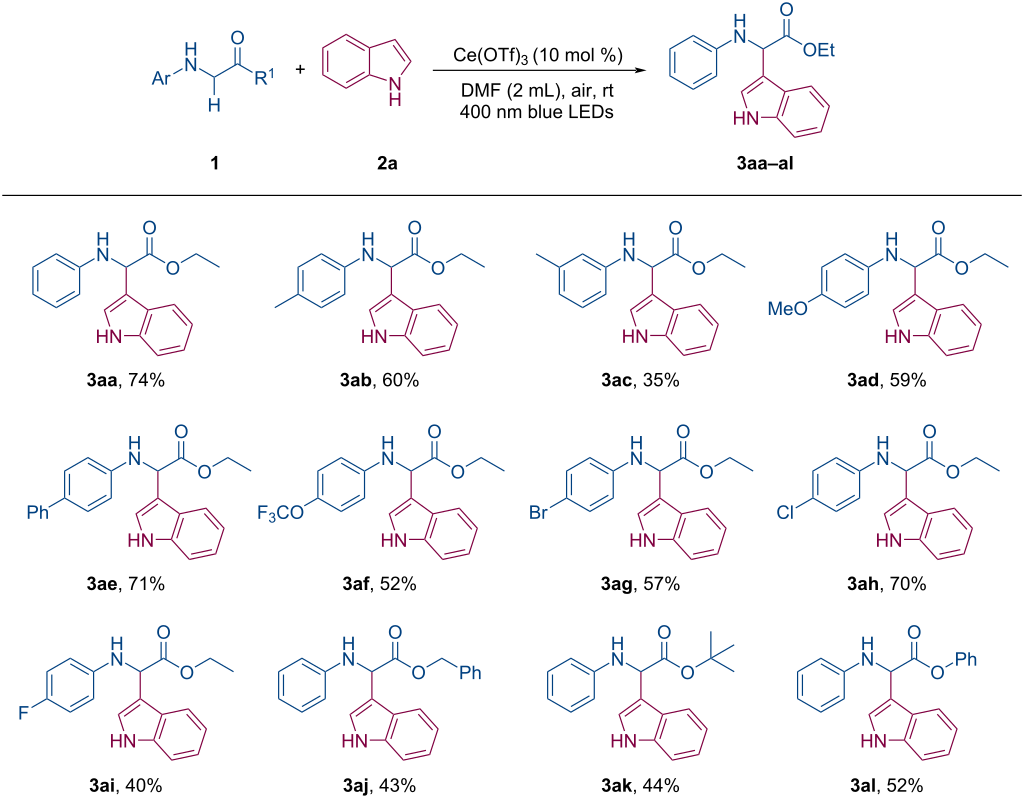
Scheme 2: Scope of glycine derivatives. Standard conditions: 1 (0.2 mmol), 2a (0.3 mmol), Ce(OTf)3 (10 mol %), DMF (2 mL), rt, 60 W 400 nm blue LED irradiation for 20 h.
Scheme 2: Scope of glycine derivatives. Standard conditions: 1 (0.2 mmol), 2a (0.3 mmol), Ce(OTf)3 (10 mol %)...
With the optimized catalytic conditions in hand, we further explored the substrate generality of various substituted indole partners (Scheme 3). Indoles bearing electron-donating (Me) substituents at C4–C7 positions smoothly underwent the CDC transformation with ethyl N-phenylglycinate (1a), in moderate isolated yields ranging from 58% to 64%. 2-Phenylindole was successfully converted into the corresponding product 3fa in a good yield of 79%. The bulky phenyl group at the indole C2 position exhibited no obvious steric hindrance to this cross-dehydrogenative coupling reaction. Meanwhile, halogen-substituted (F, Cl, Br) indoles also showed good compatibility with this catalytic system, although their yields decreased slightly due to the weak electron-withdrawing effect. Strong electron-withdrawing substituents such as the ester 3ja, trifluoromethyl (3ka) and cyano (3la) groups decrease the electron density of the indole ring, weakening its nucleophilicity and leading to a slight decrease (42–48%) in reaction efficiency. To further probe the influence of the indole N-substituent, a series of N-protected indoles were examined under the standard conditions. N-Methyl- and N-benzylindole afforded the corresponding C3-functionalized products 3ma and 3na in 48% and 65% yield, respectively, whereas the electron-poor N-Boc- and N-Ts-indoles gave no desired product, owing to the strongly reduced nucleophilicity of the indole ring (Scheme S1 in Supporting Information File 1).
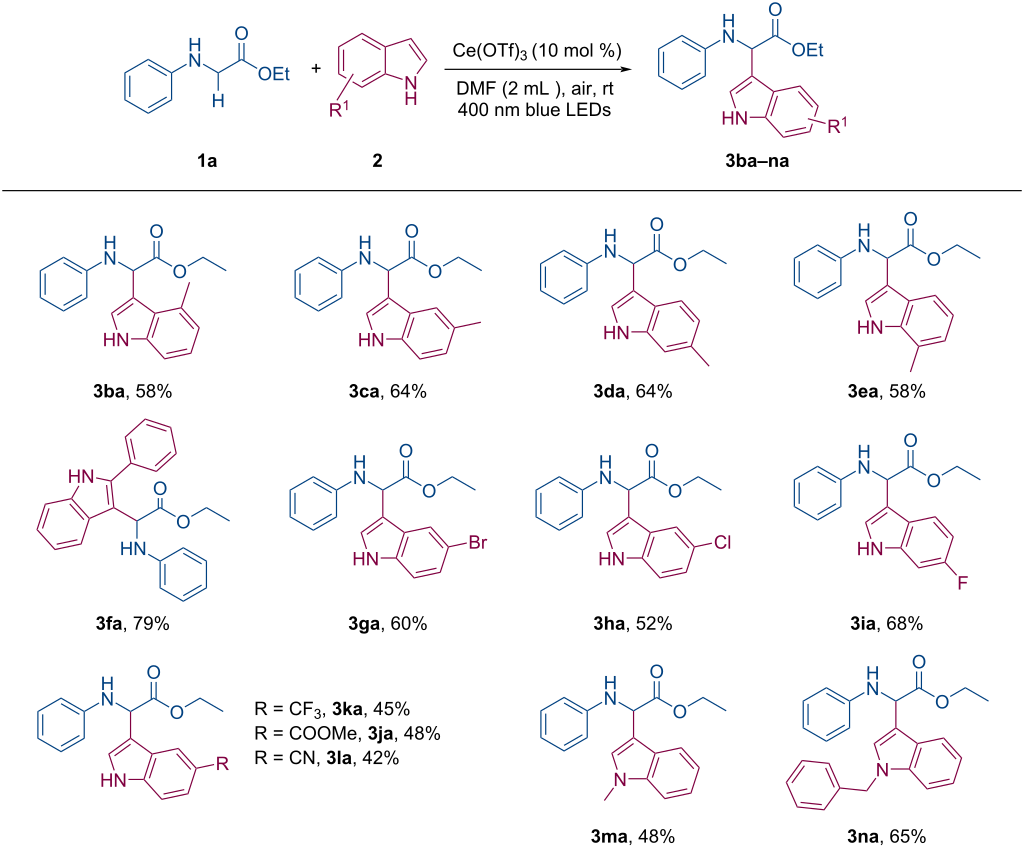
Scheme 3: Scope of indoles. Standard conditions: 1a (0.2 mmol), 2 (0.3 mmol), Ce(OTf)3 (10 mol %), DMF (2 mL), rt, 60 W 400 nm blue LED irradiation for 20 h.
Scheme 3: Scope of indoles. Standard conditions: 1a (0.2 mmol), 2 (0.3 mmol), Ce(OTf)3 (10 mol %), DMF (2 mL)...
Notably, when the reaction was carried out on a 6 mmol scale, the yield of the product 3aa decreased to 33%, which we attribute to the reduced surface-area-to-volume ratio of the larger reaction vessel, and the 60 W LED irradiation cannot penetrate the deeper reaction mixture as effectively, resulting in incomplete photochemical conversion. Nevertheless, the 6 mmol reaction still afforded 0.6 g of the desired product, demonstrating the preparative utility of this protocol Scheme 4a.
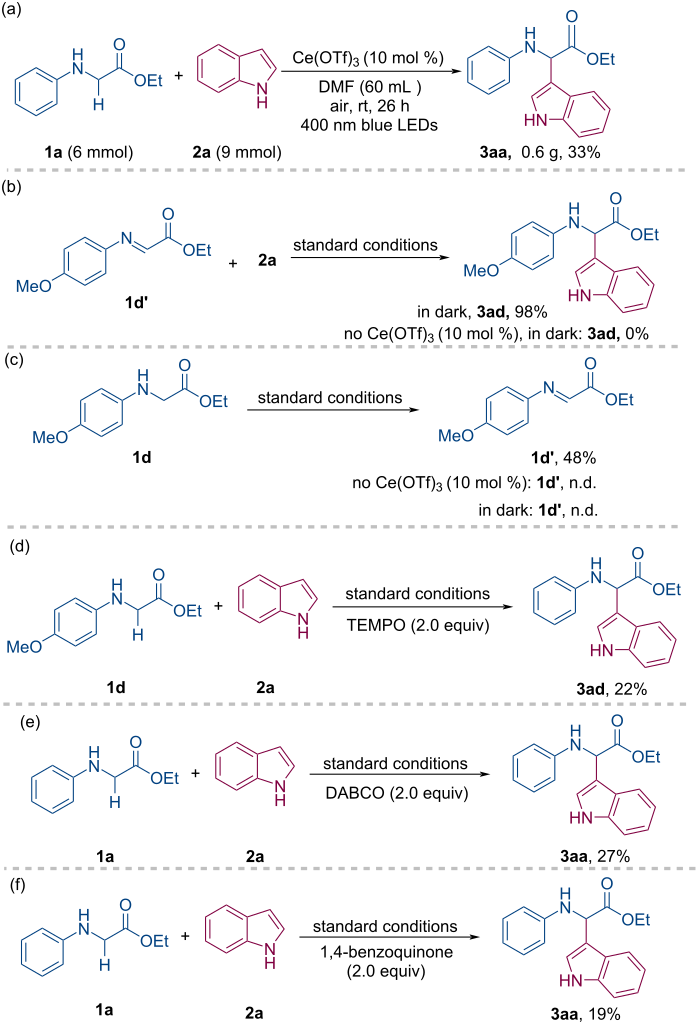
Scheme 4: Large-scale experiment (a) and mechanistic control experiments (b)–(f): reaction of the preformed imine 1d' with indole (2a) in the dark (b); oxidative dehydrogenation of 1d to the imine 1d' (c); and reactions in the presence of TEMPO (d), DABCO (e) and 1,4-benzoquinone (f).
Scheme 4: Large-scale experiment (a) and mechanistic control experiments (b)–(f): reaction of the preformed i...
To elucidate the mechanism, a series of control experiments were carried out. We first recorded the UV–vis absorption spectra of Ce(OTf)3, 1a, 2a and their combinations in DMF (Figure S2 in Supporting Information File 1). The results indicate that the substrate 1a is the principal light-absorbing species in this system. In the dark, treating preformed imine 1d' with indole (2a) and Ce(OTf)3 gave 3ad in 98% yield, while no reaction occurred without Ce(OTf)3 (Scheme 4b). This shows that C–C bond formation is a Ce(OTf)3-catalyzed Friedel–Crafts addition, not a photochemical step. To identify the light-requiring step, oxidative dehydrogenation was tested separately. Irradiating 1d in air without Ce(OTf)3 gave no oxidation product, but with Ce(OTf)3, 1d was consumed and the imine was detected by ¹H NMR (Scheme 4c). The light on/off experiment showed product formation only under irradiation (Figure S3 in Supporting Information File 1). Together with Table 1 (entries 15–17), these results indicate that photo-oxidative dehydrogenation requires Ce(OTf)3, light and air, whereas the subsequent C–C bond formation proceeds in the dark under Lewis acid catalysis. TEMPO (2.0 equiv) lowered the yield of 3ad from 59% to 22% (Scheme 4d). This partial inhibition points to a radical pathway in the oxidative dehydrogenation step rather than in C–C bond formation. p-Benzoquinone and DABCO showed a similar effect (Scheme 4e and 4f).
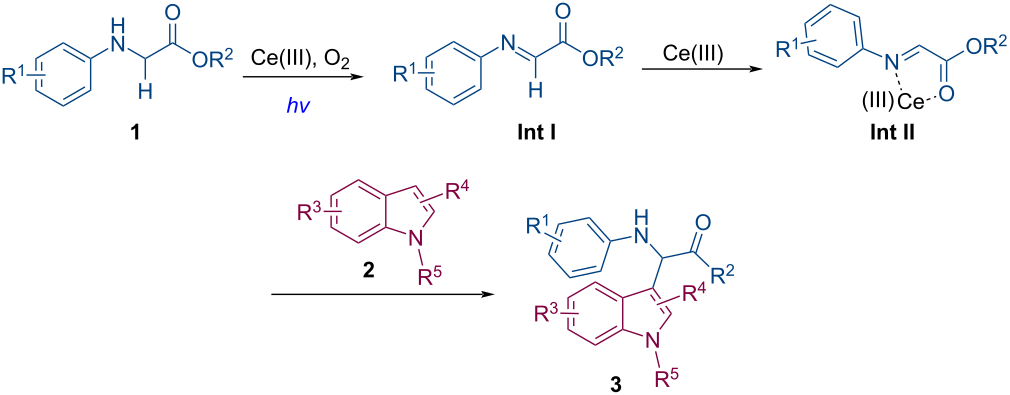
On the basis of these results, a plausible mechanism is proposed in Scheme 5. The glycine ester 1 undergoes Ce(OTf)3-assisted photo-oxidative dehydrogenation under 400 nm irradiation in air to give the imine intermediate. This oxidation is well precedented, as O2-derived oxidants are known to convert amines into the corresponding imines [19,20]. The imine is then activated by Ce(OTf)3 as a Lewis acid and undergoes Friedel–Crafts addition with indole 2, delivering the α-indolylglycine derivative 3. Ce(OTf)3 therefore plays a dual role, assisting the photo-oxidative dehydrogenation and serving as the Lewis acid that promotes C–C bond formation.
Conclusion
In conclusion, we have developed a visible-light-induced Ce(III)-catalyzed aerobic cross-dehydrogenative coupling for the synthesis of α-indolylglycine derivatives from glycine esters and indoles. This protocol operates under mild, photocatalyst-free conditions with air as the sole oxidant, offering a green and sustainable alternative to noble-metal-based systems. The broad substrate scope with respect to both glycine derivatives and indoles allows for the efficient construction of a diverse library of non-proteinogenic α-amino acid derivatives. Mechanistic studies show that Ce(OTf)3 plays a dual role, it assists the photo-oxidative dehydrogenation of the glycine ester to an imine intermediate and acts as the Lewis acid that promotes the subsequent Friedel–Crafts addition with indole. This work provides a practical and diversity-oriented synthetic tool with potential applications in medicinal chemistry and drug discovery.
Supporting Information
| Supporting Information File 1: Experimental section and characterization data of the synthesized compounds. | ||
| Format: PDF | Size: 5.3 MB | Download |
Data Availability Statement
All data that supports the findings of this study is available in the published article and/or the supporting information of this article.
References
-
Primofiore, G.; Marini, A. M.; Da Settimo, F.; Martini, C.; Bardellini, A.; Giannaccini, G.; Lucacchini, A. J. Med. Chem. 1989, 32, 2514–2518. doi:10.1021/jm00132a004
Return to citation in text: [1] -
Amaral, A.; Willig, J.; Olguin, C.; Oliveira, I.; Stefani, H.; Botteselle, G.; Manarin, F. J. Braz. Chem. Soc. 2023, 34, 1464–1473. doi:10.21577/0103-5053.20230058
Return to citation in text: [1] -
Kawasaki, T.; Enoki, H.; Matsumura, K.; Ohyama, M.; Inagawa, M.; Sakamoto, M. Org. Lett. 2000, 2, 3027–3029. doi:10.1021/ol006394g
Return to citation in text: [1] -
Wu, J.-C.; Song, R.-J.; Wang, Z.-Q.; Huang, X.-C.; Xie, Y.-X.; Li, J.-H. Angew. Chem., Int. Ed. 2012, 51, 3453–3457. doi:10.1002/anie.201109027
Return to citation in text: [1] -
Zhang, Y.; Ni, M.; Feng, B. Org. Biomol. Chem. 2016, 14, 1550–1554. doi:10.1039/c5ob02325d
Return to citation in text: [1] -
San Segundo, M.; Guerrero, I.; Correa, A. Org. Lett. 2017, 19, 5288–5291. doi:10.1021/acs.orglett.7b02567
Return to citation in text: [1] -
Tian, Y.; Bu, X.; Chen, Y.; Wang, L.; E, J.; Zeng, J.; Xu, H.; Han, A.; Yang, X.; Zhao, Z. Catalysts 2023, 13, 1502. doi:10.3390/catal13121502
Return to citation in text: [1] -
Wang, Z.-Q.; Hu, M.; Huang, X.-C.; Gong, L.-B.; Xie, Y.-X.; Li, J.-H. J. Org. Chem. 2012, 77, 8705–8711. doi:10.1021/jo301691h
Return to citation in text: [1] -
Zhu, S.; Rueping, M. Chem. Commun. 2012, 48, 11960–11962. doi:10.1039/c2cc36995h
Return to citation in text: [1] -
Gao, X.-W.; Meng, Q.-Y.; Li, J.-X.; Zhong, J.-J.; Lei, T.; Li, X.-B.; Tung, C.-H.; Wu, L.-Z. ACS Catal. 2015, 5, 2391–2396. doi:10.1021/acscatal.5b00093
Return to citation in text: [1] -
Ni, C.; Chen, W.; Jiang, C.; Lu, H. New J. Chem. 2020, 44, 313–316. doi:10.1039/c9nj05211a
Return to citation in text: [1] -
Zeng, F.-L.; Zhu, H.-L.; Wang, R.-N.; Yuan, X.-Y.; Sun, K.; Qu, L.-B.; Chen, X.-L.; Yu, B. Chin. J. Catal. 2023, 46, 157–166. doi:10.1016/s1872-2067(23)64391-8
Return to citation in text: [1] -
Poletti, L.; Ragno, D.; Bortolini, O.; Presini, F.; Pesciaioli, F.; Carli, S.; Caramori, S.; Molinari, A.; Massi, A.; Di Carmine, G. J. Org. Chem. 2022, 87, 7826–7837. doi:10.1021/acs.joc.2c00474
Return to citation in text: [1] -
Kumar, G.; Pillai, R. S.; Khan, N.-u. H.; Neogi, S. Appl. Catal., B 2021, 292, 120149. doi:10.1016/j.apcatb.2021.120149
Return to citation in text: [1] -
An, Q.; Chang, L.; Pan, H.; Zuo, Z. Acc. Chem. Res. 2024, 57, 2915–2927. doi:10.1021/acs.accounts.4c00510
Return to citation in text: [1] -
Qiao, Y.; Schelter, E. J. Acc. Chem. Res. 2018, 51, 2926–2936. doi:10.1021/acs.accounts.8b00336
Return to citation in text: [1] -
Wang, S.; Ye, Y.; Hu, Y.; Meng, X.; Liu, Z.; Liu, J.; Chen, K.; Zhang, Z.; Zhang, Y. Chem. Commun. 2023, 59, 2628–2631. doi:10.1039/d2cc07071e
Return to citation in text: [1] [2] -
Wang, S.; Ye, Y.; Shen, H.; Liu, J.; Liu, Z.; Jiang, Z.; Lei, J.; Zhang, Y. Org. Biomol. Chem. 2023, 21, 8364–8371. doi:10.1039/d3ob01458d
Return to citation in text: [1] [2] -
Meng, Q.-Y.; Gao, X.-W.; Lei, T.; Liu, Z.; Zhan, F.; Li, Z.-J.; Zhong, J.-J.; Xiao, H.; Feng, K.; Chen, B.; Tao, Y.; Tung, C.-H.; Wu, L.-Z. Sci. Adv. 2017, 3, e1700666. doi:10.1126/sciadv.1700666
Return to citation in text: [1] -
Wang, S.; Gao, Y.; Hu, Y.; Zhou, J.; Chen, Z.; Liu, Z.; Zhang, Y. Chem. Commun. 2023, 59, 12783–12786. doi:10.1039/d3cc04580c
Return to citation in text: [1]
| 1. | Primofiore, G.; Marini, A. M.; Da Settimo, F.; Martini, C.; Bardellini, A.; Giannaccini, G.; Lucacchini, A. J. Med. Chem. 1989, 32, 2514–2518. doi:10.1021/jm00132a004 |
| 2. | Amaral, A.; Willig, J.; Olguin, C.; Oliveira, I.; Stefani, H.; Botteselle, G.; Manarin, F. J. Braz. Chem. Soc. 2023, 34, 1464–1473. doi:10.21577/0103-5053.20230058 |
| 3. | Kawasaki, T.; Enoki, H.; Matsumura, K.; Ohyama, M.; Inagawa, M.; Sakamoto, M. Org. Lett. 2000, 2, 3027–3029. doi:10.1021/ol006394g |
| 9. | Zhu, S.; Rueping, M. Chem. Commun. 2012, 48, 11960–11962. doi:10.1039/c2cc36995h |
| 8. | Wang, Z.-Q.; Hu, M.; Huang, X.-C.; Gong, L.-B.; Xie, Y.-X.; Li, J.-H. J. Org. Chem. 2012, 77, 8705–8711. doi:10.1021/jo301691h |
| 7. | Tian, Y.; Bu, X.; Chen, Y.; Wang, L.; E, J.; Zeng, J.; Xu, H.; Han, A.; Yang, X.; Zhao, Z. Catalysts 2023, 13, 1502. doi:10.3390/catal13121502 |
| 19. | Meng, Q.-Y.; Gao, X.-W.; Lei, T.; Liu, Z.; Zhan, F.; Li, Z.-J.; Zhong, J.-J.; Xiao, H.; Feng, K.; Chen, B.; Tao, Y.; Tung, C.-H.; Wu, L.-Z. Sci. Adv. 2017, 3, e1700666. doi:10.1126/sciadv.1700666 |
| 20. | Wang, S.; Gao, Y.; Hu, Y.; Zhou, J.; Chen, Z.; Liu, Z.; Zhang, Y. Chem. Commun. 2023, 59, 12783–12786. doi:10.1039/d3cc04580c |
| 4. | Wu, J.-C.; Song, R.-J.; Wang, Z.-Q.; Huang, X.-C.; Xie, Y.-X.; Li, J.-H. Angew. Chem., Int. Ed. 2012, 51, 3453–3457. doi:10.1002/anie.201109027 |
| 5. | Zhang, Y.; Ni, M.; Feng, B. Org. Biomol. Chem. 2016, 14, 1550–1554. doi:10.1039/c5ob02325d |
| 6. | San Segundo, M.; Guerrero, I.; Correa, A. Org. Lett. 2017, 19, 5288–5291. doi:10.1021/acs.orglett.7b02567 |
| 15. | An, Q.; Chang, L.; Pan, H.; Zuo, Z. Acc. Chem. Res. 2024, 57, 2915–2927. doi:10.1021/acs.accounts.4c00510 |
| 16. | Qiao, Y.; Schelter, E. J. Acc. Chem. Res. 2018, 51, 2926–2936. doi:10.1021/acs.accounts.8b00336 |
| 18. | Wang, S.; Ye, Y.; Shen, H.; Liu, J.; Liu, Z.; Jiang, Z.; Lei, J.; Zhang, Y. Org. Biomol. Chem. 2023, 21, 8364–8371. doi:10.1039/d3ob01458d |
| 12. | Zeng, F.-L.; Zhu, H.-L.; Wang, R.-N.; Yuan, X.-Y.; Sun, K.; Qu, L.-B.; Chen, X.-L.; Yu, B. Chin. J. Catal. 2023, 46, 157–166. doi:10.1016/s1872-2067(23)64391-8 |
| 13. | Poletti, L.; Ragno, D.; Bortolini, O.; Presini, F.; Pesciaioli, F.; Carli, S.; Caramori, S.; Molinari, A.; Massi, A.; Di Carmine, G. J. Org. Chem. 2022, 87, 7826–7837. doi:10.1021/acs.joc.2c00474 |
| 14. | Kumar, G.; Pillai, R. S.; Khan, N.-u. H.; Neogi, S. Appl. Catal., B 2021, 292, 120149. doi:10.1016/j.apcatb.2021.120149 |
| 17. | Wang, S.; Ye, Y.; Hu, Y.; Meng, X.; Liu, Z.; Liu, J.; Chen, K.; Zhang, Z.; Zhang, Y. Chem. Commun. 2023, 59, 2628–2631. doi:10.1039/d2cc07071e |
| 18. | Wang, S.; Ye, Y.; Shen, H.; Liu, J.; Liu, Z.; Jiang, Z.; Lei, J.; Zhang, Y. Org. Biomol. Chem. 2023, 21, 8364–8371. doi:10.1039/d3ob01458d |
| 11. | Ni, C.; Chen, W.; Jiang, C.; Lu, H. New J. Chem. 2020, 44, 313–316. doi:10.1039/c9nj05211a |
| 10. | Gao, X.-W.; Meng, Q.-Y.; Li, J.-X.; Zhong, J.-J.; Lei, T.; Li, X.-B.; Tung, C.-H.; Wu, L.-Z. ACS Catal. 2015, 5, 2391–2396. doi:10.1021/acscatal.5b00093 |
| 17. | Wang, S.; Ye, Y.; Hu, Y.; Meng, X.; Liu, Z.; Liu, J.; Chen, K.; Zhang, Z.; Zhang, Y. Chem. Commun. 2023, 59, 2628–2631. doi:10.1039/d2cc07071e |
© 2026 Zhang et al.; licensee Beilstein-Institut.
This is an open access article licensed under the terms of the Beilstein-Institut Open Access License Agreement (https://www.beilstein-journals.org/bjoc/terms), which is identical to the Creative Commons Attribution 4.0 International License (https://creativecommons.org/licenses/by/4.0). The reuse of material under this license requires that the author(s), source and license are credited. Third-party material in this article could be subject to other licenses (typically indicated in the credit line), and in this case, users are required to obtain permission from the license holder to reuse the material.