


Abstract
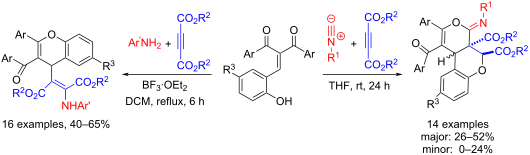
The three-component reaction of alkyl isocyanides, dialkyl but-2-ynedioates and 2-(2-hydroxybenzylidene)-1,3-diarylpropane-1,3-diones afforded diastereomeric pyrano[3,4-c]chromenes with major diastereomers in 26–52% yields and minor diastereomers in less than 24% yields. On the other hand, the three-component reaction of alkyl isocyanides, dialkyl but-2-ynedioates and with 2-(2-N-tosylaminobenzylidene)-1,3-indanediones gave tetrahydroindeno[2’,1’:5,6]pyrano[3,4-c]quinolines in moderate to good yields. In addition, the domino reaction of arylamines, dialkyl but-2-ynedioates and 2-(2-hydroxybenzylidene)-1,3-diarylpropane-1,3-diones afforded functionalized chromenes in satisfactory yields. Therefore, a convenient synthetic method for diverse functionalized chromenes was successfully developed by three-component reaction of alkyl isocyanides, dialkyl but-2-ynedioates and various α,β-unsaturated diketones.
Graphical Abstract
Introduction
Alkyl isocyanides are very special functionalized compounds with high reactivity to both electrophilic and nucleophilic reagents . Therefore, alkyl isocyanides are one of the most important and frequently used synthons for the efficient synthesis of various N-containing acyclic and heterocyclic compounds . Furthermore, alkyl isocyanides have high compatibility with versatile electrophilic and nucleophilic reagents, which enabled them to be key substrates in multicomponent and domino reactions . In the past years, many isocyanide-based multicomponent reactions have been successfully developed . It was well-known that the Passerini reaction, Ugi reaction, Orru reaction and van Leusen reaction with alkyl isocyanides as key substrates have become famous multicomponent reactions and have become the most powerful tools for rapid construction of various nitrogen-containing compounds . In recent years, the multicomponent reactions based on employing both alkyl isocyanides and electron-deficient alkynes as key substrates have attracted widespread interests . In these multicomponent reactions, the initially nucleophilic addition of alkyl or aryl isocyanides to electron-deficient alkynes generated in situ a 1,4-dipolar intermediate, which in turn was trapped by various reagents to give diverse acyclic or cyclic compounds . In recent years, we have concentrated on the developing multicomponent reactions based on employing isocyanides and electron-deficient alkynes as key substrates. Several multicomponent reactions were successfully provided for efficient synthetic protocols for diverse polycyclic O,N-containing heterocyclic compounds . For example, a three-component reaction of alkyl isocyanides, dialkyl but-2-ynedioates and 3-methyleneindolin-2-ones in refluxing toluene allowed the convenient formation of spiro[cyclopentane-1,3'-indolines] in satisfactory yields (Scheme 1, reaction 1) . When 3-(o-hydroxyarylidene)indolin-2-ones were used in the above three-component reactions, polycyclic spiro[cyclobuta[c]chromene-1,3'-indolines] were obtained in good isolated yields with high diastereoselectivities (Scheme 1, reaction 2) . When 3-(o-hydroxyphenacylidene)indolin-2-ones were employed in the reaction, spiro[benzofuran-3,2'-furans] were produced in good yields with high diastereoselectivities . In addition, the three-component reaction of alkyl isocyanides, dialkyl but-2-ynedioates and 2-arylidene-1,3-indanediones in ethanol under refluxing conditions allows the formation of functionalized cyclopenta[b]naphthalenes (Scheme 1, reaction 3) .
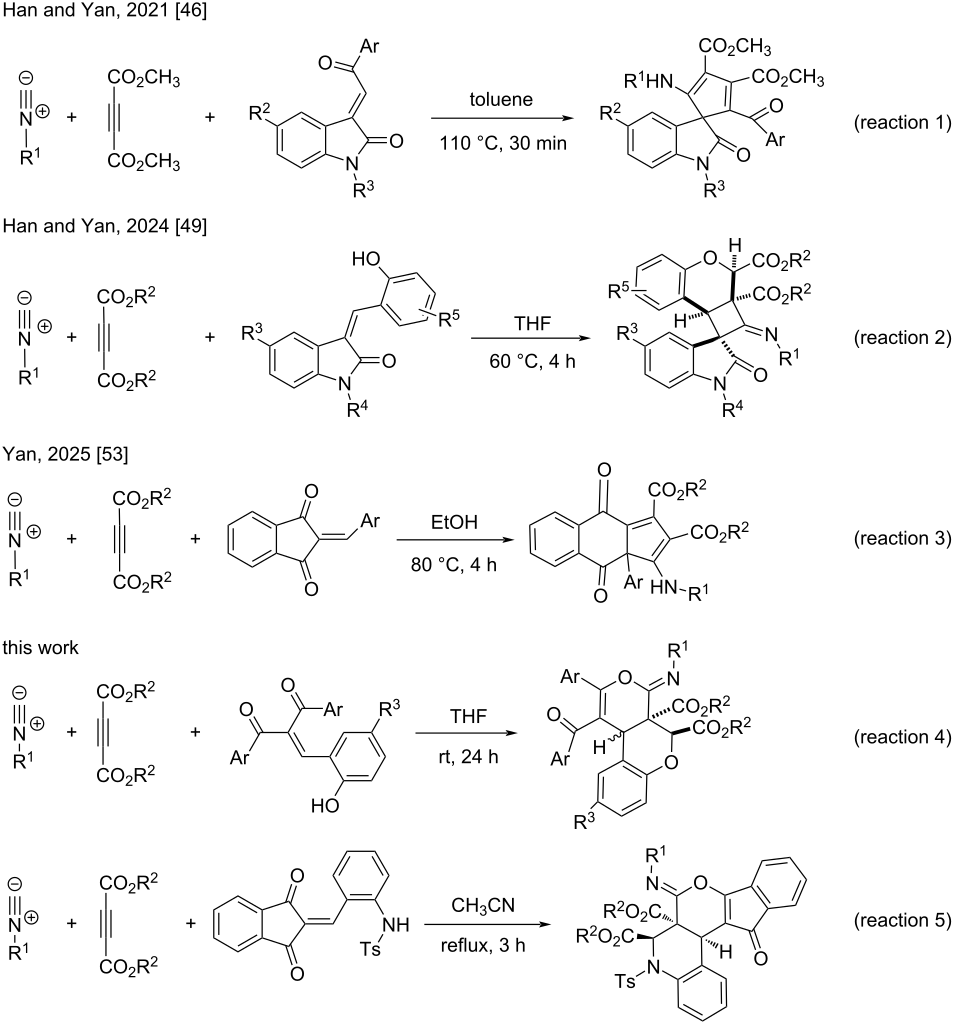
Scheme 1: Representative multicomponent reactions based on isocyanides and but-2-ynedioates.
Scheme 1: Representative multicomponent reactions based on isocyanides and but-2-ynedioates.
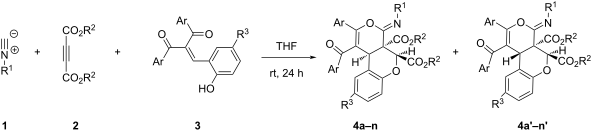
In continuation of our program on the development of convenient multicomponent reactions with isocyanides and electron-deficient alkynes for the construction of diverse heterocyclic compounds , herein, we wish to report three-component reactions of alkyl isocyanides, dialkyl but-2-ynedioates and 2-(2-hydroxybenzylidene)-1,3-diarylpropane-1,3-diones or 2-(2-N-tosylaminobenzylidene)-1,3-indanediones for the convenient syntheses of functionalized pyrano[3,4-c]chromenes (Scheme 1, reaction 4) and tetrahydroindeno[2’,1’:5,6]pyrano[3,4-c]quinolines (Scheme 1, reaction 5).
Results and Discussion
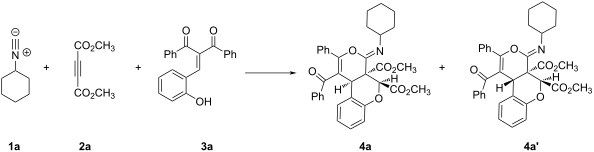
Initially, the reaction conditions were examined by using cyclohexyl isocyanide (1a), dimethyl but-2-ynedioate (2a) and 2-(2-hydroxybenzylidene)-1,3-diphenylpropane-1,3-dione (3a) as standard on the basis of our previously reported reactions . The main results are summarized in Table 1. The three-component reaction in different solvents such as dichloromethane (DCM), acetonitrile (MeCN) and dichloroethane (DCE) at room temperature for 24 hours resulted in a mixture of the diastereomeric products 4a and 4a’ in very low yields (Table 1, entries 1–3). However, the reaction in tetrahydrofuran (THF) at room temperature for 24 hours gave the product 4a in 52% yield as major product and the product 4a’ in 12% yield as minor product (Table 1, entry 4). On the other hand, no reaction was observed in methanol (Table 1, entry 5). The structural analysis indicated that two products 4a and 4a’ are belonging to two diastereomers. Then, the reaction in different solvents at elevated temperatures also afforded the two products 4a and 4a’ in low yields (Table 1, entries 6–11). On the other hand, the three-component reaction was completely inhibited when some organic bases such as DABCO (1,4-diazabicyclo[2.2.2]octane) or DMAP (N,N-dimethylpyridin-4-amine) were introduced in the reaction (Table 1, entries 12 and 13). In addition, if less amount of dimethyl but-2-ynedioate (2a) was used, the yield of the product 4a decreased to 42%, while the product 4a’ was obtained in 10% yield (Table 1, entry 14). Then, reaction time and temperature were also tested, which did not give good results (Table 1, entries 15–17). Therefore, the optimized reaction for the three-component reaction was successfully established at mild reaction conditions.
|
|||||||
| entry |
ratio of
1a/2a/3a |
solvent | base | T (°C) | time (h) |
4a
yield (%)b |
4a’
yield (%)b |
|---|---|---|---|---|---|---|---|
| 1 | 1:2:1 | DCM | – | rt | 24 | 22 | 13 |
| 2 | 1:2:1 | CH3CN | – | rt | 24 | 11 | 18 |
| 3 | 1:2:1 | DCE | – | rt | 24 | 27 | 21 |
| 4 | 1:2:1 | THF | – | rt | 24 | 52 | 12 |
| 5 | 1:2:1 | CH3OH | – | rt | 24 | – | – |
| 6 | 1:2:1 | DCM | – | reflux | 24 | 32 | 10 |
| 7 | 1:2:1 | CH3CN | – | reflux | 24 | 24 | 15 |
| 9 | 1:2:1 | DCE | – | reflux | 24 | 28 | 12 |
| 10 | 1:2:1 | THF | – | reflux | 24 | 38 | – |
| 11 | 1:2:1 | CH3OH | – | reflux | 24 | – | – |
| 12 | 1:2:1 | THF | DABCO | rt | 24 | – | – |
| 13 | 1:2:1 | THF | DMAP | rt | 24 | – | – |
| 14 | 1:1.5:1 | THF | – | rt | 24 | 42 | 10 |
| 15 | 1:2:1 | THF | – | rt | 12 | 35 | trace |
| 16 | 1:2:1 | THF | – | rt | 36 | 50 | 11 |
| 17 | 1:2:1 | THF | – | 0 | 24 | 35 | trace |
aStandard reaction conditions: cyclohexyl isocyanide (1a, 0.2 mmol), dimethyl but-2-ynedioate (2a), 2-(2-hydroxybenzylidene)-1,3-diphenylpropane-1,3-dione (3a, 0.2 mmol) and solvent (5.0 mL). bIsolated yields.
With the optimized reaction conditions in hands, the scope of the reaction was developed by employing various substrates. The results are summarized in Table 2. It can be found that the three-component reactions proceeded smoothly to give the desired major products 4a–n and minor products 4a’–n’ in moderate yields, which can be successfully isolated by column chromatography. Both of cyclohexyl and tert-butyl isocyanides can be employed for the present transformation. The substituents on the aryl group showed little effect on the yields of the products. It should be pointed out that some minor products were not isolated due to too low yields.
|
||||||||
| entry | R1 | R2 | R3 | Ar | compd | yield (%)b | compd | yield (%)b |
|---|---|---|---|---|---|---|---|---|
| 1 | cyclohexyl | CH3 | H | Ph | 4a | 52 | 4a’ | 12 |
| 2 | cyclohexyl | CH3 | OCH3 | Ph | 4b | 48 | 4b’ | 11 |
| 3 | cyclohexyl | CH3 | Cl | Ph | 4c | 30 | 4c’ | 24 |
| 4 | cyclohexyl | CH3 | Br | Ph | 4d | 33 | 4d’ | 24 |
| 5 | cyclohexyl | C2H5 | H | Ph | 4e | 33 | 4e’ | – |
| 6 | cyclohexyl | C2H5 | OCH3 | Ph | 4f | 31 | 4f’ | – |
| 7 | cyclohexyl | C2H5 | Cl | Ph | 4g | 28 | 4g’ | – |
| 8 | cyclohexyl | C2H5 | Br | Ph | 4h | 30 | 4h’ | – |
| 9 | t-Bu | CH3 | H | Ph | 4i | 39 | 4i’ | 13 |
| 10 | t-Bu | CH3 | OCH3 | Ph | 4j | 26 | 4j’ | – |
| 11 | t-Bu | CH3 | Cl | Ph | 4k | 30 | 4k’ | – |
| 12 | t-Bu | CH3 | Br | Ph | 4l | 32 | 4l’ | 10 |
| 13 | cyclohexyl | CH3 | H | p-CH3OC6H5 | 4m | 30 | 4m’ | – |
| 14 | t-Bu | CH3 | H | p-CH3OC6H5 | 4n | 28 | 4n’ | –- |
aStandard reaction conditions: alkyl isocyanides 1 (0.2 mmol, 1.0 equiv), dialkyl but-2-ynedioates 2 (0.4 mmol, 2.0 equiv), 2-(2-hydroxybenzylidene)-1,3-diarylpropane-1,3-diones 3 (0.2 mmol, 1.0 equiv), THF (5.0 mL), rt, 24 h. bIsolated yields.
The chemical structures of the compounds were fully characterized by various kinds of spectroscopies. For an example, the 1H NMR spectrum of compound 4c showed two singlets at 3.87 and 3.79 ppm for the two methyl groups of the ester and two singlets at 5.11, and 4.58 ppm for the two protons on the newly-formed chromene ring. On the other hand, the 1H NMR spectrum of compound 4c’ showed two singlets at 3.77 and 3.69 ppm for the two methyl groups of the ester and two singlets at 5.46, and 3.85 ppm for the two protons on the newly-formed chromene ring. For determining the relative configuration of two diastereomers, the single crystal structures of the compounds 4c (Figure 1) and 4c’ (Figure 2) were determined by X-ray diffraction. The corresponding single crystal data were listed in Table S1 (see Supporting Information File 1). From Figure 1, it can be seen that the two methoxycarbonyl groups are in trans-configuration to each other, while the proton atom and the methoxycarbonyl group on the two bridgehead carbon atoms in the chromene ring are in cis-position, which means that the pyranyl ring and the chromene ring was connected in cis-configuration. From Figure 2, it can be seen that the proton atom and the methoxycarbonyl group on the two bridgehead carbon atoms are in trans-position, which means that the pyranyl ring and the chromene ring was connected together in trans-configuration. The two methoxycarbonyl groups still exist on the trans-configuration. Therefore, the two diastereomers of pyrano[3,4-c]chromenes 4a–n and 4a’–n’ resulted from the cis-/trans-configuration of the fused pyranyl and chromene rings.
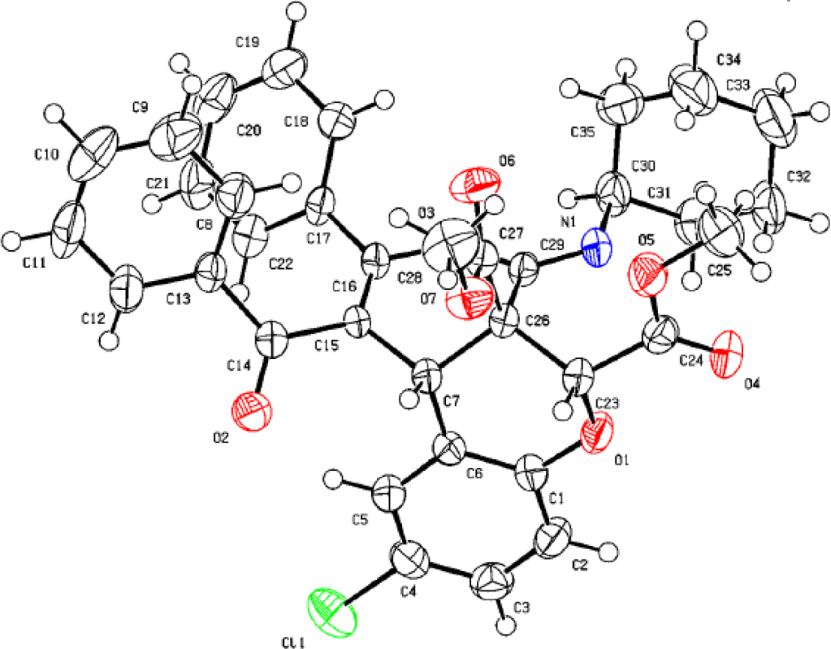
Figure 1: Single crystal structure of compound 4c (ORTEP-drawing, thermal ellipsoids set at the 30% probability level).
Figure 1: Single crystal structure of compound 4c (ORTEP-drawing, thermal ellipsoids set at the 30% probabili...
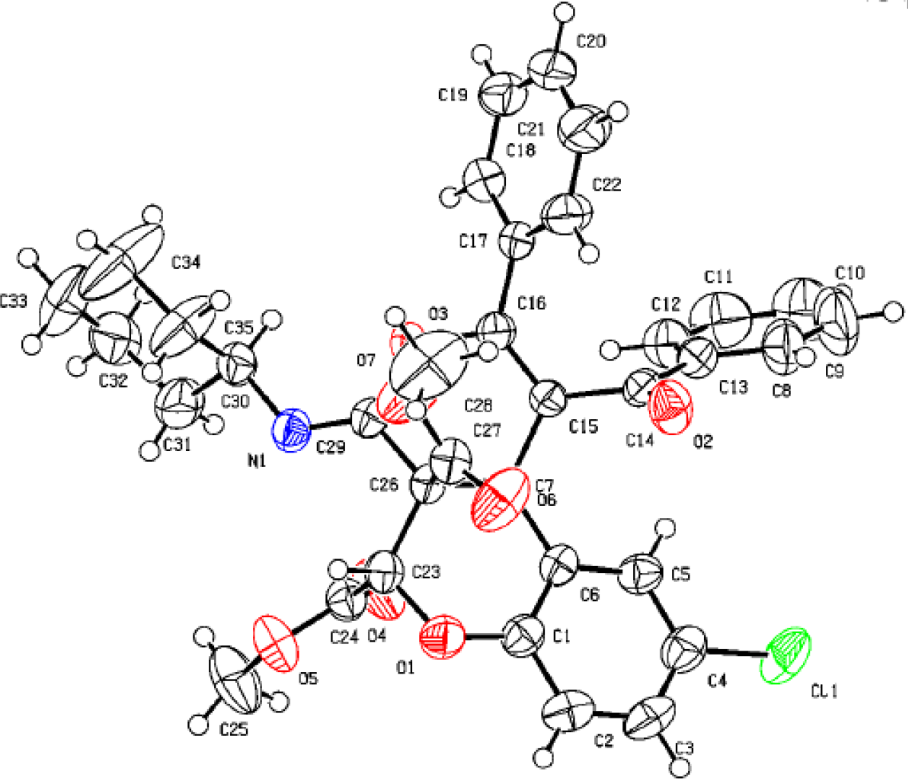
Figure 2: Single crystal structure of compound 4c’ (ORTEP-drawing, thermal ellipsoids set at the 30% probability level).
Figure 2: Single crystal structure of compound 4c’ (ORTEP-drawing, thermal ellipsoids set at the 30% probabil...
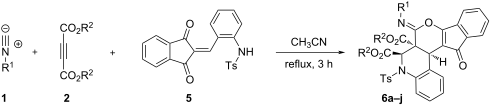
For developing the scope of this three-component reaction, 2-(2-N-tosylaminobenzylidene)-1,3-indanedione (5) were also employed in the reaction. The three-component reaction of cyclohexyl isocyanide (1a), dimethyl but-2-ynedioate (2a) and 2-(2-N-tosylaminoxbenzylidene)-1,3-indanedione (5) in tetrahydrofuran at room temperature proceeded very sluggish. Further examination of the reaction conditions showed that the three-component reaction in refluxing acetonitrile for three hours gave the expected functionalized tetrahydroindeno[2’,1’:5,6]pyrano[3,4-c]quinoline 6a in 60% yield (Table 3, entry 1). The similar reactions with other isocyanides such as tert-butyl, benzyl, p-methoxyphenyl and p-bromophenyl isocyanides also afforded tetrahydroindeno[2’,1’:5,6]pyrano[3,4-c]quinolines 6b–e in 38–54% yields (Table 3, entries 2–5). When diethyl but-2-ynedioate was used in the reaction, the three-component reaction resulted in the tetrahydroindeno[2’,1’:5,6]pyrano[3,4-c]quinolines 6f–j in lower yields (Table 3, entries 6–10). The TLC analysis and 1H NMR spectra of the crude products clearly indicated that only one diastereomer was predominately produced in the reaction, while other diastereomers were not detected in the reaction. This result is different to the above mentioned three-component reaction for the formation of two diastereomers 4 and 4’, which might be due to restriction of the polycyclic rings including the indanone skeleton. The single crystal structures of compounds 6a and 6b were also determined (Figure 3 and Figure 4). The single crystal data were listed in Table S2 (see Supporting Information File 1). From Figure 3 and Figure 4 it can be seen that the newly-formed pyrene ring and tetrahydroquinoline ring were fused in cis-form. The proton and the methoxycarbonyl group are in cis-position. The two methoxycarbonyl groups exist on trans-configuration. Therefore, the compounds 6a–j have the same relative configuration to that of the major products 4a–n, which also indicated that the two three-component reactions have a similar reaction mechanism and steric controlling factors.
|
||||
| entry | R1 | R2 | compd | yield (%)b |
|---|---|---|---|---|
| 1 | cyclohexyl | CH3 | 6a | 60 |
| 2 | t-Bu | CH3 | 6b | 54 |
| 3 | Bn | CH3 | 6c | 40 |
| 4 | p-CH3OC6H4 | CH3 | 6d | 45 |
| 5 | p-BrC6H4 | CH3 | 6e | 38 |
| 6 | cyclohexyl | C2H5 | 6f | 47 |
| 7 | t-Bu | C2H5 | 6g | 40 |
| 8 | Bn | C2H5 | 6h | 23 |
| 9 | p-CH3OC6H4 | C2H5 | 6i | 37 |
| 10 | p-BrC6H4 | C2H5 | 6j | 28 |
aReaction conditions: alkyl isocyanide 1 (0.2 mmol, 1.0 equiv), dialkyl but-2-ynedioate 2 (0.5 mmol, 2.5 equiv), 2-(2-N-tosylaminobenzylidene)-1,3-indanedione (5, 0.2 mmol, 1.0 equiv), CH3CN (5.0 mL), reflux, 3 h. bIsolated yields.
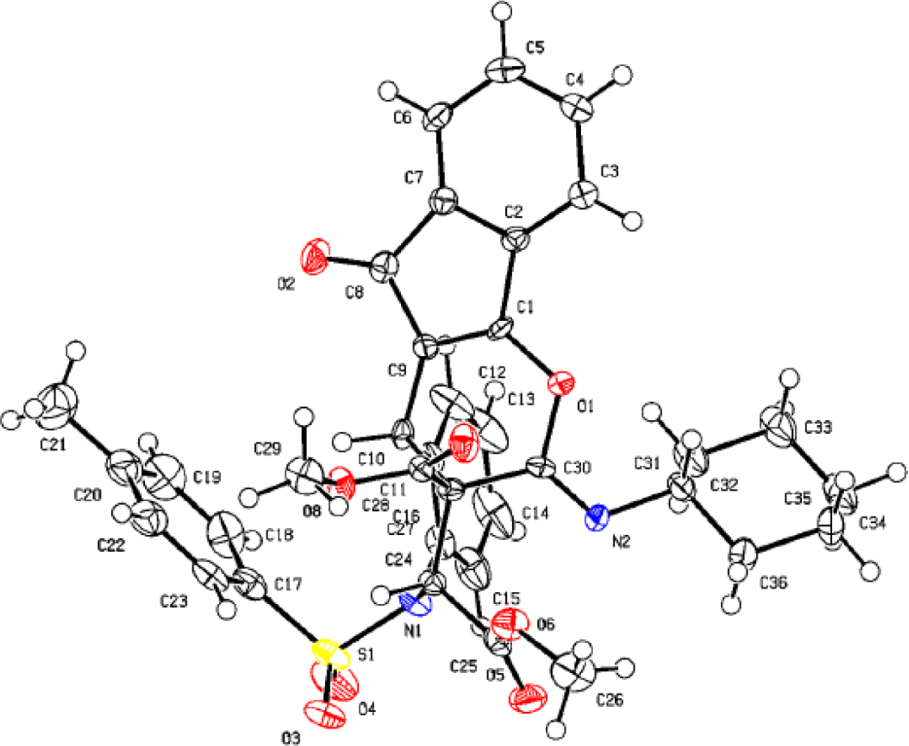
Figure 3: Single crystal structure of compound 6a (ORTEP-drawing, thermal ellipsoids set at the 30% probability level).
Figure 3: Single crystal structure of compound 6a (ORTEP-drawing, thermal ellipsoids set at the 30% probabili...
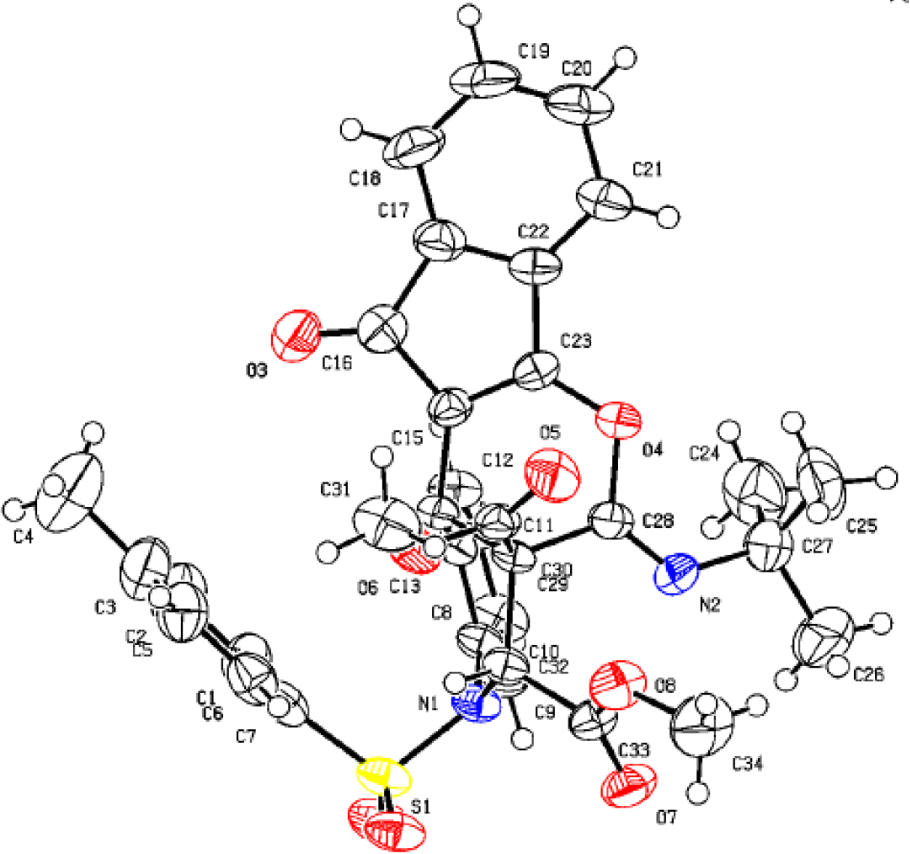
Figure 4: Single crystal structure of compound 6b (ORTEP-drawing, thermal ellipsoids set at the 30% probability level).
Figure 4: Single crystal structure of compound 6b (ORTEP-drawing, thermal ellipsoids set at the 30% probabili...
In order to explain the formation of above functionalized fused chromenes, a plausible reaction mechanism is proposed on the basis of the previously reported works and the present obtained experimental results (Scheme 2). At first, the nucleophilic addition of alkyl isocyanide 1 to alkyl but-2-ynedioate 2 gave the well-known 1,4-dipolar intermediate A. Secondly, a proton exchange between 1,4-dipolar intermediate A to 2-(2-hydroxybenzylidene)-1,3-diarylpropane-1,3-dione 3 resulted in the intermediate B and a phenoxide ion C. Thirdly, the nucleophilic addition of the phenoxide C to the intermediate B afforded adduct D. Sequentially, an intramolecular Michael addition of the carbanion to C=C bond in the adduct D produced the intermediate E with a chromane skeleton. Finally, the nueleophilic addition of the enolate ion to the nitrilium ion in the intermediate E gave the diatereomeric pyrano[3,4-c]chromenes 4 and 4’. Because each reaction step is equilibrium reaction in the cyclization process, the reaction selectively gave the more stable compounds 4a–n (cis-fused ring) as major products and less stable compounds 4a’–n’ (trans-fused ring) as minor products. On the other hand, formation of product 6 also followed this reaction mechanism. A proton exchange between the 1,4-dipolar intermediate A to 2-(2-N-tosylaminobenzylidene)-1,3-indanedione 5 produced the intermediate B and an amino anion F. Then, the nucleophilic addition of the amino anion F to the intermediate B afforded the adduct G, which was converted to the intermediate H by an intramolecular Michael addition of the carbanion to the C=C bond. Finally, the coupling of the nitrilium ion and the enolate in intermediate H gave the functionalized tetrahydroindeno[2’,1’:5,6]pyrano[3,4-c]quinolines 6. It might be due to the rigid ring of the indanone, only one diastereomer (cis-fused ring) was formed in the reaction.
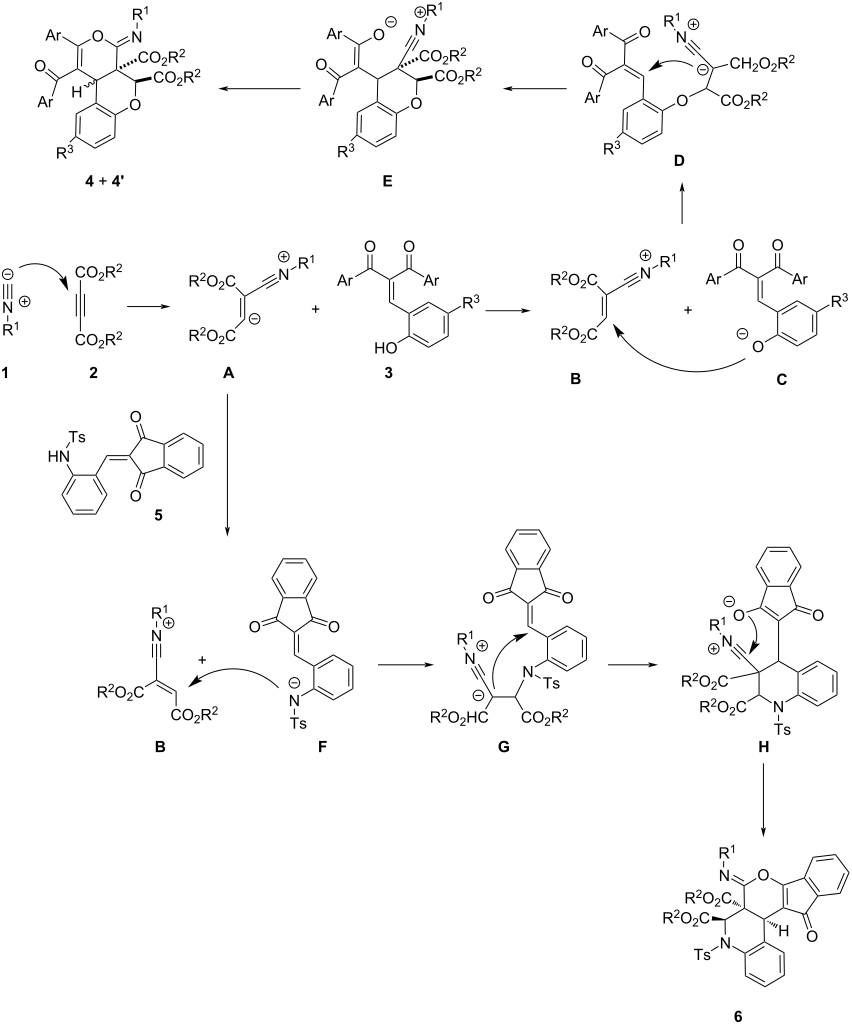
Scheme 2: Proposed reaction mechanism for the syntheses of compounds 4 and 6.
Scheme 2: Proposed reaction mechanism for the syntheses of compounds 4 and 6.
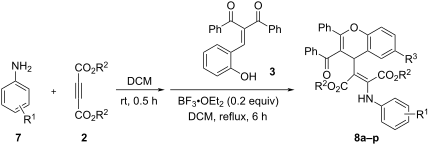
For demonstrating the synthetic value of this three-component reaction, arylamines were employed to replacing alkyl cyanides in the three-component reaction. However, the three-component reaction of arylamines 7, dialkyl but-2-ynedioates 2 and 2-(2-hydroxybenzylidene)-1,3-diphenylpropane-1,3-dione 3 in tetrahydrofuran did not give the expected polycyclic products. TLC monitoring indicated that the nucleophilic addition of arylamine to dimethyl but-2-ynedioate gave the well-known dimethyl 2-(arylamino)maleate as the isolated product , while 2-(2-hydroxybenzylidene)-1,3-diphenylpropane-1,3-dione 3 did not take part in the further reaction. Then, a one-pot two-step reaction procedure was employed. The reaction of arylamines 7 and dialkyl but-2-ynedioates 2 in dichloromethane at room temperature for half an hour resulted in the expected known dimethyl 2-(arylamino)maleate. Then, 2-(2-hydroxybenzylidene)-1,3-diphenylpropane-1,3-dione 3 and Lewis acid catalyst boron trifluoride etherate were introduced in the reaction mixture. The further reaction was carried out in refluxing dichloromethane for six hours. The poly-substituted chromenes 8a–p were obtained in 40–65% yields (Table 4). Various substituted arylamines can be successfully employed in the reaction. However, benzylamine and n-butylamine cannot be used in the reaction, which gave very complicated mixtures of products. The chemical structures of the substituted chromenes 8a–p were fully characterized by IR, 1H and 13C NMR spectroscopy as well as HRMS spectrometry. The single crystal structure of the compound 8j was determined (Figure 5). It can be seen that the phenylamino group and the moiety of dimethyl fumarate did not participate in the cyclization process and only acted as a substituent on the chromene ring. The two methoxycarbonyl groups on the C=C bond are in trans-configuration. The chromene ring results from the annulation of the 1,3-diphenylpropane-1,3-dione unit. All attempts of further cyclization of the arylamino group with the carbonyl group in the obtained compounds 8 to form a pyridyl ring were not successful. These results clearly show that alkyl isocyanides have very different reactivity to that of arylamines.
|
|||||
| entry | R1 | R2 | R3 | compd | yield (%)b |
|---|---|---|---|---|---|
| 1 | m-CH3 | CH3 | OCH3 | 8a | 62 |
| 2 | m-CH3 | CH3 | H | 8b | 57 |
| 3 | m-CH3 | CH3 | Cl | 8c | 45 |
| 4 | m-CH3 | CH3 | Br | 8d | 40 |
| 5 | m-Cl | CH3 | OCH3 | 8e | 65 |
| 6 | m-Cl | CH3 | H | 8f | 60 |
| 7 | m-Cl | CH3 | Cl | 8g | 41 |
| 8 | p-CH3O | CH3 | OCH3 | 8h | 53 |
| 9 | p-CH3O | CH3 | H | 8i | 45 |
| 10 | p-CH3O | CH3 | Cl | 8j | 40 |
| 11 | H | CH3 | OCH3 | 8k | 64 |
| 12 | H | CH3 | H | 8l | 60 |
| 13 | H | CH3 | Cl | 8m | 52 |
| 14 | m-CH3 | C2H5 | OCH3 | 8n | 49 |
| 15 | m-CH3 | C2H5 | H | 8o | 45 |
| 16 | m-CH3 | C2H5 | Cl | 8p | 40 |
aStandard reaction conditions: arylamine 7 (0.2 mmol, 1.0 equiv), dialkyl but-2-ynedioate 2 (0.4 mmol, 2.0 equiv), DCM (5 mL), rt, 0.5 h, 2-(2-hydroxybenzylidene)-1,3-diphenylpropane-1,3-dione 3 (0.2 mmol, 1.0 equiv), BF3·OEt2 (0.4 mmol, 0.2 equiv), 40 °C, 6 h. bIsolated yields.
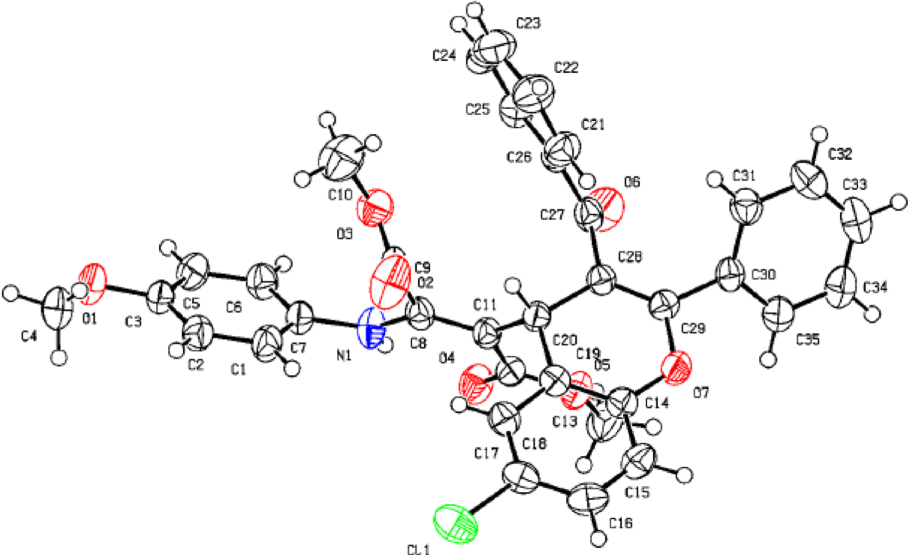
Figure 5: Single crystal structure of compound 8j (ORTEP-drawing, thermal ellipsoids set at the 30% probability level).
Figure 5: Single crystal structure of compound 8j (ORTEP-drawing, thermal ellipsoids set at the 30% probabili...
A plausible reaction mechanism was also proposed for the formation of chromenes 8 (Scheme 3) . Firstly, a nucleophilic addition of arylamine 7 to dialkyl but-2-ynedioate 2 gave the well-known dialkyl 2-(arylamino)maleate I. Secondly, the addition of the enamino unit of intermediate I to the C=C bond in reagent 3 gave adduct intermediate J. In the presence of Lewis acid, the intramolecular addition of the hydroxy group to the carbonyl group in the intermediate J afforded the intermediate K, which was converted to the isolated product 8 by a further dehydration process. The further annulation to give the expected chromeno[3,4-c]pyridine L by the addition of an arylamino group to another carbonyl group did not happen in the reaction.
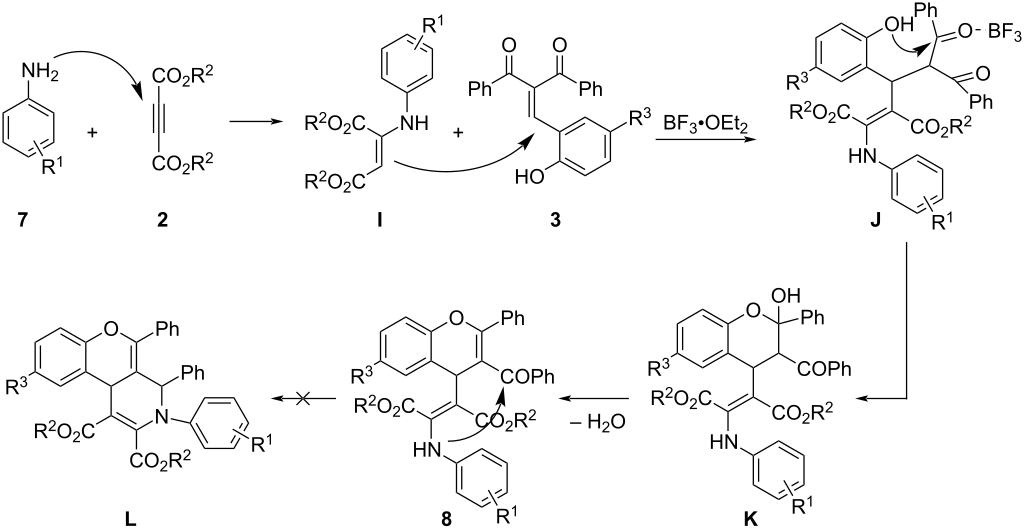
Scheme 3: Proposed reaction mechanism for the formation of chromenes 8.
Scheme 3: Proposed reaction mechanism for the formation of chromenes 8.
Conclusion
In summary, we have investigated three-component reactions of alkyl isocyanides, dialkyl but-2-ynedioates and various unsaturated diketones. These reactions successfully provided convenient synthetic methods for the formation of functionalized pyrano[3,4-c]chromenes and tetrahydroindeno[2’,1’:5,6]pyrano[3,4-c]quinolines in moderate to good yields. By using arylamines instead of alkyl isocyanides in the three-component reaction, functionalized chromenes with 2-(arylamino)maleate as substituent were also prepared in moderate to good yields. The relative configuration of the polycyclic compounds was clearly determined and a plausible formation mechanism for these polycyclic compounds were proposed. The advantages of this reaction included the use of readily available materials, a broad substrate scope, mild reaction conditions, high molecular diversity and high atomic economy. The potential applications of these multicomponent reactions might be significant in organic and medicinal chemistry.
Supporting Information
The crystallographic data of compounds 4c (CCDC 2556317), 4c’ (CCDC 2556316), 6a (CCDC 2556318), 6b (CCDC 2556319), 8j (CCDC 2556320) have been deposited at the Cambridge Crystallographic Database Centre (http://www.ccdc.cam.ac.uk).
Data Availability Statement
All data that supports the findings of this study is available in the published article and/or the supporting information of this article.
References
-
Zhu, J. Eur. J. Org. Chem. 2003, 1133–1144. doi:10.1002/ejoc.200390167
Return to citation in text: [1] -
Lygin, A. V.; de Meijere, A. Angew. Chem., Int. Ed. 2010, 49, 9094–9124. doi:10.1002/anie.201000723
Return to citation in text: [1] -
Giustiniano, M.; Basso, A.; Mercalli, V.; Massarotti, A.; Novellino, E.; Tron, G. C.; Zhu, J. Chem. Soc. Rev. 2017, 46, 1295–1357. doi:10.1039/c6cs00444j
Return to citation in text: [1] -
Gulevich, A. V.; Zhdanko, A. G.; Orru, R. V. A.; Nenajdenko, V. G. Chem. Rev. 2010, 110, 5235–5331. doi:10.1021/cr900411f
Return to citation in text: [1] -
Dömling, A.; Ugi, I. Angew. Chem., Int. Ed. 2000, 39, 3168–3210. doi:10.1002/1521-3773(20000915)39:18<3168::aid-anie3168>3.0.co;2-u
Return to citation in text: [1] -
Nair, V.; Rajesh, C.; Vinod, A. U.; Bindu, S.; Sreekanth, A. R.; Mathen, J. S.; Balagopal, L. Acc. Chem. Res. 2003, 36, 899–907. doi:10.1021/ar020258p
Return to citation in text: [1] -
Qiu, G.; Ding, Q.; Wu, J. Chem. Soc. Rev. 2013, 42, 5257–5269. doi:10.1039/c3cs35507a
Return to citation in text: [1] -
Estévez, V.; Villacampa, M.; Menéndez, J. C. Chem. Soc. Rev. 2014, 43, 4633–4657. doi:10.1039/c3cs60015g
Return to citation in text: [1] -
Lenarduzzi D'Emilio, N. A.; Paz Armero, P. K.; Mendoza Salgado, A. R.; Simonetti, S. O.; Bracca, A. B. J.; Larghi, E. L.; Kaufman, T. S. Org. Biomol. Chem. 2026, 24, 1965–1996. doi:10.1039/d5ob02009c
Return to citation in text: [1] -
Shan, Y.; Lv, D.; Zhang, X.; Wang, J.; Chen, D. Chem. Commun. 2026, 62, 1391–1408. doi:10.1039/d5cc05745k
Return to citation in text: [1] -
Kochnev, I. A.; Barkov, A. Y. New J. Chem. 2025, 49, 20254–20263. doi:10.1039/d5nj03333k
Return to citation in text: [1] -
Kumar, A.; Mishra, P. K.; Verma, A. K. Chem. Commun. 2023, 59, 7263–7266. doi:10.1039/d3cc01586f
Return to citation in text: [1] -
Wan, J.-P.; Liu, Y. RSC Adv. 2012, 2, 9763–9777. doi:10.1039/c2ra21406g
Return to citation in text: [1] -
Sadjadi, S.; Heravi, M. M.; Nazari, N. RSC Adv. 2016, 6, 53203–53272. doi:10.1039/c6ra02143c
Return to citation in text: [1] -
Ma, X.; Gao, Z.; Niu, J.; Shao, W.; Yan, S.; Zhang, S.; Zhang, W. Beilstein J. Org. Chem. 2025, 21, 2202–2210. doi:10.3762/bjoc.21.167
Return to citation in text: [1] -
Zhou, W.; Lu, S.; Zhao, X.; Wang, H.; Ding, C.-H.; Gao, M.; Xu, B. Org. Lett. 2026, 28, 5447–5452. doi:10.1021/acs.orglett.6c01047
Return to citation in text: [1] -
Zhang, T.; Wang, W.; Chen, M.; Hu, J.; Liu, P.; Sun, P. Org. Lett. 2026, 28, 3191–3195. doi:10.1021/acs.orglett.6c00189
Return to citation in text: [1] -
Fardi, E.; Rafiee, F. Tetrahedron 2026, 198, 135346. doi:10.1016/j.tet.2026.135346
Return to citation in text: [1] -
Yu, S.; Xu, J.; Li, X.; Yang, X.-Y.; Lei, J.; Lv, M.-L.; Chen, Z.-Z. J. Org. Chem. 2026, 91, 5280–5292. doi:10.1021/acs.joc.5c02998
Return to citation in text: [1] -
Li, Y.-G.; Wang, C.-C.; Ma, Z.-W.; Chen, X.-P.; Zhu, X.; Hao, X.-Q. Tetrahedron 2025, 188, 134985. doi:10.1016/j.tet.2025.134985
Return to citation in text: [1] -
He, Y.; Shen, X.-Y.; Ding, Y.; Wang, Y.-C.; Xie, Y.-Y.; Pan, Y.-M. Green Chem. 2026, 28, 4795–4831. doi:10.1039/d6gc00161k
Return to citation in text: [1] -
Mi, Y.-H.; Wang, Z.-Y.; Wang, Y.-H.; Wang, K.; Zhang, Y.; Yang, Y.-Q.; Huang, X.-Y.; Zhang, S.-X.; Zhao, H.-W. Eur. J. Org. Chem. 2026, 29, e202501126. doi:10.1002/ejoc.202501126
Return to citation in text: [1] -
Chen, L.; Xiong, D.; Yang, Z.; Chen, Y.; Xiao, J.; Tian, Y.; Zheng, J. Org. Chem. Front. 2024, 11, 5868–5875. doi:10.1039/d4qo01369g
Return to citation in text: [1] -
Dömling, A. J. Org. Chem. 2023, 88, 5242–5247. doi:10.1021/acs.joc.2c00792
Return to citation in text: [1] -
Massarotti, A.; Brunelli, F.; Aprile, S.; Giustiniano, M.; Tron, G. C. Chem. Rev. 2021, 121, 10742–10788. doi:10.1021/acs.chemrev.1c00143
Return to citation in text: [1] -
Kalhans, P.; Singh, A.; Mishra, S.; Pandey, S. Org. Biomol. Chem. 2025, 23, 3243–3269. doi:10.1039/d4ob02094d
Return to citation in text: [1] -
Nazeri, M. T.; Nasiriani, T.; Norouzi, M.; Torabi, S.; Vakili, M. A.; Shaabani, A. Org. Chem. Front. 2026, 13, 6316–6411. doi:10.1039/d6qo00608f
Return to citation in text: [1] -
Flores-Reyes, J. C.; Islas-Jácome, A.; González-Zamora, E. Org. Chem. Front. 2021, 8, 5460–5515. doi:10.1039/d1qo00313e
Return to citation in text: [1] -
Ojeda-Carralero, G. M.; Ceballos, L. G.; Coro, J.; Rivera, D. G. ACS Comb. Sci. 2020, 22, 475–494. doi:10.1021/acscombsci.0c00111
Return to citation in text: [1] -
Nazeri, M. T.; Farhid, H.; Mohammadian, R.; Shaabani, A. ACS Comb. Sci. 2020, 22, 361–400. doi:10.1021/acscombsci.0c00046
Return to citation in text: [1] -
Mathiyazhagan, A. D.; Anilkumar, G. Org. Biomol. Chem. 2019, 17, 6735–6747. doi:10.1039/c9ob00847k
Return to citation in text: [1] -
Nazeri, M. T.; Ghasemi, M.; Ahmadi, M.; Shaabani, A.; Notash, B. J. Org. Chem. 2023, 88, 13504–13519. doi:10.1021/acs.joc.3c01013
Return to citation in text: [1] -
Li, Y.; Kopcha, W. P.; Emge, T. J.; Sun, Y.; Zhang, J. Org. Lett. 2021, 23, 8867–8872. doi:10.1021/acs.orglett.1c03371
Return to citation in text: [1] -
Bankura, A.; Saha, J.; Maity, R.; Das, I. Adv. Synth. Catal. 2021, 363, 1014–1021. doi:10.1002/adsc.202001376
Return to citation in text: [1] -
Farhid, H.; Araghi, H. M.; Shaabani, A.; Notash, B. J. Mol. Struct. 2023, 1292, 136143. doi:10.1016/j.molstruc.2023.136143
Return to citation in text: [1] -
Ansari, M. D.; Sagir, H.; Yadav, V. B.; Yadav, N.; Verma, A.; Shakya, S.; Singh, M.; Siddiqui, I. R. Mol. Diversity 2023, 27, 1853–1866. doi:10.1007/s11030-022-10532-3
Return to citation in text: [1] -
Vahedi, M. M.; Asghari, S.; Tajbakhsh, M.; Mohseni, M.; Khalilpour, A. J. Mol. Struct. 2023, 1284, 135446. doi:10.1016/j.molstruc.2023.135446
Return to citation in text: [1] -
Nazeri, M. T.; Ahmadi, M.; Ghasemi, M.; Shaabani, A.; Notash, B. Org. Biomol. Chem. 2023, 21, 4095–4108. doi:10.1039/d3ob00250k
Return to citation in text: [1] -
Hasan, M.; Peshkov, A. A.; Shah, S. A. A.; Belyaev, A.; Lim, C.-K.; Wang, S.; Peshkov, V. A. Beilstein J. Org. Chem. 2025, 21, 915–925. doi:10.3762/bjoc.21.74
Return to citation in text: [1] -
Yavari, I.; Ravaghi, P.; Safaei, M. Synthesis 2022, 54, 1870–1876. doi:10.1055/s-0041-1737817
Return to citation in text: [1] -
Nair, V.; Vinod, A. U.; Rajesh, C. J. Org. Chem. 2001, 66, 4427–4429. doi:10.1021/jo001714v
Return to citation in text: [1] -
Rahmani, F.; Darehkordi, A. Synlett 2017, 28, 1224–1226. doi:10.1055/s-0036-1588732
Return to citation in text: [1] -
Nair, V.; Vinod, A. U.; Abhilash, N.; Menon, R. S.; Santhi, V.; Varma, R. L.; Viji, S.; Mathew, S.; Srinivas, R. Tetrahedron 2003, 59, 10279–10286. doi:10.1016/j.tet.2003.10.052
Return to citation in text: [1] -
Wang, C.-C.; Ma, Z.-W.; Qu, Y.-L.; Liu, Z.-J.; Chen, X.-P.; Zhou, J.; Chen, Y.-J. Chem. – Asian J. 2020, 15, 560–563. doi:10.1002/asia.201901780
Return to citation in text: [1] -
Nazeri, M. T.; Shaabani, A.; Notash, B. Org. Biomol. Chem. 2021, 19, 3722–3734. doi:10.1039/d0ob02339f
Return to citation in text: [1] -
Ma, W.; Han, Y.; Sun, J.; Yan, C. Chin. J. Org. Chem. 2021, 41, 3180–3191. doi:10.6023/cjoc202103034
Return to citation in text: [1] [2] [3] [4] -
He, Y.-W.; Ma, W.-Q.; Han, Y.; Sun, J.; Yan, C.-G. J. Org. Chem. 2023, 88, 14911–14927. doi:10.1021/acs.joc.3c01246
Return to citation in text: [1] [2] [3] -
Huang, L.; Han, Y.; Sun, J.; Sun, Q.; Yan, C.-G. Org. Biomol. Chem. 2023, 21, 6028–6033. doi:10.1039/d3ob00769c
Return to citation in text: [1] [2] [3] -
He, Y.-W.; Huang, L.; Huang, K.; Yan, C.-G.; Sun, J.; Han, Y. J. Org. Chem. 2024, 89, 10854–10866. doi:10.1021/acs.joc.4c01142
Return to citation in text: [1] [2] [3] [4] -
Chen, X.-Y.; Han, Y.; Sun, J.; Yan, C.-G. Beilstein J. Org. Chem. 2024, 20, 1436–1443. doi:10.3762/bjoc.20.126
Return to citation in text: [1] [2] [3] -
Huang, L.; Ma, W.-Q.; Sun, J.; Han, Y.; Yan, C.-G. Org. Biomol. Chem. 2025, 23, 3224–3230. doi:10.1039/d5ob00206k
Return to citation in text: [1] [2] [3] -
Zhang, X.; Huang, L.; Sun, J.; Han, Y.; Yan, C.-G. Eur. J. Org. Chem. 2026, 29, e202501219. doi:10.1002/ejoc.202501219
Return to citation in text: [1] [2] [3] [4] -
Zhan, S.-C.; Huang, L.; Sun, J.; Yan, C.-G. Tetrahedron 2025, 185, 134853. doi:10.1016/j.tet.2025.134853
Return to citation in text: [1] [2] [3] [4] -
Tang, T.; Han, Y.; Yan, C.-G.; Huang, K.; Sun, J. Eur. J. Org. Chem. 2024, 27, e202400777. doi:10.1002/ejoc.202400777
Return to citation in text: [1] [2] -
Liu, X.; Wang, D.; Sun, J.; Yan, C.-G. J. Mol. Struct. 2024, 1304, 137684. doi:10.1016/j.molstruc.2024.137684
Return to citation in text: [1] -
Xiao, Z.-Y.; Sun, J.; Yan, C.-G. Beilstein J. Org. Chem. 2025, 21, 286–295. doi:10.3762/bjoc.21.21
Return to citation in text: [1] -
Zhang, X.; Xu, F.; Kou, Z.; Sun, J.; Yan, C.-G.; Han, Y. J. Mol. Struct. 2025, 1345, 143025. doi:10.1016/j.molstruc.2025.143025
Return to citation in text: [1] -
Tang, T.; Zhan, S.-C.; Sun, J.; Han, Y.; Yan, C.-G. J. Mol. Struct. 2025, 1347, 143070. doi:10.1016/j.molstruc.2025.143070
Return to citation in text: [1] -
Chen, X.; Sun, J.; Han, Y.; Yan, C.-G. J. Org. Chem. 2025, 90, 2889–2906. doi:10.1021/acs.joc.4c02525
Return to citation in text: [1] -
Liu, D.-M.; Chen, X.; Sun, J.; Yan, C.-G. J. Mol. Struct. 2026, 1357, 145292. doi:10.1016/j.molstruc.2026.145292
Return to citation in text: [1] -
Nair, V.; Menon, R. S.; Sreekanth, A. R.; Abhilash, N.; Biju, A. T. Acc. Chem. Res. 2006, 39, 520–530. doi:10.1021/ar0502026
Return to citation in text: [1] [2] -
Shaabani, A.; Maleki, A.; Rezayan, A. H.; Sarvary, A. Mol. Diversity 2011, 15, 41–68. doi:10.1007/s11030-010-9258-1
Return to citation in text: [1] [2] -
Han, Y.; Sun, J.; Sun, Y.; Gao, H.; Yan, C. Chin. J. Org. Chem. 2012, 32, 1577–1586. doi:10.6023/cjoc201206008
Return to citation in text: [1] [2] -
Li, X.; Wang, J.-Y.; Yu, W.; Wu, L.-M. Tetrahedron 2009, 65, 1140–1146. doi:10.1016/j.tet.2008.11.095
Return to citation in text: [1] [2] -
Jiang, H.-F.; Li, J.-H.; Chen, Z.-W. Tetrahedron 2010, 66, 9721–9728. doi:10.1016/j.tet.2010.10.041
Return to citation in text: [1] [2]
© 2026 Zhang et al.; licensee Beilstein-Institut.
This is an open access article licensed under the terms of the Beilstein-Institut Open Access License Agreement (https://www.beilstein-journals.org/bjoc/terms), which is identical to the Creative Commons Attribution 4.0 International License (https://creativecommons.org/licenses/by/4.0). The reuse of material under this license requires that the author(s), source and license are credited. Third-party material in this article could be subject to other licenses (typically indicated in the credit line), and in this case, users are required to obtain permission from the license holder to reuse the material.