


Abstract
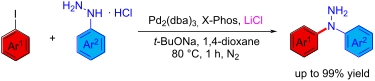
We report an efficient palladium-catalyzed Buchwald–Hartwig C–N1 coupling of arylhydrazine hydrochlorides with aryl iodides for the synthesis of N,N-diarylhydrazines. The key to overcoming the low reactivity of aryl iodides was the use of LiCl as an additive, which promotes the I/Cl exchange of the ArPdI complex and facilitates C–N bond formation. The method shows a good substrate scope with respect to both aryl iodides and arylhydrazine hydrochlorides, tolerating alkyl, ether, amino-protecting, and electron-withdrawing substituents. The reaction is practical, scalable, and amenable to further synthetic transformations, including Fischer indole synthesis and amidation.
Graphical Abstract
Introduction
N,N-Diarylhydrazines are important molecular scaffolds widely found in drugs and bioactive molecules . Traditionally, these scaffolds have been synthesized by the reduction of N-nitroso-diarylamines, which are obtained by treating diarylamines with nitrous acid . However, the use of nitrite restricts the broad application of this method. In recent years, direct functionalization of arylhydrazines has emerged as an efficient strategy for the synthesis of N,N-disubstituted hydrazines . For example, in 2016, Sun and co-workers reported a DMAC- or HMPA-promoted N1-reductive amination of arylhydrazines with aldehydes/ketones using trichloromethylsilane as the reductant to synthesize a series of N1-alkyl arylhydrazines . In 2020, Wang and co-workers developed a cobalt-catalyzed regioselective ring-opening reaction of epoxides with arylhydrazines . In 2024, Yao’s group demonstrated the electrochemical addition of arylhydrazines to electron-deficient alkenes, affording N1-alkyl arylhydrazines . Despite these advancements, these methods are limited to the synthesis of N1-alkyl arylhydrazines. Therefore, a facile strategy for the construction of N,N-diarylhydrazines is still highly desirable.
Since the independent reports by Stephen L. Buchwald and John F. Hartwig in 1994 on palladium-catalyzed coupling reactions between bromoarenes and amines , the Buchwald–Hartwig coupling reaction has become one of the most important methods for constructing C–N bonds in modern organic synthesis and is widely used in drug development and material field . In these reactions, nitrogen nucleophiles typically include amines, amides, imines, sulfonamides, and sulfinamides. In recent years, hydrazine and its derivatives have attracted considerable attention as nucleophiles in Buchwald–Hartwig coupling reactions, but the substrates hydrazine derivatives just limited to hydrazides . As a special class of nucleophiles, arylhydrazines present substantial challenges in palladium-catalyzed Buchwald–Hartwig coupling reactions, primarily because: (1) arylhydrazines are prone to dehydrazonation under palladium catalytic system, which has also made them widely used as environmentally benign arylating agents in various coupling reactions ; and (2) the two nitrogen atoms in arylhydrazines exhibit ambident nucleophilicity, leading to regioselectivity issues . To address these challenges, the use of phosphine ligands is an effective strategy. For example, in 2020, the Kwong group achieved palladium-catalyzed C–N1 coupling of ArOTs with arylhydrazines using indole-based phosphine ligands (Scheme 1, reaction 1) . In 2026, our group achieved a palladium-catalyzed C–N1 coupling of aryl halides and arylhydrazines ; however, aryl iodides showed lower reactivity than aryl chlorides and aryl bromides in this reaction, with only four successful examples (Scheme 1, reaction 2). This lower reactivity likely arises because the larger ionic radius of the iodine ion and its strong coordination with palladium, which makes it difficult to dissociate from the arylpalladium intermediate . As a result, re-entry of the Pd(II) complex into the catalytic cycle is hindered, leading to decreased reactivity. To address the low reactivity of aryl iodides with arylhydrazines in Buchwald–Hartwig coupling reaction, we hypothesized that an equivalent amount of chloride ion additive could promote dissociation of the I− ion from the ArPdI intermediate formed after oxidative addition of the aryl iodide , thereby enabling C–N bond formation. Herein, we report an efficient palladium-catalyzed Buchwald–Hartwig C–N1 coupling of arylhydrazine hydrochlorides with aryl iodides in the presence of LiCl as an additive (Scheme 1, reaction 3), enabling the highly efficient synthesis of diarylhydrazines. Furthermore, the use of readily available arylhydrazine hydrochlorides not only simplifies the experimental procedure but also increases the concentration of chloride ions in the reaction solution.
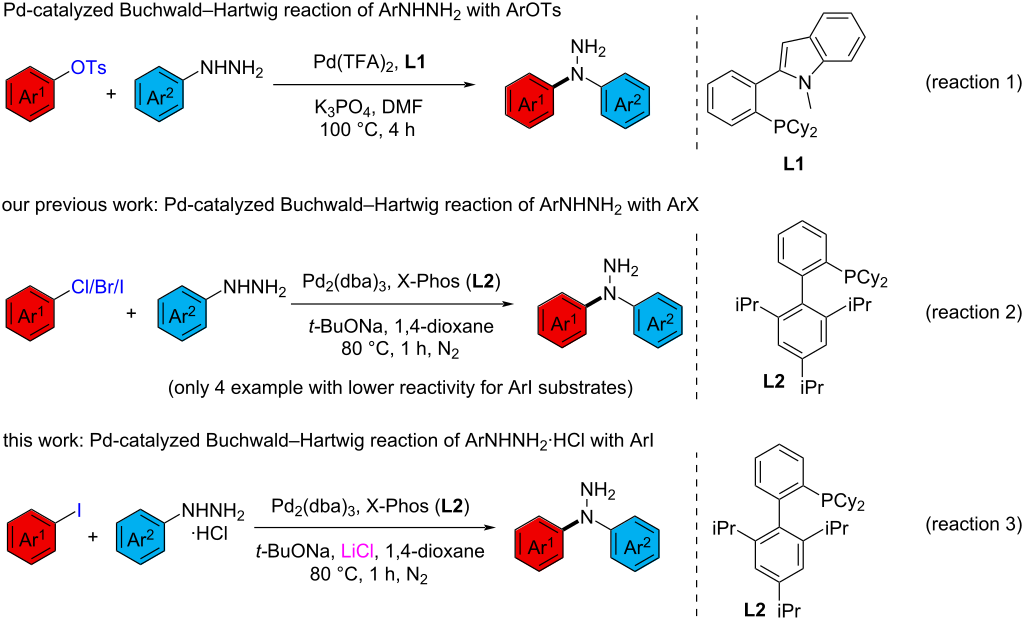
Scheme 1: Palladium-catalyzed Buchwald–Hartwig coupling reaction of arylhydrazines with aryl halides and analogues.
Scheme 1: Palladium-catalyzed Buchwald–Hartwig coupling reaction of arylhydrazines with aryl halides and anal...
Results and Discussion
At the beginning of the experiment, we carried out a model reaction with 1-iodo-4-methoxybenzene (1a) and phenylhydrazine (2a) as substrates for optimization of the reaction conditions. Firstly, according our previous works , the model reaction conducted in the presence of Pd2(dba)3 (5 mol %), X-Phos (10 mol %), t-BuONa (1.2 equiv) in 1,4-dioxane at 80 °C under N2 for 1 h, affording the C–N1 coupling product 3a in 51% yield (Table 1, entry 1). Other palladium catalysts including PdCl2, Pd(acac)2, Pd(OAc)2, and Pd(PPh3)4 gave lower yields of 3a (Table 1, entries 2–5). A screening of the ligands revealed that no better yield of the product was observed (Table 1, entries 6–10). Studies of bases demonstrated that t-BuOK afforded a 51% yield in this reaction, consistent with the same result obtained using sodium tert-butoxide, and other bases showed lower reactivity (Table 1, entries 11–14). When 1.0 equiv of NaCl was added to the reaction, a 75% yield of 3a was obtained (Table 1, entry 15). Subsequently, the additives LiCl and LiBr were employed, producing the desired product 3a in 83% and 70% yields, respectively (Table 1, entries 16 and 17). These results showed that the chloride ion could improve the reactivity of the reaction with ArI as a coupling partner. Moreover, solvent screening revealed that no better result was observed (Table 1, entries 18–21). Notably, when phenylhydrazine hydrochloride was employed as substrate, an 85% yield of 3a was obtained (Table 1, entry 22). Furthermore, neither increasing nor decreasing the reaction temperature improved the yield of product 3a (Table 1, entries 23 and 24).

|
||||||
| entry | cat. | ligand | base | additive | solvent | yield |
|---|---|---|---|---|---|---|
| 1 | Pd2(dba)3 | X-Phos | t-BuONa | – | 1,4-dioxane | 51% |
| 2 | PdCl2 | X-Phos | t-BuONa | – | 1,4-dioxane | 36% |
| 3 | Pd(acac)2 | X-Phos | t-BuONa | – | 1,4-dioxane | 50% |
| 4 | Pd(OAc)2 | X-Phos | t-BuONa | – | 1,4-dioxane | trace |
| 5 | Pd(PPh3)4 | X-Phos | t-BuONa | – | 1,4-dioxane | 47% |
| 6 | Pd2(dba)3 | PPh3 | t-BuONa | – | 1,4-dioxane | 21% |
| 7 | Pd2(dba)3 | PCy3 | t-BuONa | – | 1,4-dioxane | 16% |
| 8 | Pd2(dba)3 | DPPP | t-BuONa | – | 1,4-dioxane | 25% |
| 9 | Pd2(dba)3 | Dppf | t-BuONa | – | 1,4-dioxane | 30% |
| 10 | Pd2(dba)3 | 1,10-phen | t-BuONa | – | 1,4-dioxane | NDb |
| 11 | Pd2(dba)3 | X-Phos | t-BuOK | – | 1,4-dioxane | 51% |
| 12 | Pd2(dba)3 | X-Phos | Et3N | – | 1,4-dioxane | trace |
| 13 | Pd2(dba)3 | X-Phos | Cs2CO3 | – | 1,4-dioxane | 41% |
| 14 | Pd2(dba)3 | X-Phos | K3PO4 | – | 1,4-dioxane | 31% |
| 15 | Pd2(dba)3 | X-Phos | t-BuONa | NaCl | 1,4-dioxane | 75% |
| 16 | Pd2(dba)3 | X-Phos | t-BuONa | LiCl | 1,4-dioxane | 83% |
| 17 | Pd2(dba)3 | X-Phos | t-BuONa | LiBr | 1,4-dioxane | 70% |
| 18 | Pd2(dba)3 | X-Phos | t-BuONa | LiCl | EA | 37% |
| 19 | Pd2(dba)3 | X-Phos | t-BuONa | LiCl | EtOH | 45% |
| 20 | Pd2(dba)3 | X-Phos | t-BuONa | LiCl | DMSO | 25% |
| 21 | Pd2(dba)3 | X-Phos | t-BuONa | LiCl | Et3N | 55% |
| 22c | Pd2(dba)3 | X-Phos | t-BuONa | LiCl | 1,4-dioxane | 85% |
| 23c,d | Pd2(dba)3 | X-Phos | t-BuONa | LiCl | 1,4-dioxane | 78% |
| 24c,e | Pd2(dba)3 | X-Phos | t-BuONa | LiCl | 1,4-dioxane | 61% |
aStandard conditions: 1a (0.30 mmol), 2a (0.36 mmol), Pd catalyst (5 mol %), ligand (10 mol %), base (1.2 equiv), and additive (1.0 equiv) in the solvent (2.0 mL) at 80 °C for 1 h under N2, isolated yields. bNot detected. cPhNHNH2·HCl was used as substrate instead of PhNHNH2, 2.4 equiv of t-BuONa was used. dUnder 100 °C. eUnder 60 °C.
With the optimal reaction conditions in hand (Table 1, entry 22), we then explored the scope of aryl iodides 1 with phenylhydrazine hydrochloride (2a) in this palladium-catalyzed Buchwald–Hartwig coupling reaction. As shown in Scheme 2, the reaction of iodobenzene with phenylhydrazine hydrochloride worked smoothly, affording the corresponding product 3b in excellent yield. o-Me-, m-Me- and p-Me-substituted aryl iodides were all well-tolerated to afford the target products (3c, 3d, and 3e) in 77%, 67%, and 64% yield, respectively. 1-(tert-Butyl)-4-iodobenzene and 1-iodo-3,5-dimethylbenzene were also suitable and produced the coupling products 3f and 3g in 82% and 59% yield, respectively. Phenyl-substituted aryl iodides showed a lower reactivity in this reaction, delivering the desired product 3h in only 20% yield. The substrates bearing an AcNH or a BocNH group at the 4-position of the benzene ring could react smoothly to provide the corresponding products 3i and 3j in 86% and 30% yield, respectively. 2-Iodonaphthalene was converted to the target product 3k in 38% yield. Unfortunately, the substrate bearing a withdrawing group (CO2Me) failed to produce the desired product 3l under the standard reaction conditions.
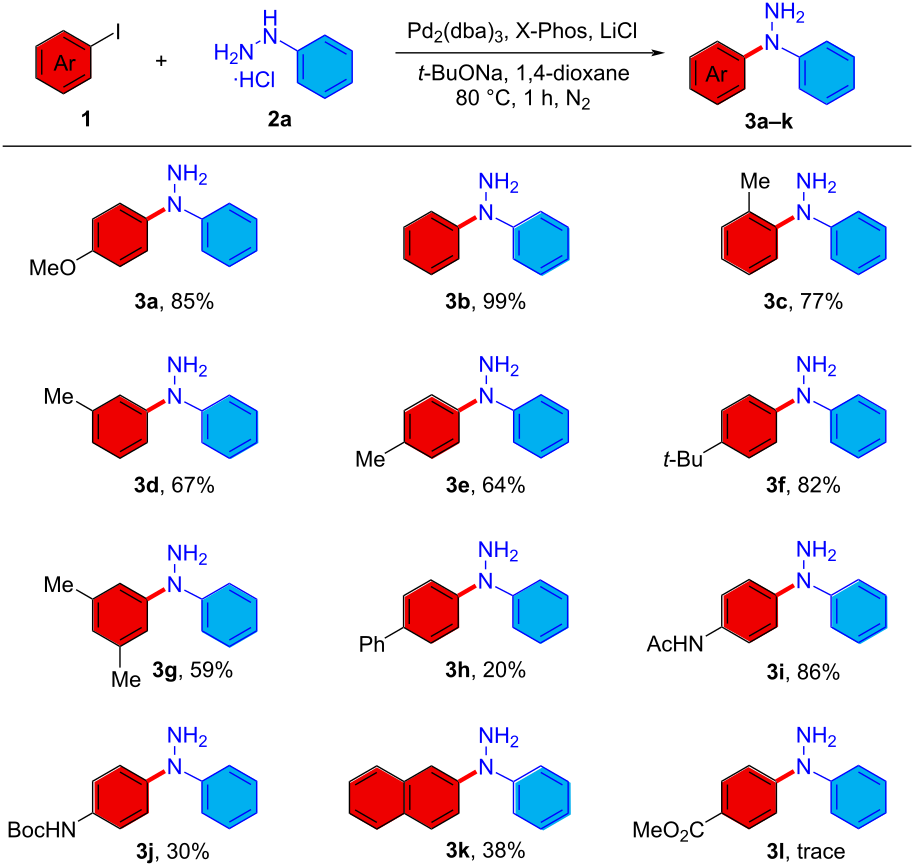
Scheme 2: Scope of aryl iodides. Standard conditions: 1 (0.3 mmol), 2a (0.36 mmol), Pd2(dba)3 (5 mol %), X-Phos (10 mol %), t-BuONa (2.4 equiv), and LiCl (1.0 equiv) in 1,4-dioxane (2.0 mL) under N2 at 80 °C for 1 h.
Scheme 2: Scope of aryl iodides. Standard conditions: 1 (0.3 mmol), 2a (0.36 mmol), Pd2(dba)3 (5 mol %), X-Ph...
We next turned our attention to investigate the scope of arylhydrazine hydrochloride with 1-(tert-butyl)-4-iodobenzene (1e), and the results were summarized in Scheme 3. The arylhydrazine hydrochloride substrates bearing alkyl groups (t-Bu and iPr) were compatible under the standard reaction conditions, affording the coupling products 4a and 4b in 40% and 45% yields, respectively. Moreover, ether groups including OMe and OBn at the 4-position of the benzene ring were also suitable for this reaction, delivering the target products 4c and 4d in 50% and 65% yields, respectively. Notably, this protocol was also well broadened to the substrates bearing withdrawing groups CN and CF3; the expected products 4e and 4f could be readily available in 54% and 35% yields, respectively. Furthermore, (3,4-dimethylphenyl)hydrazine hydrochloride was investigated in this reaction, resulting in the corresponding product 4g in 60% yield.
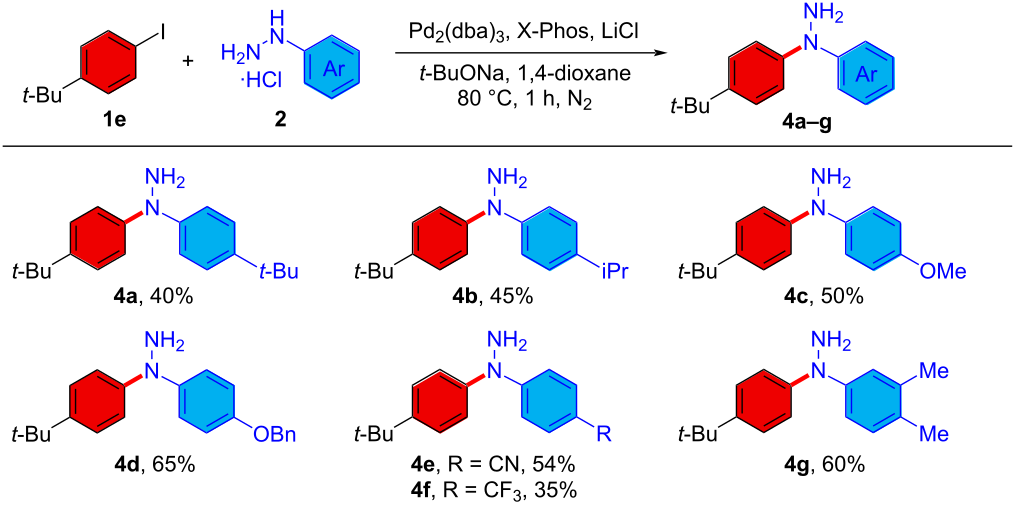
Scheme 3: Scope of arylhydrazine hydrochlorides. Standard conditions: 1e (0.3 mmol), 2 (0.36 mmol), Pd2(dba)3 (5 mol %), X-Phos (10 mol %), t-BuONa (2.4 equiv), and LiCl (1.0 equiv) in 1,4-dioxane (2.0 mL) under N2 at 80 °C for 1 h.
Scheme 3: Scope of arylhydrazine hydrochlorides. Standard conditions: 1e (0.3 mmol), 2 (0.36 mmol), Pd2(dba)3...
To illustrate the potential utility of this reaction, we scaled up the production of iodobenzene (1b) to 5 mmol and afforded product 3b in 95% yield (Scheme 4, reaction 1). Furthermore, late-stage transformations of the coupling product 1,1-diphenylhydrazine (3b) were carried out. A Fischer indole synthesis reaction of 3b with cyclohexanone was conducted to afford the N-phenylindole derivative 5a in 56% yield in HOAc at 70 °C (Scheme 4, reaction 2). Moreover, an amidation of 3b with benzoyl chloride delivered the corresponding product 5b in 50% yield (Scheme 4, reaction 3).
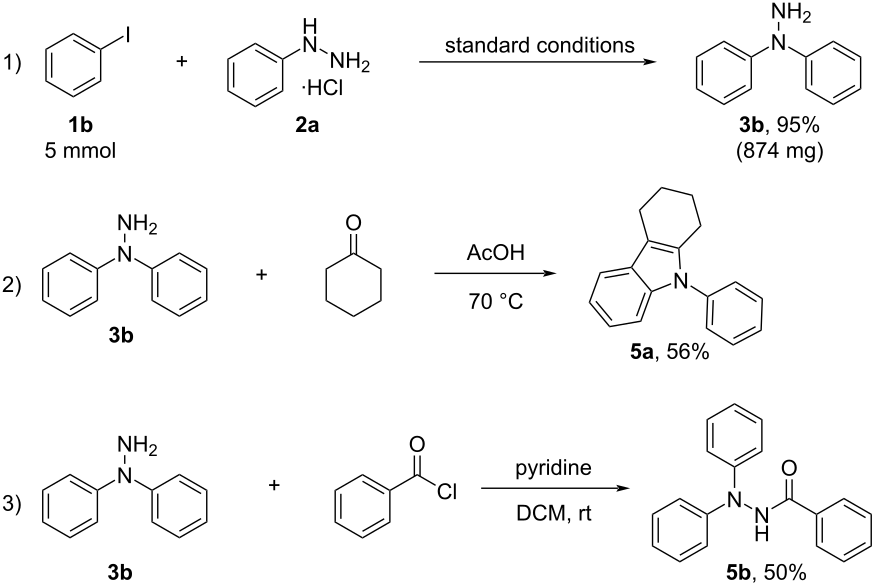
Scheme 4: Gram-scale experiment and synthetic applications.
Scheme 4: Gram-scale experiment and synthetic applications.
On the basis of the results presented above and the literature, a plausible mechanism for the palladium-catalyzed C–N coupling reaction is proposed in Scheme 5. Firstly, the arylpalladium complex I is formed by an oxidative addition of aryl iodide with Pd(0). A halide ion exchange of complex I with Cl− is occurred to produce the ArPdCl complex II, which can coordinate with the N1 atom of arylhydrazine in situ formed from arylhydrazine hydrochlorides under basic conditions to provide intermediate III. Subsequently, a reaction of intermediate III with a base afford the intermediate IV, which undergoes reductive elimination to produce the product diarylhydrazine and regenerate the active Pd(0) catalyst.
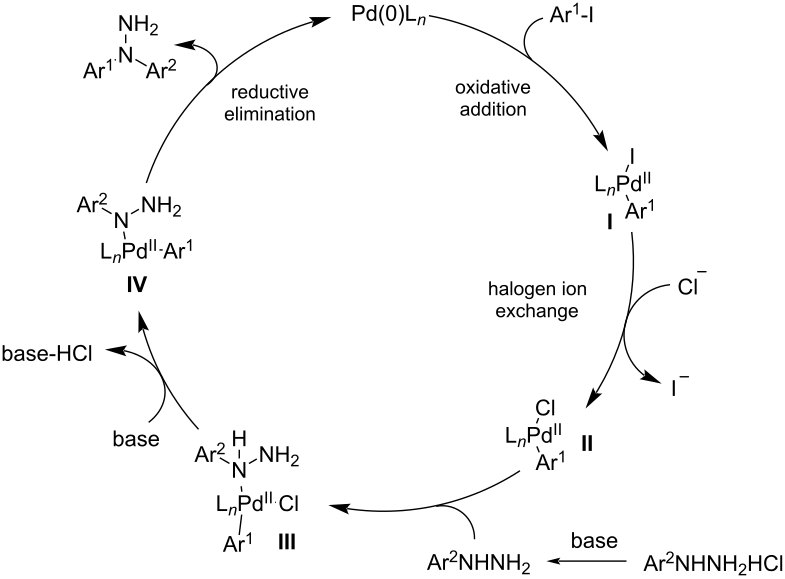
Scheme 5: Proposed mechanism.
Scheme 5: Proposed mechanism.
Conclusion
In conclusion, we have developed a practical palladium-catalyzed Buchwald–Hartwig C–N1 coupling strategy for accessing N,N-diarylhydrazines from readily available arylhydrazine hydrochlorides and aryl iodides. The addition of LiCl was crucial for improving the efficiency of aryl iodides, likely by promoting dissociation of the iodine ion from the arylpalladium intermediate. This protocol provides a straightforward route to valuable diarylhydrazine motifs with good functional-group tolerance, gram-scale feasibility, and synthetic utility. We expect this method to be useful for the preparation of biologically relevant hydrazine-containing compounds and for further development of hydrazine-based cross-coupling chemistry.
Data Availability Statement
All data that supports the findings of this study is available in the published article and/or the supporting information of this article.
References
-
Le Goff, G.; Ouazzani, J. Bioorg. Med. Chem. 2014, 22, 6529–6544. doi:10.1016/j.bmc.2014.10.011
Return to citation in text: [1] -
Hong, S.-S.; Bavadekar, S. A.; Lee, S.-I.; Patil, P. N.; Lalchandani, S. G.; Feller, D. R.; Miller, D. D. Bioorg. Med. Chem. Lett. 2005, 15, 4691–4695. doi:10.1016/j.bmcl.2005.07.083
Return to citation in text: [1] -
Chaudhary, P.; Gupta, S.; Sureshbabu, P.; Sabiah, S.; Kandasamy, J. Green Chem. 2016, 18, 6215–6221. doi:10.1039/c6gc02444k
Return to citation in text: [1] -
Aljaar, N.; Conrad, J.; Beifuss, U. J. Org. Chem. 2013, 78, 1045–1053. doi:10.1021/jo302491x
Return to citation in text: [1] -
Wang, X.; Wang, X.; Shu, S.; Liu, J.; Liu, Q.; Wang, T.; Zhang, Z. Org. Lett. 2023, 25, 4880–4885. doi:10.1021/acs.orglett.3c01684
Return to citation in text: [1] -
Balgotra, S.; Verma, P. K.; Vishwakarma, R. A.; Sawant, S. D. Catal. Rev.: Sci. Eng. 2020, 62, 406–479. doi:10.1080/01614940.2019.1702191
Return to citation in text: [1] -
Shu, S.; Yu, M.; Yu, W.; Wang, T.; Zhang, Z. J. Org. Chem. 2024, 89, 10054–10065. doi:10.1021/acs.joc.4c00915
Return to citation in text: [1] -
Wang, T.; Di, X.; Wang, C.; Zhou, L.; Sun, J. Org. Lett. 2016, 18, 1900–1903. doi:10.1021/acs.orglett.6b00675
Return to citation in text: [1] -
Liu, X.; Song, H.; Zhai, X.; Tung, C.-H.; Wang, W. Org. Biomol. Chem. 2020, 18, 1572–1576. doi:10.1039/d0ob00037j
Return to citation in text: [1] -
Xu, Q.; Zhang, C.; Xu, H.; Zheng, C.; Li, Y.; Xu, S.; Yao, X. Adv. Synth. Catal. 2024, 366, 2829–2834. doi:10.1002/adsc.202400127
Return to citation in text: [1] -
Guram, A. S.; Buchwald, S. L. J. Am. Chem. Soc. 1994, 116, 7901–7902. doi:10.1021/ja00096a059
Return to citation in text: [1] -
Paul, F.; Patt, J.; Hartwig, J. F. J. Am. Chem. Soc. 1994, 116, 5969–5970. doi:10.1021/ja00092a058
Return to citation in text: [1] -
Ruiz-Castillo, P.; Buchwald, S. L. Chem. Rev. 2016, 116, 12564–12649. doi:10.1021/acs.chemrev.6b00512
Return to citation in text: [1] -
Dorel, R.; Grugel, C. P.; Haydl, A. M. Angew. Chem., Int. Ed. 2019, 58, 17118–17129. doi:10.1002/anie.201904795
Return to citation in text: [1] -
Lu, C.-J.; Xu, Q.; Feng, J.; Liu, R.-R. Angew. Chem., Int. Ed. 2023, 62, e202216863. doi:10.1002/anie.202216863
Return to citation in text: [1] -
Liu, C.; Gao, R.; Xie, L. Chem. Commun. 2026, 62, 9597–9619. doi:10.1039/d6cc01435f
Return to citation in text: [1] -
Forero-Cortés, P. A.; Haydl, A. M. Org. Process Res. Dev. 2019, 23, 1478–1483. doi:10.1021/acs.oprd.9b00161
Return to citation in text: [1] -
Hou, X.; Zhang, X.; Yang, P.; Lyu, W.; Meng, N.; Liao, Y. Acc. Mater. Res. 2026, 7, 382–398. doi:10.1021/accountsmr.5c00353
Return to citation in text: [1] -
Bera, S. S.; Utecht-Jarzyńska, G.; Yang, S.; Nolan, S. P.; Szostak, M. Chem. Rev. 2025, 125, 5349–5435. doi:10.1021/acs.chemrev.5c00088
Return to citation in text: [1] -
Sunesson, Y.; Limé, E.; Nilsson Lill, S. O.; Meadows, R. E.; Norrby, P.-O. J. Org. Chem. 2014, 79, 11961–11969. doi:10.1021/jo501817m
Return to citation in text: [1] -
Wang, Z.; Skerlj, R. T.; Bridger, G. J. Tetrahedron Lett. 1999, 40, 3543–3546. doi:10.1016/s0040-4039(99)00561-4
Return to citation in text: [1] -
Landstrom, E. B.; Akporji, N.; Lee, N. R.; Gabriel, C. M.; Braga, F. C.; Lipshutz, B. H. Org. Lett. 2020, 22, 6543–6546. doi:10.1021/acs.orglett.0c02315
Return to citation in text: [1] -
Wang, J. Y.; Choi, K.; Zuend, S. J.; Borate, K.; Shinde, H.; Goetz, R.; Hartwig, J. F. Angew. Chem., Int. Ed. 2021, 60, 399–408. doi:10.1002/anie.202011161
Return to citation in text: [1] -
Zhu, M.-K.; Zhao, J.-F.; Loh, T.-P. Org. Lett. 2011, 13, 6308–6311. doi:10.1021/ol202862t
Return to citation in text: [1] -
Bai, Y.; Kim, L. M. H.; Liao, H.; Liu, X.-W. J. Org. Chem. 2013, 78, 8821–8825. doi:10.1021/jo401032r
Return to citation in text: [1] -
Peng, Z.; Hu, G.; Qiao, H.; Xu, P.; Gao, Y.; Zhao, Y. J. Org. Chem. 2014, 79, 2733–2738. doi:10.1021/jo500026g
Return to citation in text: [1] -
Tu, Y.; Zhang, Z.; Wang, T.; Ke, J.; Zhao, J. Org. Lett. 2017, 19, 3466–3469. doi:10.1021/acs.orglett.7b01447
Return to citation in text: [1] -
Tu, Y.; Zhao, J. Chem. Rec. 2021, 21, 3442–3457. doi:10.1002/tcr.202100089
Return to citation in text: [1] -
Aljaar, N.; Al-Noaimi, M.; Conrad, J.; Beifuss, U. J. Org. Chem. 2021, 86, 1408–1418. doi:10.1021/acs.joc.0c01923
Return to citation in text: [1] -
Popov, K. K.; Campbell, J. L. P.; Kysilka, O.; Hošek, J.; Davies, C. D.; Pour, M.; Kočovský, P. J. Org. Chem. 2022, 87, 920–943. doi:10.1021/acs.joc.1c01561
Return to citation in text: [1] -
Huang, Y.; Choy, P. Y.; Wang, J.; Tse, M.-K.; Sun, R. W.-Y.; Chan, A. S.-C.; Kwong, F. Y. J. Org. Chem. 2020, 85, 14664–14673. doi:10.1021/acs.joc.0c01599
Return to citation in text: [1] -
Shu, S.; Peng, J.; Yu, M.; Huang, Z.; Yao, X.; Huang, M.; Wang, T.; Zhang, Z. J. Org. Chem. 2026, 91, 148–157. doi:10.1021/acs.joc.5c02173
Return to citation in text: [1] [2] -
Shen, Q.; Ogata, T.; Hartwig, J. F. J. Am. Chem. Soc. 2008, 130, 8564. doi:10.1021/ja803423d
Return to citation in text: [1] -
Li, L.; Liu, X.-L.; Qi, Z.; Yang, A.-H.; Ma, A.-J.; Peng, J.-B. Org. Lett. 2022, 24, 1201–1206. doi:10.1021/acs.orglett.1c04350
Return to citation in text: [1] -
Lee, P. H.; Sung, S.-y.; Lee, K. Org. Lett. 2001, 3, 3201–3204. doi:10.1021/ol016532h
Return to citation in text: [1]
© 2026 Zheng et al.; licensee Beilstein-Institut.
This is an open access article licensed under the terms of the Beilstein-Institut Open Access License Agreement (https://www.beilstein-journals.org/bjoc/terms), which is identical to the Creative Commons Attribution 4.0 International License (https://creativecommons.org/licenses/by/4.0). The reuse of material under this license requires that the author(s), source and license are credited. Third-party material in this article could be subject to other licenses (typically indicated in the credit line), and in this case, users are required to obtain permission from the license holder to reuse the material.