Abstract
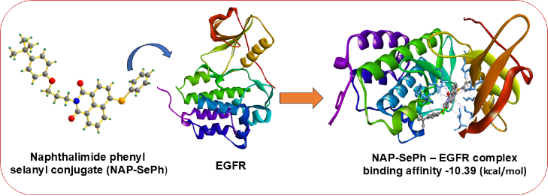
The structure-based approach remains a valuable tool for rapid and high-throughput drug discovery and lead optimisation. In this study, we report the in-silico modelling and anticancer activity of two 1,8-napthalimide (NAP) derivatives containing organyl selanyl groups. The organylselanyl function n-octylselanyl (n-OctSe) or phenylselanyl (PhSe) was introduced at the 6-position of a naphthalimide structure having a conserved 3-(4-(tert-butyl)phenoxy)propyl function at the imide nitrogen. The resultant naphthalimide–organylselanyl conjugates, NAP-SePh and NAP-Se(n-Oct), were characterised using various spectroscopic techniques, including FTIR, ¹H, ¹³C, ⁷⁷Se NMR and high-resolution mass spectrometry (HRMS). NAP-SePh was structurally characterised by single-crystal X-ray diffraction analysis. The anticancer potential of the NAP-SePh and NAP-Se(n-Oct) was evaluated using an in vitro cell viability assay with MDA-MB-231 triple-negative breast cancer (TNBC) cells. The IC₅₀ values for compounds NAP-SePh and NAP-Se(n-Oct) were 27.92 ± 3 µM and 23.06 ± 3 μM, respectively. Molecular docking simulations revealed that NAP-SePh and NAP-Se(n-Oct) show binding affinities of −10.39 and −8.53 kcal/mol for the (1M17) active, and −10.66 and −10.59 kcal/mol for the (4HJO) inactive conformation of the tyrosine kinase domain of the epidermal growth factor receptor (EGFR) in which erlotinib, a well-known anticancer drug, binds.
Graphical Abstract
Introduction
Cancer remains one of the most common and life-threatening diseases globally, posing a serious challenge to health and survival [1,2]. Among its various forms, breast cancer is a major concern, particularly for women, as it accounts for a significant proportion of cancer-related morbidity and mortality worldwide [3]. Breast cancer affects one in ten cancer patients worldwide [4]. The predicted breast cancer mortality rate will increase by 7% in East Asia and 35% in South Asia by 2030 [5]. Early detection enables identification at an earlier stage, when treatment is more effective, and survival rates are significantly higher [6]. Breast cancer is divided into luminal A (ER+/PR+/HER2−, Ki-67 low), luminal B (ER+/PR+/HER2+ or HER2−, Ki-67 high), HER2-positive, triple-negative (lacking ER, PR, and HER2 expression), and triple-positive (ER+/PR+/HER2+) subtypes [7]. Among these, breast cancer accounts for 10–20% of triple-negative breast cancer (TNBC) cases [8]. Notably, TNBC accounts for roughly 39% of breast cancer diagnoses in African American women before menopause, although the prevalence drops to about 15% among postmenopausal women [9]. Moreover, EGFR is the most frequently overexpressed receptor in TNBC compared to other breast cancer subtypes. Current therapeutic strategies for TNBC are often inadequate, with limited effectiveness for many patients, underscoring the urgent need for novel treatment approaches. In particular, the development of new small-molecule EGFR tyrosine kinase inhibitors holds significant promise, as there is currently no highly effective approved therapy targeting EGFR in TNBC [10]. Selenium is one of the vital trace elements with numerous health benefits. Its adequate intake is essential, as a minimum quantity is required to support normal physiological functions [11,12]. Adults should eat at least 55 μg of selenium per day. However, the exact quantity varies by age, gender, food, and locality [13]. A lack of selenium is associated with several illnesses, particularly in children, including stunted growth, compromised immunity, and an increased risk of developing diseases such as Keshan disease [14,15]. Among the selenium-containing compounds, selenoproteins, incorporating selenocysteine, the 21st amino acid, are of special importance due to their essential role in various biochemical processes [16,17]. Inspired by natural biosynthetic pathways, synthetic chemists have developed novel low-molecular-weight organoselenium compounds, many of which exhibit promising applications in medicinal chemistry [18,19]. Selenium has been incorporated into non-steroidal anti-inflammatory drugs (NSAIDs) and histone deacetylase (HDAC) inhibitors, both of which show considerable potential in anticancer therapy [20,21]. Over the last few decades, researchers have increasingly focused on developing novel organoselenium compounds as potential chemopreventive and anticancer agents [22-26]. Among these, the structures of a few representative examples are illustrated in Figure 1. Notably, the second-generation organoselenium compound methylseleninic acid (1) has emerged as a promising drug candidate for the treatment of triple-negative breast cancer (TNBC) [27]. In addition, the classical organoselenium compound diphenyl diselenide (2) has shown significant anticancer activity against the MDA-MB-231 breast cancer cell line [28]. Very recently, a 4-nitro-substituted benzylic diselenide 3 was reported to inhibit the Akt/mTOR and ERK pathways while suppressing NF-κB–mediated inflammation and invasiveness in TNBC cells [29]. On the other hand, naphthalimides (NAP) are well known for their potent anticancer activity, as exemplified by the parent compounds amonafide (4) and mitonafide (5), which have progressed to clinical trials but exhibited unpredictable toxicity [30]. Consequently, recent research has focused on minimising these adverse effects while enhancing antiproliferative potency through diverse synthetic modifications [31]. One major strategy involves fused-ring modification, wherein heteroatoms such as azo or thiol groups are introduced either linearly at the 4,5-position or laterally at the 5,6-position of the naphthalimide ring [32-37]. A second approach involves positional substitution, shifting functional groups from the 5-position to the 6-position to prevent N-acetylation-related side effects and enhance antitumor efficacy [38,39]. Notably, a series of naphthalimide derivatives bearing sulfur-containing secondary or tertiary amine functions at the 6-position of naphthalimide have gained attention, as secondary amino functions strongly suppress acetylation and the embedded sulfur function contributes to the apoptosis induction [40,41].The third modification route centres on functional group engineering, in which small amine substituents are replaced with polyamines or long aliphatic chains, thereby enhancing lysosomal membrane permeability and aqueous solubility [42]. Interestingly, for the first time, N-(n-octyl) chain substitution has been shown to demonstrate remarkable anticancer activity, particularly through tyrosine kinase inhibition, without significant DNA intercalation [43]. Among these derivatives, N-(n-octyl) substitution at the 6-position exhibits a more pronounced effect as compared to octyl substitutions linked to the imide nitrogen of the naphthalimide ring [44]. Furthermore, comparative studies between sulfur- and selenium-containing naphthalimide analogues revealed that the selenium-based naphthalimide derivative, particularly selenomorpholine 6, displays the highest anticancer activity against K562 and MCF-7 cell lines [41]. While the -CH2-CH2-NMe2 group is routinely attached to the imide nitrogen of the naphthalimide, attachment of simple alkyl groups to the imide nitrogen of naphthalimide has also been explored to a considerable extent [45,46]. In general, the tert-butyl group has attracted considerable attention in drug design and synthesis due to its lipophilic character [47,48]. From the above-mentioned point of view, we have changed both sides of the substitution with a new class of hydrophobic function (3-(4-(tert-butyl)phenoxy)propyl group) at the imide nitrogen and phenyl selanyl and octyl selanyl groups at the 6-position of naphthalimide to provide the naphthalimide-organyl selanyl conjugates 7 and 8. The molecular structures of these derivatives feature multivalent binding components, including electron-deficient, electron-rich, and hydrophobic regions, which offer greater affinities towards biological targets. Structures of these compounds were confirmed through various spectroscopic analyses. The structure of compound 7 was confirmed using single-crystal XRD analyses, and structure and electronic properties were further investigated using density functional theory (DFT) calculations. Cytotoxicity tests were used to assess the anticancer potential of both conjugates, and it was found that both compounds showed notable activity against the test MDA-MB-231 breast cancer cell line. Molecular docking simulation revealed strong binding interaction and affinities towards the tyrosine kinase domain of epidermal growth factor receptor (EGFR), and the protein–ligand interaction resembles the interaction found in the co-crystallised protein–erlotinib complex.
![[1860-5397-22-29-1]](/bjoc/content/figures/1860-5397-22-29-1.svg?scale=2.0&max-width=1024&background=FFFFFF)
Figure 1: Representative structures of organoselenium compounds and naphthalimide derivatives are reported as anticancer drug molecules.
Figure 1: Representative structures of organoselenium compounds and naphthalimide derivatives are reported as...
Result and Discussion
Chemistry
Scheme 1 illustrates the synthesis of naphthalimide-organylselanyl conjugates 7 and 8. The incorporation of the organoselenide moiety into the naphthalimide scaffold was achieved via a nucleophilic substitution reaction. The bromine atom in the bromonaphthalimide precursor 12, prepared from 9 via 10 and 11 using a reported protocol [49], was replaced with an organylselanyl function. Two different organyl selenolates, phenyl selenolate and n-octyl selenolate, derived respectively from diphenyl diselenide [50] and di-n-octyl diselenide [51], were employed as nucleophiles for this transformation. The phenyl selenolate is widely used in organoselenium chemistry as a source of selenium due to its high reactivity toward halogenated substrates and excellent chemical stability. The n-octyl selenolate is comparatively less explored but readily undergoes substitution reactions with halogenated compounds, making it a viable alternative for introducing long alkyl chains into selenium-containing systems towards lysosomal membrane permeability (vide supra) [42-44]. After synthesis, compounds 7 and 8 were thoroughly characterised using multinuclear NMR spectroscopy ¹H, ¹³C, and ⁷⁷Se NMR (Supporting Information File 1, S11–S13 and S16–S18). In the ¹H NMR spectrum of compound 7, the tert-butyl protons appeared as a singlet at 1.27 ppm. The protons of the propylene linker chain resonated in the aliphatic region at 2.22, 4.08, and 4.37 ppm. The aromatic protons of the tert-butyl-substituted phenyl ring appeared at 6.77 and 7.25 ppm, while the naphthalimide aromatic protons were observed between 7.53 and 8.62 ppm. Additionally, the aryl protons adjacent to the selenium atom appeared as a one multiplet at 7.41 and one doublet at 7.60 ppm [52]. For compound 8, characteristic aliphatic 1H resonance signals corresponding to the octyl chain attached to the selenium were observed. A triplet at 0.87 ppm was assigned to the terminal methyl (-CH₃) protons, a multiplet peak at 1.27 ppm corresponds to the methylene protons adjacent to the methyl group, and two quintet peaks in the range of 1.47 and 1.80 ppm and one triplet at 3.13 ppm were attributed to the remaining methylene protons located near the selenium atom [51].
![[1860-5397-22-29-i1]](/bjoc/content/inline/1860-5397-22-29-i1.svg?scale=2.0&max-width=1024&background=FFFFFF)
Scheme 1: Reagents and conditions for the step-wise synthesis of diorganyl monoselenides 7 and 8: (a) N-(3-bromopropyl) phthalimide, K2CO3, CH3CN, reflux 48 h, yield 53%; (b) hydrazine hydrate, ethanol, reflux 8 h, yield 48%; (c) 4-bromo-1,8-naphthalic anhydride, ethanol, reflux 2 h, yield 66%; (d) diphenyl diselenide, NaBH4, DMSO and THF, rt, 1.5 h, yield 54%; (e) dioctyl diselenide, DMSO and THF, rt, 1 h, yield 76%.
Scheme 1: Reagents and conditions for the step-wise synthesis of diorganyl monoselenides 7 and 8: (a) N-(3-br...
In the 13C NMR spectra, distinct chemical shift differences were observed between compounds 7 and 8, due to the small structural differences between them. For compound 7, with reference to 13C NMR signals of the starting material 12, the 13C NMR spectrum of compound 7 exhibits four additional aromatic carbon resonances, which are consistent with the phenyl ring carbons of phenyl selanyl function tethered to the naphthalimide core. The signal at 142 ppm is assigned to the ipso carbon directly attached to the selenium atom. The resonance observed at 136 ppm corresponds to the chemically equivalent ortho carbons. The meta carbons appear as a single signal at 130 ppm, while the para carbon is observed at 127 ppm. The reduced number of aromatic signals arises from the chemical equivalence of the ortho and meta carbon pairs, confirming the proposed structure. In contrast, with reference to the 13C NMR signals of starting material 12, compound 8 exhibited eight new 13C NMR peaks in the aliphatic region (14–32 ppm), which is attributed to the incorporation of an octyl selenide unit into the naphthalimide framework. These differences highlight the distinct electronic environments introduced by the aryl and octyl selenium substituents. The 77Se NMR spectral data provide further confirmation. Compound 7 exhibited a 77Se NMR resonance peak at 393 ppm, while compound 8 showed a more shielded signal at 268 ppm. The upfield shift in octyl selenide 8 is attributed to increased shielding around the selenium centre, likely resulting from the inductive electron-donating effect of the n-octyl group. The observed chemical shift values are consistent with previously reported data for related selenium-containing systems [51,52]. The ESI-HRMS mass spectral data of compound 7 showed a molecular ion peak [M + H]+ at m/z 544.1407, which is consistent with the calculated m/z value of 544.1385. For compound 8, the observed molecular ion peaks revealed extensive fragmentation of the molecular ion. However, as shown in Supporting Information File 1, Figure S19, a representative fragment ion with a m/z value of 318.0028 could be matched with naphthalimide selenenium cation, having a calculated m/z value of 318.0028.
Single-crystal X-ray diffraction analysis of compound 7
A single crystal of compound 7 was obtained by slow evaporation of a chloroform–methanol mixture (1:3 v/v). Single-crystal X-ray diffraction analysis revealed that compound 7 crystallises in the triclinic crystal system with the space group ![[Graphic 10]](/bjoc/content/inline/1860-5397-22-29-i11.svg?max-width=637&scale=1.18182) . The crystal structure of compound 7 is shown in Figure 2a. It shows a typical V-shaped geometry around the selenium atom. The structure reveals the four distinct intermolecular interactions that facilitate the self-assembly in the crystal packing. The first is a chalcogen bonding interaction (Se···Se) [53], as shown in Figure 2b, in which one aryl selenide molecule linearly connects to another, with a Se···Se distance of 3.703 Å. The second is a selenium–carbon (Se···C) interaction as shown in Figure 2c, where the molecules are arranged in a top-down orientation [54]. In this orientation, the Se motif of one molecule interacts with the carbonyl carbon of another molecule, showing the Se···C distance of 3.588 Å. Third and fourth, as shown in Supporting Information File 1, Figure S20, the intermolecular interaction of C–H···O, having an H···O distance of 2.544 Å and the (π···π) interaction having a C···C distance of 3.376 Å, stabilise and glue the self-assembled architecture in the solid state structure of the compound 7. All the above-mentioned non-bonded interaction distances are shorter than the sum of the van der Waals radii of the respective elements in contact [55].
. The crystal structure of compound 7 is shown in Figure 2a. It shows a typical V-shaped geometry around the selenium atom. The structure reveals the four distinct intermolecular interactions that facilitate the self-assembly in the crystal packing. The first is a chalcogen bonding interaction (Se···Se) [53], as shown in Figure 2b, in which one aryl selenide molecule linearly connects to another, with a Se···Se distance of 3.703 Å. The second is a selenium–carbon (Se···C) interaction as shown in Figure 2c, where the molecules are arranged in a top-down orientation [54]. In this orientation, the Se motif of one molecule interacts with the carbonyl carbon of another molecule, showing the Se···C distance of 3.588 Å. Third and fourth, as shown in Supporting Information File 1, Figure S20, the intermolecular interaction of C–H···O, having an H···O distance of 2.544 Å and the (π···π) interaction having a C···C distance of 3.376 Å, stabilise and glue the self-assembled architecture in the solid state structure of the compound 7. All the above-mentioned non-bonded interaction distances are shorter than the sum of the van der Waals radii of the respective elements in contact [55].
![[1860-5397-22-29-2]](/bjoc/content/figures/1860-5397-22-29-2.png?scale=2.0&max-width=1024&background=FFFFFF)
Figure 2: a) ORTEP diagram of compound 7 with thermal ellipsoids drawn at the 50% probability, b) and c) show Se···Se and Se···C intermolecular interaction in compound.
Figure 2: a) ORTEP diagram of compound 7 with thermal ellipsoids drawn at the 50% probability, b) and c) show...
Computational analysis
To further evaluate the energy-minimised structures useful for molecular characteristics and electronic properties of compounds 7 and 8, geometry optimisations and frequency calculations were performed using density functional theory (DFT) with the B3LYP functional and the 6-31G(d,p) basis set, as shown in Figure 3 [56,57]. The input structure of compound 7 was obtained from a single-crystal XRD coordinate file, while the structure of compound 8 was constructed using Gaussian tools. The C–Se–C bond angle computed from the gas phase optimised structure of 7 is 97.8°. It is in good agreement with the bond angle (102.5°) observed from the solid-state structure of 7. Due to steric reasons, the phenyl plane moves perpendicular to the naphthalimide plane. A similar C–Se–C angle, 97.4°, has been noticed in the gas phase optimised structure of compound 8, and the n-octyl group orients out of plane with respect to the naphthalimide plane. It shows the limited rotational motion around the selenium center. The second important feature is the torsional motion in the propylene linker attached to the imide nitrogen of the naphthalimide core. The calculated O–C–C–C torsional angle from the gas-phase structure of 7 is −61.5°. The observed torsional angle from the solid-state structure of 7 is −69.7°. This shows good agreement between the solid-state and gas-phase geometries of 7. In contrast, although a solid-state structure is not available, the computed O–C–C–C torsional angle from the gas-phase geometry of 8 is 179.7°. The comparison of the computed torsional angles between the two compounds indicates considerable torsional motion permissible across the propylene linker. This motion is relevant in the solution phase. While a direct correlation could not be made between the solid-state structure and the gas-phase (or solution-phase) geometry, the calculation reveals that a considerable degree of freedom is available across the propylene linker. Therefore, the optimised geometries were treated as one of the possible local minima and subsequently used for all analyses, including molecular docking studies, performed in this work.
![[1860-5397-22-29-3]](/bjoc/content/figures/1860-5397-22-29-3.png?scale=2.0&max-width=1024&background=FFFFFF)
Figure 3: DFT optimised structure of compounds a) 7 and b) 8.
Figure 3: DFT optimised structure of compounds a) 7 and b) 8.
FMO analysis of the compounds 7 and 8
The optimised geometries of compounds 7 and 8 were used to compute the frontier molecular orbitals (FMOs), the highest occupied molecular orbital (HOMO) and the lowest unoccupied molecular orbital (LUMO) [58]. The FMO analysis, as shown in Figure 4, provides insight into the electronic distribution and the HOMO–LUMO energy gap, which are key parameters for understanding the compound's chemical reactivity and stability. In both compounds, the HOMO is mainly localised on the tert-butyl-substituted phenyl ring, while the LUMO is localised on the naphthalimide moiety. For both structures, the estimated energy gaps are around 3 eV. Compound 7 has an energy gap of 3.098 eV, having HOMO and LUMO energies of −5.6153 eV and −2.5170 eV, respectively (Figure 4a). Compound 8 has an energy gap of 3.049 eV with HOMO and LUMO energies of −5.6036 eV and −2.5546 eV, respectively (Figure 4b). These values indicate that compounds 7 and 8 have similar electronic structure and stability.
![[1860-5397-22-29-4]](/bjoc/content/figures/1860-5397-22-29-4.png?scale=2.0&max-width=1024&background=FFFFFF)
Figure 4: HOMO, LUMO, and the energy gap of the compounds: a) 7 and b) 8.
Figure 4: HOMO, LUMO, and the energy gap of the compounds: a) 7 and b) 8.
The computed HOMO–LUMO gaps for the compounds are in good agreement with the experimentally measured HOMO–LUMO gaps measured using UV–visible spectroscopy. The UV–visible absorption spectra of compounds 7 and 8 were recorded in chloroform at a concentration of 2 × 10⁻⁵ M, as shown in Supporting Information File 1, Figure S21. Both compounds have slightly similar absorption bands. Compound 7 shows an absorption maximum at 395 nm as a broad band peak. In comparison to compound 7, compound 8 displays a slight bathochromic (red) shift, with absorption maxima at 402 nm as a broad band peak. The band observed at 395 nm (for 7) and 402 nm (for 8) is attributed to π–π* electronic transitions of the selenium-containing naphthalimide derivatives [59]. The corresponding theoretical energies for compounds 7 and 8 were determined to be 3.139 eV for compound 7 and 3.084 eV for compound 8 based on their experimental absorption wavelengths. Compound 7 (3.098 eV) and compound 8 (3.048 eV) DFT-calculated HOMO–LUMO energy gaps agree well with the energy values obtained through experimentation.
Mulliken charge analysis (MCA) of the compounds 7 and 8
The MCA of the compounds 7 and 8, as shown in Figure 5, reveals important insights into their electronic structures relevant to biomedical applications [60]. For compound 7, nitrogen and oxygen atoms exhibited high negative charges of −0.588 (N), −0.533 (O1), −0.511 (O2), and -0.500 (O3) as shown in Figure 5a. Similarly, for compound 8, the charges were −0.588 (N), −0.539 (O1), −0.506 (O2), and −0.506 (O3) as shown in Figure 5b. The selenium atom displayed Mulliken charge values of −0.045 and −0.039 for compounds 7 and 8, respectively. The carbonyl carbon of the naptthalimide ring features relatively positive character for (C1) and (C2), with a Mulliken charge value of 0.597 for compound 7, and for compound 8, (C1) and (C2) are 0.598 and 0.599. This electron charge distribution clearly indicates that the nitrogen atom has a more negative character than oxygen and selenium. Still, the oxygen atom has a significant negative character that enables it to form a hydrogen bonding interaction with the active site amino acid residue of the proteins.
![[1860-5397-22-29-5]](/bjoc/content/figures/1860-5397-22-29-5.png?scale=2.0&max-width=1024&background=FFFFFF)
Figure 5: Mulliken atomic charge of the compounds: a) 7 and b) 8.
Figure 5: Mulliken atomic charge of the compounds: a) 7 and b) 8.
MEP analysis of compounds 7 and 8
The molecular electrostatic potential (MEP) maps of compounds 7 and 8 are depicted in Figure 6a and 6b, respectively. The MEP analysis provides vital insights into the electronic characteristics of atoms within a molecule [61]. In the MEP maps, the colour distribution follows the order blue, green, and red, representing increasing electrostatic potential. The blue regions correspond to more electropositive areas, while the red regions indicate more electronegative areas. For both compounds 7 and 8, the oxygen atoms exhibit the highest electronegativity, indicating potential nucleophilicity and the ability to readily participate in hydrogen bonding with amino acids through non-covalent interactions. Overall, MEP mapping reveals the reactive surface characteristics of the compounds and highlights the region most likely to engage in molecular recognition processes.
![[1860-5397-22-29-6]](/bjoc/content/figures/1860-5397-22-29-6.png?scale=2.0&max-width=1024&background=FFFFFF)
Figure 6: MEP analysis of the compounds: a) 7 and b) 8.
Figure 6: MEP analysis of the compounds: a) 7 and b) 8.
Biology
In-vitro cytotoxicity study
The in vitro anticancer activity of the compounds 7 and 8 was evaluated against the MDA-MB-231 triple-negative breast cancer cell line using the MTT assay [62,63]. To determine the accurate IC₅₀ value, triplicate average measurements and standard deviation were used for calculation. The IC₅₀ values of compound 7 (Figure 7a) and compound 8 (Figure 7b) were found to be 27.92 ± 3 µM and 23.06 ± 3 µM, respectively. The compounds exhibited significant, dose-dependent cytotoxicity, with cell viability decreasing as the concentration increased. Notably, both compounds demonstrated comparable cytotoxic effects against the tested cancer cell line.
![[1860-5397-22-29-7]](/bjoc/content/figures/1860-5397-22-29-7.png?scale=2.0&max-width=1024&background=FFFFFF)
Figure 7: log concentration (µM) vs cell viability (%) of compounds of a) 7 and b) 8.
Figure 7: log concentration (µM) vs cell viability (%) of compounds of a) 7 and b) 8.
To assess the significance of variations between concentration and cell viability, one-way ANOVA was performed using GraphPad Prism software [64], as shown in Figure 8, comparing the control group to each test concentration of the compound 7 (Figure 8a) and compound 8 (Figure 8b). The results showed no significant differences between the control and 6.12 µM concentrations. However, significant changes were seen among higher concentrations (12.25 µM, 25 µM, 50 µM, 100 µM, and 200 µM). All showed the same degree of multifold significance with a p-value of p < 0.0001.
![[1860-5397-22-29-8]](/bjoc/content/figures/1860-5397-22-29-8.png?scale=2.0&max-width=1024&background=FFFFFF)
Figure 8: Significant difference of control vs concentration: a) compound 7, b) compound 8.
Figure 8: Significant difference of control vs concentration: a) compound 7, b) compound 8.
The IC₅₀ values of the synthesised naphthalimide conjugates 7 and 8 were compared with those of standard anticancer drugs, such as erlotinib and gefitinib, as well as previously reported selenium- and naphthalimide-based compounds (Table 1). The comparison shows that compounds 7 and 8 have IC₅₀ values in the upper range relative to the standard drugs erlotinib and gefitinib. However, their IC₅₀ values are comparable to or lower than those of the naphthalimide-based anticancer agents. These results indicate that the synthesised naphthalimide-organylselanyl conjugates 7 and 8 possess considerable anticancer activity against the MDA-MB-231 breast cancer cell line.
Table 1: Comparison table showing the IC50 values of known drug molecules.
| Drug molecule | Structure of the drugs molecules | Cell line | IC50 (μM) | Ref |
| erlotinib |
![[Graphic 1]](/bjoc/content/inline/1860-5397-22-29-i2.svg?max-width=637&scale=1.0)
|
MDA-MB-231 | 7.0 | [65] |
| gefitinib |
![[Graphic 2]](/bjoc/content/inline/1860-5397-22-29-i3.svg?max-width=637&scale=1.0)
|
MDA-MB-231 | 16.5 | [65] |
| ebselen oxide |
![[Graphic 3]](/bjoc/content/inline/1860-5397-22-29-i4.svg?max-width=637&scale=1.0)
|
MDA-MB-231 | 10 | [66] |
| naphthalimide–artesunate conjugates |
![[Graphic 4]](/bjoc/content/inline/1860-5397-22-29-i5.svg?max-width=637&scale=1.0)
|
MDA-MB-231 | 45.93 | [67] |
| 1,8-naphthalimide piperazinamide-based benzenesulfonamides |
![[Graphic 5]](/bjoc/content/inline/1860-5397-22-29-i6.svg?max-width=637&scale=1.0)
|
MDA-MB-231 | 30.45 ±2.75 | [68] |
| EDA-71 |
![[Graphic 6]](/bjoc/content/inline/1860-5397-22-29-i7.svg?max-width=637&scale=1.0)
|
MDA-MB-231 | 1.40 ± 0 | [69] |
| E-NS-4 |
![[Graphic 7]](/bjoc/content/inline/1860-5397-22-29-i8.svg?max-width=637&scale=1.0)
|
MDA-MB-231 | 4.52 ± 0.3 | [69] |
| 7 |
![[Graphic 8]](/bjoc/content/inline/1860-5397-22-29-i9.svg?max-width=637&scale=1.0)
|
MDA-MB-231 | 27.92 ± 3 | this work |
| 8 |
![[Graphic 9]](/bjoc/content/inline/1860-5397-22-29-i10.svg?max-width=637&scale=1.0)
|
MDA-MB-231 | 23.06 ± 3 | this work |
Molecular docking study
Following the in vitro cytotoxicity test, molecular docking studies were carried out to obtain a deeper understanding of the behaviour of compounds 7 and 8. It is crucial to understand that these compounds' molecular structure, which establishes important properties like molecular flexibility and their capacity to form different non-covalent interactions with the target protein, has a significant impact on their anticancer potential. The binding interactions of compounds 7 and 8 with the active (1M17) and inactive (4JHO) EGFR tyrosine kinase domain are summarised in Table 2. The ligand structure of compound 7 was obtained from a single-crystal XRD coordinate file, whereas the structure of compound 8 was derived from DFT energy minimisation. Both ligand structures were converted into PDB format for molecular docking studies using the crystal structures of EGFR tyrosine kinase in active conformation (1M17) and inactive conformation (4HJO). The docking results revealed that both ligands fit well within the binding pocket of the EGFR tyrosine kinase domain. The binding interactions were further validated by comparison with the crystal structures of the active (1M17) and inactive (4HJO) forms of EGFR complexed with the co-crystallised ligand erlotinib, which is known for its affinity towards both conformations of the receptor [70]. Notably, compounds 7 and 8 exhibited interaction patterns closely resembling the binding interaction of erlotinib within the respective binding sites.
Table 2: The binding interactions of active (1M17) and inactive (4HJO) EGFR tyrosine kinase with compounds 7 and 8.
|
Target
protein |
PDB ID | Compounds |
Binding
affinity (kcal/mol) |
Interaction
type |
Binding site residue(s) |
| EGFR | 1M17 | 7 | −10.39 |
van der Waals
H-bond |
Gly 772
Met 769 |
| C–H bond | Met 769 | ||||
| π–donor | Thr 766 | ||||
| π–σ | Leu 820 | ||||
| π–sulfur | Met 742 | ||||
| amide–π | Phe 771 | ||||
| alkyl | Leu 694 | ||||
| π–alkyl | Val 702, Ala 719, Lys 721, Leu 764, | ||||
| 8 | −8.53 | van der Waals | Pro 770 | ||
| H-bond | Met 769 | ||||
|
C–H bond
π–anion |
Thr 766
Asp 831 |
||||
| π–σ | Leu 694 | ||||
| amide–π | Met 769 | ||||
|
alkyl
π–alkyl |
His 781
Val 702, Ala 719, Leu 768, Leu 820 |
||||
| 4HJO | 7 | −10.66 | H-bond | Met 769 | |
| π–donor | Thr 766 | ||||
| π–σ | Leu 694, Val 702, Leu 820, | ||||
| π–lone pair | Phe 771 | ||||
| alkyl | Leu 694 | ||||
| π–alkyl | Ala 719, Lys 721 | ||||
| 8 | −10.59 | H-bond | Met 769 | ||
| C–H bond | Thr 766 | ||||
| π–donor | Thr 766 | ||||
|
π–σ
alkyl |
Leu 694
Val 702, Leu 753, Tyr 777, His 781, Leu 834 |
||||
| π–alkyl | Ala 719, Lys 721, Leu 764, Leu 820 | ||||
Comparative binding interaction of compounds 7 and 8 with the active (1M17) tyrosine kinase domain of EGFR
The epidermal growth factor receptor (EGFR) of the active tyrosine kinase domain in complex with erlotinib was retrieved from the Protein Data Bank (PDB ID: 1M17, https://doi.org/10.2210/pdb1M17/pdb, [71]) and subjected to molecular docking with 7 and 8. The compounds 7 and 8 exhibited binding affinity values of −10.39 kcal/mol and −8.53 kcal/mol with the active conformation 1M17 of the EGFR tyrosine kinase domain [72]. The 2D and 3D binding interaction of compounds 7 and 8 is shown in Figure 9a and 9b. Compound 7 established nine key interactions: van der Waals (Gly772), hydrogen bonding and carbon–hydrogen bonding (Met769), π–donor (Thr766), π–σ (Leu820), π–sulfur (Met742), amide–π (Phe771), alkyl (Leu694), and π–alkyl interactions (Val702, Ala719, Lys721, Leu764). In contrast, compound 8 formed eight interactions: van der Waals (Pro770), hydrogen bonding (Met769), carbon–hydrogen bonding (Thr766), π–anion (Asp831), π–σ (Leu694), amide–π (Met769), alkyl (His781), and π–alkyl (Val702, Ala719, Leu768, Leu820). These results confirm that both ligands are well accommodated within the binding pocket of EGFR tyrosine kinase, with compound 7 showing stronger binding, attributed to its additional π–sulfur interaction with Met742. The hydrogen-bonding interaction observed between the naphthalimide carbonyl oxygen and the Met-742 hydrogen atom correlates well with the negative Mulliken charge (vide supra), suggesting that the negatively charged carbonyl oxygen surface promotes hydrogen-bond formation. The binding site interactions of compounds 7 and 8 with the tyrosine kinase were further validated by comparison with the crystal structure of 1M17 with co-crystallised ligand erlotinib (Figure 9c), showing that both compounds form similar active site interactions to those observed for erlotinib. Both erlotinib and the synthesised ligands formed a hydrogen bond interaction with Met769. The synthesised ligands have a greater ability to form an interaction with the active (1M17) tyrosine kinase domain of EGFR.
![[1860-5397-22-29-9]](/bjoc/content/figures/1860-5397-22-29-9.png?scale=2.0&max-width=1024&background=FFFFFF)
Figure 9: 2D and 3D binding interaction of active (1M17) EGFR tyrosine kinase and synthesised compounds: a) 7 and b) 8, c) 2D interaction of crystal structure 1M17 and co-crystalised ligand erlotinib (PDB ID: 1M17).
Figure 9: 2D and 3D binding interaction of active (1M17) EGFR tyrosine kinase and synthesised compounds: a) 7...
Comparative binding interaction of compounds 7 and 8 with the inactive (4HJO) tyrosine kinase domain of EGFR
The epidermal growth factor receptor (EGFR) inactive tyrosine kinase domain in complex with erlotinib was retrieved from the Protein Data Bank (PDB ID: 4HJO, https://doi.org/10.2210/pdb4HJO/pdb, [70]) and subjected to molecular docking with 7 and 8. The compounds 7 and 8 exhibited binding affinity values of −10.66 kcal/mol and −10.59 kcal/mol, respectively, with the inactive conformation 4HJO of the EGFR tyrosine domain [73]. The 2D and 3D binding interaction of compounds 7 and 8 is shown in Figure 10a and 10b. Compound 7 formed six major interactions: hydrogen bonding (Met769), π–donor (Thr766), π–σ (Leu694, Val702, Leu820), π–lone pair (Phe771), alkyl (Leu694), and π–alkyl interactions (Ala719, Lys721). By comparison, compound 8 formed six interactions: hydrogen bonding (Met769), carbon–hydrogen bonding (Thr766), π–donor (Thr766), π–σ (Leu694), alkyl interactions (Val702, Leu753, Tyr777, His781, Leu834), and π–alkyl interactions (Ala719, Lys721, Leu764, Leu820). Both compounds exhibit similar interactions with the tyrosine kinase domain, with no significant difference in the binding energy values between compounds 7 and 8. Comparison with the crystal structure of 4HJO co-crystallised ligand erlotinib (Figure 10c) further confirmed that the synthesised ligands exhibit a similar interaction pattern within the inactive tyrosine kinase domain of the EGFR. The compounds 7 and 8 possess well-defined structural features comprising both hydrophobic and electron-rich/electron-deficient regions, enabling them to interact effectively with the active and inactive forms of the tyrosine kinase domain of the EGFR receptor. While the docking studies reveal a significant binding affinity of the synthesised compounds towards the EGFR receptor, further studies are required to understand the extent of specificity towards the targets.
![[1860-5397-22-29-10]](/bjoc/content/figures/1860-5397-22-29-10.png?scale=2.0&max-width=1024&background=FFFFFF)
Figure 10: 2D and 3D binding interaction of inactive (4HJO) EGFR tyrosine kinase and synthesised compounds: a) 7 and b) 8, c) 2D interactions of crystal structure 4HJO and co-crystalised ligand erlotinib (PDB ID: 4HJO).
Figure 10: 2D and 3D binding interaction of inactive (4HJO) EGFR tyrosine kinase and synthesised compounds: a) ...
Conclusion
The selenium-incorporated naphthalimide–organoselanyl conjugates, selenides 7 and 8, were extensively characterised using various spectroscopic and analytical techniques, and the molecular structure of compound 7 was further confirmed by single-crystal X-ray diffraction analysis. in vitro cytotoxicity studies against the MDA-MB-231 triple-negative breast cancer cell line demonstrated significant anticancer activity, with IC50 values of 27.92 ± 3 µM and 23.06 ± 3 µM for compounds 7 and 8, respectively, and the molecular docking simulations revealed that compounds 7 and 8 fit well within the active (1M17) and inactive (4HJO) binding pockets of the epidermal growth factor receptor (EGFR) tyrosine kinase. Their binding modes were consistent with that of the co-crystallised inhibitor erlotinib, which confirms similar types of non-covalent interactions. Altogether, the in-vitro cell line study and the molecular docking simulation showed that the compounds 7 and 8 have considerable anticancer activity against the breast cancer cell line of MDA-MB-231. Overall, this study provides valuable insight into the design of new naphthalimide selenium-based lead molecules as promising candidates for potent chemotherapeutic anticancer agents. Further studies are underway to probe the extent of specificity of these compounds towards the EGFR receptor.
Experimental
General procedure
All syntheses were carried out under a nitrogen atmosphere using standard Schlenk line methods. Reagents and solvents were obtained from GK Life Sciences Pvt. Ltd. and used without further purification unless otherwise stated. Thin-layer chromatography (TLC) was performed on silica-gel-coated aluminium sheets (silica gel 60 F254). Nuclear magnetic resonance (NMR) spectra were recorded on a Bruker Avance 400 MHz FT-NMR and a Bruker Avance III 500 MHz spectrometer. 1H, 13C, and 77Se NMR spectra were acquired in CDCl3, with chemical shifts (δ) reported in ppm. Singlet (s), doublet (d), doublet of doublets (dd), triplet (t), multiplet (m), quintet (quint) and other symbols are used to represent signal multiplicities, and Hz is used to denote the coupling constants (J). The spectra were compared to residual solvent peaks or TMS (CDCl₃: 1H, δ = 7.26 ppm; 13C, δ = 77.36 ppm). A Bruker D8 Quest diffractometer was used to obtain single-crystal X-ray diffraction data. To perform high-resolution electrospray ionisation mass spectrometry (HRESIMS), a Waters Xevo G2-XS QT spectrometer was used. Fourier transform infrared (FTIR) spectra were recorded on an Agilent Cary 630 spectrometer using a KBr module. Naphthalimide derivatives 10–12 were synthesised according to previously reported procedures [49,74,75].
Synthetic procedure of compound 10
p-tert-Butylphenol (1.00 g, 6.6 mmol) and K2CO3 (0.92 g, 6.6 mmol) were added to acetonitrile (40 mL), and the mixture was refluxed for 1 h. The N-(3-bromopropyl) phthalimide (1.78 g, 6.6 mmol) was added, and the reaction mixture was refluxed for 48 h. The reaction progress was monitored by TLC upon completion of the reaction. The mixture was allowed to cool to room temperature, and the solvent was removed under reduced pressure. The obtained residue was dissolved in chloroform and washed twice with water (20 mL) and brine (20 mL). The organic layer was dried over anhydrous MgSO₄, and the solution was concentrated under reduced pressure. Slow evaporation of the solvent followed by the addition of methanol afforded the desired compound 10 as a white solid with a yield of 1.2 g, 53%. mp: 115–117 °C; 1H NMR (400 MHz, CDCl3) δ 7.84 (dd, J = 5.5, 3.1 Hz, 2H), 7.71 (dd, J = 5.5, 3.1 Hz, 2H), 7.25 (d, J = 8.7 Hz, 2H), 6.76 (d, J = 8.7 Hz, 2H), 4.01 (t, J = 6.1 Hz, 2H), 3.90 (t, J = 6.9 Hz, 2H), 2.17 (quint, J = 6.5 Hz, 2H), 1.28 (s, 9H) ppm; 13C NMR (101 MHz, CDCl3) δ 168.4, 156.5, 143.4, 133.9, 132.2, 126.2, 123.3, 113.9, 65.6, 35.6, 34.1, 31.5, 28.4 ppm; FTIR (KBr): 2950, 2860, 1770, 1704, 1606, 1510, 1389, 1240, 1183, 1042, 931, 826, 716 cm−l.
Synthetic procedure of compound 11
Compound 10 (0.4 g, 1.1 mmol) and 80% hydrazine hydrate (0.4 mL, 6.6 mmol) were added to 15 mL of ethanol, and the reaction mixture was refluxed for 8 hours. The progress of the reaction was monitored by TLC. After completion, the reaction mixture was cooled to room temperature and the solvent was removed under reduced pressure. The resulting residue was dissolved in 30 mL of chloroform and washed with water (20 mL) and brine (20 mL). The organic layer was dried with anhydrous MgSO4, filtered and the solvent was evaporated under vacuum. Petroleum ether was added to the residue and triturated. The solid was filtered, affording white amine 11 (500 mg, 48%). mp: 95–97 °C; 1H NMR (400 MHz, CDCl3) δ 7.29 (d, J = 8.8 Hz, 2H), 6.84 (d, J = 8.8 Hz, 2H), 4.03 (t, J = 6.1 Hz, 2H), 2.90 (t, J = 6.8 Hz, 2H), 1.92 (quint, J = 6.5 Hz, 2H), 1.30 (s, 9H) ppm; 13C NMR (101 MHz, CDCl3) δ 156.7, 143.4, 126.2, 113.9, 65.8, 39.3, 34.0, 33.1, 31.5 ppm; FTIR (KBr): 3325, 2963, 2870, 1596, 1508, 1476, 1295, 1248, 1182, 1060, 941, 823, 545 cm−1.
Synthetic procedure of compound 12
Bromonaphthalic anhydride (1.3 g, 4.8 mmol) was added to a stirred solution of amine 11 (1.0 g, 4.8 mmol) in ethanol (25 mL). The reaction mixture was refluxed for 2 h, and the progress of the reaction was monitored by TLC. After completion, the reaction mixture was allowed to cool to room temperature, and the resulting precipitate was filtered, washed with ethanol, and dried to afford bromo compound 12 as an off-white powder (1.5 g, 66%). mp: 125 °C; 1H NMR (400 MHz, CDCl3) δ 8.64 (d, J = 7.2 Hz, 1H), 8.56 (d, J = 8.6 Hz, 1H), 8.39 (d, J = 7.8 Hz, 1H), 8.02 (d, J = 7.9 Hz, 1H), 7.83 (t, 1H), 7.23 (d, J = 8.8 Hz, 2H), 6.76 (d, J = 8.8 Hz, 2H), 4.39 (t, J = 7.1 Hz, 2H), 4.09 (t, J = 6.2 Hz, 2H), 2.23 (quint, J = 6.5 Hz, 2H), 1.28 (s, 9H) ppm; 13C NMR (101 MHz, CDCl3) δ 163.7, 163.6, 156.6, 143.3, 133.3, 132.1, 131.3, 131.1, 130.6, 130.3, 129.0, 128.1, 126.1, 123.1, 122.2, 113.9, 66.1, 38.2, 34.0, 31.5, 28.1 ppm; FTIR (KBr): 2959, 2867, 1705, 1659, 1581, 1508, 1357, 1233, 1169, 1068, 945, 835, 780, 661, 555 cm−1.
Synthetic procedure of compound 7
NaBH₄ (100 mg, 2.6 mmol) was added to a stirred solution of diphenyl diselenide (234 mg, 0.75 mmol) in DMSO (7.5 mL) at room temperature under a nitrogen atmosphere. The mixture was stirred until the yellow colour had disappeared. The bromo compound 12 (465 mg, 1 mmol) was dissolved in THF (7.5 mL) and slowly added to the above reaction mixture, followed by stirring for an additional 1.5 h. Thin-layer chromatography (TLC) was used to track the reaction progress. Upon completion of the reaction, ice-cold water was used to quench the reaction mixture, and the mixture was extracted with ethyl acetate. After two water and brine washes, the organic layer was dried over anhydrous magnesium sulfate (MgSO₄) and concentrated under low pressure. Column chromatography was performed to purify the crude product using a solvent ratio of petroleum ether to ethyl acetate (85:15), which yielded a yellow solid. Yield: (295 mg, 54%). mp: 156–157 °C; 1H NMR (400 MHz, CDCl3) δ 8.62 (d, J = 7.3 Hz, 1H), 8.54 (d, J = 8.4 Hz, 1H), 8.31 (d, J = 7.8 Hz, 1H), 7.76 (t, 1H), 7.60 (d, J = 6.2 Hz, 2H), 7.53 (d, J = 7.8 Hz, 1H), 7.47–7.34 (m, 3H), 7.25 (d, 2H), 6.77 (d, J = 8.8 Hz, 2H), 4.37 (t, J = 7.2 Hz, 2H), 4.08 (t, J = 6.3 Hz, 2H), 2.22 (quint, J = 6.6 Hz, 2H), 1.27 (s, 9H) ppm; 13C NMR (101 MHz, CDCl3) δ 164.0, 163.9, 156.6, 143.2, 142.2, 135.2, 132.2, 131.7, 131.1, 130.9, 130.1, 129.8, 129.1, 128.5, 127.8, 127.2, 126.1, 123.2, 121.2, 114.0, 66.1, 38.0, 34.0, 31.5, 28.1 ppm; 77Se NMR (95 MHz, CDCl3) δ 393.9 ppm. HRESIMS (m/z): [M + H]+ calcd for C21H29NO3Se, 544.1385; found, 544.1407; FTIR (KBr): 2951, 2859, 1695, 1660, 1575, 1509, 1354, 1240, 1177, 1072, 828 cm−1.
Synthetic procedure of compound 8
Dioctyl diselenide (289 mg, 0.75 mmol), NaBH4 (100 mg, 2.6 mmol), and 7.5 mL of DMSO were taken in a two-neck round-bottom flask at room temperature under a nitrogen-rich atmosphere. The mixture was stirred until the heterogeneous solution became homogeneous, then compound 12 (465 mg, 1 mmol) was dissolved in THF (7.5 mL). The THF solution was added dropwise to the reaction, which was agitated for another 1 hour. The reaction process was tracked using TLC. After completion of the reaction, ice-cold water was added to the reaction mixture, and the mixture was extracted with ethyl acetate. The organic layers were washed with water and brine, then dried on anhydrous MgSO4 and concentrated under reduced pressure. The crude yellow liquid was purified by column chromatography (petroleum ether/ethyl acetate, 85:15), affording a yellow solid. Yield: (295 mg, 76%). mp: 83–85 °C. 1H NMR (400 MHz, CDCl3) δ 8.61 (d, J = 7.3 Hz, 1H), 8.54 (d, J = 8.4 Hz, 1H), 8.41 (d, J = 7.7 Hz, 1H), 7.82–7.71 (m, 2H), 7.24 (dd, J = 8.7 Hz, 2H), 6.78 (dd, 2H), 4.38 (t, J = 7.2 Hz, 2H), 4.09 (t, J = 6.2 Hz, 2H), 3.13 (t, J = 7.4 Hz, 2H), 2.23 (quint, J = 6.5 Hz, 2H), 1.80 (quint, J = 7.4 Hz, 2H), 1.47 (quint, J = 7.1 Hz, 2H), 1.28 (s, 9H), 1.36 – 1.23 (m, 8H), 0.87 (t, 3H) ppm; 13C NMR (101 MHz, CDCl3) δ 164.2, 164.0, 156.7, 143.2, 141.8, 132.5, 131.7, 131.6, 130.6, 128.4, 128.3, 126.9, 126.1, 123.2, 120.5, 114.0, 66.2, 38.0, 34.0, 31.8, 31.5, 29.9, 29.5, 29.1, 29.0, 28.1, 28.0, 22.6, 14.1ppm; 77Se NMR (95 MHz, CDCl3) δ 268.2 ppm; HRESIMS (m/z): [M + 2H – (C10H13O) – (C8H18)]+ calcd for C15H12NO2Se+, 318.0028; found, 318.0028; FTIR (KBr): 2975, 2923, 2854, 1698, 1659, 1583, 1511, 1354, 1244, 1171, 1083, 954, 774 cm–l.
X-ray data
Table 3 shows the X-ray data of compound 7. In addition, a packing diagram of compound 7 in the crystal can be found in Figure S20 in Supporting Information File 1.
Table 3: X-ray structure refinement data of the compound 7.
| Parameters | Compound 7 |
| empirical formula | C31H29NO3Se |
| formula weight | 542.51 |
| temperature [K] | 299(2) |
| crystal system | triclinic |
| space group (number) |
![[Graphic 11]](/bjoc/content/inline/1860-5397-22-29-i12.svg?max-width=637&scale=1.0) (2) (2)
|
| a, [Å] | 8.9324(18) |
| b, [Å] | 10.913(2) |
| c, [Å] | 13.758(3) |
| α, [˚] | 79.289(6) |
| β, [˚] | 86.967(6) |
| γ, [˚] | 84.593(6) |
| V, [ų] | 1311.0(5) |
| Z | 2 |
| ρ(calculated) [Mg/m³] | 1.374 |
| absorption coefficient [mm−¹] | 1.465 |
| reflections collected | 32191 |
| final R (R) indices [I>2sigma(I)] | 0.0570 |
| wR (R2) indices [I>2sigma(I)] | 0.1459 |
| data / restraints / parameters | 6272 / 0 / 328 |
| goodness-of-fit on F2 | 1.044 |
Definitions: R(Fo) = ∑ | | Fo | – | Fc | | /∑ | Fo | and wR(Fo2) = {∑[w(Fo2 – Fc 2 ) 2]/∑[w(Fo2 )2 ]}1/2.
Computational details
All computational calculations were carried out using the Gaussian 16 (g16) program [76]. Geometry optimisations and frequency calculations were performed using density functional theory (DFT) with the B3LYP functional and the 6-31G(d,p) basis set [56,57]. The related checkpoint (.chk) data were used to construct the frontier molecular orbitals (FMO), molecular electrostatic potential (MEP) maps, and Mulliken charge analysis (MCA).
Molecular docking protocol
Auto Dock Tools version 1.5.7 was used for all molecular docking studies [77]. The Protein Data Bank (https://www.rcsb.org) provided the EGFR tyrosine kinase receptor proteins (PDB IDs: 1M17 and 4HJO) [73,74]. The structure of ligand 7 was obtained from a single-crystal XRD coordinate file, while ligand 8 was obtained from a DFT-optimised structure. Both ligand structures were converted into PDB format using Discovery Studio Visualizer [78]. After conversion, the ligand geometries were meticulously examined for bond connectivity and missing atoms. The receptor proteins were uploaded into Auto Dock, then water molecules and co-crystallised ligands were removed from the protein. After that, polar hydrogens were added, and Kollman charges were assigned. The grid box was then generated around the active site pocket with the following parameters. 1M17 protein grid point spacing = 0.503 Å; number of grid points = X = 60, Y = 54, Z = 50; grid center coordinates = (20.053, 2.049, 59.407) and for 4HJO protein grid point spacing = 0.542 Å; number of grid points = X = 40, Y = 40, Z = 42; grid center coordinates = (26.817, 9.287, 0.372). For docking with selenium-containing ligands, the parameter file (AD4.1_bound.dat) was included. The resulting protein–ligand interactions were analysed using Discovery Studio Visualizer.
Biological methods
Cell culture
The National Centre for Cell Science (NCCS), located in Pune, India, provided the MDA-MB-231 breast cancer cell line. The cells were kept in a CO₂ incubator at 37 °C, 5% CO₂, and 90% relative humidity. They were cultivated in Dulbecco's Modified Eagle Medium (DMEM), supplemented with 10% fetal bovine serum (FBS).
MTT-Assay protocols
Cell viability was evaluated using the MTT assay. MDA-MB-231 breast cancer cells were seeded into 96-well plates containing culture medium composed of 10% protein and 90% media (DMEM supplemented with fetal bovine serum, FBS) to a final volume of 100 μL per well. The cells were incubated for 48 h at 37 °C in a 5% CO₂ atmosphere. Test compounds were dissolved in DMSO and administered at concentrations of 6.27, 12.5, 25, 50, 100, and 200 μM, along with a control group. All treatments were performed in triplicate to minimise analytical and experimental errors. Cells were cultured for a further 24 hours under the same conditions following chemical exposure. After adding 1 mg/mL, 100 μL per well of MTT 3-(4,5-dimethylthiazol-2-yl)-2,5-diphenyltetrazolium bromide solution, the cells were incubated for 4 hours in a dark area. To dissolve the formazan crystals, 100 μL of DMSO was applied to each well after the media was carefully removed. After 40 minutes of incubation, absorbance at a wavelength of 590 nm was measured using a microplate reader.
Supporting Information
Crystallographic data for 7 have been deposited at the CCDC database under 2486614.
| Supporting Information File 1: Spectral data of compounds 7, 8 and 10–12. | ||
| Format: PDF | Size: 1.7 MB | Download |
Acknowledgements
The authors sincerely acknowledge the NMR facilities provided by Gandhigram Rural Institute and IISER Bhopal for their valuable support in spectral characterisation. We appreciate VIT-Vellore's help with single-crystal XRD studies and HRMS. Special thanks are extended to Sri Sai Scientific Laboratory for the cell viability test.
Data Availability Statement
All data that supports the findings of this study is available in the published article and/or the supporting information of this article.
References
-
Wellington, K. W. RSC Adv. 2015, 5, 20309–20338. doi:10.1039/c4ra13547d
Return to citation in text: [1] -
Jemal, A.; Bray, F.; Center, M. M.; Ferlay, J.; Ward, E.; Forman, D. Ca-Cancer J. Clin. 2011, 61, 69–90. doi:10.3322/caac.20107
Return to citation in text: [1] -
Coughlin, S. S.; Ekwueme, D. U. Cancer Epidemiol. 2009, 33, 315–318. doi:10.1016/j.canep.2009.10.003
Return to citation in text: [1] -
Ferlay, J.; Héry, C.; Autier, P.; Sankaranarayanan, R. Global Burden of Breast Cancer. Breast Cancer Epidemiology; Springer: New York, NY, 2009; pp 1–19. doi:10.1007/978-1-4419-0685-4_1
Return to citation in text: [1] -
Mubarik, S.; Sharma, R.; Hussain, S. R.; Iqbal, M.; Nawsherwan; Liu, X.; Yu, C. Front. Nutr. 2022, 9, 847920. doi:10.3389/fnut.2022.847920
Return to citation in text: [1] -
Ginsburg, O.; Yip, C.-H.; Brooks, A.; Cabanes, A.; Caleffi, M.; Dunstan Yataco, J. A.; Gyawali, B.; McCormack, V.; McLaughlin de Anderson, M.; Mehrotra, R.; Mohar, A.; Murillo, R.; Pace, L. E.; Paskett, E. D.; Romanoff, A.; Rositch, A. F.; Scheel, J. R.; Schneidman, M.; Unger‐Saldaña, K.; Vanderpuye, V.; Wu, T.-Y.; Yuma, S.; Dvaladze, A.; Duggan, C.; Anderson, B. O. Cancer 2020, 126 (Suppl. 10), 2379–2393. doi:10.1002/cncr.32887
Return to citation in text: [1] -
Nascimento, R. G. d.; Otoni, K. M. Mastology 2020, 30, e20200024. doi:10.29289/25945394202020200024
Return to citation in text: [1] -
Baranova, A.; Krasnoselskyi, M.; Starikov, V.; Kartashov, S.; Zhulkevych, I.; Vlasenko, V.; Oleshko, K.; Bilodid, O.; Sadchikova, M.; Vinnyk, Y. J. Med. Life 2022, 15, 153–162. doi:10.25122/jml-2021-0108
Return to citation in text: [1] -
Ismail-Khan, R.; Bui, M. M. Cancer Control 2010, 17, 173–176. doi:10.1177/107327481001700305
Return to citation in text: [1] -
Nakai, K.; Hung, M.-C.; Yamaguchi, H. Am. J. Cancer Res. 2016, 6, 1609–1623.
Return to citation in text: [1] -
Xia, X.; Zhang, X.; Liu, M.; Duan, M.; Zhang, S.; Wei, X.; Liu, X. Food Funct. 2021, 12, 976–989. doi:10.1039/d0fo03067h
Return to citation in text: [1] -
Wrobel, J. K.; Power, R.; Toborek, M. IUBMB Life 2016, 68, 97–105. doi:10.1002/iub.1466
Return to citation in text: [1] -
Post, M.; Lubiński, W.; Lubiński, J.; Krzystolik, K.; Baszuk, P.; Muszyńska, M.; Marciniak, W. Ann. Agric. Environ. Med. 2018, 25, 443–448. doi:10.26444/aaem/90886
Return to citation in text: [1] -
Batyrova, G.; Taskozhina, G.; Umarova, G.; Umarov, Y.; Morenko, M.; Iriskulov, B.; Kudabayeva, K.; Bazargaliyev, Y. J. Clin. Med. 2025, 14, 1274. doi:10.3390/jcm14041274
Return to citation in text: [1] -
Zhou, H.; Wang, T.; Li, Q.; Li, D. Biol. Trace Elem. Res. 2018, 186, 98–105. doi:10.1007/s12011-018-1302-5
Return to citation in text: [1] -
Hariharan, S.; Dharmaraj, S. Inflammopharmacology 2020, 28, 667–695. doi:10.1007/s10787-020-00690-x
Return to citation in text: [1] -
Stadtman, T. C. Annu. Rev. Biochem. 1996, 65, 83–100. doi:10.1146/annurev.bi.65.070196.000503
Return to citation in text: [1] -
Mugesh, G.; du Mont, W.-W.; Sies, H. Chem. Rev. 2001, 101, 2125–2180. doi:10.1021/cr000426w
Return to citation in text: [1] -
Reddy, K. M.; Mugesh, G. RSC Adv. 2019, 9, 34–43. doi:10.1039/c8ra09880h
Return to citation in text: [1] -
Plano, D.; Karelia, D. N.; Pandey, M. K.; Spallholz, J. E.; Amin, S.; Sharma, A. K. J. Med. Chem. 2016, 59, 1946–1959. doi:10.1021/acs.jmedchem.5b01503
Return to citation in text: [1] -
Desai, D.; Salli, U.; Vrana, K. E.; Amin, S. Bioorg. Med. Chem. Lett. 2010, 20, 2044–2047. doi:10.1016/j.bmcl.2009.07.068
Return to citation in text: [1] -
Banerjee, K.; Padmavathi, G.; Bhattacherjee, D.; Saha, S.; Kunnumakkara, A. B.; Bhabak, K. P. Org. Biomol. Chem. 2018, 16, 8769–8782. doi:10.1039/c8ob01891j
Return to citation in text: [1] -
Banerjee, K.; Bhattacherjee, D.; Raina, K.; Thummer, R. P.; Bhabak, K. P. New J. Chem. 2022, 46, 11910–11926. doi:10.1039/d2nj01322c
Return to citation in text: [1] -
Liang, Y.; Zhou, Y.; Deng, S.; Chen, T. ChemMedChem 2016, 11, 2339–2346. doi:10.1002/cmdc.201600261
Return to citation in text: [1] -
Laskowska, A.; Pacuła-Miszewska, A. J.; Obieziurska-Fabisiak, M.; Jastrzębska, A.; Gach-Janczak, K.; Janecka, A.; Ścianowski, J. RSC Adv. 2023, 13, 14698–14702. doi:10.1039/d3ra02475j
Return to citation in text: [1] -
Sanmartin, C.; Plano, D.; Palop, J. Mini-Rev. Med. Chem. 2008, 8, 1020–1031. doi:10.2174/138955708785740625
Return to citation in text: [1] -
Qi, Y.; Fu, X.; Xiong, Z.; Zhang, H.; Hill, S. M.; Rowan, B. G.; Dong, Y. PLoS One 2012, 7, e31539. doi:10.1371/journal.pone.0031539
Return to citation in text: [1] -
Jogy, J. P.; Giles, G. Free Radical Biol. Med. 2017, 112, 98–99. doi:10.1016/j.freeradbiomed.2017.10.147
Return to citation in text: [1] -
Barman, P.; Chakraborty, R.; Misra, R.; Bhuyan, H. J.; Roy, S.; Sarkar, S.; Bala, A.; P. Bhabak, K. P. J. Med. Chem. 2025, 68, 22366–22385. doi:10.1021/acs.jmedchem.5c01314
Return to citation in text: [1] -
Brana, M. F.; Ramos, A. Curr. Med. Chem.: Anti-Cancer Agents 2001, 1, 237–255. doi:10.2174/1568011013354624
Return to citation in text: [1] -
Chen, Z.; Xu, Y.; Qian, X. Chin. Chem. Lett. 2018, 29, 1741–1756. doi:10.1016/j.cclet.2018.09.020
Return to citation in text: [1] -
Yao, W.; Qian, X. J. Fluorine Chem. 2000, 106, 69–72. doi:10.1016/s0022-1139(00)00304-3
Return to citation in text: [1] -
Yang, P.; Yang, Q.; Qian, X.; Cui, J. Bioorg. Med. Chem. 2005, 13, 5909–5914. doi:10.1016/j.bmc.2005.07.029
Return to citation in text: [1] -
Yao, W.; Qian, X.; Hu, Q. Tetrahedron Lett. 2000, 41, 7711–7715. doi:10.1016/s0040-4039(00)01304-6
Return to citation in text: [1] -
Xu, Y.; Qian, X.; Yao, W.; Mao, P.; Cui, J. Bioorg. Med. Chem. 2003, 11, 5427–5433. doi:10.1016/j.bmc.2003.09.026
Return to citation in text: [1] -
Qian, X.; Mao, P.; Yao, W.; Guo, X. Tetrahedron Lett. 2002, 43, 2995–2998. doi:10.1016/s0040-4039(02)00442-2
Return to citation in text: [1] -
Qian, X.; Li, Z.; Yang, Q. Bioorg. Med. Chem. 2007, 15, 6846–6851. doi:10.1016/j.bmc.2007.07.008
Return to citation in text: [1] -
Xie, L.; Cui, J.; Qian, X.; Xu, Y.; Liu, J.; Xu, R. Bioorg. Med. Chem. 2011, 19, 961–967. doi:10.1016/j.bmc.2010.11.055
Return to citation in text: [1] -
Wu, A.; Xu, Y.; Qian, X.; Wang, J.; Liu, J. Eur. J. Med. Chem. 2009, 44, 4674–4680. doi:10.1016/j.ejmech.2009.07.011
Return to citation in text: [1] -
Wu, A.; Xu, Y.; Qian, X. Bioorg. Med. Chem. 2009, 17, 592–599. doi:10.1016/j.bmc.2008.11.080
Return to citation in text: [1] -
Zhao, L.; Li, J.; Li, Y.; Liu, J.; Wirth, T.; Li, Z. Bioorg. Med. Chem. 2012, 20, 2558–2563. doi:10.1016/j.bmc.2012.02.049
Return to citation in text: [1] [2] -
Chen, Z.; Liang, X.; Zhang, H.; Xie, H.; Liu, J.; Xu, Y.; Zhu, W.; Wang, Y.; Wang, X.; Tan, S.; Kuang, D.; Qian, X. J. Med. Chem. 2010, 53, 2589–2600. doi:10.1021/jm100025u
Return to citation in text: [1] [2] -
Wang, X.; Chen, Z.; Tong, L.; Tan, S.; Zhou, W.; Peng, T.; Han, K.; Ding, J.; Xie, H.; Xu, Y. Eur. J. Med. Chem. 2013, 65, 477–486. doi:10.1016/j.ejmech.2013.05.002
Return to citation in text: [1] [2] -
Tan, S.; Sun, D.; Lyu, J.; Sun, X.; Wu, F.; Li, Q.; Yang, Y.; Liu, J.; Wang, X.; Chen, Z.; Li, H.; Qian, X.; Xu, Y. Bioorg. Med. Chem. 2015, 23, 5672–5680. doi:10.1016/j.bmc.2015.07.011
Return to citation in text: [1] [2] -
Li, X.; Lin, Y.; Wang, Q.; Yuan, Y.; Zhang, H.; Qian, X. Eur. J. Med. Chem. 2011, 46, 1274–1279. doi:10.1016/j.ejmech.2011.01.050
Return to citation in text: [1] -
Tandon, R.; Luxami, V.; Kaur, H.; Tandon, N.; Paul, K. Chem. Rec. 2017, 17, 956–993. doi:10.1002/tcr.201600134
Return to citation in text: [1] -
Hoang, N. M. H.; Park, K. Toxics 2024, 12, 869. doi:10.3390/toxics12120869
Return to citation in text: [1] -
Hagras, M.; Abuelkhir, A. A.; Abutaleb, N. S.; Helal, A. M.; Fawzy, I. M.; Hegazy, M.; Seleem, M. N.; Mayhoub, A. S. RSC Adv. 2024, 14, 1513–1526. doi:10.1039/d3ra07619a
Return to citation in text: [1] -
Narula, A.; Hussain, M. A.; Upadhyay, A.; Rao, C. P. ACS Omega 2020, 5, 25747–25756. doi:10.1021/acsomega.0c03060
Return to citation in text: [1] [2] -
Ranu, B. C.; Mandal, T.; Samanta, S. Org. Lett. 2003, 5, 1439–1441. doi:10.1021/ol034178c
Return to citation in text: [1] -
Sakthinathan, I.; Mahendran, M.; Krishnan, K.; Karuthapandi, S. Sustainable Energy Fuels 2021, 5, 3617–3631. doi:10.1039/d1se00595b
Return to citation in text: [1] [2] [3] -
Bhasin, K. K.; Doomra, S.; Kaur, G.; Arora, E.; Singh, N.; Nagpal, Y.; Kumar, R.; Rishu, R.; Klapoetke, T. M.; Mehta, S. K. Phosphorus, Sulfur Silicon Relat. Elem. 2008, 183, 992–997. doi:10.1080/10426500801900980
Return to citation in text: [1] [2] -
Veljković, I. S.; Kretić, D. S.; Veljković, D. Ž. CrystEngComm 2021, 23, 3383–3390. doi:10.1039/d1ce00129a
Return to citation in text: [1] -
Selladurai, V.; Karuthapandi, S. Beilstein J. Org. Chem. 2024, 20, 1221–1235. doi:10.3762/bjoc.20.105
Return to citation in text: [1] -
Bondi, A. J. Phys. Chem. 1964, 68, 441–451. doi:10.1021/j100785a001
Return to citation in text: [1] -
Yadav, M.; Singh, V. P. J. Org. Chem. 2023, 88, 16934–16948. doi:10.1021/acs.joc.3c01762
Return to citation in text: [1] [2] -
Amanjot; Kumar, R.; Singh, A.; Kumar, S.; Singh, A.; Saroa, A.; Vivek; Singh, K. Comput. Theor. Chem. 2023, 1219, 113962. doi:10.1016/j.comptc.2022.113962
Return to citation in text: [1] [2] -
Madibone, K. S.; Deshmukh, P. P.; Navalkar, A.; Maji, S. K.; Badani, P. M.; Manjare, S. T. ACS Omega 2020, 5, 14186–14193. doi:10.1021/acsomega.0c02074
Return to citation in text: [1] -
Nagarajan, B.; Bhanumathi, N.; Athrey, C. D.; Elumalai, R.; Chandran, S.; Raghavachari, D. J. Photochem. Photobiol., A 2021, 404, 112820. doi:10.1016/j.jphotochem.2020.112820
Return to citation in text: [1] -
Nawaz, I.; Khan, M. N.; Shah, S. T. A.; Hawsawi, M. B.; Saleem, R. S. Z.; Chotana, G. A. ACS Omega 2025, 10, 10579–10593. doi:10.1021/acsomega.4c11223
Return to citation in text: [1] -
Younas, S.; Riaz, A.; Nawaz, H.; Majeed, M. I.; Iqbal, M. A.; Rashid, N.; Altaf, A.; Shoukat, U. S.; Jamil, F.; Sehar, A.; Munir, S.; Javed, M.; Imran, M. RSC Adv. 2023, 13, 35292–35304. doi:10.1039/d3ra04931k
Return to citation in text: [1] -
Govindaraj, S.; Ganesan, K.; Dharmasivam, M.; Raman, L.; Alam, M. M.; Amanullah, M. Sci. Rep. 2023, 13, 18241. doi:10.1038/s41598-023-45455-y
Return to citation in text: [1] -
Raju, S.; Sharangi, S.; Singh, H. B.; Prabhuraj, R. S.; Srivastava, R.; Butcher, R. J.; Kumar, S. Dalton Trans. 2025, 54, 13235–13245. doi:10.1039/d5dt00916b
Return to citation in text: [1] -
Tung, Y.-C.; Tsai, M.-L.; Kuo, F.-L.; Lai, C.-S.; Badmaev, V.; Ho, C.-T.; Pan, M.-H. J. Agric. Food Chem. 2015, 63, 5008–5016. doi:10.1021/acs.jafc.5b01779
Return to citation in text: [1] -
El Guerrab, A.; Bamdad, M.; Kwiatkowski, F.; Bignon, Y.-J.; Penault-Llorca, F.; Aubel, C. Oncotarget 2016, 7, 73618–73637. doi:10.18632/oncotarget.12037
Return to citation in text: [1] [2] -
Blasquez, L.; Bouzinba-Segard, H.; Bourdoulous, S.; Faure, C. Mol. Oncol. 2023, 17, 1981–1999. doi:10.1002/1878-0261.13419
Return to citation in text: [1] -
Das, K.; Roy, R.; Ria, T.; RoyMahapatra, D.; Hossain, S. U. J. Curr. Oncol. Trends 2025, 2, 82–90. doi:10.4103/jcot.jcot_3_25
Return to citation in text: [1] -
Liang, Q.; Zhang, S.; Liu, J.; Zhou, X.; Ariffin, N. S.; Wei, J.; Shi, C.; Ma, X.; Zhang, Y.; Huang, R. Bioorg. Chem. 2024, 150, 107596. doi:10.1016/j.bioorg.2024.107596
Return to citation in text: [1] -
Radomska, D.; Czarnomysy, R.; Szymanowska, A.; Radomski, D.; Domínguez-Álvarez, E.; Bielawska, A.; Bielawski, K. Cancers 2022, 14, 4304. doi:10.3390/cancers14174304
Return to citation in text: [1] [2] -
Park, J. H.; Liu, Y.; Lemmon, M. A.; Radhakrishnan, R. Biochem. J. 2012, 448, 417–423. doi:10.1042/bj20121513
Return to citation in text: [1] [2] -
Stamos, J.; Sliwkowski, M. X.; Eigenbrot, C. J. Biol. Chem. 2002, 277, 46265–46272. doi:10.1074/jbc.m207135200
Return to citation in text: [1] -
Hussein, B. R. M.; El-Saghier, S. M. M.; Allam, R. M.; Mohamed, M. F. A.; Amer, A. A. Mol. Diversity 2025, 29, 519–534. doi:10.1007/s11030-024-10872-2
Return to citation in text: [1] -
Makhal, P. N.; Sood, A.; Shaikh, A. S.; Dayare, L. N.; Khatri, D. K.; Kaki, V. R. RSC Med. Chem. 2023, 14, 2677–2698. doi:10.1039/d3md00403a
Return to citation in text: [1] [2] -
Ungati, H.; Govindaraj, V.; Narayanan, M.; Mugesh, G. Angew. Chem. 2019, 131, 8240–8244. doi:10.1002/ange.201903958
Return to citation in text: [1] [2] -
Ma, T.; Fu, K.; Li, Z.; Yuan, C.; Ma, W. Spectrochim. Acta, Part A 2022, 276, 121218. doi:10.1016/j.saa.2022.121218
Return to citation in text: [1] -
Gaussian 16, Revision A.03; Gaussian, Inc: Wallingford, CT, 2016.
Return to citation in text: [1] -
He, Q.; Liu, C.; Wang, X.; Rong, K.; Zhu, M.; Duan, L.; Zheng, P.; Mi, Y. Front. Pharmacol. 2023, 14, 1102581. doi:10.3389/fphar.2023.1102581
Return to citation in text: [1] -
Bhat, S. S.; Pradeep, S.; Jadhav, G.; Devegowda, D.; Sommano, S. R.; Shivamallu, C.; Kollur, S. P.; Prasad, S. K. Int. J. Health Allied Sci. 2022, 11, 9. doi:10.55691/2278-344x.1029
Return to citation in text: [1]
| 41. | Zhao, L.; Li, J.; Li, Y.; Liu, J.; Wirth, T.; Li, Z. Bioorg. Med. Chem. 2012, 20, 2558–2563. doi:10.1016/j.bmc.2012.02.049 |
| 45. | Li, X.; Lin, Y.; Wang, Q.; Yuan, Y.; Zhang, H.; Qian, X. Eur. J. Med. Chem. 2011, 46, 1274–1279. doi:10.1016/j.ejmech.2011.01.050 |
| 46. | Tandon, R.; Luxami, V.; Kaur, H.; Tandon, N.; Paul, K. Chem. Rec. 2017, 17, 956–993. doi:10.1002/tcr.201600134 |
| 47. | Hoang, N. M. H.; Park, K. Toxics 2024, 12, 869. doi:10.3390/toxics12120869 |
| 48. | Hagras, M.; Abuelkhir, A. A.; Abutaleb, N. S.; Helal, A. M.; Fawzy, I. M.; Hegazy, M.; Seleem, M. N.; Mayhoub, A. S. RSC Adv. 2024, 14, 1513–1526. doi:10.1039/d3ra07619a |
| 51. | Sakthinathan, I.; Mahendran, M.; Krishnan, K.; Karuthapandi, S. Sustainable Energy Fuels 2021, 5, 3617–3631. doi:10.1039/d1se00595b |
| 52. | Bhasin, K. K.; Doomra, S.; Kaur, G.; Arora, E.; Singh, N.; Nagpal, Y.; Kumar, R.; Rishu, R.; Klapoetke, T. M.; Mehta, S. K. Phosphorus, Sulfur Silicon Relat. Elem. 2008, 183, 992–997. doi:10.1080/10426500801900980 |
| 53. | Veljković, I. S.; Kretić, D. S.; Veljković, D. Ž. CrystEngComm 2021, 23, 3383–3390. doi:10.1039/d1ce00129a |
| 52. | Bhasin, K. K.; Doomra, S.; Kaur, G.; Arora, E.; Singh, N.; Nagpal, Y.; Kumar, R.; Rishu, R.; Klapoetke, T. M.; Mehta, S. K. Phosphorus, Sulfur Silicon Relat. Elem. 2008, 183, 992–997. doi:10.1080/10426500801900980 |
| 51. | Sakthinathan, I.; Mahendran, M.; Krishnan, K.; Karuthapandi, S. Sustainable Energy Fuels 2021, 5, 3617–3631. doi:10.1039/d1se00595b |
| 51. | Sakthinathan, I.; Mahendran, M.; Krishnan, K.; Karuthapandi, S. Sustainable Energy Fuels 2021, 5, 3617–3631. doi:10.1039/d1se00595b |
| 42. | Chen, Z.; Liang, X.; Zhang, H.; Xie, H.; Liu, J.; Xu, Y.; Zhu, W.; Wang, Y.; Wang, X.; Tan, S.; Kuang, D.; Qian, X. J. Med. Chem. 2010, 53, 2589–2600. doi:10.1021/jm100025u |
| 43. | Wang, X.; Chen, Z.; Tong, L.; Tan, S.; Zhou, W.; Peng, T.; Han, K.; Ding, J.; Xie, H.; Xu, Y. Eur. J. Med. Chem. 2013, 65, 477–486. doi:10.1016/j.ejmech.2013.05.002 |
| 44. | Tan, S.; Sun, D.; Lyu, J.; Sun, X.; Wu, F.; Li, Q.; Yang, Y.; Liu, J.; Wang, X.; Chen, Z.; Li, H.; Qian, X.; Xu, Y. Bioorg. Med. Chem. 2015, 23, 5672–5680. doi:10.1016/j.bmc.2015.07.011 |
| 49. | Narula, A.; Hussain, M. A.; Upadhyay, A.; Rao, C. P. ACS Omega 2020, 5, 25747–25756. doi:10.1021/acsomega.0c03060 |
| 50. | Ranu, B. C.; Mandal, T.; Samanta, S. Org. Lett. 2003, 5, 1439–1441. doi:10.1021/ol034178c |
| 54. | Selladurai, V.; Karuthapandi, S. Beilstein J. Org. Chem. 2024, 20, 1221–1235. doi:10.3762/bjoc.20.105 |
| 56. | Yadav, M.; Singh, V. P. J. Org. Chem. 2023, 88, 16934–16948. doi:10.1021/acs.joc.3c01762 |
| 57. | Amanjot; Kumar, R.; Singh, A.; Kumar, S.; Singh, A.; Saroa, A.; Vivek; Singh, K. Comput. Theor. Chem. 2023, 1219, 113962. doi:10.1016/j.comptc.2022.113962 |
| 65. | El Guerrab, A.; Bamdad, M.; Kwiatkowski, F.; Bignon, Y.-J.; Penault-Llorca, F.; Aubel, C. Oncotarget 2016, 7, 73618–73637. doi:10.18632/oncotarget.12037 |
| 65. | El Guerrab, A.; Bamdad, M.; Kwiatkowski, F.; Bignon, Y.-J.; Penault-Llorca, F.; Aubel, C. Oncotarget 2016, 7, 73618–73637. doi:10.18632/oncotarget.12037 |
| 62. | Govindaraj, S.; Ganesan, K.; Dharmasivam, M.; Raman, L.; Alam, M. M.; Amanullah, M. Sci. Rep. 2023, 13, 18241. doi:10.1038/s41598-023-45455-y |
| 63. | Raju, S.; Sharangi, S.; Singh, H. B.; Prabhuraj, R. S.; Srivastava, R.; Butcher, R. J.; Kumar, S. Dalton Trans. 2025, 54, 13235–13245. doi:10.1039/d5dt00916b |
| 64. | Tung, Y.-C.; Tsai, M.-L.; Kuo, F.-L.; Lai, C.-S.; Badmaev, V.; Ho, C.-T.; Pan, M.-H. J. Agric. Food Chem. 2015, 63, 5008–5016. doi:10.1021/acs.jafc.5b01779 |
| 60. | Nawaz, I.; Khan, M. N.; Shah, S. T. A.; Hawsawi, M. B.; Saleem, R. S. Z.; Chotana, G. A. ACS Omega 2025, 10, 10579–10593. doi:10.1021/acsomega.4c11223 |
| 61. | Younas, S.; Riaz, A.; Nawaz, H.; Majeed, M. I.; Iqbal, M. A.; Rashid, N.; Altaf, A.; Shoukat, U. S.; Jamil, F.; Sehar, A.; Munir, S.; Javed, M.; Imran, M. RSC Adv. 2023, 13, 35292–35304. doi:10.1039/d3ra04931k |
| 58. | Madibone, K. S.; Deshmukh, P. P.; Navalkar, A.; Maji, S. K.; Badani, P. M.; Manjare, S. T. ACS Omega 2020, 5, 14186–14193. doi:10.1021/acsomega.0c02074 |
| 59. | Nagarajan, B.; Bhanumathi, N.; Athrey, C. D.; Elumalai, R.; Chandran, S.; Raghavachari, D. J. Photochem. Photobiol., A 2021, 404, 112820. doi:10.1016/j.jphotochem.2020.112820 |
| 67. | Das, K.; Roy, R.; Ria, T.; RoyMahapatra, D.; Hossain, S. U. J. Curr. Oncol. Trends 2025, 2, 82–90. doi:10.4103/jcot.jcot_3_25 |
| 68. | Liang, Q.; Zhang, S.; Liu, J.; Zhou, X.; Ariffin, N. S.; Wei, J.; Shi, C.; Ma, X.; Zhang, Y.; Huang, R. Bioorg. Chem. 2024, 150, 107596. doi:10.1016/j.bioorg.2024.107596 |
| 66. | Blasquez, L.; Bouzinba-Segard, H.; Bourdoulous, S.; Faure, C. Mol. Oncol. 2023, 17, 1981–1999. doi:10.1002/1878-0261.13419 |
| 1. | Wellington, K. W. RSC Adv. 2015, 5, 20309–20338. doi:10.1039/c4ra13547d |
| 2. | Jemal, A.; Bray, F.; Center, M. M.; Ferlay, J.; Ward, E.; Forman, D. Ca-Cancer J. Clin. 2011, 61, 69–90. doi:10.3322/caac.20107 |
| 6. | Ginsburg, O.; Yip, C.-H.; Brooks, A.; Cabanes, A.; Caleffi, M.; Dunstan Yataco, J. A.; Gyawali, B.; McCormack, V.; McLaughlin de Anderson, M.; Mehrotra, R.; Mohar, A.; Murillo, R.; Pace, L. E.; Paskett, E. D.; Romanoff, A.; Rositch, A. F.; Scheel, J. R.; Schneidman, M.; Unger‐Saldaña, K.; Vanderpuye, V.; Wu, T.-Y.; Yuma, S.; Dvaladze, A.; Duggan, C.; Anderson, B. O. Cancer 2020, 126 (Suppl. 10), 2379–2393. doi:10.1002/cncr.32887 |
| 20. | Plano, D.; Karelia, D. N.; Pandey, M. K.; Spallholz, J. E.; Amin, S.; Sharma, A. K. J. Med. Chem. 2016, 59, 1946–1959. doi:10.1021/acs.jmedchem.5b01503 |
| 21. | Desai, D.; Salli, U.; Vrana, K. E.; Amin, S. Bioorg. Med. Chem. Lett. 2010, 20, 2044–2047. doi:10.1016/j.bmcl.2009.07.068 |
| 73. | Makhal, P. N.; Sood, A.; Shaikh, A. S.; Dayare, L. N.; Khatri, D. K.; Kaki, V. R. RSC Med. Chem. 2023, 14, 2677–2698. doi:10.1039/d3md00403a |
| 5. | Mubarik, S.; Sharma, R.; Hussain, S. R.; Iqbal, M.; Nawsherwan; Liu, X.; Yu, C. Front. Nutr. 2022, 9, 847920. doi:10.3389/fnut.2022.847920 |
| 22. | Banerjee, K.; Padmavathi, G.; Bhattacherjee, D.; Saha, S.; Kunnumakkara, A. B.; Bhabak, K. P. Org. Biomol. Chem. 2018, 16, 8769–8782. doi:10.1039/c8ob01891j |
| 23. | Banerjee, K.; Bhattacherjee, D.; Raina, K.; Thummer, R. P.; Bhabak, K. P. New J. Chem. 2022, 46, 11910–11926. doi:10.1039/d2nj01322c |
| 24. | Liang, Y.; Zhou, Y.; Deng, S.; Chen, T. ChemMedChem 2016, 11, 2339–2346. doi:10.1002/cmdc.201600261 |
| 25. | Laskowska, A.; Pacuła-Miszewska, A. J.; Obieziurska-Fabisiak, M.; Jastrzębska, A.; Gach-Janczak, K.; Janecka, A.; Ścianowski, J. RSC Adv. 2023, 13, 14698–14702. doi:10.1039/d3ra02475j |
| 26. | Sanmartin, C.; Plano, D.; Palop, J. Mini-Rev. Med. Chem. 2008, 8, 1020–1031. doi:10.2174/138955708785740625 |
| 4. | Ferlay, J.; Héry, C.; Autier, P.; Sankaranarayanan, R. Global Burden of Breast Cancer. Breast Cancer Epidemiology; Springer: New York, NY, 2009; pp 1–19. doi:10.1007/978-1-4419-0685-4_1 |
| 16. | Hariharan, S.; Dharmaraj, S. Inflammopharmacology 2020, 28, 667–695. doi:10.1007/s10787-020-00690-x |
| 17. | Stadtman, T. C. Annu. Rev. Biochem. 1996, 65, 83–100. doi:10.1146/annurev.bi.65.070196.000503 |
| 72. | Hussein, B. R. M.; El-Saghier, S. M. M.; Allam, R. M.; Mohamed, M. F. A.; Amer, A. A. Mol. Diversity 2025, 29, 519–534. doi:10.1007/s11030-024-10872-2 |
| 3. | Coughlin, S. S.; Ekwueme, D. U. Cancer Epidemiol. 2009, 33, 315–318. doi:10.1016/j.canep.2009.10.003 |
| 18. | Mugesh, G.; du Mont, W.-W.; Sies, H. Chem. Rev. 2001, 101, 2125–2180. doi:10.1021/cr000426w |
| 19. | Reddy, K. M.; Mugesh, G. RSC Adv. 2019, 9, 34–43. doi:10.1039/c8ra09880h |
| 70. | Park, J. H.; Liu, Y.; Lemmon, M. A.; Radhakrishnan, R. Biochem. J. 2012, 448, 417–423. doi:10.1042/bj20121513 |
| 13. | Post, M.; Lubiński, W.; Lubiński, J.; Krzystolik, K.; Baszuk, P.; Muszyńska, M.; Marciniak, W. Ann. Agric. Environ. Med. 2018, 25, 443–448. doi:10.26444/aaem/90886 |
| 70. | Park, J. H.; Liu, Y.; Lemmon, M. A.; Radhakrishnan, R. Biochem. J. 2012, 448, 417–423. doi:10.1042/bj20121513 |
| 9. | Ismail-Khan, R.; Bui, M. M. Cancer Control 2010, 17, 173–176. doi:10.1177/107327481001700305 |
| 14. | Batyrova, G.; Taskozhina, G.; Umarova, G.; Umarov, Y.; Morenko, M.; Iriskulov, B.; Kudabayeva, K.; Bazargaliyev, Y. J. Clin. Med. 2025, 14, 1274. doi:10.3390/jcm14041274 |
| 15. | Zhou, H.; Wang, T.; Li, Q.; Li, D. Biol. Trace Elem. Res. 2018, 186, 98–105. doi:10.1007/s12011-018-1302-5 |
| 71. | Stamos, J.; Sliwkowski, M. X.; Eigenbrot, C. J. Biol. Chem. 2002, 277, 46265–46272. doi:10.1074/jbc.m207135200 |
| 8. | Baranova, A.; Krasnoselskyi, M.; Starikov, V.; Kartashov, S.; Zhulkevych, I.; Vlasenko, V.; Oleshko, K.; Bilodid, O.; Sadchikova, M.; Vinnyk, Y. J. Med. Life 2022, 15, 153–162. doi:10.25122/jml-2021-0108 |
| 69. | Radomska, D.; Czarnomysy, R.; Szymanowska, A.; Radomski, D.; Domínguez-Álvarez, E.; Bielawska, A.; Bielawski, K. Cancers 2022, 14, 4304. doi:10.3390/cancers14174304 |
| 7. | Nascimento, R. G. d.; Otoni, K. M. Mastology 2020, 30, e20200024. doi:10.29289/25945394202020200024 |
| 11. | Xia, X.; Zhang, X.; Liu, M.; Duan, M.; Zhang, S.; Wei, X.; Liu, X. Food Funct. 2021, 12, 976–989. doi:10.1039/d0fo03067h |
| 12. | Wrobel, J. K.; Power, R.; Toborek, M. IUBMB Life 2016, 68, 97–105. doi:10.1002/iub.1466 |
| 69. | Radomska, D.; Czarnomysy, R.; Szymanowska, A.; Radomski, D.; Domínguez-Álvarez, E.; Bielawska, A.; Bielawski, K. Cancers 2022, 14, 4304. doi:10.3390/cancers14174304 |
| 29. | Barman, P.; Chakraborty, R.; Misra, R.; Bhuyan, H. J.; Roy, S.; Sarkar, S.; Bala, A.; P. Bhabak, K. P. J. Med. Chem. 2025, 68, 22366–22385. doi:10.1021/acs.jmedchem.5c01314 |
| 27. | Qi, Y.; Fu, X.; Xiong, Z.; Zhang, H.; Hill, S. M.; Rowan, B. G.; Dong, Y. PLoS One 2012, 7, e31539. doi:10.1371/journal.pone.0031539 |
| 28. | Jogy, J. P.; Giles, G. Free Radical Biol. Med. 2017, 112, 98–99. doi:10.1016/j.freeradbiomed.2017.10.147 |
| 56. | Yadav, M.; Singh, V. P. J. Org. Chem. 2023, 88, 16934–16948. doi:10.1021/acs.joc.3c01762 |
| 57. | Amanjot; Kumar, R.; Singh, A.; Kumar, S.; Singh, A.; Saroa, A.; Vivek; Singh, K. Comput. Theor. Chem. 2023, 1219, 113962. doi:10.1016/j.comptc.2022.113962 |
| 77. | He, Q.; Liu, C.; Wang, X.; Rong, K.; Zhu, M.; Duan, L.; Zheng, P.; Mi, Y. Front. Pharmacol. 2023, 14, 1102581. doi:10.3389/fphar.2023.1102581 |
| 49. | Narula, A.; Hussain, M. A.; Upadhyay, A.; Rao, C. P. ACS Omega 2020, 5, 25747–25756. doi:10.1021/acsomega.0c03060 |
| 74. | Ungati, H.; Govindaraj, V.; Narayanan, M.; Mugesh, G. Angew. Chem. 2019, 131, 8240–8244. doi:10.1002/ange.201903958 |
| 75. | Ma, T.; Fu, K.; Li, Z.; Yuan, C.; Ma, W. Spectrochim. Acta, Part A 2022, 276, 121218. doi:10.1016/j.saa.2022.121218 |
| 43. | Wang, X.; Chen, Z.; Tong, L.; Tan, S.; Zhou, W.; Peng, T.; Han, K.; Ding, J.; Xie, H.; Xu, Y. Eur. J. Med. Chem. 2013, 65, 477–486. doi:10.1016/j.ejmech.2013.05.002 |
| 44. | Tan, S.; Sun, D.; Lyu, J.; Sun, X.; Wu, F.; Li, Q.; Yang, Y.; Liu, J.; Wang, X.; Chen, Z.; Li, H.; Qian, X.; Xu, Y. Bioorg. Med. Chem. 2015, 23, 5672–5680. doi:10.1016/j.bmc.2015.07.011 |
| 40. | Wu, A.; Xu, Y.; Qian, X. Bioorg. Med. Chem. 2009, 17, 592–599. doi:10.1016/j.bmc.2008.11.080 |
| 41. | Zhao, L.; Li, J.; Li, Y.; Liu, J.; Wirth, T.; Li, Z. Bioorg. Med. Chem. 2012, 20, 2558–2563. doi:10.1016/j.bmc.2012.02.049 |
| 42. | Chen, Z.; Liang, X.; Zhang, H.; Xie, H.; Liu, J.; Xu, Y.; Zhu, W.; Wang, Y.; Wang, X.; Tan, S.; Kuang, D.; Qian, X. J. Med. Chem. 2010, 53, 2589–2600. doi:10.1021/jm100025u |
| 32. | Yao, W.; Qian, X. J. Fluorine Chem. 2000, 106, 69–72. doi:10.1016/s0022-1139(00)00304-3 |
| 33. | Yang, P.; Yang, Q.; Qian, X.; Cui, J. Bioorg. Med. Chem. 2005, 13, 5909–5914. doi:10.1016/j.bmc.2005.07.029 |
| 34. | Yao, W.; Qian, X.; Hu, Q. Tetrahedron Lett. 2000, 41, 7711–7715. doi:10.1016/s0040-4039(00)01304-6 |
| 35. | Xu, Y.; Qian, X.; Yao, W.; Mao, P.; Cui, J. Bioorg. Med. Chem. 2003, 11, 5427–5433. doi:10.1016/j.bmc.2003.09.026 |
| 36. | Qian, X.; Mao, P.; Yao, W.; Guo, X. Tetrahedron Lett. 2002, 43, 2995–2998. doi:10.1016/s0040-4039(02)00442-2 |
| 37. | Qian, X.; Li, Z.; Yang, Q. Bioorg. Med. Chem. 2007, 15, 6846–6851. doi:10.1016/j.bmc.2007.07.008 |
| 38. | Xie, L.; Cui, J.; Qian, X.; Xu, Y.; Liu, J.; Xu, R. Bioorg. Med. Chem. 2011, 19, 961–967. doi:10.1016/j.bmc.2010.11.055 |
| 39. | Wu, A.; Xu, Y.; Qian, X.; Wang, J.; Liu, J. Eur. J. Med. Chem. 2009, 44, 4674–4680. doi:10.1016/j.ejmech.2009.07.011 |
| 30. | Brana, M. F.; Ramos, A. Curr. Med. Chem.: Anti-Cancer Agents 2001, 1, 237–255. doi:10.2174/1568011013354624 |
| 73. | Makhal, P. N.; Sood, A.; Shaikh, A. S.; Dayare, L. N.; Khatri, D. K.; Kaki, V. R. RSC Med. Chem. 2023, 14, 2677–2698. doi:10.1039/d3md00403a |
| 74. | Ungati, H.; Govindaraj, V.; Narayanan, M.; Mugesh, G. Angew. Chem. 2019, 131, 8240–8244. doi:10.1002/ange.201903958 |
| 31. | Chen, Z.; Xu, Y.; Qian, X. Chin. Chem. Lett. 2018, 29, 1741–1756. doi:10.1016/j.cclet.2018.09.020 |
| 78. | Bhat, S. S.; Pradeep, S.; Jadhav, G.; Devegowda, D.; Sommano, S. R.; Shivamallu, C.; Kollur, S. P.; Prasad, S. K. Int. J. Health Allied Sci. 2022, 11, 9. doi:10.55691/2278-344x.1029 |
© 2026 Ravi and Karuthapandi; licensee Beilstein-Institut.
This is an open access article licensed under the terms of the Beilstein-Institut Open Access License Agreement (https://www.beilstein-journals.org/bjoc/terms), which is identical to the Creative Commons Attribution 4.0 International License (https://creativecommons.org/licenses/by/4.0). The reuse of material under this license requires that the author(s), source and license are credited. Third-party material in this article could be subject to other licenses (typically indicated in the credit line), and in this case, users are required to obtain permission from the license holder to reuse the material.