Abstract
This review focuses on new directions in (3 + 2) cycloaddition of azomethine ylides to alkenes, resulting in the formation of fused or spiro-fused pyrrolidine derivatives with multiple chiral centers under high regio- and stereocontrol. Currently, strategies using azomethine ylides based on imino esters or α-amino acids with a variety of cyclic and acyclic carbonyl compounds dominate. Enantioselective (3 + 2) cycloaddition reactions of azomethine ylides obtained from imino esters, catalyzed by chiral Cu(I,II) and Ag(I) complexes, are widely used. Reactions using α-amino acids proceed, in most cases, without the use of catalysts, with high yields and high stereoselectivity. Electrophilic alkenes of various structures, (hetero)aromatic olefins and benzofulvenes, cyclic and acyclic unsaturated substrates, and fullerenes are useful dipolarophiles. This reaction method allows for the single-step creation of a wide variety of complex polyheterocyclic systems that may be useful for practical applications.
Graphical Abstract
Introduction
The 1,3-dipolar cycloaddition is one of the most popular pericyclic reactions in organic synthesis, in which a dipole molecule interacts with a dipolarophile, such as an alkene or alkyne, to form a five-membered heterocycle in one step. Currently, this type of reaction allows for the efficient preparation of bi- and polycyclic fused or spiro-linked structures with multiple chiral centers and high regio- and stereocontrol [1-4]. The use of azomethine ylides as dipoles is necessary for the synthesis of pyrrolidine systems, which are often found in natural products and are important structural fragments of pharmaceuticals [5]. This method is also used to obtain pyrrolizidine derivatives, which are the structural basis of pyrrolizidine alkaloids with diverse biological activity [6-8].
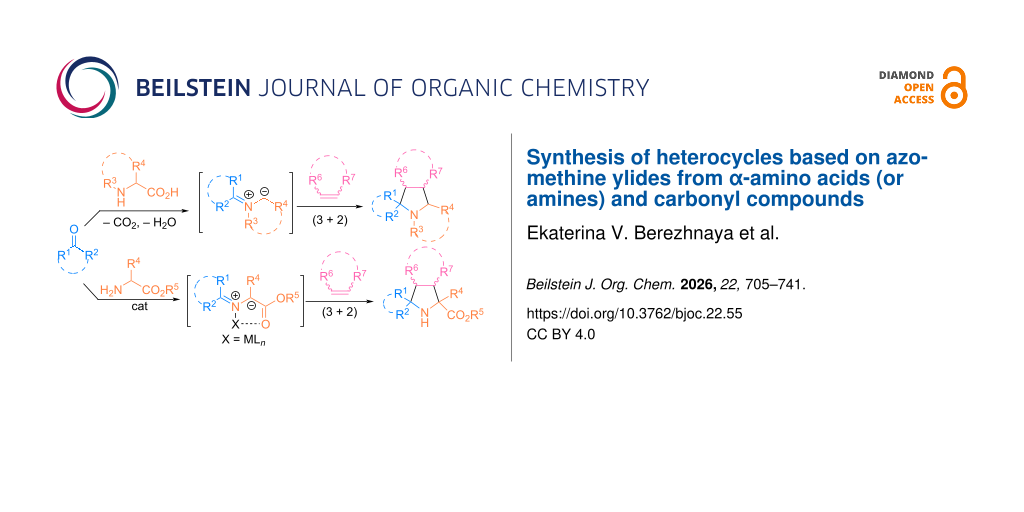
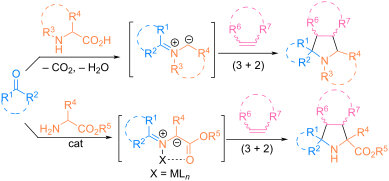
An analysis of experimental and review articles showed that (3 + 2) cycloaddition reactions are carried out, in most cases, using two main strategies for obtaining azomethine ylides, depending on the amino acid derivative used: a free amino acid or its ester (Scheme 1).
![[1860-5397-22-55-i1]](/bjoc/content/inline/1860-5397-22-55-i1.svg?scale=2.0&max-width=1024&background=FFFFFF)
Scheme 1: Strategies for the preparation of pyrrolidine derivatives by (3 + 2) cycloaddition of azomethine ylides to alkenes.
Scheme 1: Strategies for the preparation of pyrrolidine derivatives by (3 + 2) cycloaddition of azomethine yl...
In both cases, condensation of amino acids with carbonyl compounds occurs; however, in the first case, decarboxylation occurs with the in situ formation of azomethine ylides, which subsequently undergo cycloaddition to unsaturated substrates. The advantage of the first strategy is that the synthesis is often carried out under mild conditions without the use of a catalyst, and despite this, the resulting cycloadducts exhibit pronounced regio- and stereoselectivity [9-11].
In the second case, the generation of azomethine ylides from iminoesters is often realized using chiral metal complexes of Ag(I), Cu(I/II), Zn(II), Ni(II) with ligands of the Segphos, Fesulfos, or Biphamphos type [12-15]. Such catalytic systems control the enantioselectivity of cycloaddition and allow the preparation of enantioenriched pyrrolidines containing several stereocenters in high yields.
Previously published reviews [16-19] focused on decarboxylative reactions of 1,3-dipolar cycloaddition of azomethine ylides from isatin, acenaphthenequinone or ninhydrin and amino acids to unsaturated 2π-electron substrates. In review works [20,21] the synthesis of spirooxindole-pyrrolizidine derivatives obtained from isatin, various α-amino acids and dipolarophiles is considered. This structural fragment plays an important role in biological processes, exhibiting antitumor activity, anti-HIV activity, anti-inflammatory, and, in some cases, analgesic effects.
A 2016 review addressed the development of 1,3-dipolar cycloaddition over the past decade, examining the reactions of various dipoles, including azomethine ylides, with a wide range of dipolarophiles [22]. In reviews [23-25], various methods for the generation of azomethine ylides were discussed in detail, for example, the importance of the formation of azomethine ylides from amino esters, amino acids, imine derivatives, aziridines or other substrates was emphasized. A review [26] demonstrates metal-catalyzed as well as metal-free asymmetric and racemic transformations of imino ethers upon interaction with various dipolarophiles. A review [27] published in 2025 focused on the double cycloaddition of azomethine ylides derived from amino esters or amino acids, which is of great value for the synthesis of complex polyheterocycles.
Currently, the (3 + 2) cycloaddition reactions of azomethine ylides with dipolarophiles having electron-withdrawing substituents have been widely studied; acrylates, vinyl sulfones, maleimides, β-nitrostyrenes, fumarates, and maleates have been used most frequently [28,29]. Reactions of aromatic and heteroaromatic olefins containing both electron-donating and electron-withdrawing groups in the aromatic ring, as well as heterosubstituted alkenes and polyenes, are also known [30-32]. The review [33] examines the reactions of 1,3-dipolar cycloaddition of cyclopropenes with various dipoles, such as diazo compounds, azides, azomethine imines, nitrones, azomethine ylides, carbonyl ylides, etc. At the same time, (3 + 2) cycloaddition involving non-activated alkenes of various structures has not yet been sufficiently studied [3]. A review article [34] examines 1,3-dipolar cycloaddition reactions occurring under organocatalytic conditions. Zhao's and Bayat's works provide a detailed discussion of multicomponent one-pot (3 + 2) cycloaddition reactions involving azomethine ylides from isatins and amino acids [21,35].
The main feature of this review is that we have attempted to consider all currently known systems for generating azomethine ylides based on carbonyl compounds and amino acid derivatives (or amines) and to demonstrate their synthetic potential using a number of examples. The main strategies for synthesizing pyrrolidine derivatives via asymmetric and non-asymmetric 1,3-dipolar cycloaddition of azomethine ylides derived from cyclic and acyclic amino acids or amino esters with various carbonyl compounds were reviewed. Rare methods for preparing azomethine ylides using pyridylimines and α-silylimine were described. Electrophilic alkenes, styrene derivatives, and new, previously undescribed unsaturated substrates were frequently used as dipolarophiles. The contribution of our research group to the development of this method is also presented.
Review
Imine derivatives as precursors of azomethine ylides
Azomethine ylides based on iminoesters
In 2002, Zhang and co-workers described a highly enantioselective Ag(I)-catalyzed (3 + 2) cycloaddition of azomethine ylides from α-(arylimino)esters using AgOAc as the catalytic precursor and chiral bis-ferrocenyl amide phosphine (FAP) (L1) as ligand [36] (Scheme 2). The obtained results demonstrated the high efficiency of the Ag(I)-FAP catalytic system for this transformation. In particular, most α-(arylimino)esters yielded cycloaddition products 3 in excellent yields and with high diastereoselectivity and enantioselectivity (up to 97% ee). However, α-(alkylimino)esters were less reactive, requiring longer reaction times and yielding products with slightly lower enantioselectivity (up to 81% ee).
![[1860-5397-22-55-i2]](/bjoc/content/inline/1860-5397-22-55-i2.svg?scale=2.0&max-width=1024&background=FFFFFF)
Scheme 2: (3 + 2) Cycloaddition of iminoesters to dimethylmaleate.
Scheme 2: (3 + 2) Cycloaddition of iminoesters to dimethylmaleate.
In addition to dimethyl maleate, other dipolarophiles, such as dimethyl fumarate, acrylates, and N-methylmaleimide, were also studied in the cycloaddition reaction (Scheme 3). Lower enantioselectivity was observed in these cases, and the most important result was a significant improvement in enantioselectivity upon switching from methyl acrylate to bulk tert-butyl acrylate, 60 and 93% ee, respectively.
![[1860-5397-22-55-i3]](/bjoc/content/inline/1860-5397-22-55-i3.svg?scale=2.0&max-width=1024&background=FFFFFF)
Scheme 3: Cycloaddition of 1 with various dipolarophiles catalyzed by Ag(I)-L1.
Scheme 3: Cycloaddition of 1 with various dipolarophiles catalyzed by Ag(I)-L1.
In 2003, Schreiber et al. reported an efficient silver(I) acetate/QUINAP (L2) catalytic system for the (3 + 2) cycloaddition of azomethine ylides to unsaturated carboxylic acid esters [37]. The reaction with tert-butyl acrylate showed excellent levels of diastereoselectivity (>20:1) and enantioselectivity (89–96% ee) regardless of the electronic and steric properties of the aromatic ring in the α-(arylimino)ester (Scheme 4). However, when using other dipolarophiles, such as dimethyl maleate, tert-butyl crotonate, and tert-butyl cinnamate, a noticeable decrease in enantioselectivity was observed.
![[1860-5397-22-55-i4]](/bjoc/content/inline/1860-5397-22-55-i4.svg?scale=2.0&max-width=1024&background=FFFFFF)
Scheme 4: Cycloaddition of 1 with tert-butyl acrylate catalyzed by Ag(I)-L2.
Scheme 4: Cycloaddition of 1 with tert-butyl acrylate catalyzed by Ag(I)-L2.
In a similar study, Wang et al. reported the CuI/TF-BiphamPhos (L3) complex, a new and highly efficient catalyst for the asymmetric 1,3-dipolar cycloaddition reaction [38]. The authors noted excellent reactivity, selectivity, and a wide range of structural variants for various azomethine ylides derived from amino esters, leading to the formation of the corresponding cycloadducts 5 with exceptionally high enantioselectivity (Scheme 5).
![[1860-5397-22-55-i5]](/bjoc/content/inline/1860-5397-22-55-i5.svg?scale=2.0&max-width=1024&background=FFFFFF)
Scheme 5: Cycloaddition of 1 with dimethyl maleate catalyzed by Cu(I)-L3.
Scheme 5: Cycloaddition of 1 with dimethyl maleate catalyzed by Cu(I)-L3.
In a classic paper published in 2002, Jørgensen investigated the catalytic asymmetric 1,3-dipolar cycloaddition of azomethine ylides from N-(arylmethylidene)glycinates with unsaturated substrates. The reactions were successfully catalyzed by the Zn(II)-t-Bu-BOX complex (L4) and produced diastereomerically pure, highly functionalized pyrrolidines in high yields and enantiomeric excesses of up to 94% (Scheme 6) [39]. Based on the data obtained, the authors proposed a model for the intermediate complex in 1,3-dipolar cycloaddition reactions. This intermediate consists of an azomethine ylide coordinated to a Zn(II)-t-Bu-BOX catalyst and is an 18-electron complex with a tetrahedral arrangement of ligands around the zinc center. Excellent results for yields, diastereo- and enantioselectivities of analogous (3 + 2) cycloaddition reactions were achieved using new chiral catalytic systems, in particular, Zn(II)-imidazolinyl-[2.2]paracyclophanol (UCDImphanol) ligand [40] and Zn(II)-ferrocenyl-substituted aziridino alcohol ligand [41].
![[1860-5397-22-55-i6]](/bjoc/content/inline/1860-5397-22-55-i6.svg?scale=2.0&max-width=1024&background=FFFFFF)
Scheme 6: Cycloaddition of 1 with alkenes catalyzed by Zn(II)-t-Bu-BOX (L4).
Scheme 6: Cycloaddition of 1 with alkenes catalyzed by Zn(II)-t-Bu-BOX (L4).
Later in 2005, the Jørgensen group presented an asymmetric strategy for the 1,3-dipolar cycloaddition of azomethine ylides based on iminoesters 1 with alkyl acrylates 4 using a metal salt of AgF with the chiral base hydrochinchonine L5 as a catalyst system (Scheme 7) [42]. The cycloaddition of iminoesters 1, obtained from glycinates and aromatic or aliphatic aldehydes, to alkyl acrylates 2 proceeds with high endo-diastereoselectivity and moderate enantioselectivity. However, most pyrrolidine derivatives 8, obtained from tert-butyl acrylate, are solids that can be enantiomerically enriched by recrystallization.
![[1860-5397-22-55-i7]](/bjoc/content/inline/1860-5397-22-55-i7.svg?scale=2.0&max-width=1024&background=FFFFFF)
Scheme 7: (3 + 2) Cycloaddition of iminoesters to acrylates.
Scheme 7: (3 + 2) Cycloaddition of iminoesters to acrylates.
In [43], a silver-catalyzed asymmetric double 1,3-dipolar cycloaddition reaction was developed that provides highly substituted, enantioenriched pyrrolizidines 9 containing up to six stereocenters (Scheme 8). It is assumed that the endo-selective (3 + 2) cycloaddition of the azomethine ylide obtained from iminoester 1 with tert-butyl acrylic acid ester 4 occurs first. This is followed by condensation of pyrrolidine 9 with cinnamic aldehyde (10) to form azomethine ylide B, which enters into a second diastereoselective 1,3-DC with various electrophilic alkenes. The authors used acrylic acid esters, vinylphenyl sulfone, cinnamic, croton, and methacrylic aldehydes, and β-nitrostyrene as dipolarophiles. Depending on the dipolarophile used, pyrrolizidines 11 were obtained with an enantiomeric excess of up to 94% and yields of up to 92%.
![[1860-5397-22-55-i8]](/bjoc/content/inline/1860-5397-22-55-i8.svg?scale=2.0&max-width=1024&background=FFFFFF)
Scheme 8: Catalytic double (3 + 2) cycloaddition to form pyrrolizidine derivatives.
Scheme 8: Catalytic double (3 + 2) cycloaddition to form pyrrolizidine derivatives.
In 2009, Wang and co-workers reported the catalytic endo-selective cycloaddition of azomethine ylides based on glycine or alanine methyl ester imines 12 with vinyl phenyl sulfone 13 catalyzed by a chiral silver complex (Scheme 3) [44]. It was found that iminoethers 12 are capable of reacting smoothly with vinylphenylsulfone 13, forming the corresponding endo-cycloadducts 14 in high yields (77–98%) and good enantioselectivity (67–92% ee). The in situ-generated azomethine ylide is coordinated to the metal center and oriented in transition state A due to the spatial repulsion between the aryl or cyclohexyl group in the ylide and the cyclohexyl fragments of ligand L7, while its significant size effectively blocks the approach of the dipolarophile to the Re surface of the ylide and forms the endo-product as a result of exposure to the Si surface (Scheme 9).
![[1860-5397-22-55-i9]](/bjoc/content/inline/1860-5397-22-55-i9.svg?scale=2.0&max-width=1024&background=FFFFFF)
Scheme 9: (3 + 2) Cycloaddition of iminoethers to vinyl phenyl sulfone.
Scheme 9: (3 + 2) Cycloaddition of iminoethers to vinyl phenyl sulfone.
In [45], the Cu(I)-catalyzed enantioselective and regiodivergent asymmetric (3 + 2) cycloaddition of α-substituted iminoesters 12 with β-fluoromethyl-β,β-disubstituted enones 15 was studied, resulting in the formation of pyrrolidines 16 and 17 with two adjacent or two discrete quaternary stereocenters (Scheme 10). The regioselectivity of this reaction is controlled by the choice of a suitable chiral ligand. The authors hypothesized that when ligand L8 is utilized, throughout the entire catalytic cycle both the nitrogen and phosphorus atoms of the ligand maintain their coordination to copper. The final product 16 is formed as a consequence of electron redistribution within the metal-ligand assembly, coupled with steric constraints and π–π interactions occurring in transition state E between the aromatic rings of the enone and iminoester substrates. It has been also demonstrated that in this particular (3 + 2) cycloaddition reaction ligand L9 acts as a pseudo-bidentate ligand. The formation of the enone Cu−O bond and the dissociation of the amine nitrogen of L9 from the Cu(I) center in the transition state F leads to a change in regioselectivity and the formation of cycloadduct 17 [46]. A similar catalytic system was successfully used for the asymmetric (3 + 2) cycloaddition of azomethine ylides with trisubstituted cyclopropenes, resulting in a variety of complex 3-azabicyclo[3.1.0]hexane derivatives as a single isomer in excellent yields (up to 99%) and enantioselectivities (97–99% ee) [46].
![[1860-5397-22-55-i10]](/bjoc/content/inline/1860-5397-22-55-i10.svg?scale=2.0&max-width=1024&background=FFFFFF)
Scheme 10: Regiodivergent and enantioselective synthesis of pyrrolidines 16 and 17.
Scheme 10: Regiodivergent and enantioselective synthesis of pyrrolidines 16 and 17.
In [47], Singh and co-workers reported an enantioselective (3 + 2) cycloaddition reaction of iminoesters 12 with substituted imidazoles 18 catalyzed by Cu(I)/phosphine L10, which resulted in the formation of chiral pyrrolidines 19 and 20 with high diastereoselectivity (Scheme 11). The authors attribute the reactivity patterns observed in imino esters reactions, including regioselectivity variations, by differences in electron density distribution between the C2 and C4 positions following deprotonation. An aryl group located at the α-position (C2) greater facilitates the resulting negative charge delocalization, thereby reducing electron density at C2 relative to C4. Consequently, this stabilized carbanion directs the formation of a product exhibiting reversed polarity (20). Conversely, when no α-aryl substitution is present, increased electron density remains at the C2 position, favoring the typical (3 + 2) cycloaddition pathway leading to product 19.
![[1860-5397-22-55-i11]](/bjoc/content/inline/1860-5397-22-55-i11.svg?scale=2.0&max-width=1024&background=FFFFFF)
Scheme 11: Substrate-controlled regioreversible "normal" and "incomplete" 1,3-dipolar cycloaddition.
Scheme 11: Substrate-controlled regioreversible "normal" and "incomplete" 1,3-dipolar cycloaddition.
In [48], the authors studied the reason for the complete change in diastereoselectivity in the catalytic (3 + 2) cycloaddition between iminoethers and electrophilic alkenes occurring using chiral metal complexes based on copper(I) and silver(I) salts and ligands (S)-DM-Segphos (L12) or (S)-DTBM-Segphos (L11) (Scheme 12). The reactions involved various dipolarophiles such as acrylates, maleimides, alkenyl sulfones, β-nitrostyrene, chalcone, acrylonitrile, N,N-dimethylacrylamide, and N-acryloyloxazolidin-2-one. Using computational density functional theory (DFT), the authors concluded that the diastereoselectivity of the reaction is influenced by the size of the ligand, the presence or absence of interaction between the metal and the electron-withdrawing group of the dipolarophile, and the coordination properties of the metal, for example, the possibility of changing the coordination sphere of copper(I) from bidentate to monodentate, which does not occur with the Ag(I) atom, which has stronger bonds with the ligands [42].
![[1860-5397-22-55-i12]](/bjoc/content/inline/1860-5397-22-55-i12.svg?scale=2.0&max-width=1024&background=FFFFFF)
Scheme 12: Enantioselective synthesis of exo-/endo-pyrrolidines.
Scheme 12: Enantioselective synthesis of exo-/endo-pyrrolidines.
In [49,50], a variety of dipolarophiles 22–24 containing electron-withdrawing substituents was demonstrated, which can participate in the 1,3-dipolar cycloaddition catalyzed by chiral copper complexes Cu(I) or Cu(II) with arylimines of glycine or alanine methyl esters 21 (Scheme 13). In these reactions, N-substituted maleimides, acyclic deactivated alkenes such as dimethyl maleate, dimethyl fumarate and fumarodinitrile, and monoactivated alkenes such as methyl acrylate, β-nitrostyrene and methacrolein have shown high activity.
![[1860-5397-22-55-i13]](/bjoc/content/inline/1860-5397-22-55-i13.svg?scale=2.0&max-width=1024&background=FFFFFF)
Scheme 13: (3 + 2) Cycloaddition of iminoethers 21 to dipolarophiles 22–24.
Scheme 13: (3 + 2) Cycloaddition of iminoethers 21 to dipolarophiles 22–24.
In [51,52], the authors demonstrated the possibility of using racemic cyclopentene-1,3-diones 28 as dipolarophiles in 1,3-dipolar cycloaddition reactions using the chiral complex Ag(I)/TF-BiphamPhos (L3) (Scheme 14). The authors used various substituted diones 28 containing aromatic and aliphatic substituents, for example, silyloxy, acetoxy, benzyloxy, etc. It was established that the reaction of glycine methyl ester arylimines 1 with racemic cyclopentene-1,3-diones 28 leads to bicyclic pyrrolidines 29 and enantiomerically enriched cyclopentenediones (R)-28 in moderate yields. The Ag(I)/L3 catalytic system also showed high efficiency in the asymmetric (3 + 2) cycloaddition of iminoethers with various 2-alkylidenecyclopentanones [53]
![[1860-5397-22-55-i14]](/bjoc/content/inline/1860-5397-22-55-i14.svg?scale=2.0&max-width=1024&background=FFFFFF)
Scheme 14: Synthesis of bicyclic pyrrolidines 29 from cyclopentene-1,3-diones.
Scheme 14: Synthesis of bicyclic pyrrolidines 29 from cyclopentene-1,3-diones.
In 2025, Wang and co-workers carried out a cascade enantioconvergent reaction between aldimine esters 1 and low-reactivity allylic alcohols 30, which are activated by oxidative dehydrogenation to form enones, which trigger a 1,3-dipolar cycloaddition via copper–ruthenium catalysis [54] (Scheme 15). Further reductive hydrogenation of ketopyrrolidines proceeds to form hydroxypyrrolidines 31 in high yields and excellent diastereo-/enantioselectivity. The reaction can be used with aldimine esters with various aromatic and aliphatic substituents; vinylaryl carbinols with electron-withdrawing and electron-donating substituents in the phenyl ring have successfully proven themselves as dipolarophiles; replacement of the aryl substituent with heteroaromatic or aliphatic ones also led to acceptable results.
![[1860-5397-22-55-i15]](/bjoc/content/inline/1860-5397-22-55-i15.svg?scale=2.0&max-width=1024&background=FFFFFF)
Scheme 15: (3 + 2) Cycloaddition of aldimine esters and allyl alcohols using copper-ruthenium catalysis.
Scheme 15: (3 + 2) Cycloaddition of aldimine esters and allyl alcohols using copper-ruthenium catalysis.
The authors used this methodology to modify peptides and functionalize several natural products. Thus, aldimine dipeptides Gly–Gly, Gly–Ala, as well as iminoesters in combination with natural ʟ-borneol, ʟ-menthol, cholesterol, or lactate scaffolds proved to be suitable precursors of azomethine ylides, allowing the production of functionalized pyrrolidines with potential biological activity [54].
Currently, organofluorine chemistry is one of the most pressing areas of modern chemistry, since the introduction of fluorine-containing groups into compounds often has a significant impact on their biological activity. In 2022, Wang and Teng developed an efficient method for the preparation of enantioenriched derivatives of 3,3-difluoro- and 3,3,4-trifluoropyrrolidines 33 in yields of up to 97% via Cu(I)-catalyzed enantioselective 1,3-dipolar cycloaddition of azomethine ylides to 1,1-difluoro- and 1,1,2-trifluorostyrenes 32 (Scheme 16) [30]. The best results were achieved using [Cu(CH3CN)4]PF6/(S)-DTBM-Segphos L11 as the catalytic system.
![[1860-5397-22-55-i16]](/bjoc/content/inline/1860-5397-22-55-i16.svg?scale=2.0&max-width=1024&background=FFFFFF)
Scheme 16: Synthesis of 3,3-difluoro- and 3,3,4-trifluoropyrrolidine derivatives.
Scheme 16: Synthesis of 3,3-difluoro- and 3,3,4-trifluoropyrrolidine derivatives.
The authors extended the scope of application of this method to various aryl-substituted iminoesters containing furyl, thienyl, indolyl, triazolyl, and ferrocenyl substituents. Various aryl-substituted gem-difluorostyrenes, not only with electron-withdrawing but also with electron-donating and neutral substituents in the aromatic ring, can also participate in this reaction, since cycloaddition is facilitated by the electron-withdrawing inductive effect of fluorine atoms. In addition to gem-difluorostyrenes, 1,1,2-trifluorostyrenes can be used in the synthesis, which leads to the formation of 3,3,4-trifluoropyrrolidines in moderate yields and high diastereoselectivity [30]. In addition to the above, the authors demonstrated the broad applicability of this method using iminoesters 34 derived from natural compounds or currently available synthetic drugs (Scheme 17). Iminoesters containing molecules of cholesterol, androsterone, indomethacin, pitavastatin, menthol, as well as fructose and glucose, were introduced into the reaction.
![[1860-5397-22-55-i17]](/bjoc/content/inline/1860-5397-22-55-i17.svg?scale=2.0&max-width=1024&background=FFFFFF)
Scheme 17: Use of iminoesters from natural compounds and pharmaceuticals for reactions with 1,1-difluoro- and 1,1,2-trifluorostyrenes.
Scheme 17: Use of iminoesters from natural compounds and pharmaceuticals for reactions with 1,1-difluoro- and ...
In [55], copper(I)-catalyzed asymmetric 1,3-dipolar cycloaddition of iminoesters 1 and 1,3-enynes 36 is described, which provides a series of chiral polysubstituted pyrrolidines 37 with high regio-, diastereo-, and enantioselectivities (Scheme 18). It is noted that the presence of a conjugated triple bond leads to weak activation of the olefin group and, thus, somewhat simplifies the cycloaddition reaction. The introduction of aryl and alkynyl substituents at the C4 position of the dipolarophile increases the reactivity of the multiple bond due to double activation by conjugated groups. In 2016, a study was published [56] in which vinyl(hetero)arenes 16 were investigated as dipolarophiles in CuI- and AgI-catalyzed 1,3-dipolar cycloaddition reactions with various imines 1 (Scheme 19).
![[1860-5397-22-55-i18]](/bjoc/content/inline/1860-5397-22-55-i18.svg?scale=2.0&max-width=1024&background=FFFFFF)
Scheme 18: Reaction of iminoesters with 1,3-enynes.
Scheme 18: Reaction of iminoesters with 1,3-enynes.
![[1860-5397-22-55-i19]](/bjoc/content/inline/1860-5397-22-55-i19.svg?scale=2.0&max-width=1024&background=FFFFFF)
Scheme 19: Synthesis of pyrrolidines from iminoesters and vinyl(hetero)arenes.
Scheme 19: Synthesis of pyrrolidines from iminoesters and vinyl(hetero)arenes.
It is noteworthy that when using the [Cu(CH3CN)4]PF6/(R)-DTBM-Segphos L11 catalytic system, exo-pyrrolidines 39 are formed with >98% ee and almost complete diastereoselectivity, while the AgOAc/(R)-Fesulphos L13 catalytic system gives an inversion of diastereoselectivity and the formation of predominantly endo-adduct 39 with up to 95% ee (Scheme 19). The authors used various substituted styrenes in the reactions, as well as vinyl heteroarenes containing 2-thiazolyl, 2-quinolyl, 2-pyridyl, and 4-pyridyl fragments. It is worth noting that 1-(4-nitrophenyl)-1,3-butadiene (40) and 1,1-bis(2-pyridyl)ethylene (41) also proved to be suitable substrates in this reaction (Scheme 20). It was demonstrated by computational methods (DFT) that electronic effects within the dipolarophile can lead to a change in the mechanism and to an effective electrophilicity polarization toward the terminal carbon atom. This finding strongly supports the suitability of moderately activated olefins as dipolarophiles for the catalyzed asymmetric cycloaddition reactions involving azomethine ylides [56].
![[1860-5397-22-55-i20]](/bjoc/content/inline/1860-5397-22-55-i20.svg?scale=2.0&max-width=1024&background=FFFFFF)
Scheme 20: Synthesis of exo-pyrrolidines 42 and 43.
Scheme 20: Synthesis of exo-pyrrolidines 42 and 43.
In 2021, Wang and co-workers developed a novel catalytic system based on Cu(I) and the bulky phosphoramidite ligand L16 with triple homoaxial chirality, allowing β-substituted alkenylheteroarenes 44, which lack a strong electron-withdrawing substituent in heteroarenes, to act as effective dipolarophiles in 1,3-dipolar cycloaddition reactions. This resulted in chiral compounds 45 and 46 containing two biologically important moieties: a heteroarene and a pyrrolidine (Scheme 21) [31].
![[1860-5397-22-55-i21]](/bjoc/content/inline/1860-5397-22-55-i21.svg?scale=2.0&max-width=1024&background=FFFFFF)
Scheme 21: Enantioselective synthesis of heteroarylpyrrolidines 45 and 46.
Scheme 21: Enantioselective synthesis of heteroarylpyrrolidines 45 and 46.
This synthesis method is applicable to a wide range of substrates: imino esters containing aryl, alkyl, and heteroaryl substituents; various β-aryl- and alkyl-substituted alkenyl heteroarenes, such as benzoxazole, benzothiazole, 1-methyl-1H-benzo[d]imidazole, dihydrooxazole, and isoquinoline, as well as monocyclic heteroarenes, including oxazole, thiazole, imidazole, pyridine, and pyrazine, can be used as dipolarophiles. The pyrrolidines obtained during the synthesis exhibit exceptional diastereoselectivity (>20:1 dr) and excellent enantioselectivity (up to 99%). The authors suggested that the strong steric repulsion between the 1-naphthyl group of ligand L16 and the bicyclic substituent in the dipolarophile is a key factor in controlling enantioselectivity. Replacing the bicyclic heteroarene with a monocyclic one reduces the steric burden and inverse enantioselectivity is observed [31].
Today, the reactions of [6 + 3] cycloaddition of imines to fulvenes, catalyzed by chiral metal complexes, are well known, during which piperidine derivatives are formed [57,58]. In 2023, Wang's research group developed a (3 + 2) cycloaddition strategy of azomethine ylides from iminoethers 12 and benzofulvenes 47, in which benzofulvenes without electron-withdrawing substituents can act as active 2π-dipolarophiles for the efficient synthesis of a series of polysubstituted enantioenriched pyrrolidine derivatives 48 possessing a spiroindene molecular structure (Scheme 22) [59].
![[1860-5397-22-55-i22]](/bjoc/content/inline/1860-5397-22-55-i22.svg?scale=2.0&max-width=1024&background=FFFFFF)
Scheme 22: Catalytic reaction of (3 + 2) cycloaddition of imines 12 to benzofulvenes 47.
Scheme 22: Catalytic reaction of (3 + 2) cycloaddition of imines 12 to benzofulvenes 47.
Based on the results of DFT calculations, it was suggested that the [6 + 3] cycloaddition product for benzofulvene 47 loses aromatic stability and exhibits high steric hindrance, which makes the [6 + 3] cycloadduct extremely unstable and also increases its reaction barrier (29.6 kcal mol−1). At the same time, the formation of the (3 + 2) cycloaddition product 48 is thermodynamically more favorable, which is the main factor controlling chemoselectivity. It is noteworthy that carrying out the reaction in the same catalytic system with the simplest fulvene, 6,6-dimethylfulvene, promotes [6 + 3] cycloaddition [59].
In [60], Martín and colleagues investigated the possibility of using C60 fullerene as a dipolarophile in 1,3-dipolar cycloaddition reactions. Due to their unique chemical properties and high versatility, fullerenes are finding increasing application in organic synthesis. In this work, the authors focused on the functionalization of C60 with a helicene component via Cu(II)/L13-catalyzed enantioselective 1,3-dipolar cycloaddition of racemic 2-hexalicene iminoester 49 to C60 fullerene 50 (Scheme 23).
![[1860-5397-22-55-i23]](/bjoc/content/inline/1860-5397-22-55-i23.svg?scale=2.0&max-width=1024&background=FFFFFF)
Scheme 23: Fullerene as a dipolarophile in (3 + 2) cycloaddition reactions.
Scheme 23: Fullerene as a dipolarophile in (3 + 2) cycloaddition reactions.
During the reaction, two diastereomeric helicenepyrrolidino[3.4:1.2][60]fullerenes 51a and 51b are formed with a good enantiomeric excess. Further separation of the two diastereomers using column chromatography allows one to obtain optically pure products. Thus, fullerene can be used as an effective template for the chiral resolution of racemates [60].
In 2025, Morisaki and Sato reported an asymmetric synthesis termed “reflexive chirality transfer”, which provides direct access to optically active tetrasubstituted pyrrolidine derivatives 54 from readily available optically pure amino acids without any external chiral additives [4] (Scheme 24). Deprotonation and coordination of optically active imines 52, obtained from various natural or synthetic α-amino acids, such as ʟ-alanine, ʟ-tryptophan, ʟ-aspartic acid, ʟ-glutamic acid, ʟ-serine, ʟ-methionine, β-naphthylalanine, phenylglycine, 4-iodophenylalanine, on the achiral Cu(I)/L17 complex leads to the formation of enolates with copper-centered chirality in the form of complex D. Next, complex D interacts with dipolarophiles 53, including fumaronitrile, N-substituted maleimides, β-nitrostyrene, forming optically active tetrasubstituted pyrrolidines 54 [4].
![[1860-5397-22-55-i24]](/bjoc/content/inline/1860-5397-22-55-i24.svg?scale=2.0&max-width=1024&background=FFFFFF)
Scheme 24: Asymmetric synthesis of optically active tetrasubstituted pyrrolidines 54.
Scheme 24: Asymmetric synthesis of optically active tetrasubstituted pyrrolidines 54.
We would like to separately note the organocatalytic (metal-free) approach to enantioselective syntheses involving azomethine ylides from imino esters. In recent years, thanks to intensive efforts of several research groups, a number of very efficient protocols have been developed to carry out this reaction in an organocatalytic asymmetric version. In particular, Vicario [61-64] reported the first organocatalytic enantioselective (3 + 2) cycloaddition reaction between α,β-unsaturated aldehydes and azomethine ylides. The reaction proceeded with complete regioselectivity and very high diastereo- and enantioselectivity, affording stereoisomerically pure highly functionalized polysubstituted pyrrolidines in excellent yields (Scheme 25).
![[1860-5397-22-55-i25]](/bjoc/content/inline/1860-5397-22-55-i25.svg?scale=2.0&max-width=1024&background=FFFFFF)
Scheme 25: (3 + 2) Cycloaddition reaction of imines 55 and α,β-unsaturated aldehydes.
Scheme 25: (3 + 2) Cycloaddition reaction of imines 55 and α,β-unsaturated aldehydes.
Considering the probable reaction mechanism, the authors suggest that the effective shielding of the Si-side of the chiral iminium intermediate by bulky aryl groups leads to a stereoselective endo approach of the 1,3-dipole to the sterically less hindered Re-side of the intermediate iminium cation (Scheme 26). In this context, it is worth noting a work published in 2011, in which the reaction of analogous azomethine ylides with 2-arylacrylates was catalyzed by chiral binol-based phosphoric acids [65].
![[1860-5397-22-55-i26]](/bjoc/content/inline/1860-5397-22-55-i26.svg?scale=2.0&max-width=1024&background=FFFFFF)
Scheme 26: Probable mechanism of enantioselective (3 + 2) cycloaddition of azomethine ylides to α,β-unsaturated aldehydes.
Scheme 26: Probable mechanism of enantioselective (3 + 2) cycloaddition of azomethine ylides to α,β-unsaturate...
In 2023, Retamosa and Sansano carried out a diastereoselective synthesis of polysubstituted pyrrolidines 59 under mild conditions via 1,3-dipolar cycloaddition between tert-butylsulfinylimines 58 and iminoesters 12 using Ag2CO3 as a base (Scheme 27) [66]. Electrophilic dipolarophiles such as sulfinyl imines have been shown to readily undergo (3 + 2) cycloaddition reactions with azomethine ylides generated in situ from the corresponding imino esters, affording pyrrolidines 59 in high yields (up to 83%) and diastereoselectivity (up to 95%). The (S)-configuration of the sulfinyl group is capable of inducing the absolute configuration (2S,3R,4S,5R) in the final pyrrolidines.
![[1860-5397-22-55-i27]](/bjoc/content/inline/1860-5397-22-55-i27.svg?scale=2.0&max-width=1024&background=FFFFFF)
Scheme 27: Cycloaddition between iminoesters 12 and sulfinylimines 58.
Scheme 27: Cycloaddition between iminoesters 12 and sulfinylimines 58.
In the study [67], the 1,3-dipolar cycloaddition reaction of triarylideneacetylacetone derivatives with azomethine ylides derived from glycine ester and aromatic aldehyde, catalyzed by titanocene dichloride, was studied for the first time (Scheme 28). This catalyst demonstrated a number of advantages, including mild reaction conditions, short reaction times, improved yields, and high regio- and stereoselectivity. The cycloaddition proceeded with the formation of syn-endo cycloadducts 61 and was accompanied by the cleavage of the cinnamoyl group from triarylideneacetylacetone.
![[1860-5397-22-55-i28]](/bjoc/content/inline/1860-5397-22-55-i28.svg?scale=2.0&max-width=1024&background=FFFFFF)
Scheme 28: (3 + 2) Cycloaddition between triarylideneacetylacetone and azomethine ylides in the presence of titanocene dichloride.
Scheme 28: (3 + 2) Cycloaddition between triarylideneacetylacetone and azomethine ylides in the presence of ti...
In the context of the use of catalytic systems based on metals other than Cu and Ag for the (3 + 2) cycloaddition reactions of N-metalated azomethine ylides, processes catalyzed by Li(I) should be mentioned. The work [68] showed that using Li(I) results in products with different stereoselectivity than those obtained in processes catalyzed by Ag(I). In general, catalytic systems based on lithium salts can be considered as accessible and effective for the preparation of racemic cycloadducts [69-71].
Of interest are also non-catalytic reactions of 1,3-dipolar cycloaddition of azomethine ylides, which are formed in situ from the corresponding aldehydes and amino acid esters. In 2011, Shi and Gan proposed a stereoselective approach to the synthesis of a rare heterocyclic system, a fully hydrogenated pyrrolo[2,1,5-cd]indolizine derivative [72] (Scheme 29). The process begins with the 1,3-dipolar cycloaddition of azomethine ylide, obtained from glycine methyl ester (62) and cinnamaldehyde (56), to N-phenylmaleimide (63) to form pyrrolidine 64. Further treatment of 64 with cinnamaldehyde and N-phenylmaleimide leads to the second (3 + 2) cycloaddition adduct 65. Addition of ICl to 65 results in cyclization involving the styrene groups, which is accompanied by the formation of decahydropyrrolo[2,1,5-cd]indolizine 66. The reactions proceed with high stereoselectivity, providing products with eleven chiral carbon atoms in three steps.
![[1860-5397-22-55-i29]](/bjoc/content/inline/1860-5397-22-55-i29.svg?scale=2.0&max-width=1024&background=FFFFFF)
Scheme 29: Stereoselective synthesis of decahydropyrrolo[2,1,5-cd]indolizine 66.
Scheme 29: Stereoselective synthesis of decahydropyrrolo[2,1,5-cd]indolizine 66.
In 2018, Zhang and co-workers presented a sequential process based on a combination of inter- and intramolecular (3 + 2) cycloaddition reactions to prepare highly fused heterocyclic systems containing cyclic succinimide, pyrrolidine, pyrrolizidine, and chroman moieties [73] (Scheme 30). The authors showed that the first stage involves intermolecular 1,3-dipolar cycloaddition of azomethine ylides obtained as a result of the interaction of aromatic aldehydes 67 and glycine methyl ester (62) to N-alkylmaleimides 63, with the formation of cycloadducts 68. Next, without isolating the intermediate product 68, the resulting reaction mixture was used for the intramolecular (3 + 2) cycloaddition step with alkynes 69 and alkenes 70, which led to the formation of cycloadducts 71 and 72 with high diastereoselectivity.
![[1860-5397-22-55-i30]](/bjoc/content/inline/1860-5397-22-55-i30.svg?scale=2.0&max-width=1024&background=FFFFFF)
Scheme 30: Synthesis of policyclic derivatives 71 and 72.
Scheme 30: Synthesis of policyclic derivatives 71 and 72.
Azomethine ylides based on (2-pyridyl)imines, silylimines and silylamines
In 2010, Carretero and co-workers demonstrated that N-(2-pyridylmethyl)imines 73 are effective precursors of azomethine ylides in catalytic asymmetric (3 + 2) cycloaddition reactions (Scheme 31) [74]. Using Cu(CH3CN)4PF6/bisoxazoline L19 as a chiral catalyst system, high enantioselectivity (up to 97% ee) and moderate to high exo-selectivity were achieved in the reactions with N-methylmaleimide. The high efficiency of iminoesters as azomethine precursors is due to the high acidity at the enolizable Cα position and the formation of a five-membered N,O-bidentate metalated azomethine. At the same time, a suitable coordinating nitrogen-containing heterocycle, such as a 2-pyridyl group, can also provide sufficient activation via the formation of an N,N-bidentate metalated azomethine, which facilitates asymmetric cycloaddition.
![[1860-5397-22-55-i31]](/bjoc/content/inline/1860-5397-22-55-i31.svg?scale=2.0&max-width=1024&background=FFFFFF)
Scheme 31: Catalytic аsymmetric (3 + 2) сycloaddition of 2-pyridylimines with N-methylmaleimide.
Scheme 31: Catalytic аsymmetric (3 + 2) сycloaddition of 2-pyridylimines with N-methylmaleimide.
Further studies revealed that reactions of deactivated symmetrical dipolarophiles such as dimethyl fumarate, dibenzoylethylene, and fumarodinitrile proceeded with moderate exo-selectivity and good enantioselectivity (72–91% ee) (Scheme 32). Importantly, reactions with unsymmetrically substituted alkenes such as nitroalkenes and enones were completely regioselective, yielding regioisomers in which the activating group is located adjacent to the pyridyl moiety (86–96% ee).
![[1860-5397-22-55-i32]](/bjoc/content/inline/1860-5397-22-55-i32.svg?scale=2.0&max-width=1024&background=FFFFFF)
Scheme 32: Catalytic аsymmetric (3 + 2) сycloaddition of 2-pyridylimines 1 with other dipolarophiles.
Scheme 32: Catalytic аsymmetric (3 + 2) сycloaddition of 2-pyridylimines 1 with other dipolarophiles.
The work of Carretero's scientific group has developed effective methodologies for the enantioselective synthesis of complex pyrrolidines, via (3 + 2) cycloaddition of α-silylimines with alkenes [75,76]. In particular, in the work [75] the use of the chiral catalytic system Cu(CH3CN)4PF6/Walphos (L20) for the direct enantioselective synthesis of α-heteroarylpyrrolidines via by (3 + 2)-cycloaddition of heteroarylsilylimines with activated alkenes was proposed. The authors demonstrated the potential for cycloaddition of silylimines containing a pyridine substituent with various dipolarophiles (Scheme 33). In all cases, the cycloaddition reactions proceeded with very high diastereoselectivity (trans/cis >95:<5), providing the trans adduct in good yield (47–96%) and high enantioselectivity, regardless of the electronic nature and position of the substituents (82–98% ee).
![[1860-5397-22-55-i33]](/bjoc/content/inline/1860-5397-22-55-i33.svg?scale=2.0&max-width=1024&background=FFFFFF)
Scheme 33: Enantioselective (3 + 2) cycloaddition of silylimine with various dipolarophiles.
Scheme 33: Enantioselective (3 + 2) cycloaddition of silylimine with various dipolarophiles.
The authors suggest that bidentate coordination of the chiral copper complex with silylimine 77 is crucial for substrate activation, which is presumably accompanied by the formation of N,N-complex I. Water then promotes the desilylation step, leading to metallodipole II, which undergoes cycloaddition with a dipolarophile to form metalated adduct III. Final protonation leads to free pyrrolidine (Scheme 34).
![[1860-5397-22-55-i34]](/bjoc/content/inline/1860-5397-22-55-i34.svg?scale=2.0&max-width=1024&background=FFFFFF)
Scheme 34: Proposed mechanism of formation of pyrrolidines 78.
Scheme 34: Proposed mechanism of formation of pyrrolidines 78.
In [3], Mendoza and colleagues developed a universal method for the synthesis of polycyclic pyrrolidines 82–91, which in addition to their use in medicinal chemistry, serve as polydentate N-donor ligands. The authors described the trimethylaluminum-catalyzed (3 + 2)-cycloaddition of bis(2-pyridyl)imine 79 with a wide range of acyclic and cyclic olefins 36 (Scheme 35).
![[1860-5397-22-55-i35]](/bjoc/content/inline/1860-5397-22-55-i35.svg?scale=2.0&max-width=1024&background=FFFFFF)
Scheme 35: Synthesis of polyheterocyclic pyrrolidines 82–91.
Scheme 35: Synthesis of polyheterocyclic pyrrolidines 82–91.
This synthesis method is applicable to a wide range of terminally unsubstituted olefins with electron-withdrawing and electron-donating substituents, as well as to non-activated alkenes such as hex-1-ene, styrene, α-methylstyrene, and 2,3-dimethylbutadiene. In addition to the above, various cyclic olefins have shown good performance, in particular derivatives of cyclopentene, cyclooctene, norbornene, norbornanediene, indene, and iminostilbene. In turn, unsymmetrical imines containing aryl, heteroaryl π-deficient (pyrazine) or π-excessive (furan, thiophene, thiazole) substituents can also participate in (3 + 2)-cycloaddition reactions with olefins [3].
Above we considered the possibility of generating azomethine ylides from α-silylimines, while a method for forming these dipoles from silylamines is also known. In 2017, Mykhailiuk proposed using N-(methoxymethyl)-N-(trimethylsilylmethyl)benzylamine (92) as an azomethine ylide precursor in (3 + 2)-dipolar cycloaddition reactions with electron-deficient exo-cyclic 93 and endo-cyclic alkenes 94 (Scheme 36) [77-79]. To generate the azomethine ylide from reagent 92, TFA in methylene chloride at room temperature or LiF in acetonitrile with heating were used. Notably, this process can proceed solvent-free at 140 °C, which is suitable for less reactive substrates. Various exo-cyclic alkenes obtained from cyclic (hetero)aliphatic ketones such as cyclobutanone, azetidinone, thienone, as well as endo-(hetero)cyclic alkenes containing oxygen, nitrogen, sulfur or a sulfone group as heteroatoms, reacted with azomethine ylide to form spirocyclic or fused pyrrolidines 95 in yields up to 98%.
![[1860-5397-22-55-i36]](/bjoc/content/inline/1860-5397-22-55-i36.svg?scale=2.0&max-width=1024&background=FFFFFF)
Scheme 36: Synthesis of spirocyclic (95) and fused (96) pyrrolidines.
Scheme 36: Synthesis of spirocyclic (95) and fused (96) pyrrolidines.
The authors suggest that the reaction of silylamine 92 with LiF proceeds via a concerted mechanism: in transition state I, the polarized fluorine atom (δ−) attacks the silicon atom, while the polarized lithium atom (δ+) coordinates with the methoxy group as a Lewis acid, further removal of TMSF and LiOMe leads to the in situ formation of azomethine ylide, which then participates in cycloaddition with alkenes (Scheme 36) [79].
The decarboxylative route to azomethine ylides
Formation of azomethine ylides via decarboxylative condensation of amino acids and aldehydes
Ronald Grigg and colleagues were the first to describe the generation of azomethine ylides by condensation and decarboxylation of primary or secondary α-amino acids with various aldehydes. Early work by Grigg's group investigated intramolecular cycloaddition at terminal double or triple bonds, leading to the formation of fused ring systems [80,81].
In a later work by Grigg's group [82], the cycloaddition of azomethine ylides obtained from aromatic aldehydes 97 and sarcosine (proline, pipecolic acid, or 1,2,3,4-tetrahydroisoquinoline-3-carboxylic acid) 99 (100) to N-propargylmaleimide (98) was described. The reaction yielded a mixture of endo- and exo-diastereomers 101 and 102 in overall yields of up to 69% (Scheme 37).
![[1860-5397-22-55-i37]](/bjoc/content/inline/1860-5397-22-55-i37.svg?scale=2.0&max-width=1024&background=FFFFFF)
Scheme 37: (3 + 2) Cycloaddition involving aromatic aldehydes 97, N-propargylmaleimide (98) and α-amino acids 99 and 100.
Scheme 37: (3 + 2) Cycloaddition involving aromatic aldehydes 97, N-propargylmaleimide (98) and α-amino acids ...
In [83], Dhara and co-workers developed a simple strategy for the synthesis of trisubstituted pyrrolizidines 106 via 1,3-dipolar cycloaddition reactions using proline (103), arylaldehydes 104, and electron-deficient dipolarophiles, chalcones 105 (Scheme 38).
![[1860-5397-22-55-i38]](/bjoc/content/inline/1860-5397-22-55-i38.svg?scale=2.0&max-width=1024&background=FFFFFF)
Scheme 38: Synthesis of pyrrolizidines 106 and by-product 107.
Scheme 38: Synthesis of pyrrolizidines 106 and by-product 107.
The authors suggest that the interaction of proline and arylaldehydes results in the formation in situ of an S-shaped azomethine ylide, which reacts with chalcones with high regio- and stereoselectivity, forming cycloadducts in yields of up to 87%. A side reaction in this case is the cycloaddition of the azomethine ylide to the arylaldehyde to yield substituted oxazolidines 107. The formation of such a product is due to the possibility of cycloaddition at the carbon–oxygen double bond (C=O) of the aldehyde, which acts as an alternative to the carbon–carbon double bond (C=C) [83].
In 2016, Sridharan reported a one-pot iridium-catalyzed three-component dehydrogenation/1,3-dipolar cycloaddition cascade reaction using benzyl alcohols as aldehyde precursors to prepare fused heterocycles [84]. The authors note that the iridium-catalyzed oxidation of benzyl alcohol 108 to the corresponding aldehyde initially occurs. This is followed by condensation of the aldehyde with proline (103) and subsequent decarboxylation to form azomethine ylide J, which undergoes a 1,3-dipolar cycloaddition reaction with N-substituted maleimides 42d. This results in a mixture of endo/exo products 109 in good yields (Scheme 39).
![[1860-5397-22-55-i39]](/bjoc/content/inline/1860-5397-22-55-i39.svg?scale=2.0&max-width=1024&background=FFFFFF)
Scheme 39: Iridium-catalyzed three-component cascade (3 + 2) cycloaddition.
Scheme 39: Iridium-catalyzed three-component cascade (3 + 2) cycloaddition.
In [85], Kathiravan and Raghunathan presented an efficient protocol for the synthesis of pyrrolo[2,3-a]pyrrolizidine derivatives via intramolecular 1,3-dipolar cycloaddition using [bmim][BF4] as a green solvent. When N-alkenylpyrrole-2-carbaldehyde 110 reacts with sarcosine or with cyclic secondary amino acids such as proline, thiaproline, pipecolic acid, or isoquinolinic acid 100, azomethine ylide K is formed, which undergoes intramolecular cycloaddition at the multiple bond of the N-alkenylpyrrole moiety. As a result, the corresponding derivatives of pyrrolidine, pyrrolizidine, indolizidine and isoquinoline 111 are formed in yields from 80 to 92% (Scheme 40).
![[1860-5397-22-55-i40]](/bjoc/content/inline/1860-5397-22-55-i40.svg?scale=2.0&max-width=1024&background=FFFFFF)
Scheme 40: Intramolecular (3 + 2) cycloaddition of N-alkenylpyrrole-2-carbaldehyde 110 and α-amino acids.
Scheme 40: Intramolecular (3 + 2) cycloaddition of N-alkenylpyrrole-2-carbaldehyde 110 and α-amino acids.
It is known that when C60 is functionalized using fragments of natural molecules such as steroids, peptides or sugars, its solubility in water improves, thereby increasing the possibility of potential biological activity. In 2020, Martín and colleagues investigated fullerene 50 as a dipolarophile in 1,3-dipolar cycloaddition with azomethine ylide based on formyl steroid 112 and sarcosine 99 (Scheme 41) [86]. The synthesis yielded N-methyl-2-substituted pyrrolidino[3,4:1,2][60]fullerenes (2R/2S)-113 as a mixture of two diastereomers.
![[1860-5397-22-55-i41]](/bjoc/content/inline/1860-5397-22-55-i41.svg?scale=2.0&max-width=1024&background=FFFFFF)
Scheme 41: Three-component (3 + 2) cycloaddition involving fullerene.
Scheme 41: Three-component (3 + 2) cycloaddition involving fullerene.
Azomethine ylides based on cyclic ketones
Azomethine ylides from ninhydrin. In [87-90], four-component one-pot reactions of 1,3-dipolar cycloaddition of ninhydrin (114), phenylenediamines115, α-amino acids, and various dipolarophiles such as alkyl acrylates 116, chalcones 117, N-arylmaleimides 63, and arylidene dihydrothiophenones 118 were investigated. The process proceeds stereoselectively with the formation of spiro-fused heterocycles 116–122 in high yields (Scheme 42).
![[1860-5397-22-55-i42]](/bjoc/content/inline/1860-5397-22-55-i42.svg?scale=2.0&max-width=1024&background=FFFFFF)
Scheme 42: Four-component stereoselective one-pot synthesis of spiro-cycloadducts 119–122.
Scheme 42: Four-component stereoselective one-pot synthesis of spiro-cycloadducts 119–122.
When examining the reaction mechanism, the authors proposed that the first step involves the condensation of phenylenediamine and ninhydrin to form indenoquinoxalin-11-one, which then reacts with proline to yield azomethine ylide. The latter subsequently undergoes cycloaddition reactions with various dipolarophiles to stereoselectively obtain spiropyrrolidines. It is noteworthy that the resulting products have three or four (relative to nitrogen) chiral centers, but only one diastereomer is formed during their synthesis, due to the fixed dipole configuration and the structure of the transition state [88].
In [1], we developed an efficient protocol for the diastereo- and regioselective synthesis of spiro[cyclopropa[a]pyrrolizine-2,2'-indenes] 128–131 using 1,3-dipolar cycloaddition reactions of stable azomethine ylide 123, obtained in situ by decarboxylating condensation of ninhydrin and ʟ-proline, with a wide range of cyclopropenes, including gaseous and unstable ones (Scheme 43).
![[1860-5397-22-55-i43]](/bjoc/content/inline/1860-5397-22-55-i43.svg?scale=2.0&max-width=1024&background=FFFFFF)
Scheme 43: Reactions of azomethine ylide 123 with cyclopropenes.
Scheme 43: Reactions of azomethine ylide 123 with cyclopropenes.
In this reaction, symmetrically and asymmetrically substituted cyclopropenes at the multiple bond with various electron-donating and electron-withdrawing substituents at C3 were used, resulting in spiro-pyrrolizidines with yields of up to 96%. It should be noted that azomethine ylide 123 can be an effective trap for gaseous cyclopropene and 1-methylcyclopropene, as well as unstable 1-phenylcyclopropene.
The authors also succeeded in carrying out the reaction of 123 with 3-nitro-1,2-diphenylcyclopropene 127 in primary, secondary, and tertiary alcohols, as well as using certain thiols. The authors suggest that the reactions proceed via a stage of heterolytic cleavage of the C–N bond of the starting 3-nitro-1,2-diphenylcyclopropene to form a cyclopropenyl cation, which then reacts with the nucleophile RXH to form the corresponding 3-substituted cyclopropenes. The latter reacts with azomethine ylide 67 to form cycloadducts in moderate yields. Density functional theory (DFT) calculations revealed that the regio- and endo-stereoselective formation of products in the observed reactions is due to charge and orbital control [1].
Continuing the study of 1,3-dipolar cycloaddition reactions of ninhydrin-based azomethine ylides with cyclopropene dipolarophiles, our research group examined the interaction of cyclopropenes with azomethine ylides from ninhydrin and acyclic amino acids [91]. The authors carried out three-component reactions involving ninhydrin (114), 3-R-1,2-diphenylcyclopropenes 124 and sarcosine (99), as well as some primary α-amino acids 132, such as ʟ-leucine, ʟ-phenylalanine, ʟ-methionine, ʟ-tyrosine, 3,5-diiodo-ʟ-tyrosine, ᴅʟ-phenylglycine (Scheme 44). The authors also carried out cycloaddition reactions of 1,2,3-triphenylcyclopropene and 2,3-diphenylcycloprop-2-enecarboxylic acid with azomethine ylides formed from ninhydrin and peptides 133, such as Gly–Gly and Gly–Gly–Gly. All reactions proceed under mild conditions to form spiro[3-azabicyclo[3.1.0]hexanes 136 in good yields and excellent diastereoselectivity.
![[1860-5397-22-55-i44]](/bjoc/content/inline/1860-5397-22-55-i44.svg?scale=2.0&max-width=1024&background=FFFFFF)
Scheme 44: Three-component reactions involving ninhydrin, cyclopropenes and acyclic α-amino acids.
Scheme 44: Three-component reactions involving ninhydrin, cyclopropenes and acyclic α-amino acids.
In [92], our group developed a method for the synthesis of bis-spiro[3-azabicyclo[3.1.0]hexanes] 139 from the N-protonated form of Ruhemann purple 137 (PRP) and various stable and unstable cyclopropenes 138 (Scheme 45). The study revealed that protonated Ruhemann purple is one of the few known stable azomethine ylides that can be used as an effective trap for various stable and unstable cyclopropenes.
![[1860-5397-22-55-i45]](/bjoc/content/inline/1860-5397-22-55-i45.svg?scale=2.0&max-width=1024&background=FFFFFF)
Scheme 45: Reaction of cyclopropenes 138 with the N-protonated form of Ruhemann purple 137.
Scheme 45: Reaction of cyclopropenes 138 with the N-protonated form of Ruhemann purple 137.
Azomethine ylides from isatins. Isatin-based azomethine ylides are important intermediates, as they provide an effective approach to potentially biologically active oxindoles spiro-fused with pyrrolidines. Naturally, the task arises of developing synthetic methods for the organocatalytic 1,3-dipolar cycloaddition of isatin-derived azomethine ylides and exploring their further application in the enantioselective synthesis of spiro-oxindoles. Azomethine ylides from isatin can be formed via two main pathways: the decarboxylative route [93] or 1,2-prototropy [94]. It was on the basis of the second approach to the generation of azomethine ylides, via 1,2-prototropy, that effective organocatalytic enantioselective methods for the preparation of spiro-oxindoles were developed.
The first example of a 1,3-dipolar cycloaddition reaction involving azomethine ylides generated in situ from isatin and aminomalonic ester and unsaturated carboxylic acids catalyzed by chiral phosphoric acid (L21) was reported in [95] (Scheme 46). The method provides a unique platform for the preparation of spiro systems with the simultaneous creation of multiple stereogenic centers. Theoretical calculations showed that in the transition state, the dipole and dipolarophile are simultaneously activated by bisphosphoric acid, forming a chiral catalytic cell in which the cycloaddition occurs.
![[1860-5397-22-55-i46]](/bjoc/content/inline/1860-5397-22-55-i46.svg?scale=2.0&max-width=1024&background=FFFFFF)
Scheme 46: Enantioselective (3 + 2) cycloaddition of azomethine ylides generated in situ from isatins and aminomalonic ester to maleate.
Scheme 46: Enantioselective (3 + 2) cycloaddition of azomethine ylides generated in situ from isatins and amin...
In 2014, an article [96] was published that examined the enantioselective 1,3-dipolar cycloaddition of cyclohexenone 143 to azomethine ylides obtained in situ from isatins 140 and aminomalonic diesters 141, catalyzed by readily available proline sulfonamide L22 (Scheme 47). Spirooxindoles 144 were obtained in high yields (up to 95%) and excellent stereoselectivity (up to 99% ee). The used catalyst L22 can effectively activate cyclohexenone through the formation of an iminium cation and promote the formation of hydrogen bonds between the catalyst and the dipole [96].
![[1860-5397-22-55-i47]](/bjoc/content/inline/1860-5397-22-55-i47.svg?scale=2.0&max-width=1024&background=FFFFFF)
Scheme 47: (3 + 2) Cycloaddition of cyclohexenone 143, isatins 140 and aminomalonic diesters 141, catalyzed by prolinosulfonamide L22.
Scheme 47: (3 + 2) Cycloaddition of cyclohexenone 143, isatins 140 and aminomalonic diesters 141, catalyzed by...
The Shi group has successfully implemented the catalytic asymmetric 1,3-dipolar cycloaddition of alkynes to azomethine ylides derived from isatin and diethyl 2-aminomalonate in the presence of BINOL-based chiral phosphoric acid L23, affording synthetically and pharmaceutically important spiro[indoline-3,2'-pyrroles] in high yields and excellent enantioselectivity (Scheme 48) [97]. A similar spirocyclic system was constructed via enantioselective (3 + 2) cycloaddition of isatin-derived azomethine ylides to 2,3-allenoates [98]. The authors consider allene in the cycloaddition reaction as a synthetic equivalent of alkyne for constructing the structure of spiro[indoline-3,2'-pyrrole].
![[1860-5397-22-55-i48]](/bjoc/content/inline/1860-5397-22-55-i48.svg?scale=2.0&max-width=1024&background=FFFFFF)
Scheme 48: Enantioselective (3 + 2) cycloaddition of azomethine ylides generated in situ from isatins and aminomalonic ester to 1-phenylprop-2-yn-1-one.
Scheme 48: Enantioselective (3 + 2) cycloaddition of azomethine ylides generated in situ from isatins and amin...
In a study by Zhao and co-workers, asymmetric 1,3-dipolar cycloaddition of azomethine ylides derived from isatin and benzylamines to maleimides was catalyzed by Cinchona alkaloid-based squaramide L24 (Scheme 49) [99]. The cycloaddition proceeded facilely, providing pharmaceutically important pyrrolidine-fused spirooxindoles in good yields (up to 89%) and excellent diastereo- and enantioselectivity (up to >20:1 dr, >99% ee). The study established an important fact: acidic additives, while not significantly affecting the chemical yield and diastereoselectivity of the reaction, have a significant impact on enantioselectivity. The same bifunctional squaramide L24 showed better efficiency as a catalyst for the (3 + 2) cycloaddition reaction of azomethine ylides from isatin and benzylamines to nitroalkenes [100].
![[1860-5397-22-55-i49]](/bjoc/content/inline/1860-5397-22-55-i49.svg?scale=2.0&max-width=1024&background=FFFFFF)
Scheme 49: Enantioselective (3 + 2) cycloaddition of azomethine ylides generated in situ from isatins and benzylamines to maleimides.
Scheme 49: Enantioselective (3 + 2) cycloaddition of azomethine ylides generated in situ from isatins and benz...
A wide variety of heterocyclic systems have been created based on azomethine ylides obtained from isatin via the decarboxylative route. In 2025, an article [101] was published in which we studied in detail the diastereo- and regioselective three-component (3 + 2) cycloaddition reactions of azomethine ylides, obtained in situ from isatins 140 and azetidine-2-carboxylic acid 149, with various maleimides 63 and itaconimides 150 (Scheme 50).
![[1860-5397-22-55-i50]](/bjoc/content/inline/1860-5397-22-55-i50.svg?scale=2.0&max-width=1024&background=FFFFFF)
Scheme 50: (3 + 2) Cycloaddition involving isatins, azetidine-2-carboxylic acid, maleimides or itaconimides.
Scheme 50: (3 + 2) Cycloaddition involving isatins, azetidine-2-carboxylic acid, maleimides or itaconimides.
DFT calculations showed that the 1,3-dipolar cycloaddition of azomethine ylide, obtained from isatin and azetidine-2-carboxylic acid, to maleimides and itaconimides occurs via a concerted mechanism. The formation of regio- and endo-stereoselective spiro- and dispiro-derivatives of azabicyclo[3.2.0]heptane 151 and 152 is due to orbital control along with second orbital interactions [101].
In 2015, Wu and co-workers described a multicomponent synthesis of various spiro[indole-pyrrolizine], spiro[indole-indolizine], and spiro[indole-pyrrolidine] gem-bisphosphonates 154 via reactions between substituted isatins 140, tetraethylvinylidenebis(phosphonate) 153, and amino acids 100 in the presence of montmorillonite (Scheme 51) [102].
![[1860-5397-22-55-i51]](/bjoc/content/inline/1860-5397-22-55-i51.svg?scale=2.0&max-width=1024&background=FFFFFF)
Scheme 51: (3 + 2) Cycloaddition involving isatins, amino acids and tetraethylvinylidenebis(phosphonate).
Scheme 51: (3 + 2) Cycloaddition involving isatins, amino acids and tetraethylvinylidenebis(phosphonate).
Although this reaction proceeds moderately without a catalyst, the introduction of montmorillonite, a mild Lewis acid, accelerates the process and yields the best yield of the target product. The authors note that the presence of two electron-withdrawing phosphonate groups in the dipolarophile facilitates 1,3-dipolar cycloaddition reactions with azomethine ylides generated from isatins and amino acids, in which the nucleophilic center is activated due to the possibility of delocalization of the negative charge involving the indole ring. In these reactions, the authors used ʟ-proline, piperidine-2-carboxylic acid, and sarcosine. In all cases, the synthesis proceeds with high regioselectivity, forming cycloadducts in yields of up to 95%.
In work [103], the 1,3-dipolar cycloaddition reactions of stabilized azomethine ylides, obtained by decarboxylative condensation of isatin 140 with sarcosine/ʟ-proline/octahydro-1H-indole-2-carboxylic acid, with various derivatives of triarylidene acetylacetone 155 were studied (Scheme 52).
![[1860-5397-22-55-i52]](/bjoc/content/inline/1860-5397-22-55-i52.svg?scale=2.0&max-width=1024&background=FFFFFF)
Scheme 52: Synthesis of spirooxindoles 156 from triarylideneacetylacetones 155.
Scheme 52: Synthesis of spirooxindoles 156 from triarylideneacetylacetones 155.
It was established that the cycloaddition proceeds through an endo transition state and forms a syn-endo cycloadduct, while the possibility of forming another isomer through an exo transition state is unlikely. The reaction proceeds chemoselectively at the most electron-deficient central multiple bond of triarylidene acetylacetone. The cleavage of the cinnamoyl group that occurs during the formation of spiroheterocycles was additionally confirmed using mass spectrometry [103].
In [104,105], our group investigated three-component one-pot reactions of substituted and unsubstituted isatins, various α-amino acids, as well as the peptide Gly–Gly and benzylamines with cyclopropenes, which resulted in the preparation of 3-spiro[cyclopropa[a]pyrrolizine]- and 3-spiro[3-azabicyclo[3.1.0]hexane]oxindoles 157–160, predominantly in the form of one diastereomer, with yields of up to 94% (Scheme 53). In 2019, the Kanizsai group described the regio- and diastereoselective 1,3-dipolar cycloaddition of 2H-azirines to azomethine ylides generated in situ from isatins and α-amino acids, resulting in a previously unknown aziridine-fused spiro[imidazolidine-4,3′-oxyindole] scaffold [106].
![[1860-5397-22-55-i53]](/bjoc/content/inline/1860-5397-22-55-i53.svg?scale=2.0&max-width=1024&background=FFFFFF)
Scheme 53: Synthesis of spirooxindole derivatives 157–160.
Scheme 53: Synthesis of spirooxindole derivatives 157–160.
In [90,107,108], Kumar and co-workers developed a regio- and stereoselective method for the synthesis of dispirooxindole-pyrrolidine derivatives 164–166 based on (3 + 2) cycloaddition reactions involving azomethine ylides based on isatin and exo-cyclic alkenes (Scheme 54).
![[1860-5397-22-55-i54]](/bjoc/content/inline/1860-5397-22-55-i54.svg?scale=2.0&max-width=1024&background=FFFFFF)
Scheme 54: Synthesis of hybrid spiro-heterocycles 164–166.
Scheme 54: Synthesis of hybrid spiro-heterocycles 164–166.
In these studies, the authors used dipolarophiles such as dihydroquinolin-5(6H)-ones 161, 6-arylidene-N-aryl-pyrazolo[3,4-b]quinolin-5-ones 163, and 2,4-bis(arylidene)dihydrothiophen-3(2H)-ones 164, which, when reacted with azomethine ylides based on isatin and secondary α-amino acids, such as sarcosine, thiaproline, and pipecolic acid, form spiro-fused products 164–166 with four new adjacent stereocenters in yields of up to 98%. When discussing the proposed reaction mechanism, the authors concluded that the initial interaction of isatin and sarcosine proceeds via decarboxylation to form azomethine ylide L (Scheme 55).
![[1860-5397-22-55-i55]](/bjoc/content/inline/1860-5397-22-55-i55.svg?scale=2.0&max-width=1024&background=FFFFFF)
Scheme 55: Formation of azomethine ylide from isatin and sarcosine.
Scheme 55: Formation of azomethine ylide from isatin and sarcosine.
Further cycloaddition of the exo-cyclic alkene proceeds predominantly with the formation of a dispirocycloadduct, in which the carbonyls of the dipole and dipolarophile are in the trans position. The authors note that the cis position of the carbonyls is undesirable due to electrostatic repulsion. The regioselectivity of the reaction is explained by the polarization of the C=C bond of the exo-cyclic alkene, in which the more electron-deficient β-carbon atom reacts with the electron-rich carbon of the 1,3-dipole, forming the corresponding cycloadduct [107].
In 2025, Quiroga and Abonia described a regio- and stereoselective three-component synthesis of pyrrolizine- and indolizine-spirooxindole derivatives 168 via (3 + 2) cycloaddition of isatins, α-amino acids, and trans-3-benzoylacrylic acid 167 (Scheme 56) [109]. The authors found that cycloaddition proceeds through the sterically least hindered transition state M, and of the four possible products, predominantly one regio- and stereoisomer 168 is formed.
![[1860-5397-22-55-i56]](/bjoc/content/inline/1860-5397-22-55-i56.svg?scale=2.0&max-width=1024&background=FFFFFF)
Scheme 56: (3 + 2) Cycloaddition involving isatins, amino acids and trans-3-benzoylacrylic acid.
Scheme 56: (3 + 2) Cycloaddition involving isatins, amino acids and trans-3-benzoylacrylic acid.
In 2015, Rao and Raghunathan reported the synthesis of glyco-3-nitrochromane hybrid spiroheterocycles 170 via (3 + 2) cycloaddition of azomethine ylides, prepared in situ from isatin and various amino acids, to 3-nitrochromenes 169 modified with a carbohydrate moiety [110] (Scheme 57). It was established that glyco-3-nitrochromenes react with azomethine ylides based on isatin and various amino acids (sarcosine, proline, pipecolic acid), forming glyco-3-nitrochromane-hybrid pyrrolidinylspirooxindoles with yields from 82 to 86% and high regioselectivity.
![[1860-5397-22-55-i57]](/bjoc/content/inline/1860-5397-22-55-i57.svg?scale=2.0&max-width=1024&background=FFFFFF)
Scheme 57: Regioselective synthesis of spirooxindoles 170.
Scheme 57: Regioselective synthesis of spirooxindoles 170.
Azomethine ylides from acenaphthenequinone. In [107,108,111], Kumar and co-workers studied the 1,3-dipolar cycloaddition reactions of azomethine ylides based on acenaphthylene-1,2-dione 171 with exo-cyclic alkenes 161, 162, and 172 (Scheme 58). It was established that the interaction of 6-arylidene-2-aryl-7,8-dihydroquinolin-5(6H)-ones 161 and 6-arylidene-N-aryl-pyrazolo[3,4-b]quinolin-5-ones 162 with azomethine ylides formed in situ as a result of decarboxylative condensation of acenaphthenequinone and secondary α-amino acids such as sarcosine, thiaproline, and pipecolic acid results in the formation of bis-spirocycloadducts 173 and 174 in high yields, as well as with high stereo- and regioselectivity [107,108].
![[1860-5397-22-55-i58]](/bjoc/content/inline/1860-5397-22-55-i58.svg?scale=2.0&max-width=1024&background=FFFFFF)
Scheme 58: Synthesis of hybrid spiro-heterocycles 86.
Scheme 58: Synthesis of hybrid spiro-heterocycles 86.
The cycloaddition of exo-cyclic alkene 172 occurred in the ionic liquid 1-butyl-3-methylimidazolinium bromide [bmim]Br under microwave activation conditions. Proline and phenylglycine were used as amino acids. The addition products 175 were obtained in high yields and with high stereo- and regioselectivity [111].
In 2024, our group described the (3 + 2) cycloaddition of azomethine ylides based on acenaphthylene-1,2-dione with cyclopropene dipolarophiles [112]. Based on the reaction, a simple and efficient method was developed for the preparation of cyclopropa[a]pyrrolizidines 177 and 3-azabicyclo[3.1.0]hexanes 178 spiro-fused with an acenaphthylene-1,2-dione or aceanthrylene-1,2-dione moiety via the reaction of diketones with α-amino acids and 1,2-diphenylcyclopropenes 124 (Scheme 59).
![[1860-5397-22-55-i59]](/bjoc/content/inline/1860-5397-22-55-i59.svg?scale=2.0&max-width=1024&background=FFFFFF)
Scheme 59: (3 + 2) Cycloaddition involving acenaphthenequinones, amino acids and cyclopropenes.
Scheme 59: (3 + 2) Cycloaddition involving acenaphthenequinones, amino acids and cyclopropenes.
The authors examined the influence of the electronic nature of the substituents at position C3 of 1,2-diphenylcyclopropenes on the yields of the reaction products. It was found that the highest yields (68–77%) were obtained for cycloadducts obtained using cyclopropenes without substituents at position 3 or with substituents such as phenyl, vinyl, and TMS-ethynyl. However, when using 1,2-diphenylcyclopropenes with electron-withdrawing substituents such as carboxymethyl and nitrile, the yields of the products decreased to 44 and 40%, respectively. To generate azomethine ylides from acenaphthenequinone, the authors used ʟ-proline and its derivatives, such as ʟ-hydroxyproline and thiazolidine-4-carboxylic acid, as well as acyclic α-amino acids, such as norvaline, norleucine, leucine, and methionine.
To determine the reasons for the high diastereoselectivity in these reactions, comprehensive computational studies using density functional theory (DFT) were conducted. Based on the data obtained, it was concluded that the cycloaddition, with the formation of predominantly one endo-diastereomer, is due to the energetically more favorable approach of the S-ylide to 1,2-diphenylcyclopropene via the endo-transition state.
In addition to using isatin to generate azomethine ylides in reactions with glyco-3-nitrochromenes 169, Rao and Raghunathan studied the possibility of using acenaphthenequinone 171 for this process (Scheme 60) [110]. It was found that the interaction of 171, 169 and various amino acids formed glyco-3-nitrochromane cycloadducts 179 in yields from 80 to 87% and with high regioselectivity.
![[1860-5397-22-55-i60]](/bjoc/content/inline/1860-5397-22-55-i60.svg?scale=2.0&max-width=1024&background=FFFFFF)
Scheme 60: Synthesis of hybrid glyco-3-nitrochromane cycloadducts 179.
Scheme 60: Synthesis of hybrid glyco-3-nitrochromane cycloadducts 179.
Azomethine ylides from 11H-indeno[1,2-b]quinoxalin-11-one. In [113], Sosnovskikh and co-workers searched for suitable dipolarophiles that would react smoothly with azomethine ylides obtained from indenoquinoxalinone 180. For example, the relatively easily accessible (E)-1,5-diarylpent-4-ene-1,3-diones 181, also called hemicurcuminoids or 5C-curcuminoids, hold special significance as electrophilic alkenes due to their incorporation of a 1,3-diketone moiety. It was established that 1,3-dipolar cycloaddition based on 11H-indeno[1,2-b]quinoxalin-11-ones and α-amino acids stabilized azomethine ylides to dipolarophiles 181 proceeds regio- and stereoselectively with the formation of spiro[indenoquinoxaline-(thia)pyrrolizidines] 182 in yields from 37 to 97% (Scheme 61).
![[1860-5397-22-55-i61]](/bjoc/content/inline/1860-5397-22-55-i61.svg?scale=2.0&max-width=1024&background=FFFFFF)
Scheme 61: Synthesis of spiro[indenoquinoxaline-(thia)pyrrolizidines] 90a.
Scheme 61: Synthesis of spiro[indenoquinoxaline-(thia)pyrrolizidines] 90a.
The authors propose that the reactions of 1,3-diones with stabilized azomethine ylides derived from indenoquinoxalinones and cyclic amino acids proceed via attachment of the more electrophilic β-C atom of the dipolarophile to the less substituted C3 atom of the 1,3-dipole, likely governed by orbital control of the cycloaddition process. In the exo-O transition state, the 1,3-dicarbonyl and quinoxaline units, together with the Ar2 substituent and the (thia)proline ring, are positioned directly above one another, resulting in reduced stability due to steric repulsion. Thus, the reactions proceed with the formation of endo-cycloadducts, the structure and relative configuration of which were unambiguously established using X-ray structural analysis [113].
In [114], we described in detail the 1,3-dipolar cycloaddition of various cyclopropenes and azomethine ylides obtained in situ from 11H-indeno[1,2-b]quinoxalin-11-ones 180 and primary or secondary α-amino acids, simple peptides and benzylamines (Scheme 62). A unique feature of this work is that reactions using 11H-indeno[1,2-b]quinoxalin-11-ones can involve a fairly wide range of primary α-amino acids, including such rarely used substrates as tyrosine, 3,5-diiodotyrosine, tryptophan, histidine, serine, cysteine, homoserine, arginine, asparagine, and glutamine. In addition to the above-mentioned amino acids, simple peptides (Gly–Gly and Gly–Gly–Gly) and benzylamines, such as 4-methylbenzylamine, 4-fluorobenzylamine, 3-picolylamine, and 2-furylmethylamine, can also participate in cycloaddition. 1,2-Diphenylcyclopropene and 1,2-diphenylcyclopropenes with electron-donating (Ph, Et, vinyl) and electron-withdrawing (CO2Me, CONHiPr, CN) substituents at position C3 showed good results in the reactions. The resulting 3-azabicyclo[3.1.0]hexanes and cyclopropa[a]pyrrolizines, spiro-fused with an indeno[1,2-b]quinoxaline fragment, exhibit good yields and high diastereoselectivity.
![[1860-5397-22-55-i62]](/bjoc/content/inline/1860-5397-22-55-i62.svg?scale=2.0&max-width=1024&background=FFFFFF)
Scheme 62: Three-component reactions of cyclopropenes, 11H-indeno[1,2-b]quinoxalin-11-onesand α-amino acids, simple peptides or benzylamines.
Scheme 62: Three-component reactions of cyclopropenes, 11H-indeno[1,2-b]quinoxalin-11-onesand α-amino acids, s...
In [110], Rao and Raghunathan considered the possibility of using indenoquinoxalinone 180 as a precursor of azomethine ylide in reactions with 3-nitrochromenes 169 modified with a carbohydrate substituent (Scheme 63).
![[1860-5397-22-55-i63]](/bjoc/content/inline/1860-5397-22-55-i63.svg?scale=2.0&max-width=1024&background=FFFFFF)
Scheme 63: Synthesis of hybrid glyco-3-nitrochromane cycloadducts 92.
Scheme 63: Synthesis of hybrid glyco-3-nitrochromane cycloadducts 92.
Azomethine ylides from other cyclic ketones. Our research group is searching for new carbonyl compounds as precursors for the generation of azomethine ylides and studying their reactions with cyclopropene dipolarophiles. In 2022, the authors demonstrated the possibility of generating azomethine ylides from the tetracyclic ketone 11H-benzo[4,5]imidazo[1,2-a]indol-11-one (189) and α-amino acids, and also examined their (3 + 2) cycloaddition to diphenylcyclopropenes 124 and N-substituted maleimides 63 (Scheme 64) [115].
![[1860-5397-22-55-i64]](/bjoc/content/inline/1860-5397-22-55-i64.svg?scale=2.0&max-width=1024&background=FFFFFF)
Scheme 64: (3 + 2) Cycloaddition of 11H-benzo[4,5]imidazo[1,2-a]indol-11-one (189) with cyclopropenes and maleimides.
Scheme 64: (3 + 2) Cycloaddition of 11H-benzo[4,5]imidazo[1,2-a]indol-11-one (189) with cyclopropenes and male...
A disadvantage of reactions using ketone 189 is the formation of products 190–192 as mixtures of two diastereomers that differ in the configuration of the spiro atom. In this synthesis, the authors used cyclopropenes with both electron-donating and electron-withdrawing substituents at position C3; in addition to ʟ-proline, the authors introduced 2-aminobutanoic acid, ᴅʟ-norvaline, ʟ-methionine, ᴅʟ-norleucine, and ʟ-leucine as α-amino acids [115].
In [2,116], the authors described the 1,3-dipolar cycloaddition of azomethine ylides generated from alloxan 193 and primary or secondary α-amino acids to cyclopropene dipolarophiles 124 (Scheme 65). It was established that the cycloaddition of alloxan azomethine ylides to cyclopropenes proceeds with the formation of spiro adducts 194 and 195 with excellent diastereoselectivity. In addition to ʟ-proline, such α-amino acids as glycine, methionine, norleucine, phenylglycine, and norvaline turned out to be suitable reactants in the three-component synthesis of spirobarbiturate-3-azabicyclo[3.1.0]hexanes 96b with yields of up to 83%.
![[1860-5397-22-55-i65]](/bjoc/content/inline/1860-5397-22-55-i65.svg?scale=2.0&max-width=1024&background=FFFFFF)
Scheme 65: Diastereoselective synthesis of spiro derivatives of barbituric acid from alloxan 193, α-amino acids and cyclopropenes.
Scheme 65: Diastereoselective synthesis of spiro derivatives of barbituric acid from alloxan 193, α-amino acid...
A computational study using density functional theory (DFT) showed that the condensation reaction of alloxan and ʟ-proline leads to the formation of a zwitterionic imine Q, which undergoes intramolecular cyclization to form lactone R (Scheme 66). Being a thermally unstable compound, the lactone undergoes a decarboxylation reaction via ring opening to form a 1,3-dipole S. Thus, the experimentally obtained endo-cycloadducts are the most thermodynamically favorable, and the presence of a barbituric acid fragment in the molecule makes the compound biologically significant [2].
![[1860-5397-22-55-i66]](/bjoc/content/inline/1860-5397-22-55-i66.svg?scale=2.0&max-width=1024&background=FFFFFF)
Scheme 66: Probable mechanism of formation of azomethine ylide from alloxan and ʟ-proline.
Scheme 66: Probable mechanism of formation of azomethine ylide from alloxan and ʟ-proline.
In 2019, our research group published an article on the synthesis of complex alkaloid-like compounds with spiro-fused fragments of indolo[2,1-b]quinazoline and cyclopropa[a]pyrrolizine or 3-azabicyclo[3.1.0]hexane [117]. The authors found that three-component 1,3-dipolar cycloaddition reactions of azomethine ylides obtained in situ from substituted or unsubstituted tryptanthrins 196 and α-amino acids (ʟ-proline, ʟ-4-thiazolidinecarboxylic acid) or simple peptides (dipeptide Gly–Gly, tripeptide Gly–Gly–Gly) with cyclopropenes containing phenyl substituents at the multiple bond allow the desired products 197 and 198 to be obtained in good yields (up to 80%) and excellent diastereoselectivity (Scheme 67).
![[1860-5397-22-55-i67]](/bjoc/content/inline/1860-5397-22-55-i67.svg?scale=2.0&max-width=1024&background=FFFFFF)
Scheme 67: Three-component reactions involving tryptanthrin 196, α-amino acids and cyclopropenes.
Scheme 67: Three-component reactions involving tryptanthrin 196, α-amino acids and cyclopropenes.
The authors decided to examine the effect of substituted tryptanthrins on the reaction. It was shown that the introduction of electron-donating substituents, such as methyl and methoxy groups, at the C8 position of tryptanthrin did not result in a significant difference in stereoselectivity compared to unsubstituted tryptanthrin, and spirocycloadducts were obtained in good yields and high diastereoselectivity. However, when tryptanthrins with electron-withdrawing groups (-Cl and -NO2) at the C8 and C2 positions were used in the reactions, the cycloaddition proceeded with a decrease in the yield of products, and a three-component reaction involving 2-nitrotryptanthrin did not lead to the formation of the corresponding cycloadduct at all.
In general, the authors note that azomethine ylides from tryptanthrin and amino acids were less reactive in reactions with cyclopropenes than azomethine ylides based on isatins and 11H-indeno[1,2-b]quinoxalin-11-ones. For example, three-component reactions involving tryptanthrin, primary amino acids, and cyclopropenes were unsuccessful. The reaction of the azomethine ylide generated from tryptanthrin and ʟ-proline with maleimides is described in [118].
Conclusion
As can be seen from this review, enantioselective 1,3-dipolar cycloaddition reactions of azomethine ylides based on iminoesters with alkenes of various structures, catalyzed by chiral metal complexes, have now been studied in considerable detail. These reactions provide chemists with reliable methods for the enantioselective synthesis of polysubstituted pyrrolidines. In decarboxylating 1,3-dipolar cycloaddition reactions, special attention is paid to the search for new carbonyl substrates for the generation of azomethine ylides. This is extremely important, as it allows for the production of new cyclic systems of great practical interest. Advances in this field open up new possibilities for the synthesis of complex poly- and spirocyclic compounds. A distinctive feature of such reactions is their high regio- and diastereoselectivity. However, despite significant achievements, unresolved problems remain. For example, azomethine ylides, which are formed by decarboxylating condensation between ketones (or aldehydes) and natural amino acids, are widely used in the synthesis of various biologically active compounds, but their use in asymmetric catalysis has been insufficiently studied. Intensification of work in this direction, in particular the search for new chiral metal complexes capable of coordinating with the nitrogen atom of such azomethine ylides, would contribute to a significant increase in the synthetic significance of this methodology.
In conclusion, it should be noted that through the reactions of 1,3-dipolar cycloaddition of azomethine ylides to various olefins, it becomes possible to create a wide range of unique monocyclic, polycondensed and spiro-fused heterocyclic systems that may be of interest for medicinal chemistry, pharmacology and materials science.
Data Availability Statement
Data sharing is not applicable as no new data was generated or analyzed in this study.
References
-
Filatov, A. S.; Wang, S.; Khoroshilova, O. V.; Lozovskiy, S. V.; Larina, A. G.; Boitsov, V. M.; Stepakov, A. V. J. Org. Chem. 2019, 84, 7017–7036. doi:10.1021/acs.joc.9b00753
Return to citation in text: [1] [2] [3] -
Filatov, A. S.; Selivanov, S. I.; Shmakov, S. V.; Larina, A. G.; Boitsov, V. M.; Stepakov, A. V. Synthesis 2022, 54, 1803–1816. doi:10.1055/a-1700-3115
Return to citation in text: [1] [2] [3] -
Otero‐Fraga, J.; Suárez‐Pantiga, S.; Montesinos‐Magraner, M.; Rhein, D.; Mendoza, A. Angew. Chem., Int. Ed. 2017, 56, 12962–12966. doi:10.1002/anie.201706682
Return to citation in text: [1] [2] [3] [4] -
Morisaki, K.; Furuki, Y.; Kousaka, R.; Nagai, S.; Oonishi, Y.; Sato, Y. J. Am. Chem. Soc. 2025, 147, 12740–12748. doi:10.1021/jacs.5c00965
Return to citation in text: [1] [2] [3] -
Poyraz, S.; Döndaş, H. A.; Döndaş, N. Y.; Sansano, J. M. Front. Pharmacol. 2023, 14, 1239658. doi:10.3389/fphar.2023.1239658
Return to citation in text: [1] -
Biswas, R. G.; Singh, V. K. Tetrahedron Lett. 2021, 69, 152954. doi:10.1016/j.tetlet.2021.152954
Return to citation in text: [1] -
Robertson, J.; Stevens, K. Nat. Prod. Rep. 2014, 31, 1721–1788. doi:10.1039/c4np00055b
Return to citation in text: [1] -
Bonaccini, C.; Chioccioli, M.; Parmeggiani, C.; Cardona, F.; Lo Re, D.; Soldaini, G.; Vogel, P.; Bello, C.; Goti, A.; Gratteri, P. Eur. J. Org. Chem. 2010, 5574–5585. doi:10.1002/ejoc.201000632
Return to citation in text: [1] -
Doraghi, F.; Serajian, A.; Karimian, S.; Ghanbarlou, M.; Moradkhani, F.; Larijani, B.; Mahdavi, M. RSC Adv. 2024, 14, 8481–8501. doi:10.1039/d3ra08160e
Return to citation in text: [1] -
Zhang, X.; Ma, X.; Zhang, W. Beilstein J. Org. Chem. 2023, 19, 1677–1693. doi:10.3762/bjoc.19.123
Return to citation in text: [1] -
Nájera, C.; Sansano, J. M. Pure Appl. Chem. 2019, 91, 575–596. doi:10.1515/pac-2018-0710
Return to citation in text: [1] -
Wei, L.; Chang, X.; Wang, C.-J. Acc. Chem. Res. 2020, 53, 1084–1100. doi:10.1021/acs.accounts.0c00113
Return to citation in text: [1] -
Adrio, J.; Carretero, J. C. Chem. Commun. 2014, 50, 12434–12446. doi:10.1039/c4cc04381b
Return to citation in text: [1] -
Kumar, S. V.; Guiry, P. J. Chem. – Eur. J. 2023, 29, e202300296. doi:10.1002/chem.202300296
Return to citation in text: [1] -
Carretero, J. C.; Rodríguez, N.; Adrio, J. Chem. Commun. 2025, 61, 3821–3831. doi:10.1039/d4cc06484d
Return to citation in text: [1] -
Panda, S. S.; Aziz, M. N.; Stawinski, J.; Girgis, A. S. Molecules 2023, 28, 668. doi:10.3390/molecules28020668
Return to citation in text: [1] -
Saraswat, P.; Jeyabalan, G.; Hassan, M. Z.; Rahman, M. U.; Nyola, N. K. Synth. Commun. 2016, 46, 1643–1664. doi:10.1080/00397911.2016.1211704
Return to citation in text: [1] -
Martina, K.; Tagliapietra, S.; Veselov, V. V.; Cravotto, G. Front. Chem. (Lausanne, Switz.) 2019, 7, 95. doi:10.3389/fchem.2019.00095
Return to citation in text: [1] -
Narayan, R.; Potowski, M.; Jia, Z.-J.; Antonchick, A. P.; Waldmann, H. Acc. Chem. Res. 2014, 47, 1296–1310. doi:10.1021/ar400286b
Return to citation in text: [1] -
Lashgari, N.; Ziarani, G. M. ARKIVOC 2012, No. i, 277–320. doi:10.3998/ark.5550190.0013.108
Return to citation in text: [1] -
Miankooshki, F. R.; Bayat, M.; Nasri, S.; Samet, N. H. Mol. Diversity 2023, 27, 2365–2397. doi:10.1007/s11030-022-10510-9
Return to citation in text: [1] [2] -
Singh, M. S.; Chowdhury, S.; Koley, S. Tetrahedron 2016, 72, 1603–1644. doi:10.1016/j.tet.2016.02.031
Return to citation in text: [1] -
Coldham, I.; Hufton, R. Chem. Rev. 2005, 105, 2765–2810. doi:10.1021/cr040004c
Return to citation in text: [1] -
Najera, C.; Sansano, J. M. Curr. Org. Chem. 2003, 7, 1105–1150. doi:10.2174/1385272033486594
Return to citation in text: [1] -
Meyer, A. G.; Ryan, J. H. Molecules 2016, 21, 935. doi:10.3390/molecules21080935
Return to citation in text: [1] -
Dubey, S.; Pal, A.; Roy, S.; Sasmal, S.; Tamrakar, A.; Jana, R.; Das, T. New J. Chem. 2023, 47, 8997–9034. doi:10.1039/d3nj01018j
Return to citation in text: [1] -
Zhou, T.; Zhang, X.; Sheng, Y. J.; Zhan, D.; Zhang, W. Molecules 2025, 30, 4019. doi:10.3390/molecules30194019
Return to citation in text: [1] -
Arrastia, I.; Arrieta, A.; Cossío, F. P. Eur. J. Org. Chem. 2018, 5889–5904. doi:10.1002/ejoc.201800911
Return to citation in text: [1] -
Hashimoto, T.; Maruoka, K. Chem. Rev. 2015, 115, 5366–5412. doi:10.1021/cr5007182
Return to citation in text: [1] -
Xu, X.; Bao, L.; Ran, L.; Yang, Z.; Yan, D.; Wang, C.-J.; Teng, H. Chem. Sci. 2022, 13, 1398–1407. doi:10.1039/d1sc04595d
Return to citation in text: [1] [2] [3] -
Chang, X.; Yang, Y.; Shen, C.; Xue, K.-S.; Wang, Z.-F.; Cong, H.; Tao, H.-Y.; Chung, L. W.; Wang, C.-J. J. Am. Chem. Soc. 2021, 143, 3519–3535. doi:10.1021/jacs.0c12911
Return to citation in text: [1] [2] [3] -
Otero-Fraga, J.; Montesinos-Magraner, M.; Mendoza, A. Synthesis 2017, 49, 802–809. doi:10.1055/s-0036-1588662
Return to citation in text: [1] -
Boitsov, V. M.; Vyazmin, S. Yu.; Stepakov, A. V. Targets Heterocycl. Syst. 2019, 23, 261–282. doi:10.17374/targets.2020.23.261
Return to citation in text: [1] -
Pronina, Y. A.; Teglyai, L. A.; Ponyaev, A. I.; Petrov, M. L.; Boitsov, V. M.; Stepakov, A. V. Russ. J. Gen. Chem. 2024, 94, 1–44. doi:10.1134/s1070363224010018
Return to citation in text: [1] -
Zhao, H.; Zhao, Y. Molecules 2023, 28, 6488. doi:10.3390/molecules28186488
Return to citation in text: [1] -
Longmire, J. M.; Wang, B.; Zhang, X. J. Am. Chem. Soc. 2002, 124, 13400–13401. doi:10.1021/ja025969x
Return to citation in text: [1] -
Chen, C.; Li, X.; Schreiber, S. L. J. Am. Chem. Soc. 2003, 125, 10174–10175. doi:10.1021/ja036558z
Return to citation in text: [1] -
Wang, C.-J.; Liang, G.; Xue, Z.-Y.; Gao, F. J. Am. Chem. Soc. 2008, 130, 17250–17251. doi:10.1021/ja807669q
Return to citation in text: [1] -
Gothelf, A. S.; Gothelf, K. V.; Hazell, R. G.; Jørgensen, K. A. Angew. Chem., Int. Ed. 2002, 41, 4236–4238. doi:10.1002/1521-3773(20021115)41:22<4236::aid-anie4236>3.0.co;2-w
Return to citation in text: [1] -
Kumar, S. V.; Guiry, P. J. Angew. Chem., Int. Ed. 2022, 61, e202205516. doi:10.1002/anie.202205516
Return to citation in text: [1] -
Dogan, Ö.; Koyuncu, H.; Garner, P.; Bulut, A.; Youngs, W. J.; Panzner, M. Org. Lett. 2006, 8, 4687–4690. doi:10.1021/ol061521f
Return to citation in text: [1] -
Alemparte, C.; Blay, G.; Jørgensen, K. A. Org. Lett. 2005, 7, 4569–4572. doi:10.1021/ol0514653
Return to citation in text: [1] [2] -
Lim, A. D.; Codelli, J. A.; Reisman, S. E. Chem. Sci. 2013, 4, 650–654. doi:10.1039/c2sc21617e
Return to citation in text: [1] -
Liang, G.; Tong, M.-C.; Wang, C.-J. Adv. Synth. Catal. 2009, 351, 3101–3106. doi:10.1002/adsc.200900552
Return to citation in text: [1] -
Xu, S.; Zhang, Z.-M.; Xu, B.; Liu, B.; Liu, Y.; Zhang, J. J. Am. Chem. Soc. 2018, 140, 2272–2283. doi:10.1021/jacs.7b12137
Return to citation in text: [1] -
Deng, H.; Yang, W.-L.; Tian, F.; Tang, W.; Deng, W.-P. Org. Lett. 2018, 20, 4121–4125. doi:10.1021/acs.orglett.8b01686
Return to citation in text: [1] [2] -
Gill, M.; Das, A.; Singh, V. K. Org. Lett. 2022, 24, 5629–5634. doi:10.1021/acs.orglett.2c01438
Return to citation in text: [1] -
Caleffi, G. S.; Larrañaga, O.; Ferrándiz-Saperas, M.; Costa, P. R. R.; Nájera, C.; de Cózar, A.; Cossío, F. P.; Sansano, J. M. J. Org. Chem. 2019, 84, 10593–10605. doi:10.1021/acs.joc.9b00267
Return to citation in text: [1] -
Oderaotoshi, Y.; Cheng, W.; Fujitomi, S.; Kasano, Y.; Minakata, S.; Komatsu, M. Org. Lett. 2003, 5, 5043–5046. doi:10.1021/ol036076s
Return to citation in text: [1] -
Cabrera, S.; Arrayás, R. G.; Carretero, J. C. J. Am. Chem. Soc. 2005, 127, 16394–16395. doi:10.1021/ja0552186
Return to citation in text: [1] -
Liu, H.-C.; Liu, K.; Xue, Z.-Y.; He, Z.-L.; Wang, C.-J. Org. Lett. 2015, 17, 5440–5443. doi:10.1021/acs.orglett.5b02810
Return to citation in text: [1] -
Liu, H.-C.; Wei, L.; Huang, R.; Tao, H.-Y.; Cong, H.; Wang, C.-J. Org. Lett. 2018, 20, 3482–3486. doi:10.1021/acs.orglett.8b01254
Return to citation in text: [1] -
Liu, T.-L.; He, Z.-L.; Li, Q.-H.; Tao, H.-Y.; Wang, C.-J. Adv. Synth. Catal. 2011, 353, 1713–1719. doi:10.1002/adsc.201100104
Return to citation in text: [1] -
Cheng, X.; Fu, C.; Chen, B.-B.; Chang, X.; Dong, X.-Q.; Wang, C.-J. J. Am. Chem. Soc. 2025, 147, 5014–5024. doi:10.1021/jacs.4c14761
Return to citation in text: [1] [2] -
Wang, B.-R.; Li, Y.-B.; Zhang, Q.; Gao, D.; Tian, P.; Li, Q.; Yin, L. Nat. Commun. 2023, 14, 4688. doi:10.1038/s41467-023-40409-4
Return to citation in text: [1] -
Pascual‐Escudero, A.; de Cózar, A.; Cossío, F. P.; Adrio, J.; Carretero, J. C. Angew. Chem., Int. Ed. 2016, 55, 15334–15338. doi:10.1002/anie.201609187
Return to citation in text: [1] [2] -
Potowski, M.; Antonchick, A. P.; Waldmann, H. Chem. Commun. 2013, 49, 7800–7802. doi:10.1039/c3cc43824d
Return to citation in text: [1] -
Hong, B.-C.; Gupta, A. K.; Wu, M.-F.; Liao, J.-H.; Lee, G.-H. Org. Lett. 2003, 5, 1689–1692. doi:10.1021/ol034329b
Return to citation in text: [1] -
Chang, X.; Liu, X.-T.; Li, F.; Yang, Y.; Chung, L. W.; Wang, C.-J. Chem. Sci. 2023, 14, 5460–5469. doi:10.1039/d3sc00435j
Return to citation in text: [1] [2] -
Girón, R. M.; Ouyang, J.; Favereau, L.; Vanthuyne, N.; Crassous, J.; Filippone, S.; Martín, N. Org. Lett. 2018, 20, 1764–1767. doi:10.1021/acs.orglett.8b00256
Return to citation in text: [1] [2] -
Vicario, J. L.; Reboredo, S.; Badía, D.; Carrillo, L. Angew. Chem., Int. Ed. 2007, 46, 5168–5170. doi:10.1002/anie.200700988
Return to citation in text: [1] -
Iza, A.; Carrillo, L.; Vicario, J. L.; Badía, D.; Reyes, E.; Martínez, J. I. Org. Biomol. Chem. 2010, 8, 2238–2244. doi:10.1039/c001274b
Return to citation in text: [1] -
Iza, A.; Ugarriza, I.; Uria, U.; Reyes, E.; Carrillo, L.; Vicario, J. L. Tetrahedron 2013, 69, 8878–8884. doi:10.1016/j.tet.2013.08.012
Return to citation in text: [1] -
Ugarriza, I.; Uria, U.; Reyes, E.; Carrillo, L.; Vicario, J. L. Asymmetric Catal. 2015, 2, 26–36. doi:10.1515/asorg-2015-0003
Return to citation in text: [1] -
Cheng, M.-N.; Wang, H.; Gong, L.-Z. Org. Lett. 2011, 13, 2418–2421. doi:10.1021/ol200652j
Return to citation in text: [1] -
Blanco-López, E.; Foubelo, F.; de Garcia Retamosa, M.; Sansano, J. M. Org. Lett. 2023, 25, 8051–8056. doi:10.1021/acs.orglett.3c02572
Return to citation in text: [1] -
Murugan, R.; Raghunathan, R.; Narayanan, S. S. Synth. Commun. 2009, 39, 1936–1948. doi:10.1080/00397910802621723
Return to citation in text: [1] -
Nyerges, M.; Rudas, M.; Tóth, G.; Herényi, B.; Kádas, I.; Bitter, I.; Töke, L. Tetrahedron 1995, 51, 13321–13330. doi:10.1016/0040-4020(95)00844-x
Return to citation in text: [1] -
Kanemasa, S.; Yamamoto, H. Tetrahedron Lett. 1990, 31, 3633–3636. doi:10.1016/s0040-4039(00)94463-0
Return to citation in text: [1] -
Bouraiou, A.; Debache, A.; Rhouati, S.; Belfaitah, A.; Carboni, B. J. Heterocycl. Chem. 2008, 45, 329–333. doi:10.1002/jhet.5570450206
Return to citation in text: [1] -
Tripathi, R. P.; Bisht, S. S.; Pandey, V. P.; Pandey, S. K.; Singh, S.; Sinha, S. K.; Chaturvedi, V. Med. Chem. Res. 2011, 20, 1515–1522. doi:10.1007/s00044-010-9402-6
Return to citation in text: [1] -
Cui, P.; Xu, L.; Shi, Z.; Gan, L. J. Org. Chem. 2011, 76, 4210–4212. doi:10.1021/jo200601y
Return to citation in text: [1] -
Zhang, X.; Qiu, W.; Ma, X.; Evans, J.; Kaur, M.; Jasinski, J. P.; Zhang, W. J. Org. Chem. 2018, 83, 13536–13542. doi:10.1021/acs.joc.8b02046
Return to citation in text: [1] -
Padilla, S.; Tejero, R.; Adrio, J.; Carretero, J. C. Org. Lett. 2010, 12, 5608–5611. doi:10.1021/ol102605q
Return to citation in text: [1] -
Pascual-Escudero, A.; González-Esguevillas, M.; Padilla, S.; Adrio, J.; Carretero, J. C. Org. Lett. 2014, 16, 2228–2231. doi:10.1021/ol5007373
Return to citation in text: [1] [2] -
Hernández‐Toribio, J.; Padilla, S.; Adrio, J.; Carretero, J. C. Angew. Chem., Int. Ed. 2012, 51, 8854–8858. doi:10.1002/anie.201203828
Return to citation in text: [1] -
Chalyk, B. A.; Butko, M. V.; Yanshyna, O. O.; Gavrilenko, K. S.; Druzhenko, T. V.; Mykhailiuk, P. K. Chem. – Eur. J. 2017, 23, 16782–16786. doi:10.1002/chem.201702362
Return to citation in text: [1] -
Chalyk, B. A.; Isakov, A. A.; Butko, M. V.; Hrebeniuk, K. V.; Savych, O. V.; Kucher, O. V.; Gavrilenko, K. S.; Druzhenko, T. V.; Yarmolchuk, V. S.; Zozulya, S.; Mykhailiuk, P. K. Eur. J. Org. Chem. 2017, 4530–4542. doi:10.1002/ejoc.201700536
Return to citation in text: [1] -
Savych, V. I.; Mykhalchuk, V. L.; Melnychuk, P. V.; Isakov, A. O.; Savchuk, T.; Timoshenko, V. M.; Siry, S. A.; Pavlenko, S. O.; Kovalenko, D. V.; Hryshchuk, O. V.; Reznik, V. A.; Chalyk, B. A.; Yarmolchuk, V. S.; Rusanov, E. B.; Mykhailiuk, P. K. J. Org. Chem. 2021, 86, 13289–13309. doi:10.1021/acs.joc.1c01327
Return to citation in text: [1] [2] -
Armstrong, P.; Grigg, R.; Jordan, M. W.; Malone, J. F. Tetrahedron 1985, 41, 3547–3558. doi:10.1016/s0040-4020(01)96708-0
Return to citation in text: [1] -
Ardill, H.; Grigg, R.; Sridharan, V.; Surendrakumar, S. Tetrahedron 1988, 44, 4953–4966. doi:10.1016/s0040-4020(01)86199-8
Return to citation in text: [1] -
Grigg, R.; Jones, M. F.; McTiernan, M.; Sridharan, V. Tetrahedron 2001, 57, 7979–7989. doi:10.1016/s0040-4020(01)00772-4
Return to citation in text: [1] -
Gayen, B.; Banerji, A.; Dhara, K. Synth. Commun. 2016, 46, 293–308. doi:10.1080/00397911.2015.1135954
Return to citation in text: [1] [2] -
Hunter, J.; Pask, C. M.; Sridharan, V. Tetrahedron Lett. 2016, 57, 2774–2777. doi:10.1016/j.tetlet.2016.05.029
Return to citation in text: [1] -
Kathiravan, S.; Raghunathan, R. Synth. Commun. 2013, 43, 147–155. doi:10.1080/00397911.2011.594545
Return to citation in text: [1] -
Alonso, D.; Hernández-Castillo, D.; Almagro, L.; González-Alemán, R.; Molero, D.; Herranz, M. Á.; Medina-Páez, E.; Coro, J.; Martínez-Álvarez, R.; Suárez, M.; Martín, N. J. Org. Chem. 2020, 85, 2426–2437. doi:10.1021/acs.joc.9b03121
Return to citation in text: [1] -
Karsalary, A. A.; Mohammadizadeh, M. R.; Hasaninejad, A. R.; Mohammadi, A. A.; Karimi, A. R. J. Iran. Chem. Soc. 2010, 7, 45–50. doi:10.1007/bf03245858
Return to citation in text: [1] -
Mohammadizadeh, M. R.; Firoozi, N. Bull. Korean Chem. Soc. 2009, 30, 1877–1880. doi:10.5012/bkcs.2009.30.8.1877
Return to citation in text: [1] [2] -
Azizian, J.; Karimi, A. R.; Mohammadi, A. A.; Mohammadizadeh, M. R. Synthesis 2004, 2263–2265. doi:10.1055/s-2004-831186
Return to citation in text: [1] -
Anusha Rani, M.; Vivek Kumar, S.; Malathi, K.; Muthu, M.; Almansour, A. I.; Suresh Kumar, R.; Ranjith Kumar, R. ACS Comb. Sci. 2017, 19, 308–314. doi:10.1021/acscombsci.6b00186
Return to citation in text: [1] [2] -
Wang, S.; Filatov, A. S.; Lozovskiy, S. V.; Shmakov, S. V.; Khoroshilova, O. V.; Larina, A. G.; Selivanov, S. I.; Boitsov, V. M.; Stepakov, A. V. Synthesis 2021, 53, 2114–2132. doi:10.1055/a-1360-9716
Return to citation in text: [1] -
Filatov, A. S.; Khoroshilova, O. V.; Larina, A. G.; Boitsov, V. M.; Stepakov, A. V. Beilstein J. Org. Chem. 2022, 18, 769–780. doi:10.3762/bjoc.18.77
Return to citation in text: [1] -
Grigg, R.; Idle, J.; McMeekin, P.; Vipond, D. J. Chem. Soc., Chem. Commun. 1987, 49–51. doi:10.1039/c39870000049
Return to citation in text: [1] -
Grigg, R.; Nimal Gunaratne, H. Q.; Henderson, D.; Sridharan, V. Tetrahedron 1990, 46, 1599–1610. doi:10.1016/s0040-4020(01)81969-4
Return to citation in text: [1] -
Shi, F.; Tao, Z.-L.; Luo, S.-W.; Tu, S.-J.; Gong, L.-Z. Chem. – Eur. J. 2012, 18, 6885–6894. doi:10.1002/chem.201200358
Return to citation in text: [1] -
Xiao, J.-A.; Liu, Q.; Ren, J.-W.; Liu, J.; Carter, R. G.; Chen, X.-Q.; Yang, H. Eur. J. Org. Chem. 2014, 5700–5704. doi:10.1002/ejoc.201402953
Return to citation in text: [1] [2] -
Shi, F.; Zhu, R.-Y.; Liang, X.; Tu, S.-J. Adv. Synth. Catal. 2013, 355, 2447–2458. doi:10.1002/adsc.201300366
Return to citation in text: [1] -
Wang, C.-S.; Zhu, R.-Y.; Zheng, J.; Shi, F.; Tu, S.-J. J. Org. Chem. 2015, 80, 512–520. doi:10.1021/jo502516e
Return to citation in text: [1] -
Zhao, H.-W.; Yang, Z.; Meng, W.; Tian, T.; Li, B.; Song, X.-Q.; Chen, X.-Q.; Pang, H.-L. Adv. Synth. Catal. 2015, 357, 2492–2502. doi:10.1002/adsc.201500162
Return to citation in text: [1] -
Tian, L.; Hu, X.-Q.; Li, Y.-H.; Xu, P.-F. Chem. Commun. 2013, 49, 7213–7215. doi:10.1039/c3cc43755h
Return to citation in text: [1] -
Pronina, Y.; Filatov, A.; Shmakov, S.; Selivanov, S.; Kryukova, M.; Spiridonova, D.; Ponyaev, A.; Stepakov, A.; Boitsov, V. J. Org. Chem. 2025, 90, 4926–4945. doi:10.1021/acs.joc.4c03183
Return to citation in text: [1] [2] -
Li, G.; Wu, M.; Liu, F.; Jiang, J. Synthesis 2015, 47, 3783–3796. doi:10.1055/s-0035-1560463
Return to citation in text: [1] -
Murugan, R.; Raghunathan, R.; Narayanan, S. S. Synth. Commun. 2010, 40, 3135–3151. doi:10.1080/00397910903341189
Return to citation in text: [1] [2] -
Filatov, A. S.; Knyazev, N. A.; Molchanov, A. P.; Panikorovsky, T. L.; Kostikov, R. R.; Larina, A. G.; Boitsov, V. M.; Stepakov, A. V. J. Org. Chem. 2017, 82, 959–975. doi:10.1021/acs.joc.6b02505
Return to citation in text: [1] -
Kornev, A. A.; Shmakov, S. V.; Ponyaev, A. I.; Stepakov, A. V.; Boitsov, V. M. Pharmaceuticals 2024, 17, 1582. doi:10.3390/ph17121582
Return to citation in text: [1] -
Angyal, A.; Demjén, A.; Harmat, V.; Wölfling, J.; Puskás, L. G.; Kanizsai, I. J. Org. Chem. 2019, 84, 4273–4281. doi:10.1021/acs.joc.9b00242
Return to citation in text: [1] -
Vasudevan Sumesh, R.; Shylaja, A.; Ranjith Kumar, R.; Almansour, A. I.; Suresh Kumar, R. Tetrahedron Lett. 2018, 59, 4086–4089. doi:10.1016/j.tetlet.2018.10.002
Return to citation in text: [1] [2] [3] [4] -
Sumesh, R. V.; Muthu, M.; Almansour, A. I.; Suresh Kumar, R.; Arumugam, N.; Athimoolam, S.; Jeya Yasmi Prabha, E. A.; Kumar, R. R. ACS Comb. Sci. 2016, 18, 262–270. doi:10.1021/acscombsci.6b00003
Return to citation in text: [1] [2] [3] -
Romo, P.; del Pilar Crespo, M.; Barreto, M.; Burbano, M. E.; Mejia-Gutierrez, M.; Quiroga, J.; Abonia, R. Chemistry 2025, 7, 18. doi:10.3390/chemistry7010018
Return to citation in text: [1] -
Naga Siva Rao, J.; Raghunathan, R. Tetrahedron Lett. 2015, 56, 2276–2279. doi:10.1016/j.tetlet.2015.03.069
Return to citation in text: [1] [2] [3] -
Kumar, R. S.; Almansour, A. I.; Arumugam, N.; Menéndez, J. C.; Osman, H.; Kumar, R. R. Synthesis 2015, 47, 2721–2730. doi:10.1055/s-0034-1379931
Return to citation in text: [1] [2] -
Stepakov, A. V.; Pronina, Y. A.; Filatov, A. S.; Selivanov, S. I.; Kornev, A. A.; Kryukova, M. A.; Ponyaev, A. I.; Boitsov, V. M. Tetrahedron 2024, 151, 133792. doi:10.1016/j.tet.2023.133792
Return to citation in text: [1] -
Zimnitskiy, N. S.; Barkov, A. Y.; Ulitko, M. V.; Kutyashev, I. B.; Korotaev, V. Y.; Sosnovskikh, V. Y. New J. Chem. 2020, 44, 16185–16199. doi:10.1039/d0nj02817g
Return to citation in text: [1] [2] -
Filatov, A. S.; Knyazev, N. A.; Ryazantsev, M. N.; Suslonov, V. V.; Larina, A. G.; Molchanov, A. P.; Kostikov, R. R.; Boitsov, V. M.; Stepakov, A. V. Org. Chem. Front. 2018, 5, 595–605. doi:10.1039/c7qo00888k
Return to citation in text: [1] -
Filatov, A. S.; Pronina, Y. A.; Selivanov, S. I.; Shmakov, S. V.; Uspenski, A. A.; Boitsov, V. M.; Stepakov, A. V. Int. J. Mol. Sci. 2022, 23, 13202. doi:10.3390/ijms232113202
Return to citation in text: [1] [2] -
Shmakov, S. V.; Latypova, D. K.; Shmakova, T. V.; Rubinshtein, A. A.; Chukin, M. V.; Zhuravskii, S. G.; Knyazev, N. A.; Stepakov, A. V.; Galagudza, M. M.; Boitsov, V. M. Int. J. Mol. Sci. 2022, 23, 10759. doi:10.3390/ijms231810759
Return to citation in text: [1] -
Filatov, A. S.; Knyazev, N. A.; Shmakov, S. V.; Bogdanov, A. A.; Ryazantsev, M. N.; Shtyrov, A. A.; Starova, G. L.; Molchanov, A. P.; Larina, A. G.; Boitsov, V. M.; Stepakov, A. V. Synthesis 2019, 51, 713–729. doi:10.1055/s-0037-1611059
Return to citation in text: [1] -
Latypova, D. K.; Shmakov, S. V.; Pechkovskaya, S. A.; Filatov, A. S.; Stepakov, A. V.; Knyazev, N. A.; Boitsov, V. M. Int. J. Mol. Sci. 2021, 22, 11997. doi:10.3390/ijms222111997
Return to citation in text: [1]
| 86. | Alonso, D.; Hernández-Castillo, D.; Almagro, L.; González-Alemán, R.; Molero, D.; Herranz, M. Á.; Medina-Páez, E.; Coro, J.; Martínez-Álvarez, R.; Suárez, M.; Martín, N. J. Org. Chem. 2020, 85, 2426–2437. doi:10.1021/acs.joc.9b03121 |
| 87. | Karsalary, A. A.; Mohammadizadeh, M. R.; Hasaninejad, A. R.; Mohammadi, A. A.; Karimi, A. R. J. Iran. Chem. Soc. 2010, 7, 45–50. doi:10.1007/bf03245858 |
| 88. | Mohammadizadeh, M. R.; Firoozi, N. Bull. Korean Chem. Soc. 2009, 30, 1877–1880. doi:10.5012/bkcs.2009.30.8.1877 |
| 89. | Azizian, J.; Karimi, A. R.; Mohammadi, A. A.; Mohammadizadeh, M. R. Synthesis 2004, 2263–2265. doi:10.1055/s-2004-831186 |
| 90. | Anusha Rani, M.; Vivek Kumar, S.; Malathi, K.; Muthu, M.; Almansour, A. I.; Suresh Kumar, R.; Ranjith Kumar, R. ACS Comb. Sci. 2017, 19, 308–314. doi:10.1021/acscombsci.6b00186 |
| 84. | Hunter, J.; Pask, C. M.; Sridharan, V. Tetrahedron Lett. 2016, 57, 2774–2777. doi:10.1016/j.tetlet.2016.05.029 |
| 85. | Kathiravan, S.; Raghunathan, R. Synth. Commun. 2013, 43, 147–155. doi:10.1080/00397911.2011.594545 |
| 83. | Gayen, B.; Banerji, A.; Dhara, K. Synth. Commun. 2016, 46, 293–308. doi:10.1080/00397911.2015.1135954 |
| 92. | Filatov, A. S.; Khoroshilova, O. V.; Larina, A. G.; Boitsov, V. M.; Stepakov, A. V. Beilstein J. Org. Chem. 2022, 18, 769–780. doi:10.3762/bjoc.18.77 |
| 1. | Filatov, A. S.; Wang, S.; Khoroshilova, O. V.; Lozovskiy, S. V.; Larina, A. G.; Boitsov, V. M.; Stepakov, A. V. J. Org. Chem. 2019, 84, 7017–7036. doi:10.1021/acs.joc.9b00753 |
| 91. | Wang, S.; Filatov, A. S.; Lozovskiy, S. V.; Shmakov, S. V.; Khoroshilova, O. V.; Larina, A. G.; Selivanov, S. I.; Boitsov, V. M.; Stepakov, A. V. Synthesis 2021, 53, 2114–2132. doi:10.1055/a-1360-9716 |
| 88. | Mohammadizadeh, M. R.; Firoozi, N. Bull. Korean Chem. Soc. 2009, 30, 1877–1880. doi:10.5012/bkcs.2009.30.8.1877 |
| 1. | Filatov, A. S.; Wang, S.; Khoroshilova, O. V.; Lozovskiy, S. V.; Larina, A. G.; Boitsov, V. M.; Stepakov, A. V. J. Org. Chem. 2019, 84, 7017–7036. doi:10.1021/acs.joc.9b00753 |
| 96. | Xiao, J.-A.; Liu, Q.; Ren, J.-W.; Liu, J.; Carter, R. G.; Chen, X.-Q.; Yang, H. Eur. J. Org. Chem. 2014, 5700–5704. doi:10.1002/ejoc.201402953 |
| 113. | Zimnitskiy, N. S.; Barkov, A. Y.; Ulitko, M. V.; Kutyashev, I. B.; Korotaev, V. Y.; Sosnovskikh, V. Y. New J. Chem. 2020, 44, 16185–16199. doi:10.1039/d0nj02817g |
| 97. | Shi, F.; Zhu, R.-Y.; Liang, X.; Tu, S.-J. Adv. Synth. Catal. 2013, 355, 2447–2458. doi:10.1002/adsc.201300366 |
| 113. | Zimnitskiy, N. S.; Barkov, A. Y.; Ulitko, M. V.; Kutyashev, I. B.; Korotaev, V. Y.; Sosnovskikh, V. Y. New J. Chem. 2020, 44, 16185–16199. doi:10.1039/d0nj02817g |
| 95. | Shi, F.; Tao, Z.-L.; Luo, S.-W.; Tu, S.-J.; Gong, L.-Z. Chem. – Eur. J. 2012, 18, 6885–6894. doi:10.1002/chem.201200358 |
| 110. | Naga Siva Rao, J.; Raghunathan, R. Tetrahedron Lett. 2015, 56, 2276–2279. doi:10.1016/j.tetlet.2015.03.069 |
| 96. | Xiao, J.-A.; Liu, Q.; Ren, J.-W.; Liu, J.; Carter, R. G.; Chen, X.-Q.; Yang, H. Eur. J. Org. Chem. 2014, 5700–5704. doi:10.1002/ejoc.201402953 |
| 114. | Filatov, A. S.; Knyazev, N. A.; Ryazantsev, M. N.; Suslonov, V. V.; Larina, A. G.; Molchanov, A. P.; Kostikov, R. R.; Boitsov, V. M.; Stepakov, A. V. Org. Chem. Front. 2018, 5, 595–605. doi:10.1039/c7qo00888k |
| 93. | Grigg, R.; Idle, J.; McMeekin, P.; Vipond, D. J. Chem. Soc., Chem. Commun. 1987, 49–51. doi:10.1039/c39870000049 |
| 111. | Kumar, R. S.; Almansour, A. I.; Arumugam, N.; Menéndez, J. C.; Osman, H.; Kumar, R. R. Synthesis 2015, 47, 2721–2730. doi:10.1055/s-0034-1379931 |
| 94. | Grigg, R.; Nimal Gunaratne, H. Q.; Henderson, D.; Sridharan, V. Tetrahedron 1990, 46, 1599–1610. doi:10.1016/s0040-4020(01)81969-4 |
| 107. | Vasudevan Sumesh, R.; Shylaja, A.; Ranjith Kumar, R.; Almansour, A. I.; Suresh Kumar, R. Tetrahedron Lett. 2018, 59, 4086–4089. doi:10.1016/j.tetlet.2018.10.002 |
| 108. | Sumesh, R. V.; Muthu, M.; Almansour, A. I.; Suresh Kumar, R.; Arumugam, N.; Athimoolam, S.; Jeya Yasmi Prabha, E. A.; Kumar, R. R. ACS Comb. Sci. 2016, 18, 262–270. doi:10.1021/acscombsci.6b00003 |
| 110. | Naga Siva Rao, J.; Raghunathan, R. Tetrahedron Lett. 2015, 56, 2276–2279. doi:10.1016/j.tetlet.2015.03.069 |
| 112. | Stepakov, A. V.; Pronina, Y. A.; Filatov, A. S.; Selivanov, S. I.; Kornev, A. A.; Kryukova, M. A.; Ponyaev, A. I.; Boitsov, V. M. Tetrahedron 2024, 151, 133792. doi:10.1016/j.tet.2023.133792 |
| 107. | Vasudevan Sumesh, R.; Shylaja, A.; Ranjith Kumar, R.; Almansour, A. I.; Suresh Kumar, R. Tetrahedron Lett. 2018, 59, 4086–4089. doi:10.1016/j.tetlet.2018.10.002 |
| 108. | Sumesh, R. V.; Muthu, M.; Almansour, A. I.; Suresh Kumar, R.; Arumugam, N.; Athimoolam, S.; Jeya Yasmi Prabha, E. A.; Kumar, R. R. ACS Comb. Sci. 2016, 18, 262–270. doi:10.1021/acscombsci.6b00003 |
| 111. | Kumar, R. S.; Almansour, A. I.; Arumugam, N.; Menéndez, J. C.; Osman, H.; Kumar, R. R. Synthesis 2015, 47, 2721–2730. doi:10.1055/s-0034-1379931 |
| 100. | Tian, L.; Hu, X.-Q.; Li, Y.-H.; Xu, P.-F. Chem. Commun. 2013, 49, 7213–7215. doi:10.1039/c3cc43755h |
| 101. | Pronina, Y.; Filatov, A.; Shmakov, S.; Selivanov, S.; Kryukova, M.; Spiridonova, D.; Ponyaev, A.; Stepakov, A.; Boitsov, V. J. Org. Chem. 2025, 90, 4926–4945. doi:10.1021/acs.joc.4c03183 |
| 98. | Wang, C.-S.; Zhu, R.-Y.; Zheng, J.; Shi, F.; Tu, S.-J. J. Org. Chem. 2015, 80, 512–520. doi:10.1021/jo502516e |
| 99. | Zhao, H.-W.; Yang, Z.; Meng, W.; Tian, T.; Li, B.; Song, X.-Q.; Chen, X.-Q.; Pang, H.-L. Adv. Synth. Catal. 2015, 357, 2492–2502. doi:10.1002/adsc.201500162 |
| 115. | Filatov, A. S.; Pronina, Y. A.; Selivanov, S. I.; Shmakov, S. V.; Uspenski, A. A.; Boitsov, V. M.; Stepakov, A. V. Int. J. Mol. Sci. 2022, 23, 13202. doi:10.3390/ijms232113202 |
| 4. | Morisaki, K.; Furuki, Y.; Kousaka, R.; Nagai, S.; Oonishi, Y.; Sato, Y. J. Am. Chem. Soc. 2025, 147, 12740–12748. doi:10.1021/jacs.5c00965 |
| 61. | Vicario, J. L.; Reboredo, S.; Badía, D.; Carrillo, L. Angew. Chem., Int. Ed. 2007, 46, 5168–5170. doi:10.1002/anie.200700988 |
| 62. | Iza, A.; Carrillo, L.; Vicario, J. L.; Badía, D.; Reyes, E.; Martínez, J. I. Org. Biomol. Chem. 2010, 8, 2238–2244. doi:10.1039/c001274b |
| 63. | Iza, A.; Ugarriza, I.; Uria, U.; Reyes, E.; Carrillo, L.; Vicario, J. L. Tetrahedron 2013, 69, 8878–8884. doi:10.1016/j.tet.2013.08.012 |
| 64. | Ugarriza, I.; Uria, U.; Reyes, E.; Carrillo, L.; Vicario, J. L. Asymmetric Catal. 2015, 2, 26–36. doi:10.1515/asorg-2015-0003 |
| 4. | Morisaki, K.; Furuki, Y.; Kousaka, R.; Nagai, S.; Oonishi, Y.; Sato, Y. J. Am. Chem. Soc. 2025, 147, 12740–12748. doi:10.1021/jacs.5c00965 |
| 1. | Filatov, A. S.; Wang, S.; Khoroshilova, O. V.; Lozovskiy, S. V.; Larina, A. G.; Boitsov, V. M.; Stepakov, A. V. J. Org. Chem. 2019, 84, 7017–7036. doi:10.1021/acs.joc.9b00753 |
| 2. | Filatov, A. S.; Selivanov, S. I.; Shmakov, S. V.; Larina, A. G.; Boitsov, V. M.; Stepakov, A. V. Synthesis 2022, 54, 1803–1816. doi:10.1055/a-1700-3115 |
| 3. | Otero‐Fraga, J.; Suárez‐Pantiga, S.; Montesinos‐Magraner, M.; Rhein, D.; Mendoza, A. Angew. Chem., Int. Ed. 2017, 56, 12962–12966. doi:10.1002/anie.201706682 |
| 4. | Morisaki, K.; Furuki, Y.; Kousaka, R.; Nagai, S.; Oonishi, Y.; Sato, Y. J. Am. Chem. Soc. 2025, 147, 12740–12748. doi:10.1021/jacs.5c00965 |
| 117. | Filatov, A. S.; Knyazev, N. A.; Shmakov, S. V.; Bogdanov, A. A.; Ryazantsev, M. N.; Shtyrov, A. A.; Starova, G. L.; Molchanov, A. P.; Larina, A. G.; Boitsov, V. M.; Stepakov, A. V. Synthesis 2019, 51, 713–729. doi:10.1055/s-0037-1611059 |
| 2. | Filatov, A. S.; Selivanov, S. I.; Shmakov, S. V.; Larina, A. G.; Boitsov, V. M.; Stepakov, A. V. Synthesis 2022, 54, 1803–1816. doi:10.1055/a-1700-3115 |
| 118. | Latypova, D. K.; Shmakov, S. V.; Pechkovskaya, S. A.; Filatov, A. S.; Stepakov, A. V.; Knyazev, N. A.; Boitsov, V. M. Int. J. Mol. Sci. 2021, 22, 11997. doi:10.3390/ijms222111997 |
| 12. | Wei, L.; Chang, X.; Wang, C.-J. Acc. Chem. Res. 2020, 53, 1084–1100. doi:10.1021/acs.accounts.0c00113 |
| 13. | Adrio, J.; Carretero, J. C. Chem. Commun. 2014, 50, 12434–12446. doi:10.1039/c4cc04381b |
| 14. | Kumar, S. V.; Guiry, P. J. Chem. – Eur. J. 2023, 29, e202300296. doi:10.1002/chem.202300296 |
| 15. | Carretero, J. C.; Rodríguez, N.; Adrio, J. Chem. Commun. 2025, 61, 3821–3831. doi:10.1039/d4cc06484d |
| 73. | Zhang, X.; Qiu, W.; Ma, X.; Evans, J.; Kaur, M.; Jasinski, J. P.; Zhang, W. J. Org. Chem. 2018, 83, 13536–13542. doi:10.1021/acs.joc.8b02046 |
| 9. | Doraghi, F.; Serajian, A.; Karimian, S.; Ghanbarlou, M.; Moradkhani, F.; Larijani, B.; Mahdavi, M. RSC Adv. 2024, 14, 8481–8501. doi:10.1039/d3ra08160e |
| 10. | Zhang, X.; Ma, X.; Zhang, W. Beilstein J. Org. Chem. 2023, 19, 1677–1693. doi:10.3762/bjoc.19.123 |
| 11. | Nájera, C.; Sansano, J. M. Pure Appl. Chem. 2019, 91, 575–596. doi:10.1515/pac-2018-0710 |
| 6. | Biswas, R. G.; Singh, V. K. Tetrahedron Lett. 2021, 69, 152954. doi:10.1016/j.tetlet.2021.152954 |
| 7. | Robertson, J.; Stevens, K. Nat. Prod. Rep. 2014, 31, 1721–1788. doi:10.1039/c4np00055b |
| 8. | Bonaccini, C.; Chioccioli, M.; Parmeggiani, C.; Cardona, F.; Lo Re, D.; Soldaini, G.; Vogel, P.; Bello, C.; Goti, A.; Gratteri, P. Eur. J. Org. Chem. 2010, 5574–5585. doi:10.1002/ejoc.201000632 |
| 69. | Kanemasa, S.; Yamamoto, H. Tetrahedron Lett. 1990, 31, 3633–3636. doi:10.1016/s0040-4039(00)94463-0 |
| 70. | Bouraiou, A.; Debache, A.; Rhouati, S.; Belfaitah, A.; Carboni, B. J. Heterocycl. Chem. 2008, 45, 329–333. doi:10.1002/jhet.5570450206 |
| 71. | Tripathi, R. P.; Bisht, S. S.; Pandey, V. P.; Pandey, S. K.; Singh, S.; Sinha, S. K.; Chaturvedi, V. Med. Chem. Res. 2011, 20, 1515–1522. doi:10.1007/s00044-010-9402-6 |
| 2. | Filatov, A. S.; Selivanov, S. I.; Shmakov, S. V.; Larina, A. G.; Boitsov, V. M.; Stepakov, A. V. Synthesis 2022, 54, 1803–1816. doi:10.1055/a-1700-3115 |
| 116. | Shmakov, S. V.; Latypova, D. K.; Shmakova, T. V.; Rubinshtein, A. A.; Chukin, M. V.; Zhuravskii, S. G.; Knyazev, N. A.; Stepakov, A. V.; Galagudza, M. M.; Boitsov, V. M. Int. J. Mol. Sci. 2022, 23, 10759. doi:10.3390/ijms231810759 |
| 5. | Poyraz, S.; Döndaş, H. A.; Döndaş, N. Y.; Sansano, J. M. Front. Pharmacol. 2023, 14, 1239658. doi:10.3389/fphar.2023.1239658 |
| 72. | Cui, P.; Xu, L.; Shi, Z.; Gan, L. J. Org. Chem. 2011, 76, 4210–4212. doi:10.1021/jo200601y |
| 115. | Filatov, A. S.; Pronina, Y. A.; Selivanov, S. I.; Shmakov, S. V.; Uspenski, A. A.; Boitsov, V. M.; Stepakov, A. V. Int. J. Mol. Sci. 2022, 23, 13202. doi:10.3390/ijms232113202 |
| 23. | Coldham, I.; Hufton, R. Chem. Rev. 2005, 105, 2765–2810. doi:10.1021/cr040004c |
| 24. | Najera, C.; Sansano, J. M. Curr. Org. Chem. 2003, 7, 1105–1150. doi:10.2174/1385272033486594 |
| 25. | Meyer, A. G.; Ryan, J. H. Molecules 2016, 21, 935. doi:10.3390/molecules21080935 |
| 67. | Murugan, R.; Raghunathan, R.; Narayanan, S. S. Synth. Commun. 2009, 39, 1936–1948. doi:10.1080/00397910802621723 |
| 22. | Singh, M. S.; Chowdhury, S.; Koley, S. Tetrahedron 2016, 72, 1603–1644. doi:10.1016/j.tet.2016.02.031 |
| 68. | Nyerges, M.; Rudas, M.; Tóth, G.; Herényi, B.; Kádas, I.; Bitter, I.; Töke, L. Tetrahedron 1995, 51, 13321–13330. doi:10.1016/0040-4020(95)00844-x |
| 20. | Lashgari, N.; Ziarani, G. M. ARKIVOC 2012, No. i, 277–320. doi:10.3998/ark.5550190.0013.108 |
| 21. | Miankooshki, F. R.; Bayat, M.; Nasri, S.; Samet, N. H. Mol. Diversity 2023, 27, 2365–2397. doi:10.1007/s11030-022-10510-9 |
| 65. | Cheng, M.-N.; Wang, H.; Gong, L.-Z. Org. Lett. 2011, 13, 2418–2421. doi:10.1021/ol200652j |
| 16. | Panda, S. S.; Aziz, M. N.; Stawinski, J.; Girgis, A. S. Molecules 2023, 28, 668. doi:10.3390/molecules28020668 |
| 17. | Saraswat, P.; Jeyabalan, G.; Hassan, M. Z.; Rahman, M. U.; Nyola, N. K. Synth. Commun. 2016, 46, 1643–1664. doi:10.1080/00397911.2016.1211704 |
| 18. | Martina, K.; Tagliapietra, S.; Veselov, V. V.; Cravotto, G. Front. Chem. (Lausanne, Switz.) 2019, 7, 95. doi:10.3389/fchem.2019.00095 |
| 19. | Narayan, R.; Potowski, M.; Jia, Z.-J.; Antonchick, A. P.; Waldmann, H. Acc. Chem. Res. 2014, 47, 1296–1310. doi:10.1021/ar400286b |
| 66. | Blanco-López, E.; Foubelo, F.; de Garcia Retamosa, M.; Sansano, J. M. Org. Lett. 2023, 25, 8051–8056. doi:10.1021/acs.orglett.3c02572 |
| 75. | Pascual-Escudero, A.; González-Esguevillas, M.; Padilla, S.; Adrio, J.; Carretero, J. C. Org. Lett. 2014, 16, 2228–2231. doi:10.1021/ol5007373 |
| 3. | Otero‐Fraga, J.; Suárez‐Pantiga, S.; Montesinos‐Magraner, M.; Rhein, D.; Mendoza, A. Angew. Chem., Int. Ed. 2017, 56, 12962–12966. doi:10.1002/anie.201706682 |
| 74. | Padilla, S.; Tejero, R.; Adrio, J.; Carretero, J. C. Org. Lett. 2010, 12, 5608–5611. doi:10.1021/ol102605q |
| 75. | Pascual-Escudero, A.; González-Esguevillas, M.; Padilla, S.; Adrio, J.; Carretero, J. C. Org. Lett. 2014, 16, 2228–2231. doi:10.1021/ol5007373 |
| 76. | Hernández‐Toribio, J.; Padilla, S.; Adrio, J.; Carretero, J. C. Angew. Chem., Int. Ed. 2012, 51, 8854–8858. doi:10.1002/anie.201203828 |
| 82. | Grigg, R.; Jones, M. F.; McTiernan, M.; Sridharan, V. Tetrahedron 2001, 57, 7979–7989. doi:10.1016/s0040-4020(01)00772-4 |
| 83. | Gayen, B.; Banerji, A.; Dhara, K. Synth. Commun. 2016, 46, 293–308. doi:10.1080/00397911.2015.1135954 |
| 79. | Savych, V. I.; Mykhalchuk, V. L.; Melnychuk, P. V.; Isakov, A. O.; Savchuk, T.; Timoshenko, V. M.; Siry, S. A.; Pavlenko, S. O.; Kovalenko, D. V.; Hryshchuk, O. V.; Reznik, V. A.; Chalyk, B. A.; Yarmolchuk, V. S.; Rusanov, E. B.; Mykhailiuk, P. K. J. Org. Chem. 2021, 86, 13289–13309. doi:10.1021/acs.joc.1c01327 |
| 80. | Armstrong, P.; Grigg, R.; Jordan, M. W.; Malone, J. F. Tetrahedron 1985, 41, 3547–3558. doi:10.1016/s0040-4020(01)96708-0 |
| 81. | Ardill, H.; Grigg, R.; Sridharan, V.; Surendrakumar, S. Tetrahedron 1988, 44, 4953–4966. doi:10.1016/s0040-4020(01)86199-8 |
| 3. | Otero‐Fraga, J.; Suárez‐Pantiga, S.; Montesinos‐Magraner, M.; Rhein, D.; Mendoza, A. Angew. Chem., Int. Ed. 2017, 56, 12962–12966. doi:10.1002/anie.201706682 |
| 77. | Chalyk, B. A.; Butko, M. V.; Yanshyna, O. O.; Gavrilenko, K. S.; Druzhenko, T. V.; Mykhailiuk, P. K. Chem. – Eur. J. 2017, 23, 16782–16786. doi:10.1002/chem.201702362 |
| 78. | Chalyk, B. A.; Isakov, A. A.; Butko, M. V.; Hrebeniuk, K. V.; Savych, O. V.; Kucher, O. V.; Gavrilenko, K. S.; Druzhenko, T. V.; Yarmolchuk, V. S.; Zozulya, S.; Mykhailiuk, P. K. Eur. J. Org. Chem. 2017, 4530–4542. doi:10.1002/ejoc.201700536 |
| 79. | Savych, V. I.; Mykhalchuk, V. L.; Melnychuk, P. V.; Isakov, A. O.; Savchuk, T.; Timoshenko, V. M.; Siry, S. A.; Pavlenko, S. O.; Kovalenko, D. V.; Hryshchuk, O. V.; Reznik, V. A.; Chalyk, B. A.; Yarmolchuk, V. S.; Rusanov, E. B.; Mykhailiuk, P. K. J. Org. Chem. 2021, 86, 13289–13309. doi:10.1021/acs.joc.1c01327 |
| 46. | Deng, H.; Yang, W.-L.; Tian, F.; Tang, W.; Deng, W.-P. Org. Lett. 2018, 20, 4121–4125. doi:10.1021/acs.orglett.8b01686 |
| 46. | Deng, H.; Yang, W.-L.; Tian, F.; Tang, W.; Deng, W.-P. Org. Lett. 2018, 20, 4121–4125. doi:10.1021/acs.orglett.8b01686 |
| 47. | Gill, M.; Das, A.; Singh, V. K. Org. Lett. 2022, 24, 5629–5634. doi:10.1021/acs.orglett.2c01438 |
| 54. | Cheng, X.; Fu, C.; Chen, B.-B.; Chang, X.; Dong, X.-Q.; Wang, C.-J. J. Am. Chem. Soc. 2025, 147, 5014–5024. doi:10.1021/jacs.4c14761 |
| 30. | Xu, X.; Bao, L.; Ran, L.; Yang, Z.; Yan, D.; Wang, C.-J.; Teng, H. Chem. Sci. 2022, 13, 1398–1407. doi:10.1039/d1sc04595d |
| 53. | Liu, T.-L.; He, Z.-L.; Li, Q.-H.; Tao, H.-Y.; Wang, C.-J. Adv. Synth. Catal. 2011, 353, 1713–1719. doi:10.1002/adsc.201100104 |
| 54. | Cheng, X.; Fu, C.; Chen, B.-B.; Chang, X.; Dong, X.-Q.; Wang, C.-J. J. Am. Chem. Soc. 2025, 147, 5014–5024. doi:10.1021/jacs.4c14761 |
| 49. | Oderaotoshi, Y.; Cheng, W.; Fujitomi, S.; Kasano, Y.; Minakata, S.; Komatsu, M. Org. Lett. 2003, 5, 5043–5046. doi:10.1021/ol036076s |
| 50. | Cabrera, S.; Arrayás, R. G.; Carretero, J. C. J. Am. Chem. Soc. 2005, 127, 16394–16395. doi:10.1021/ja0552186 |
| 51. | Liu, H.-C.; Liu, K.; Xue, Z.-Y.; He, Z.-L.; Wang, C.-J. Org. Lett. 2015, 17, 5440–5443. doi:10.1021/acs.orglett.5b02810 |
| 52. | Liu, H.-C.; Wei, L.; Huang, R.; Tao, H.-Y.; Cong, H.; Wang, C.-J. Org. Lett. 2018, 20, 3482–3486. doi:10.1021/acs.orglett.8b01254 |
| 48. | Caleffi, G. S.; Larrañaga, O.; Ferrándiz-Saperas, M.; Costa, P. R. R.; Nájera, C.; de Cózar, A.; Cossío, F. P.; Sansano, J. M. J. Org. Chem. 2019, 84, 10593–10605. doi:10.1021/acs.joc.9b00267 |
| 42. | Alemparte, C.; Blay, G.; Jørgensen, K. A. Org. Lett. 2005, 7, 4569–4572. doi:10.1021/ol0514653 |
| 30. | Xu, X.; Bao, L.; Ran, L.; Yang, Z.; Yan, D.; Wang, C.-J.; Teng, H. Chem. Sci. 2022, 13, 1398–1407. doi:10.1039/d1sc04595d |
| 55. | Wang, B.-R.; Li, Y.-B.; Zhang, Q.; Gao, D.; Tian, P.; Li, Q.; Yin, L. Nat. Commun. 2023, 14, 4688. doi:10.1038/s41467-023-40409-4 |
| 56. | Pascual‐Escudero, A.; de Cózar, A.; Cossío, F. P.; Adrio, J.; Carretero, J. C. Angew. Chem., Int. Ed. 2016, 55, 15334–15338. doi:10.1002/anie.201609187 |
| 60. | Girón, R. M.; Ouyang, J.; Favereau, L.; Vanthuyne, N.; Crassous, J.; Filippone, S.; Martín, N. Org. Lett. 2018, 20, 1764–1767. doi:10.1021/acs.orglett.8b00256 |
| 60. | Girón, R. M.; Ouyang, J.; Favereau, L.; Vanthuyne, N.; Crassous, J.; Filippone, S.; Martín, N. Org. Lett. 2018, 20, 1764–1767. doi:10.1021/acs.orglett.8b00256 |
| 59. | Chang, X.; Liu, X.-T.; Li, F.; Yang, Y.; Chung, L. W.; Wang, C.-J. Chem. Sci. 2023, 14, 5460–5469. doi:10.1039/d3sc00435j |
| 59. | Chang, X.; Liu, X.-T.; Li, F.; Yang, Y.; Chung, L. W.; Wang, C.-J. Chem. Sci. 2023, 14, 5460–5469. doi:10.1039/d3sc00435j |
| 31. | Chang, X.; Yang, Y.; Shen, C.; Xue, K.-S.; Wang, Z.-F.; Cong, H.; Tao, H.-Y.; Chung, L. W.; Wang, C.-J. J. Am. Chem. Soc. 2021, 143, 3519–3535. doi:10.1021/jacs.0c12911 |
| 57. | Potowski, M.; Antonchick, A. P.; Waldmann, H. Chem. Commun. 2013, 49, 7800–7802. doi:10.1039/c3cc43824d |
| 58. | Hong, B.-C.; Gupta, A. K.; Wu, M.-F.; Liao, J.-H.; Lee, G.-H. Org. Lett. 2003, 5, 1689–1692. doi:10.1021/ol034329b |
| 56. | Pascual‐Escudero, A.; de Cózar, A.; Cossío, F. P.; Adrio, J.; Carretero, J. C. Angew. Chem., Int. Ed. 2016, 55, 15334–15338. doi:10.1002/anie.201609187 |
| 31. | Chang, X.; Yang, Y.; Shen, C.; Xue, K.-S.; Wang, Z.-F.; Cong, H.; Tao, H.-Y.; Chung, L. W.; Wang, C.-J. J. Am. Chem. Soc. 2021, 143, 3519–3535. doi:10.1021/jacs.0c12911 |
| 106. | Angyal, A.; Demjén, A.; Harmat, V.; Wölfling, J.; Puskás, L. G.; Kanizsai, I. J. Org. Chem. 2019, 84, 4273–4281. doi:10.1021/acs.joc.9b00242 |
| 90. | Anusha Rani, M.; Vivek Kumar, S.; Malathi, K.; Muthu, M.; Almansour, A. I.; Suresh Kumar, R.; Ranjith Kumar, R. ACS Comb. Sci. 2017, 19, 308–314. doi:10.1021/acscombsci.6b00186 |
| 107. | Vasudevan Sumesh, R.; Shylaja, A.; Ranjith Kumar, R.; Almansour, A. I.; Suresh Kumar, R. Tetrahedron Lett. 2018, 59, 4086–4089. doi:10.1016/j.tetlet.2018.10.002 |
| 108. | Sumesh, R. V.; Muthu, M.; Almansour, A. I.; Suresh Kumar, R.; Arumugam, N.; Athimoolam, S.; Jeya Yasmi Prabha, E. A.; Kumar, R. R. ACS Comb. Sci. 2016, 18, 262–270. doi:10.1021/acscombsci.6b00003 |
| 103. | Murugan, R.; Raghunathan, R.; Narayanan, S. S. Synth. Commun. 2010, 40, 3135–3151. doi:10.1080/00397910903341189 |
| 104. | Filatov, A. S.; Knyazev, N. A.; Molchanov, A. P.; Panikorovsky, T. L.; Kostikov, R. R.; Larina, A. G.; Boitsov, V. M.; Stepakov, A. V. J. Org. Chem. 2017, 82, 959–975. doi:10.1021/acs.joc.6b02505 |
| 105. | Kornev, A. A.; Shmakov, S. V.; Ponyaev, A. I.; Stepakov, A. V.; Boitsov, V. M. Pharmaceuticals 2024, 17, 1582. doi:10.3390/ph17121582 |
| 102. | Li, G.; Wu, M.; Liu, F.; Jiang, J. Synthesis 2015, 47, 3783–3796. doi:10.1055/s-0035-1560463 |
| 103. | Murugan, R.; Raghunathan, R.; Narayanan, S. S. Synth. Commun. 2010, 40, 3135–3151. doi:10.1080/00397910903341189 |
| 101. | Pronina, Y.; Filatov, A.; Shmakov, S.; Selivanov, S.; Kryukova, M.; Spiridonova, D.; Ponyaev, A.; Stepakov, A.; Boitsov, V. J. Org. Chem. 2025, 90, 4926–4945. doi:10.1021/acs.joc.4c03183 |
| 3. | Otero‐Fraga, J.; Suárez‐Pantiga, S.; Montesinos‐Magraner, M.; Rhein, D.; Mendoza, A. Angew. Chem., Int. Ed. 2017, 56, 12962–12966. doi:10.1002/anie.201706682 |
| 34. | Pronina, Y. A.; Teglyai, L. A.; Ponyaev, A. I.; Petrov, M. L.; Boitsov, V. M.; Stepakov, A. V. Russ. J. Gen. Chem. 2024, 94, 1–44. doi:10.1134/s1070363224010018 |
| 30. | Xu, X.; Bao, L.; Ran, L.; Yang, Z.; Yan, D.; Wang, C.-J.; Teng, H. Chem. Sci. 2022, 13, 1398–1407. doi:10.1039/d1sc04595d |
| 31. | Chang, X.; Yang, Y.; Shen, C.; Xue, K.-S.; Wang, Z.-F.; Cong, H.; Tao, H.-Y.; Chung, L. W.; Wang, C.-J. J. Am. Chem. Soc. 2021, 143, 3519–3535. doi:10.1021/jacs.0c12911 |
| 32. | Otero-Fraga, J.; Montesinos-Magraner, M.; Mendoza, A. Synthesis 2017, 49, 802–809. doi:10.1055/s-0036-1588662 |
| 33. | Boitsov, V. M.; Vyazmin, S. Yu.; Stepakov, A. V. Targets Heterocycl. Syst. 2019, 23, 261–282. doi:10.17374/targets.2020.23.261 |
| 27. | Zhou, T.; Zhang, X.; Sheng, Y. J.; Zhan, D.; Zhang, W. Molecules 2025, 30, 4019. doi:10.3390/molecules30194019 |
| 110. | Naga Siva Rao, J.; Raghunathan, R. Tetrahedron Lett. 2015, 56, 2276–2279. doi:10.1016/j.tetlet.2015.03.069 |
| 28. | Arrastia, I.; Arrieta, A.; Cossío, F. P. Eur. J. Org. Chem. 2018, 5889–5904. doi:10.1002/ejoc.201800911 |
| 29. | Hashimoto, T.; Maruoka, K. Chem. Rev. 2015, 115, 5366–5412. doi:10.1021/cr5007182 |
| 107. | Vasudevan Sumesh, R.; Shylaja, A.; Ranjith Kumar, R.; Almansour, A. I.; Suresh Kumar, R. Tetrahedron Lett. 2018, 59, 4086–4089. doi:10.1016/j.tetlet.2018.10.002 |
| 26. | Dubey, S.; Pal, A.; Roy, S.; Sasmal, S.; Tamrakar, A.; Jana, R.; Das, T. New J. Chem. 2023, 47, 8997–9034. doi:10.1039/d3nj01018j |
| 109. | Romo, P.; del Pilar Crespo, M.; Barreto, M.; Burbano, M. E.; Mejia-Gutierrez, M.; Quiroga, J.; Abonia, R. Chemistry 2025, 7, 18. doi:10.3390/chemistry7010018 |
| 37. | Chen, C.; Li, X.; Schreiber, S. L. J. Am. Chem. Soc. 2003, 125, 10174–10175. doi:10.1021/ja036558z |
| 21. | Miankooshki, F. R.; Bayat, M.; Nasri, S.; Samet, N. H. Mol. Diversity 2023, 27, 2365–2397. doi:10.1007/s11030-022-10510-9 |
| 35. | Zhao, H.; Zhao, Y. Molecules 2023, 28, 6488. doi:10.3390/molecules28186488 |
| 36. | Longmire, J. M.; Wang, B.; Zhang, X. J. Am. Chem. Soc. 2002, 124, 13400–13401. doi:10.1021/ja025969x |
| 44. | Liang, G.; Tong, M.-C.; Wang, C.-J. Adv. Synth. Catal. 2009, 351, 3101–3106. doi:10.1002/adsc.200900552 |
| 45. | Xu, S.; Zhang, Z.-M.; Xu, B.; Liu, B.; Liu, Y.; Zhang, J. J. Am. Chem. Soc. 2018, 140, 2272–2283. doi:10.1021/jacs.7b12137 |
| 42. | Alemparte, C.; Blay, G.; Jørgensen, K. A. Org. Lett. 2005, 7, 4569–4572. doi:10.1021/ol0514653 |
| 43. | Lim, A. D.; Codelli, J. A.; Reisman, S. E. Chem. Sci. 2013, 4, 650–654. doi:10.1039/c2sc21617e |
| 40. | Kumar, S. V.; Guiry, P. J. Angew. Chem., Int. Ed. 2022, 61, e202205516. doi:10.1002/anie.202205516 |
| 41. | Dogan, Ö.; Koyuncu, H.; Garner, P.; Bulut, A.; Youngs, W. J.; Panzner, M. Org. Lett. 2006, 8, 4687–4690. doi:10.1021/ol061521f |
| 38. | Wang, C.-J.; Liang, G.; Xue, Z.-Y.; Gao, F. J. Am. Chem. Soc. 2008, 130, 17250–17251. doi:10.1021/ja807669q |
| 39. | Gothelf, A. S.; Gothelf, K. V.; Hazell, R. G.; Jørgensen, K. A. Angew. Chem., Int. Ed. 2002, 41, 4236–4238. doi:10.1002/1521-3773(20021115)41:22<4236::aid-anie4236>3.0.co;2-w |
© 2026 Berezhnaya et al.; licensee Beilstein-Institut.
This is an open access article licensed under the terms of the Beilstein-Institut Open Access License Agreement (https://www.beilstein-journals.org/bjoc/terms), which is identical to the Creative Commons Attribution 4.0 International License (https://creativecommons.org/licenses/by/4.0). The reuse of material under this license requires that the author(s), source and license are credited. Third-party material in this article could be subject to other licenses (typically indicated in the credit line), and in this case, users are required to obtain permission from the license holder to reuse the material.