Abstract
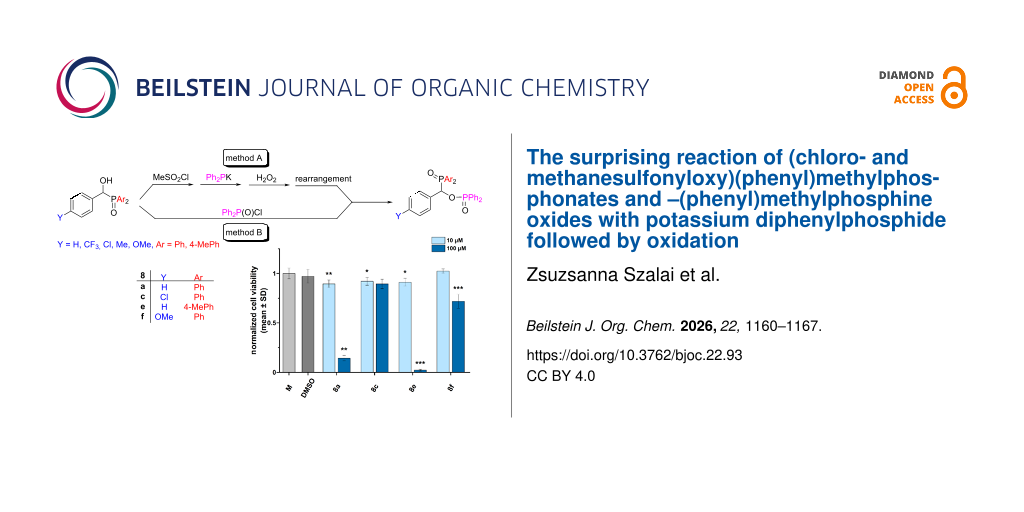
α-Hydroxyphosphonates and α-hydroxyphosphine oxides are important intermediates for additional biologically active species. While (hydroxy(phenyl)methyl)(diphenyl)phosphine oxide did not even undergo chlorination with thionyl chloride, the reaction of diethyl chloro(phenyl)methylphosphonate with potassium diphenylphosphide followed by oxidation with hydrogen peroxide resulted in the expected bis(>P(O)-functionalized) product only as a minor component. The similar reaction of the analogous (methanesulfonyloxy)(phenyl)methyl derivative afforded a mixture of a diethyl (diethoxyphosphonyl)(phenyl)methyl phosphate, a diethyl (diphenylphosphinyl)(phenyl)methyl phosphate, and a ((diphenylphosphinyl)(phenyl)methyl) diphenylphosphinate. The formation of the unexpected products was explained assuming rearrangements and reversible formation of the hydroxymethylene-bis(>P(O)-functionalized) intermediate. Contrary to the earlier experiences, the reaction of ((methanesulfonyloxy)(phenyl)methyl)(diaryl)phosphine oxides with potassium diphenylphosphide followed by oxidation took place in a clear-cut manner providing, with one exception, the corresponding α-phosphinylated α-hydroxyphosphine oxides that could also be synthesized by direct phosphinylation of the starting α-hydroxyphosphine oxide. Cell viability assays performed on U266 myeloma cells revealed concentration-dependent antiproliferative effects of the synthesized compounds on U266 myeloma cells, highlighting the key role of the phosphinoyloxy moiety in the cytotoxic activity, which may be enhanced further by 4-methyl groups in the P-phenyl rings.
Graphical Abstract
Introduction
α-Hydroxyphosphonates and α-hydroxyphosphine oxides represent a prominent class of compounds due to three reasons [1]. Their synthesis by the Pudovik reaction of oxo compounds and >P(O)H reagents, such as dialkyl phosphites and secondary phosphine oxides still hides challenges for green chemists [1]. Moreover, the adducts obtained in the Pudovik addition may serve as intermediates in a wide range of reactions [2-9]. Last but not least, the α-hydroxyphosphonates and their derivatives may be of real or potential biological activity [10-16]. As regards the reactions of α-hydroxyphosphonates, the Keglevich group found that under microwave (MW) conditions, due to the beneficial effect of the adjacent P=O group, the hydroxy group may be substituted by an amino function in the reaction with primary amines [2,3]. Beyond these unexpected transformations, the hydroxy function was acylated [4], phosphorylated [5-7], and sulfonylated [8]. The sulfonyloxyphosphonates were good starting materials in solvolytic reactions with alcohols to provide the α-alkoxy derivatives [8]. Surprisingly, the sulfonyloxyphosphonates could also be involved in the Michaelis–Arbuzov reaction with trivalent P-esters to furnish bisphosphonic derivatives [8,9]. Hydroxymethylene-bisphosphonates form a special group within α-hydroxyphosphonates, and comprise the corresponding bisphosphonic acids that are called dronic acids, and used in the treatment of bone diseases like osteoporosis [17-20]. We have interest in the synthesis of dronic acid derivatives [21], and also in the preparation of bisphosphonic derivatives in a broader sense to make available newer families and species that may be of biological activity.
For this, in this article, we wish to explore the reaction of α-substituted phosphonates and phosphine oxides with potassium diphenylphosphide. Our hope was to synthesize new bisphosphonic or related derivatives displaying cytotoxic effects.
Results and Discussion
Preparative experiments: reaction of α-substituted (phenyl)methylphosphonates and (phenyl)methylphosphine oxides with potassium diphenylphosphide
Diethyl chloro(phenyl)methylphosphonate and diethyl (sulfonyloxy)(phenyl)methylphosphonate as starting materials in reactions with potassium diphenylphosphide: The first attempt was, when diethyl chloro(phenyl)methylphosphonate (2), obtained from diethyl hydroxy(phenyl)methylphosphonate (1) according to our earlier method [22], was reacted with 1.1 equiv of potassium diphenylphosphide (PDPP) under N2 atmosphere in THF. The first run was performed at −40 °C, while the second trial at 0 °C (applying PDPP in the second case in a 1.5 equivalent quantity). The main reaction was then followed by oxidation with 30% hydrogen peroxide. 31P NMR and LC–MS analysis of the crude mixtures revealed that at −40 °C, the expected bis(>P(O)-functionalized) product 3 appeared as a minor component (6%) in the crude mixture, while the major component was diethyl phenylmethylphosphonate (4: 94%). At 0 °C, diethyl ((diphenylphosphinyl)(phenyl)methyl)phosphonate (3) was present in 27%, while phenylmethylphosphonate 4 in 73% (Scheme 1). The latter product (4) was formed by dechlorination of diethyl chloro(phenyl)methylphosphonate (2). Diphenylphosphine oxide (δP 21.6, δP,lit. 22.0 [23], [M + H]+ = 203), diphenylphosphinic acid (δP 31.3, δP,lit. 33.8 [24], [M + H]+ = 219) and ethyl diphenylphosphinate (δP 28.4, δP,lit. 31.9 [25], [M + H]+ = 247) were also present in the reaction mixtures.
![[1860-5397-22-93-i1]](/bjoc/content/inline/1860-5397-22-93-i1.svg?scale=2.0&max-width=1024&background=FFFFFF)
Scheme 1: Unexpected outcome of the reaction of diethyl chloro(phenyl)methylphosphonate (2) with PDPP followed by oxidation.
Scheme 1: Unexpected outcome of the reaction of diethyl chloro(phenyl)methylphosphonate (2) with PDPP followe...
In the second round, (methanesulfonyloxy)(phenyl)methylphosphonate 5 was chosen as the starting material that was prepared by the sulfonylation of hydroxyphosphonate 1 using our method [8]. Then, the sulfonyloxy derivative 5 was reacted with 1.1 equiv of PDPP at 0→25 °C in THF. After oxidation, as above, the crude mixture comprised diethyl (diethoxyphosphonyl)(phenyl)methyl phosphate (6, 60%), diethyl (diphenylphosphinyl)(phenyl)methyl phosphate (7, 30%), and (diphenylphosphinyl)(phenyl)methyl diphenylphosphinate (8a, 10%) (Scheme 2).
![[1860-5397-22-93-i2]](/bjoc/content/inline/1860-5397-22-93-i2.svg?scale=2.0&max-width=1024&background=FFFFFF)
Scheme 2: Unexpected outcome of the reaction of (sulfonyloxy)(phenyl)methylphosphonate 5 with PDPP followed by oxidation.
Scheme 2: Unexpected outcome of the reaction of (sulfonyloxy)(phenyl)methylphosphonate 5 with PDPP followed b...
The unexpected outcome of the reaction may be explained as follows. In the first step, the desired substitution may take place, that is followed by the blocking of the trivalent phosphorus atom to pentavalent-tetracoordinated 3. Then, diethyl ((diphenylphosphinyl)(phenyl)methyl)phosphonate (3) undergoes oxidation to furnish bis(>P(O))-functionalized hydroxymethylene derivative 9 that is the key intermediate for further transformations (Scheme 3). A simple rearrangement of species 9 may lead to the minor component, diethyl (diphenylphosphinyl)(phenyl)methyl phosphate (7). The rearrangement of hydroxymethylene-bis(>P(O)) species 9 to phosphine oxide–phosphate 7 seems to be selective, as the other possibility, the transfer of the P(O)Ph2 moiety to the O atom was not realized. This suggests the dominance of the steric factors over the electronic ones, as although the P atom of the P(O)Ph2 unit is more electrophilic than that of the P(O)(OEt)2 function, the latter center may be approached easier than the more hindered P(O)Ph2 unit. The other possibility is that the bis(>P(O))hydroxymethylene derivative 9, that is as a matter of fact, the adduct of α-oxophosphonate 10 and diphenylphosphine oxide, or that of α-oxophosphine oxide 11 and diethyl phosphite, may get decomposed to the components mentioned above under the conditions applied. Reversible formation of hydroxy(phenyl)methylphosphonates is a well-known phenomenon [26,27]. Returning to the putative reaction sequence suggested in Scheme 3, the Pudovik reaction of diethyl phosphite and α-oxophosphonate 10, and the addition of diphenylphosphine oxide on the C=O group of α-oxophosphine oxide 11 provided hydroxymethylenebisphosphonate 12, and hydroxymethylenebis(phosphine oxide) 13, respectively, that under the conditions of the reaction undergo rearrangement to give the major product diethyl (diethoxyphosphonyl)(phenyl)methyl phosphate (6), and the minor species (diphenylphosphinoyl)(phenyl)methyl diphenylphosphinate (8a). The unstability of bis(>P(O)-functionalized hydroxymethylene derivatives, especially with a phenyl group on the central carbon atom was observed by us [28,29]. Traces of product 6, 7 and 8a were also detected in the reaction mixture of diethyl chloro(phenyl)methyl)phosphonate (2) and PDPP, followed by oxidation (not shown in Scheme 1).
![[1860-5397-22-93-i3]](/bjoc/content/inline/1860-5397-22-93-i3.svg?scale=2.0&max-width=1024&background=FFFFFF)
Scheme 3: Putative explanation for the formation of compounds 6–8 shown in Scheme 2.
Scheme 3: Putative explanation for the formation of compounds 6–8 shown in Scheme 2.
(Chloro(phenyl)methyl)(diphenyl)phosphine oxide and ((sulfonyloxy)(phenyl)methyl)(diaryl)phosphine oxides as starting materials in reaction with potassium diphenylphosphide: In the next stage of our work, α-substituted (phenyl)methylphosphine oxides were selected as starting materials. However, we failed already at the attempt to convert (hydroxy(phenyl)methyl)(diphenyl)phosphine oxide (14a) to the corresponding α-chloro derivative 15 by reaction with thionyl chloride, as under the conditions of the reaction, the starting α-hydroxyphosphine oxide was phosphinoylated to give product 8a in a 5% proportion, along with diphenylphosphinic acid (δP 31.3, δP,lit. 33.8 [24], [M + H]+ = 219) and benzaldehyde ([M + H]+ = 107) as the major components. Ph2P(O)OH came from the oxidation of Ph2P(O)H under the aerobic conditions (Scheme 4). Benzaldehyde and Ph2P(O)H were formed from hydroxyphosphine oxide 14a as a consequence of the reversibility of the Pudovik reaction discussed above [26,27].
![[1860-5397-22-93-i4]](/bjoc/content/inline/1860-5397-22-93-i4.svg?scale=2.0&max-width=1024&background=FFFFFF)
Scheme 4: Result of the attempted chloro-substitution of hydroxy(phenyl)methylphosphine oxide 14a.
Scheme 4: Result of the attempted chloro-substitution of hydroxy(phenyl)methylphosphine oxide 14a.
The explanation for the formation of product 8a may be the following. Under the conditions of the attempted chlorination, a part of the “Pudovik adduct” of benzaldehyde and diphenylphosphine oxide gets decomposed to the components. Reversible formation of the benzaldehyde–diphenylphosphine oxide adduct has been described in [30]. Then, the P-reagent may be chlorinated, and it may react with the remaining hydroxyphosphine oxide 14a to result in the formation of the phosphinoylated species 8a. Some oxidation of the secondary phosphine oxide to the diphenylphosphinic acid is inevitable. Chlorination of the latter byproduct may also provide the P-reagent that phosphinoylates the remaining hydroxyphosphine oxide 14a.
Finally, a series of (hydroxy(aryl)methyl)(diaryl)phosphine oxides 14a–e was prepared by the Pudovik reaction, and were transformed into the methanesulfonylated derivatives 16a–e by reaction with methanesulfonyl chloride in the presence of triethylamine at 25 °C in toluene (Scheme 5). It was found that the attempted methanesulfonylation of the (hydroxy(4-methoxyphenyl)methyl)phosphine oxide 14f did not provide the expected product, but the corresponding (chloro(aryl)methyl)phosphine oxide 15f was formed. This phenomenon has already been observed by us on the analogous example of (hydroxy(4- and 2-methoxyphenyl)methyl)phosphonates [8], and the proposed mechanism involving a quinoide intermediate is shown in Scheme 6.
![[1860-5397-22-93-i5]](/bjoc/content/inline/1860-5397-22-93-i5.svg?scale=2.0&max-width=1024&background=FFFFFF)
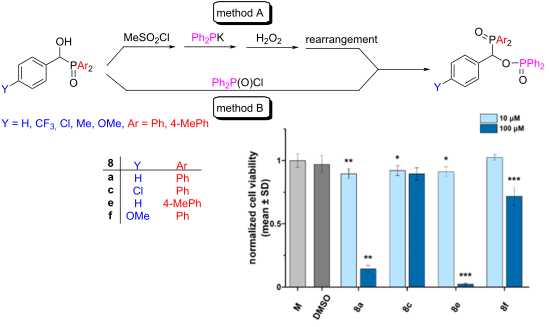
Scheme 5: Two pathways (methods A and B) for the preparation of (diarylphosphinyl)(aryl)methyl diphenylphosphinates 8 starting from the corresponding (hydroxy(aryl)methyl)(diaryl)phosphine oxides 14.
Scheme 5: Two pathways (methods A and B) for the preparation of (diarylphosphinyl)(aryl)methyl diphenylphosph...
![[1860-5397-22-93-i6]](/bjoc/content/inline/1860-5397-22-93-i6.svg?scale=2.0&max-width=1024&background=FFFFFF)
Scheme 6: Unexpected route following the mesylation of (hydroxy(4-methoxyphenyl)methyl)(diphenyl)phosphine oxide (14f).
Scheme 6: Unexpected route following the mesylation of (hydroxy(4-methoxyphenyl)methyl)(diphenyl)phosphine ox...
Interaction of the sulfonyloxy species 16a–e with PDPP at 0→25 °C in THF under N2, followed by oxidation with 30% hydrogen peroxide afforded eventually the corresponding (diarylphosphinoyl)(aryl)methyl diphenylphosphinates 8a–e. Hydroxymethylene-bis(>P(O)) species 18 was assumed as an intermediate. Its rearrangement to phosphine oxide–phosphinate 8, in most cases (when Ar = Ph) may afford a single isomer. However, in the instance, when Ar = 4-MePh, the selectivity may be explained by electronic reasons, as the P atom of the P(O)Ph2-function is more electrophilic than that of the P(O)(4-MePh)2 moiety. Purification by column chromatography afforded products 8a–e in 37–56% yields. Beside the above approach marked as “method A”, products 8a–e completed with 8f could also be prepared by the direct phosphinylation of the starting (hydroxy(aryl)methyl)(diaryl)phosphine oxides 14a–f (Scheme 5, “method B”).
The new products (14b, 16b–d, 15f, 8b–f) were fully characterized by 31P, 13C and 1H NMR spectral data, and the elemental composition was confirmed by HRMS.
Cytotoxic effects of 14a–d,f, 16a,e and 8a,c,e,f on U266 myeloma cells
Figure 1 demonstrates that the synthesized compounds induced concentration-dependent decreases in the viability of the U266 myeloma cells after a 72 h treatment. Multiple myeloma is a hematological malignancy characterized by the clonal proliferation of plasma cells, the terminally differentiated effector cells of the B-cell lineage within the bone marrow. Given the established role of phosphorus-containing drugs in the treatment of myeloma-related complications and their potential antitumor effects, this disease represents an attractive target for the development of novel phosphorus-containing therapeutic agents [31]. Moreover, in our previous studies, several phosphonate derivatives synthesized by our group exhibited promising activity against the U266 cell line [9,32].
![[1860-5397-22-93-1]](/bjoc/content/figures/1860-5397-22-93-1.png?scale=2.0&max-width=1024&background=FFFFFF)
Figure 1: In vitro antiproliferative effects of compounds tested at 10 and 100 µM on U266 cell line after 72 h. The data are normalized to the medium control. Data represented as the mean ± SD; n = 3. The levels of significance are shown as follows: *: p < 0.05; **: p < 0.01; ***: p < 0.001, determined by the one-way ANOVA test, followed by Fisher’s LSD post hoc test.
Figure 1: In vitro antiproliferative effects of compounds tested at 10 and 100 µM on U266 cell line after 72 ...
Consistent with a concentration-dependent response, at 10 µM, most of the compounds caused only moderate reductions in the cell viability, generally maintaining 80–100% survival relative to the untreated control medium. In contrast, treatment of the cell line at 100 µM resulted in more pronounced antiproliferative effects. Several derivatives resulted in statistically significant decreases in the number of viable cells.
(Hydroxy(aryl)methyl)(diaryl)phosphine oxides 14a–d,f and ((methanesulfonyloxy)(aryl)methyl)(diaryl)phosphine oxides 16a and 16e induced only moderate reductions, generally maintaining viabilities between ca. 75–90% of the control level at a 100 µM treatment. Among these compounds, derivative 14a resulted in the strongest effect, reducing the cell viability to 62 ± 4.4%.
Among the tested compounds, the (diphenylphosphinyl)(phenyl)methyl) (bis(4-methylphenyl))phosphinate (8e) exhibited the strongest cytotoxic activity, reducing the cell viability to nearly complete loss of survival (characterized by a 2.2 ± 0.8% residual viability) at 100 µM. Compound 8a also showed a remarkably strong effect, decreasing cell viability to 14.3 ± 2.6% at the higher concentration.
Interestingly, a part of the (diarylphosphinyl)(aryl)methyl diphenylphosphinates 8 proved to be substantially more effective than the starting model compounds, suggesting that replacement of the hydroxy or mesyloxy group with a diphenylphosphinyloxy moiety strongly enhances the cytotoxic activity. Within the series of compound family 8, the P-diphenyl derivative 8a and the bis(4-methylphenyl)-substituted 8e were the most potent. These results indicate that the strong activity does not require substitution at the aryl ring attached to the central carbon, since neither the electron-withdrawing chloro-substituent, nor the electron-donating methoxy group enhanced the potency comapared to the unsubstituted 8a. However, the presence of the electron-donating 4-methyl group in the phenyl rings attached to the central P-atom, as in compound 8e, may enhance further the antiproliferative activity.
Overall, the phosphinoylation of the starting (hydroxy(aryl)methyl)(diaryl)phosphine oxides 8 led to a cytotoxic effect on myeloma cells. Hence, the phosphinoyloxy moiety appears to be the primary structural feature associated with the enhanced antiproliferative activity. This effect may be increased further by the introduction of electron-donating methyl-substituents in the para-position of the P-phenyl rings. The results suggest that these compounds are suitable candidates for further development and structural refinement.
Conclusion
The preparation of the ((chloro- and methanesulfonyloxy)(phenyl)methyl)phosphonates, as well as the (chloro- and methanesulfonyloxy)(phenyl)methylphosphine oxides and their subsequent reaction with potassium diphenylphosphide followed by oxidation with hydrogen peroxide revealed a diverse situation. While (hydroxy(phenyl)methyl)(diphenyl)phosphine oxide resisted undergoing chlorination with thionyl chloride, the reaction of diethyl chloro(phenyl)methylphosphonate with potassium diphenylphosphide followed by oxidation resulted in the expected bis(>P(O)-functionalized) product as a minor product. The analogous reaction of the (methanesulfonyloxy)(phenyl)methyl derivative furnished a mixture of three compounds: a diethyl (diethoxyphosphonyl)(phenyl)methyl phosphate, a diethyl (diphenylphosphinyl)(phenyl)methyl phosphate, and a (diphenylphinyl)(phenyl)methyl diphenylphosphinate.
The products could be deduced by assuming rearrangements and reversible formation of the hydroxymethylene-bis(>P(O)-functionalized) intermediate. The reaction sequence of ((methanesulfonyloxy)(phenyl)methyl)(diaryl)phosphine oxides with potassium diphenylphosphide followed by oxidation led to the α-phosphinylated α-hydroxyphosphine oxides that were prepared alternatively by the direct phosphinoylation of the starting α-hydroxyphosphine oxide. Cell viability assays demonstrated that the synthesized compounds exerted concentration-dependent antiproliferative effects on U266 myeloma cells, with derivatives 8e and 8a exhibiting the highest activity. These findings suggest that the presence of the phosphinoyloxy moiety is essential for enhanced cytotoxic potency, but 4-methyl substituents in the P-phenyl rings may increase further the antiproliferative effect.
Supporting Information
| Supporting Information File 1: Experimental details and the NMR spectra of the compounds synthesized. | ||
| Format: PDF | Size: 3.3 MB | Download |
Funding
The project was supported by the grant of the National Research, Development and Innovation Office (NKKP ADVANCED-149447). The research supported by the Doctoral Excellence Fellowship Programme (DCEP) was financed by the National Research Development and Innovation Fund of the Ministry of Culture and Innovation and the Budapest University of Technology and Economics under a grant agreement with the National Research, Development and Innovation Office. The program was also supported by the Gedeon Richter Talentum Foundation established by Gedeon Richter Plc. (1103 Budapest, Gyomrői út 19−21.) within the support of the Gedeon Richter Excellence Ph.D Scholarship and by the “BMEVBK EUROAPI” Scholarship Program.
Data Availability Statement
Data generated and analyzed during this study is available from the corresponding author upon reasonable request.
References
-
Rádai, Z.; Keglevich, G. Molecules 2018, 23, 1493. doi:10.3390/molecules23061493
Return to citation in text: [1] [2] -
Kiss, N. Z.; Kaszás, A.; Drahos, L.; Mucsi, Z.; Keglevich, G. Tetrahedron Lett. 2012, 53, 207–209. doi:10.1016/j.tetlet.2011.11.026
Return to citation in text: [1] [2] -
Kiss, N. Z.; Rádai, Z.; Mucsi, Z.; Keglevich, G. Heteroat. Chem. 2016, 27, 260–268. doi:10.1002/hc.21324
Return to citation in text: [1] [2] -
Varga, P. R.; Belovics, A.; Bagi, P.; Tóth, S.; Szakács, G.; Bősze, S.; Szabó, R.; Drahos, L.; Keglevich, G. Molecules 2022, 27, 2067. doi:10.3390/molecules27072067
Return to citation in text: [1] [2] -
Rádai, Z.; Hodula, V.; Kiss, N. Z.; Kóti, J.; Keglevich, G. Mendeleev Commun. 2019, 29, 153–154. doi:10.1016/j.mencom.2019.03.011
Return to citation in text: [1] [2] -
Rádai, Z.; Windt, T.; Nagy, V.; Füredi, A.; Kiss, N. Z.; Ranđelović, I.; Tóvári, J.; Keglevich, G.; Szakács, G.; Tóth, S. New J. Chem. 2019, 43, 14028–14035. doi:10.1039/c9nj02144b
Return to citation in text: [1] [2] -
Szalai, Z.; Ábrányi-Balogh, P.; Keglevich, G. J. Org. Chem. 2025, 90, 439–447. doi:10.1021/acs.joc.4c02355
Return to citation in text: [1] [2] -
Szalai, Z.; Debrei, M.; Ábrányi-Balogh, P.; Bősze, S.; Oláhné Szabó, R.; Karaghiosoff, K.; Drahos, L.; Keglevich, G. ACS Omega 2024, 9, 31043–31055. doi:10.1021/acsomega.4c04382
Return to citation in text: [1] [2] [3] [4] [5] [6] -
Szalai, Z.; Bednárik, J.; Tóth, B. S.; Takács, A.; Tekula, S.; Kőhidai, L.; Karaghiosoff, K.; Drahos, L.; Keglevich, G. Pharmaceuticals 2025, 18, 91. doi:10.3390/ph18010091
Return to citation in text: [1] [2] [3] -
Rádai, Z.; Széles, P.; Kiss, N. Z.; Hegedűs, L.; Windt, T.; Nagy, V.; Keglevich, G. Heteroat. Chem. 2018, 29, e21436. doi:10.1002/hc.21436
Return to citation in text: [1] -
Rao, K. U. M.; Sundar, C. S.; Prasad, S. S.; Rani, C. R.; Reddy, C. S. Bull. Korean Chem. Soc. 2011, 32, 3343–3347. doi:10.5012/bkcs.2011.32.9.3343
Return to citation in text: [1] -
Kafarski, P.; Lejczak, B. J. Mol. Catal. B: Enzym. 2004, 29, 99–104. doi:10.1016/j.molcatb.2003.12.013
Return to citation in text: [1] -
Fields, S. C. Tetrahedron 1999, 55, 12237–12273. doi:10.1016/s0040-4020(99)00701-2
Return to citation in text: [1] -
Pokalwar, R. U.; Hangarge, R. V.; Maske, P. V.; Shingare, M. S. ARKIVOC 2006, No. xi, 196–204. doi:10.3998/ark.5550190.0007.b20
Return to citation in text: [1] -
Lorenz, W.; Henglein, A.; Schrader, G. J. Am. Chem. Soc. 1955, 77, 2554–2556. doi:10.1021/ja01614a061
Return to citation in text: [1] -
Naidu, K. R. M.; Kumar, K. S.; Arulselvan, P.; Reddy, C. B.; Lasekan, O. Arch. Pharm. (Weinheim, Ger.) 2012, 345, 957–963. doi:10.1002/ardp.201200192
Return to citation in text: [1] -
Hudson, H. R.; Wardle, N. J.; Bligh, S. W. A.; Greiner, I.; Grün, A.; Keglevich, G. Mini-Rev. Med. Chem. 2012, 12, 313–325. doi:10.2174/138955712799829285
Return to citation in text: [1] -
Mucha, A.; Kafarski, P.; Berlicki, Ł. J. Med. Chem. 2011, 54, 5955–5980. doi:10.1021/jm200587f
Return to citation in text: [1] -
Breuer, E. The development of bisphosphonates as drugs. In Analogue-Based Drug Discovery; Fischer, J.; Ganellin, C. R., Eds.; Wiley-VCH: Weinheim, Germany, 2006; pp 371–384. doi:10.1002/3527608001.ch18
Return to citation in text: [1] -
Grembecka, J.; Mucha, A.; Cierpicki, T.; Kafarski, P. J. Med. Chem. 2003, 46, 2641–2655. doi:10.1021/jm030795v
Return to citation in text: [1] -
Nagy, D.; Grün, A.; Garadnay, S.; Greiner, I.; Keglevich, G. Molecules 2016, 21, 1046. doi:10.3390/molecules21081046
Return to citation in text: [1] -
Grün, A.; Greiner, I.; Keglevich, G. Curr. Org. Chem. 2019, 23, 968–973. doi:10.2174/1385272823666190611103102
Return to citation in text: [1] -
Li, C.; Wang, Q.; Zhang, J.-Q.; Ye, J.; Xie, J.; Xu, Q.; Han, L.-B. Green Chem. 2019, 21, 2916–2922. doi:10.1039/c9gc01254k
Return to citation in text: [1] -
Wyatt, P.; Eley, H.; Charmant, J.; Daniel, B. J.; Kantacha, A. Eur. J. Org. Chem. 2003, 4216–4226. doi:10.1002/ejoc.200300396
Return to citation in text: [1] [2] -
Albanese, D.; Landini, D.; Maia, A. J. Org. Chem. 2001, 66, 3249–3252. doi:10.1021/jo0056388
Return to citation in text: [1] -
Gancarz, R.; Gancarz, I.; Walkowiak, U. Phosphorus, Sulfur Silicon Relat. Elem. 1995, 104, 45–52. doi:10.1080/10426509508042576
Return to citation in text: [1] [2] -
Keglevich, G.; Rádai, Z. Tetrahedron Lett. 2020, 61, 151961. doi:10.1016/j.tetlet.2020.151961
Return to citation in text: [1] [2] -
Szalai, Z.; Keglevich, G. Molecules 2021, 26, 7575. doi:10.3390/molecules26247575
Return to citation in text: [1] -
Keglevich, G.; Grün, A.; Molnár, I. G.; Greiner, I. Heteroat. Chem. 2011, 22, 640–648. doi:10.1002/hc.20727
Return to citation in text: [1] -
Zhang, J.-Q.; Gao, M.; Han, L.-B. Tetrahedron Lett. 2024, 135, 154889. doi:10.1016/j.tetlet.2023.154889
Return to citation in text: [1] -
Abduh, M. S. Saudi J. Biol. Sci. 2024, 31, 103920. doi:10.1016/j.sjbs.2023.103920
Return to citation in text: [1] -
Szalai, Z.; Szloboda, K.; Karaghiosoff, K.; Czugler, M.; Takács, A.; Kőhidai, L.; Gömöry, Á.; Drahos, L.; Keglevich, G. ACS Omega 2026, 11, 14964–14975. doi:10.1021/acsomega.5c11546
Return to citation in text: [1]
| 1. | Rádai, Z.; Keglevich, G. Molecules 2018, 23, 1493. doi:10.3390/molecules23061493 |
| 2. | Kiss, N. Z.; Kaszás, A.; Drahos, L.; Mucsi, Z.; Keglevich, G. Tetrahedron Lett. 2012, 53, 207–209. doi:10.1016/j.tetlet.2011.11.026 |
| 3. | Kiss, N. Z.; Rádai, Z.; Mucsi, Z.; Keglevich, G. Heteroat. Chem. 2016, 27, 260–268. doi:10.1002/hc.21324 |
| 24. | Wyatt, P.; Eley, H.; Charmant, J.; Daniel, B. J.; Kantacha, A. Eur. J. Org. Chem. 2003, 4216–4226. doi:10.1002/ejoc.200300396 |
| 10. | Rádai, Z.; Széles, P.; Kiss, N. Z.; Hegedűs, L.; Windt, T.; Nagy, V.; Keglevich, G. Heteroat. Chem. 2018, 29, e21436. doi:10.1002/hc.21436 |
| 11. | Rao, K. U. M.; Sundar, C. S.; Prasad, S. S.; Rani, C. R.; Reddy, C. S. Bull. Korean Chem. Soc. 2011, 32, 3343–3347. doi:10.5012/bkcs.2011.32.9.3343 |
| 12. | Kafarski, P.; Lejczak, B. J. Mol. Catal. B: Enzym. 2004, 29, 99–104. doi:10.1016/j.molcatb.2003.12.013 |
| 13. | Fields, S. C. Tetrahedron 1999, 55, 12237–12273. doi:10.1016/s0040-4020(99)00701-2 |
| 14. | Pokalwar, R. U.; Hangarge, R. V.; Maske, P. V.; Shingare, M. S. ARKIVOC 2006, No. xi, 196–204. doi:10.3998/ark.5550190.0007.b20 |
| 15. | Lorenz, W.; Henglein, A.; Schrader, G. J. Am. Chem. Soc. 1955, 77, 2554–2556. doi:10.1021/ja01614a061 |
| 16. | Naidu, K. R. M.; Kumar, K. S.; Arulselvan, P.; Reddy, C. B.; Lasekan, O. Arch. Pharm. (Weinheim, Ger.) 2012, 345, 957–963. doi:10.1002/ardp.201200192 |
| 25. | Albanese, D.; Landini, D.; Maia, A. J. Org. Chem. 2001, 66, 3249–3252. doi:10.1021/jo0056388 |
| 2. | Kiss, N. Z.; Kaszás, A.; Drahos, L.; Mucsi, Z.; Keglevich, G. Tetrahedron Lett. 2012, 53, 207–209. doi:10.1016/j.tetlet.2011.11.026 |
| 3. | Kiss, N. Z.; Rádai, Z.; Mucsi, Z.; Keglevich, G. Heteroat. Chem. 2016, 27, 260–268. doi:10.1002/hc.21324 |
| 4. | Varga, P. R.; Belovics, A.; Bagi, P.; Tóth, S.; Szakács, G.; Bősze, S.; Szabó, R.; Drahos, L.; Keglevich, G. Molecules 2022, 27, 2067. doi:10.3390/molecules27072067 |
| 5. | Rádai, Z.; Hodula, V.; Kiss, N. Z.; Kóti, J.; Keglevich, G. Mendeleev Commun. 2019, 29, 153–154. doi:10.1016/j.mencom.2019.03.011 |
| 6. | Rádai, Z.; Windt, T.; Nagy, V.; Füredi, A.; Kiss, N. Z.; Ranđelović, I.; Tóvári, J.; Keglevich, G.; Szakács, G.; Tóth, S. New J. Chem. 2019, 43, 14028–14035. doi:10.1039/c9nj02144b |
| 7. | Szalai, Z.; Ábrányi-Balogh, P.; Keglevich, G. J. Org. Chem. 2025, 90, 439–447. doi:10.1021/acs.joc.4c02355 |
| 8. | Szalai, Z.; Debrei, M.; Ábrányi-Balogh, P.; Bősze, S.; Oláhné Szabó, R.; Karaghiosoff, K.; Drahos, L.; Keglevich, G. ACS Omega 2024, 9, 31043–31055. doi:10.1021/acsomega.4c04382 |
| 9. | Szalai, Z.; Bednárik, J.; Tóth, B. S.; Takács, A.; Tekula, S.; Kőhidai, L.; Karaghiosoff, K.; Drahos, L.; Keglevich, G. Pharmaceuticals 2025, 18, 91. doi:10.3390/ph18010091 |
| 22. | Grün, A.; Greiner, I.; Keglevich, G. Curr. Org. Chem. 2019, 23, 968–973. doi:10.2174/1385272823666190611103102 |
| 1. | Rádai, Z.; Keglevich, G. Molecules 2018, 23, 1493. doi:10.3390/molecules23061493 |
| 23. | Li, C.; Wang, Q.; Zhang, J.-Q.; Ye, J.; Xie, J.; Xu, Q.; Han, L.-B. Green Chem. 2019, 21, 2916–2922. doi:10.1039/c9gc01254k |
| 8. | Szalai, Z.; Debrei, M.; Ábrányi-Balogh, P.; Bősze, S.; Oláhné Szabó, R.; Karaghiosoff, K.; Drahos, L.; Keglevich, G. ACS Omega 2024, 9, 31043–31055. doi:10.1021/acsomega.4c04382 |
| 17. | Hudson, H. R.; Wardle, N. J.; Bligh, S. W. A.; Greiner, I.; Grün, A.; Keglevich, G. Mini-Rev. Med. Chem. 2012, 12, 313–325. doi:10.2174/138955712799829285 |
| 18. | Mucha, A.; Kafarski, P.; Berlicki, Ł. J. Med. Chem. 2011, 54, 5955–5980. doi:10.1021/jm200587f |
| 19. | Breuer, E. The development of bisphosphonates as drugs. In Analogue-Based Drug Discovery; Fischer, J.; Ganellin, C. R., Eds.; Wiley-VCH: Weinheim, Germany, 2006; pp 371–384. doi:10.1002/3527608001.ch18 |
| 20. | Grembecka, J.; Mucha, A.; Cierpicki, T.; Kafarski, P. J. Med. Chem. 2003, 46, 2641–2655. doi:10.1021/jm030795v |
| 8. | Szalai, Z.; Debrei, M.; Ábrányi-Balogh, P.; Bősze, S.; Oláhné Szabó, R.; Karaghiosoff, K.; Drahos, L.; Keglevich, G. ACS Omega 2024, 9, 31043–31055. doi:10.1021/acsomega.4c04382 |
| 21. | Nagy, D.; Grün, A.; Garadnay, S.; Greiner, I.; Keglevich, G. Molecules 2016, 21, 1046. doi:10.3390/molecules21081046 |
| 5. | Rádai, Z.; Hodula, V.; Kiss, N. Z.; Kóti, J.; Keglevich, G. Mendeleev Commun. 2019, 29, 153–154. doi:10.1016/j.mencom.2019.03.011 |
| 6. | Rádai, Z.; Windt, T.; Nagy, V.; Füredi, A.; Kiss, N. Z.; Ranđelović, I.; Tóvári, J.; Keglevich, G.; Szakács, G.; Tóth, S. New J. Chem. 2019, 43, 14028–14035. doi:10.1039/c9nj02144b |
| 7. | Szalai, Z.; Ábrányi-Balogh, P.; Keglevich, G. J. Org. Chem. 2025, 90, 439–447. doi:10.1021/acs.joc.4c02355 |
| 4. | Varga, P. R.; Belovics, A.; Bagi, P.; Tóth, S.; Szakács, G.; Bősze, S.; Szabó, R.; Drahos, L.; Keglevich, G. Molecules 2022, 27, 2067. doi:10.3390/molecules27072067 |
| 8. | Szalai, Z.; Debrei, M.; Ábrányi-Balogh, P.; Bősze, S.; Oláhné Szabó, R.; Karaghiosoff, K.; Drahos, L.; Keglevich, G. ACS Omega 2024, 9, 31043–31055. doi:10.1021/acsomega.4c04382 |
| 9. | Szalai, Z.; Bednárik, J.; Tóth, B. S.; Takács, A.; Tekula, S.; Kőhidai, L.; Karaghiosoff, K.; Drahos, L.; Keglevich, G. Pharmaceuticals 2025, 18, 91. doi:10.3390/ph18010091 |
| 28. | Szalai, Z.; Keglevich, G. Molecules 2021, 26, 7575. doi:10.3390/molecules26247575 |
| 29. | Keglevich, G.; Grün, A.; Molnár, I. G.; Greiner, I. Heteroat. Chem. 2011, 22, 640–648. doi:10.1002/hc.20727 |
| 8. | Szalai, Z.; Debrei, M.; Ábrányi-Balogh, P.; Bősze, S.; Oláhné Szabó, R.; Karaghiosoff, K.; Drahos, L.; Keglevich, G. ACS Omega 2024, 9, 31043–31055. doi:10.1021/acsomega.4c04382 |
| 26. | Gancarz, R.; Gancarz, I.; Walkowiak, U. Phosphorus, Sulfur Silicon Relat. Elem. 1995, 104, 45–52. doi:10.1080/10426509508042576 |
| 27. | Keglevich, G.; Rádai, Z. Tetrahedron Lett. 2020, 61, 151961. doi:10.1016/j.tetlet.2020.151961 |
| 31. | Abduh, M. S. Saudi J. Biol. Sci. 2024, 31, 103920. doi:10.1016/j.sjbs.2023.103920 |
| 9. | Szalai, Z.; Bednárik, J.; Tóth, B. S.; Takács, A.; Tekula, S.; Kőhidai, L.; Karaghiosoff, K.; Drahos, L.; Keglevich, G. Pharmaceuticals 2025, 18, 91. doi:10.3390/ph18010091 |
| 32. | Szalai, Z.; Szloboda, K.; Karaghiosoff, K.; Czugler, M.; Takács, A.; Kőhidai, L.; Gömöry, Á.; Drahos, L.; Keglevich, G. ACS Omega 2026, 11, 14964–14975. doi:10.1021/acsomega.5c11546 |
| 30. | Zhang, J.-Q.; Gao, M.; Han, L.-B. Tetrahedron Lett. 2024, 135, 154889. doi:10.1016/j.tetlet.2023.154889 |
| 8. | Szalai, Z.; Debrei, M.; Ábrányi-Balogh, P.; Bősze, S.; Oláhné Szabó, R.; Karaghiosoff, K.; Drahos, L.; Keglevich, G. ACS Omega 2024, 9, 31043–31055. doi:10.1021/acsomega.4c04382 |
| 24. | Wyatt, P.; Eley, H.; Charmant, J.; Daniel, B. J.; Kantacha, A. Eur. J. Org. Chem. 2003, 4216–4226. doi:10.1002/ejoc.200300396 |
| 26. | Gancarz, R.; Gancarz, I.; Walkowiak, U. Phosphorus, Sulfur Silicon Relat. Elem. 1995, 104, 45–52. doi:10.1080/10426509508042576 |
| 27. | Keglevich, G.; Rádai, Z. Tetrahedron Lett. 2020, 61, 151961. doi:10.1016/j.tetlet.2020.151961 |
© 2026 Szalai et al.; licensee Beilstein-Institut.
This is an open access article licensed under the terms of the Beilstein-Institut Open Access License Agreement (https://www.beilstein-journals.org/bjoc/terms), which is identical to the Creative Commons Attribution 4.0 International License (https://creativecommons.org/licenses/by/4.0). The reuse of material under this license requires that the author(s), source and license are credited. Third-party material in this article could be subject to other licenses (typically indicated in the credit line), and in this case, users are required to obtain permission from the license holder to reuse the material.