Abstract
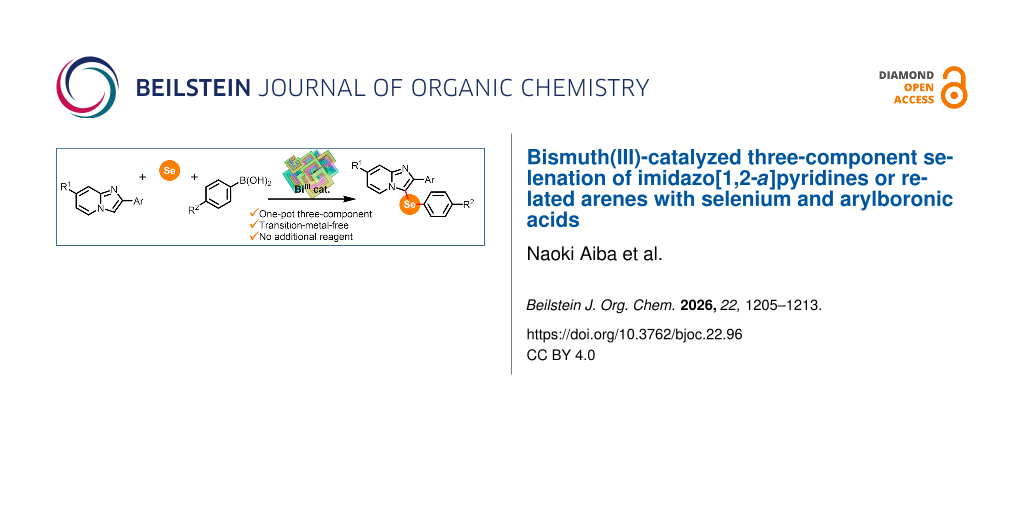
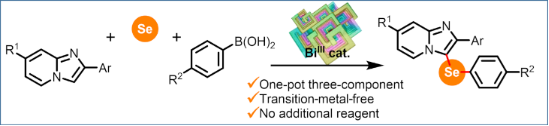
Unsymmetrical diaryl selenides bearing heteroaromatic moieties have attracted increasing attention because of their notable biological activities. In this paper, a novel bismuth-catalyzed three-component reaction is reported for the synthesis of 3-selanylimidazopyridines from imidazopyridines, arylboronic acids, and elemental selenium. The reaction proceeded under aerobic conditions at 100 °C using BiI3 (10 mol %) as the catalyst, affording the desired products in moderate to good yields. The application of this method to other electron-rich arenes was also explored. This transformation represents the first example of a three-component reaction catalyzed by a bismuth reagent. The use of BiI3, a non-hygroscopic and low-toxicity catalyst, offers an alternative to traditional transition-metal-catalyzed systems.
Graphical Abstract
Introduction
Efficient and sustainable strategies for C–Se bond formation [1-8] are crucial in organic synthesis, as they enable the production of pharmaceuticals and bioactive compounds that incorporate selenium atoms [7-12]. For example, one-pot double selenation offers a straightforward method for synthesizing unsymmetrical diaryl selenides via a transition-metal-catalyzed three-component reaction using cost-effective and stable selenium powder as the selenium source [2,13,14]. This approach has attracted considerable interest as a powerful but demanding pathway for assembling unsymmetrical selenides, allowing two distinct functional aryl groups to be attached to a single selenium atom simultaneously. 3-(Arylselanyl)imidazopyridines have also garnered attention due to their interesting biological activities, which include antioxidant effects [15]. Consequently, a number of synthetic methods based on three-component reactions of various aryl sources (e.g., arylboronic acids, triarylbismuthines, or aryl halides) with imidazopyridines and Se powder in the presence of an appropriate transition-metal catalyst (e.g., CuI, Cu(OAc)2, or NiBr2) and ligand (e.g., 1,10-phenanthroline or 2,2'-bipyridyl) have been reported (Scheme 1a–d) [16-19]. However, due to toxicity concerns related to the transition-metal catalysts, the development of synthetic methods with a reduced environmental impact is desirable.
![[1860-5397-22-96-i1]](/bjoc/content/inline/1860-5397-22-96-i1.svg?scale=2.0&max-width=1024&background=FFFFFF)
Scheme 1: Syntheses of 3-(arylselanyl)imidazopyridines using three-component reactions.
Scheme 1: Syntheses of 3-(arylselanyl)imidazopyridines using three-component reactions.
Bismuth is located in the 6th period of the 15th group of the periodic table and is a heavy main group element. Inorganic compounds containing bismuth have gained attention in organic synthesis because of their excellent reactivities as mild Lewis acids, in addition to their low toxicities and environmental friendliness [20-25]. For example, BiCl3 has been used as a catalyst for a wide range of transformations. These include the Mukaiyama aldol reactions [26,27], the nucleophilic ring-opening reactions of epoxides [28], deoxygenative allylation [29], and Diels–Alder reactions [30,31]. It has also been applied to multicomponent reactions involving aldehydes with amines and alkynes or ketones for the synthesis of propargylamines or β-aminocarbonyl compounds [32,33]. Moreover, BiCl3 has demonstrated catalytic activity in Friedel–Crafts reactions [34], oxa-Michael addition reactions [35], the aminooxygenation of propargylamidines [36], and in the tandem cyclization of tryptamine-ynamides [37]. Recently, BiCl3 has garnered interest as an alternative to transition-metal catalysts in organic synthesis. Chakraborty et al. demonstrated its utility in the Suzuki reaction, which involves C(Ar)–C(Ar) bond formation [38]. Additionally, Swu and Aamir Bin Riyaz reported the effectiveness of BiCl3 in promoting the reaction of benzimidazol-2-amines with arylboronic acids, leading to the formation of N-arylbenzimidazol-2-amines via C(Ar)–N bond formation [39]. In contrast, BiI3 is primarily employed in semiconductor and solar cell development [40,41]; however, its utility as a catalyst in organic synthesis remains largely underexplored. Furthermore, the reported uses of catalytic BiI3 have been limited to a few reactions, such as acetal deprotection, guanylation via the desulfurization of thioureas with amines, and the S,S-acetalization of benzaldehyde [42-44]. Recently, our research group reported that the reaction of indoles with diaryl diselenides in the presence of 10 mol % BiI3 yielded 3-selanylindoles via a regioselective C–H selenation at the 3-position of the indole [45]. Thus, focusing on the expanding applicability of BiI3, this paper presents a novel bismuth(III)-catalyzed three-component reaction of Se powder with imidazo[1,2-a]pyridines and arylboronic acids for the synthesis of 3-(arylselanyl)imidazopyridines (Scheme 1, this work) and its application to other electron-rich arenes.
Results and Discussion
Initially, the optimal conditions were investigated for the synthesis of 3-(phenylselanyl)imidazopyridine 9aa via a three-component reaction involving 2-phenylimidazo[1,2-a]pyridine (1a), Se, and aryl reagents 2a–8. The results obtained during the screening of various catalysts, solvents, aryl donors, and reagent ratios are summarized in Table 1. Initially, 1a (0.5 mmol) was reacted with Se (0.5 mmol) and various aryl reagents 2a‒8 in the presence of 10 mol % of BiI3 under aerobic conditions in dimethylformamide (DMF) at 100 °C for 24 h (Table 1, entries 1–7). The reactions employing phenylboronic acid (2a) and triphenylbismuthine (7) afforded the corresponding compound 9aa in moderate yields of 56% and 44%, respectively (Table 1, entries 1 and 6). In contrast, other boron reagents 3 and 4, silicon and tin reagents 5 and 6 as well as iodobenzene (8) proved less effective in producing the desired product. Moreover, despite the fact that triphenylbismuthine (7) contains three phenyl groups, it produced only a moderate product yield. Therefore, phenylboronic acid (2a) was selected as the phenyl-group donor and several commercially available Lewis acids were screened to evaluate their suitability as catalyst in the reaction between 1a and 2a (Table 1, entries 1 and 8–16). As indicated, only BiI3 was found to catalyze the reaction, with minimal reaction progress being observed for the other Lewis acids. A subsequent solvent screening revealed that the reaction proceeded efficiently in DMF (56%), whereas N-methyl-2-pyrrolidone (NMP) and dimethyl sulfoxide (DMSO) were less efficient and toluene, 1,4-dioxane, 1,2-dichloroethane, and ethanol failed to yield the desired product (Table 1, entries 1, 17–22). Next, the optimum amounts of Se powder and phenylboronic acid (2a) for addition to 1a were also investigated (Table 1, entries 1, 23, and 24). Specifically, the reaction of 1a with Se powder (1.2 equiv) and boronic acid 2a (1.2 equiv) proved to be superior, affording product 9aa in a good yield (72%, Table 1, entry 23). With all other parameters kept unchanged, no improvements in the product yield were observed upon increasing the reaction temperature to 130 °C or increasing the BiI3 catalyst loading to 20 mol % (Table 1, entries 25 and 26). Additionally, performing the reaction under oxygen produced 9aa in a 71% yield, which was almost the same as that obtained under aerobic conditions. In contrast, the reaction was completely suppressed under an argon atmosphere (0%, Table 1, entry 28). Notably, the optimal results were obtained under aerobic conditions, offering practical advantages in terms of the operational simplicity (Table 1, entry 23).
Table 1: Screening of reaction conditions.a
![[Graphic 1]](/bjoc/content/inline/1860-5397-22-96-i5.svg?max-width=637&scale=1.0)
|
|||||
| Entry | Aryl source |
Ratio
1a:Se:2a–8 |
Cat. | Solvent | Yield (%)b |
|---|---|---|---|---|---|
| 1 | PhB(OH)2, 2a | 1:1:1 | BiI3 | DMF | 56 |
| 2 | PhBpin, 3 | 1:1:1 | BiI3 | DMF | 0 |
| 3 | PhBF3K, 4 | 1:1:1 | BiI3 | DMF | 0 |
| 4 | PhSi(OEt)3, 5 | 1:1:1 | BiI3 | DMF | 0 |
| 5 | PhSn(n-Bu)3, 6 | 1:1:1 | BiI3 | DMF | 15 |
| 6 | Ph3Bi, 7 | 1:1:1 | BiI3 | DMF | 44 |
| 7 | PhI, 8 | 1:1:1 | BiI3 | DMF | 0 |
| 8 | PhB(OH)2, 2a | 1:1:1 | BiBr3 | DMF | 19 |
| 9 | PhB(OH)2, 2a | 1:1:1 | BiCl3 | DMF | 0 |
| 10 | PhB(OH)2, 2a | 1:1:1 | BiF3 | DMF | 0 |
| 11 | PhB(OH)2, 2a | 1:1:1 | Bi(OTf)3 | DMF | 3 |
| 12 | PhB(OH)2, 2a | 1:1:1 | SbBr3 | DMF | 0 |
| 13 | PhB(OH)2, 2a | 1:1:1 | SbI3 | DMF | 7 |
| 14 | PhB(OH)2, 2a | 1:1:1 | AlCl3 | DMF | 0 |
| 15 | PhB(OH)2, 2a | 1:1:1 | FeCl3 | DMF | 0 |
| 16 | PhB(OH)2, 2a | 1:1:1 | InCl3 | DMF | 0 |
| 17 | PhB(OH)2, 2a | 1:1:1 | BiI3 | NMP | 46 |
| 18 | PhB(OH)2, 2a | 1:1:1 | BiI3 | DMSO | 38 |
| 19 | PhB(OH)2, 2a | 1:1:1 | BiI3 | toluene | 0 |
| 20 | PhB(OH)2, 2a | 1:1:1 | BiI3 | 1,4-dioxane | 0 |
| 21c | PhB(OH)2, 2a | 1:1:1 | BiI3 | 1,2-DCE | 0 |
| 22c | PhB(OH)2, 2a | 1:1:1 | BiI3 | EtOH | 0 |
| 23 | PhB(OH)2, 2a | 1:1.2:1.2 | BiI3 | DMF | 72 |
| 24 | PhB(OH)2, 2a | 1:1.5:1.5 | BiI3 | DMF | 70 |
| 25d | PhB(OH)2, 2a | 1:1.2:1.2 | BiI3 | DMF | 70 |
| 26e | PhB(OH)2, 2a | 1:1.2:1.2 | BiI3 | DMF | 68 |
| 27f | PhB(OH)2, 2a | 1:1.2:1.2 | BiI3 | DMF | 71 |
| 28g | PhB(OH)2, 2a | 1:1.2:1.2 | BiI3 | DMF | 0 |
aConditions: 1a (0.5 mmol), Se (0.5–0.75 mmol), aryl source 2–8 (0.5–0.75 mmol), solvent (2 mL); byield of isolated product; cat 90 °C; dat 130 °C; eBiI3 (20 mol %); funder O2; gunder Ar.
To demonstrate the efficiency and generality of this three-component system, the reactions of Se powder (0.6 mmol) with various imidazopyridines 1 (0.5 mmol) and boronic acids 2 (0.6 mmol) were investigated under the optimized conditions (Scheme 2). Specifically, the reaction of 2-phenylimidazopyridine 1a with Se powder and arylboron reagents 2b–e bearing electron-donating and electron-withdrawing groups at the 4-position of the benzene ring afforded the desired products 9ab–ae in 58–71% yields. The reaction with benzo[b]thiophene-2-boronic acid (2f) also gave the desired product 9af. However, when (E)-styrylboronic acid (2g) or cyclohexylboronic acid (2h) were used, the reaction did not proceed, and the corresponding vinyl- and alkylselanyl derivatives 9ag and 9ah were not obtained. These results suggest that the reaction is specific to arylboronic acids. Subsequently, the reactions of substrates 1b–e, which bear substituents on the phenyl group at the 2-position of the imidazopyridine moiety with Se powder and phenylboronic acid (2a) produced the corresponding products 9ba–ea in good to moderate yields. Additionally, 2-phenylimidazopyridine derivatives 1f–i bearing various electron-donating and electron-withdrawing substituents at the 6-position successfully provided the desired products 9fa–ha in fair to good yields (59–65%). However, in the presence of the strongly electron-withdrawing trifluoromethyl group, the corresponding product 9ia was formed in a low yield (31%). Notably, the unsubstituted imidazopyridine 1j underwent a regioselective transformation to give 3-selanylimidazopyridine 9ja in a good yield. The reactions of 1a with sulfur or tellurium were attempted, but unfortunately, they did not proceed.
![[1860-5397-22-96-i2]](/bjoc/content/inline/1860-5397-22-96-i2.svg?scale=2.0&max-width=1024&background=FFFFFF)
Scheme 2: Synthesis of 3-(arylselanyl)imidazopyridines via three-component reaction of Se powder with various imidazopyridines 1 and boronic acids 2. Conditions: imidazopyridines 1 (0.5 mmol), Se (0.6 mmol), arylboronic acids 2 (0.6 mmol), BiI3 (0.05 mmol), DMF (2 mL), and isolated product yields are indicated. aSulfur powder was used instead of selenium; btellurium powder was used instead of selenium.
Scheme 2: Synthesis of 3-(arylselanyl)imidazopyridines via three-component reaction of Se powder with various...
To further explore the scope of this reaction, we examined its applicability not only to imidazopyridines but also to other arenes, as summarized in Scheme 3. The reaction of Se powder and boronic acid 2a with 2-phenylimidazo[1,2-a]pyrimidine (12a) afforded the corresponding selanyl derivative 13a in 66% yield. Furthermore, pyrrolo[2,3-b]pyridine (12b) or indoles 12c and 12d underwent 3-selective selenation to afford the desired products 13b–d in good yield. In contrast, when benzoxazole (12e) was employed the target product 13e was not generated, and only the starting material was recovered. These results suggest that both the nature and position of the heteroatoms within the aromatic ring significantly influence the reactivity. Furthermore, among the various benzene derivatives bearing activating substituents, the reaction proceeded smoothly using β-naphthol (12f), whereas 1,3,5-trimethoxybenzene (12g) and N,N-dimethylaniline (12h) gave the corresponding products in low yields, and the starting materials were recovered. These results indicate that the reaction tends to proceed more readily with electron-rich aromatic compounds or nitrogen-containing heterocycles.
![[1860-5397-22-96-i3]](/bjoc/content/inline/1860-5397-22-96-i3.svg?scale=2.0&max-width=1024&background=FFFFFF)
Scheme 3: Selenation of other electron-rich arenes. Conditions: arenes 12 (0.5 mmol), Se (0.6 mmol), phenylboronic acid (2a, 0.6 mmol), BiI3 (0.05 mmol), DMF (2 mL), and isolated product yields are indicated.
Scheme 3: Selenation of other electron-rich arenes. Conditions: arenes 12 (0.5 mmol), Se (0.6 mmol), phenylbo...
Subsequently, a series of control experiments was conducted to investigate the reaction pathway and its underlying mechanism. Initially, 2-phenylimidazo[1,2-a]pyridine (1a) was reacted with Se powder and phenylboronic acid (2a) under standard conditions in the presence of 1 equiv of 2,2,6,6-tetramethylpiperidine 1-oxyl (TEMPO) as a radical scavenger. The reaction proceeded without a significant decrease in the yield, suggesting that a radical mechanism is unlikely (Scheme 4, reaction 1). The reaction of 1a with BiI3 alone resulted in recovery of the starting material, with no formation of the iodination product 14 being observed (Scheme 4, reaction 2). In contrast, the reaction of 2a with Se powder afforded diphenyl diselenide (15) in 63% yield (Scheme 4, reaction 3). Upon the subsequent reaction of 15 with 1a in the presence of BiI3, the corresponding 3-(phenylselanyl)imidazopyridine 9aa was obtained in a high yield of 89% (Scheme 4, reaction 4). Additionally, the reaction of 1a with Se powder gave imidazopyridine-substituted diselenide 16 in a 28% yield (Scheme 4, reaction 5); however, the subsequent reaction of 16 with phenylboronic acid (2a) afforded the desired product 9aa in a low yield (9%) (Scheme 4, reaction 6). Furthermore, upon quenching the three-component reaction of 1a with Se powder and 2a after 6 h, product 9aa and diselenide 15 were isolated in 22% and 31% yields, respectively (Scheme 4, reaction 7). These findings suggest that the three-component reaction proceeds primarily with diphenyl diselenide 15 as the key intermediate.
![[1860-5397-22-96-i4]](/bjoc/content/inline/1860-5397-22-96-i4.svg?scale=2.0&max-width=1024&background=FFFFFF)
Although some mechanistic details remain ambiguous, a plausible reaction pathway for the three-component process is proposed in Figure 1, based on the above control experiments and the supporting evidence described below. The reaction was influenced by the surrounding atmosphere and proceeded efficiently in the presence of molecular oxygen, but was significantly inhibited under inert gas conditions (Table 1, entries 23, 27, and 28). This is likely due to the ability of BiI3 to form pentacoordinate complexes with oxygen-containing reagents and solvents such as Mo8O26 and THF, wherein bismuth acts as the central atom [46,47]. This process is initiated by the formation of the pentacoordinate Bi–peroxo complex A through the interaction of BiI3 with molecular oxygen. Complex A undergoes nucleophilic attack from Se to form intermediate B, which then reacts with arylboronic acid via ipso-substitution [48] to generate the six-membered intermediate C. Subsequently, the reductive elimination of BiI3 forms selenide anion D, which is then oxidized by air to give diselenide E. BiI3 or complex A then acts as a Lewis acid to activate diselenide E [49], which undergoes electrophilic substitution with the imidazopyridine to give the corresponding 3-selanylimidazopyridine via F. At this time, the proposed bismuth complexes A–C, which are presumed to form during the reaction, have not yet been identified or isolated, leaving this as a subject for further investigation.
![[1860-5397-22-96-1]](/bjoc/content/figures/1860-5397-22-96-1.svg?scale=2.0&max-width=1024&background=FFFFFF)
Conclusion
In conclusion, a novel bismuth-catalyzed three-component reaction was developed for the synthesis of 3-(arylselanyl)imidazopyridines from elemental selenium, arylboronic acids, and imidazopyridines. The reaction was tested using several other electron-rich arenes, suggesting a limited but possible extension of this method. This transformation proceeded under aerobic conditions without the requirement for additives. Additionally, this reaction enabled simultaneous C–H selanylation and arylselanylation to be performed under relatively mild conditions using BiI3 as the catalyst, which is less toxic than conventional transition-metal catalysts. Although the reaction yields require further optimization, the method provides access to potentially valuable organoselenium compounds. Studies on the mechanism of this reaction, as well as on the application of BiI3 as an alternative to transition-metal catalysts in other chalcogen–carbon bond-formation reactions, are currently underway.
Experimental
Typical procedure
A solution of imidazo[1,2-a]pyridine 1 or arene 12 (0.5 mmol), selenium powder (47 mg, 0.6 mmol, 1.2 equiv), arylboronic acid (0.6 mmol, 1.2 equiv), BiI3 (29 mg, 0.05 mmol, 10 mol %) in DMF (2 mL) was heated at 100 °C under air atmosphere for the indicated time (Scheme 2 or Scheme 3) until complete consumption of starting material was observed by TLC. After completion of the reaction, the mixture was allowed to cool to room temperature and CH2Cl2 (10 mL) and water (10 mL) were added. The aqueous layer was extracted with CH2Cl2 (20 mL × 2). The combined organic layer was washed with water (30 mL) and brine (30 mL), dried (MgSO4) and concentrated under reduced pressure. The crude residue was purified by column chromatography on silica gel eluting with hexane/EtOAc (9, 13a, 13b, 13e–g) or hexane/CH2Cl2 (13c, 13d, 13h), to afford products 9 or 13. The spectroscopic data of known products are in accordance with the literature.
Data Availability Statement
All data that supports the findings of this study is available in the published article and/or the supporting information of this article.
References
-
Gandeepan, P.; Müller, T.; Zell, D.; Cera, G.; Warratz, S.; Ackermann, L. Chem. Rev. 2019, 119, 2192–2452. doi:10.1021/acs.chemrev.8b00507
Return to citation in text: [1] -
Rampon, D. S.; Luz, E. Q.; Lima, D. B.; Balaguez, R. A.; Schneider, P. H.; Alves, D. Dalton Trans. 2019, 48, 9851–9905. doi:10.1039/c9dt00473d
Return to citation in text: [1] [2] -
Sonawane, A. D.; Sonawane, R. A.; Ninomiya, M.; Koketsu, M. Dalton Trans. 2021, 50, 12764–12790. doi:10.1039/d1dt01982a
Return to citation in text: [1] -
Beletskaya, I. P.; Ananikov, V. P. Chem. Rev. 2022, 122, 16110–16293. doi:10.1021/acs.chemrev.1c00836
Return to citation in text: [1] -
Budnikov, A. S.; Krylov, I. B.; Mulina, O. M.; Lapshin, D. A.; Terent'ev, A. O. Adv. Synth. Catal. 2023, 365, 1714–1755. doi:10.1002/adsc.202300144
Return to citation in text: [1] -
Sonego, J. M.; de Diego, S. I.; Szajnman, S. H.; Gallo‐Rodriguez, C.; Rodriguez, J. B. Chem. – Eur. J. 2023, 29, e202300030. doi:10.1002/chem.202300030
Return to citation in text: [1] -
do Carmo Pinheiro, R.; Souza Marques, L.; Ten Kathen Jung, J.; Nogueira, C. W.; Zeni, G. Chem. Rec. 2024, 24, e202400044. doi:10.1002/tcr.202400044
Return to citation in text: [1] [2] -
Benchawan, T.; Saeeng, R. Asian J. Org. Chem. 2025, 14, e202500148. doi:10.1002/ajoc.202500148
Return to citation in text: [1] [2] -
Nogueira, C. W.; Zeni, G.; Rocha, J. B. T. Chem. Rev. 2004, 104, 6255–6286. doi:10.1021/cr0406559
Return to citation in text: [1] -
Sarma, B. K.; Mugesh, G. Org. Biomol. Chem. 2008, 6, 965–974. doi:10.1039/b716239a
Return to citation in text: [1] -
Álvarez-Pérez, M.; Ali, W.; Marć, M. A.; Handzlik, J.; Domínguez-Álvarez, E. Molecules 2018, 23, 628. doi:10.3390/molecules23030628
Return to citation in text: [1] -
Chuai, H.; Zhang, S.-Q.; Bai, H.; Li, J.; Wang, Y.; Sun, J.; Wen, E.; Zhang, J.; Xin, M. Eur. J. Med. Chem. 2021, 223, 113621. doi:10.1016/j.ejmech.2021.113621
Return to citation in text: [1] -
Ma, Y.-T.; Liu, M.-C.; Zhou, Y.-B.; Wu, H.-Y. Adv. Synth. Catal. 2021, 363, 5386–5406. doi:10.1002/adsc.202101227
Return to citation in text: [1] -
Guo, T.; Li, Z.; Bi, L.; Fan, L.; Zhang, P. Tetrahedron 2022, 112, 132752. doi:10.1016/j.tet.2022.132752
Return to citation in text: [1] -
Vieira, B. M.; Thurow, S.; da Costa, M.; Casaril, A. M.; Domingues, M.; Schumacher, R. F.; Perin, G.; Alves, D.; Savegnago, L.; Lenardão, E. J. Asian J. Org. Chem. 2017, 6, 1635–1646. doi:10.1002/ajoc.201700339
Return to citation in text: [1] -
Guo, T.; Wei, X.-N.; Zhu, Y.-L.; Chen, H.; Han, S.-L.; Ma, Y.-C. Synlett 2018, 29, 1530–1536. doi:10.1055/s-0037-1609758
Return to citation in text: [1] -
Kondo, K.; Matsumura, M.; Kanasaki, K.; Murata, Y.; Kakusawa, N.; Yasuike, S. Synthesis 2018, 50, 2200–2210. doi:10.1055/s-0036-1591972
Return to citation in text: [1] -
Guo, T.; Dong, Z.; Zhang, P.; Xing, W.; Li, L. Tetrahedron Lett. 2018, 59, 2554–2558. doi:10.1016/j.tetlet.2018.05.046
Return to citation in text: [1] -
Zhu, J.; Zhu, W.; Xie, P.; Pittman, C. U., Jr.; Zhou, A. Tetrahedron 2018, 74, 6569–6576. doi:10.1016/j.tet.2018.09.037
Return to citation in text: [1] -
Leonard, N. M.; Wieland, L. C.; Mohan, R. S. Tetrahedron 2002, 58, 8373–8397. doi:10.1016/s0040-4020(02)01000-1
Return to citation in text: [1] -
Gaspard‐Iloughmane, H.; Le Roux, C. Eur. J. Org. Chem. 2004, 2517–2532. doi:10.1002/ejoc.200300754
Return to citation in text: [1] -
Bothwell, J. M.; Krabbe, S. W.; Mohan, R. S. Chem. Soc. Rev. 2011, 40, 4649–4707. doi:10.1039/c0cs00206b
Return to citation in text: [1] -
Ondet, P.; Lemière, G.; Duñach, E. Eur. J. Org. Chem. 2017, 761–780. doi:10.1002/ejoc.201600937
Return to citation in text: [1] -
Raţ, C. I.; Soran, A.; Varga, R. A.; Silvestru, C. Adv. Organomet. Chem. 2018, 70, 233–311. doi:10.1016/bs.adomc.2018.07.003
Return to citation in text: [1] -
Takasawa, R.; Jona, A.; Inoue, M.; Azuma, M.; Akahane, H.; Ueno, Y.; Nakagawa, Y.; Chimori, R.; Mano, Y.; Murata, Y.; Yasuike, S.; Kaji, T. J. Toxicol. Sci. 2022, 47, 539–546. doi:10.2131/jts.47.539
Return to citation in text: [1] -
Ohki, H.; Wada, M.; Akiba, K.-y. Tetrahedron Lett. 1988, 29, 4719–4722. doi:10.1016/s0040-4039(00)80590-0
Return to citation in text: [1] -
Wada, M.; Takeichi, E.; Matsumoto, T. Bull. Chem. Soc. Jpn. 1991, 64, 990–994. doi:10.1246/bcsj.64.990
Return to citation in text: [1] -
Ollevier, T.; Lavie-Compin, G. Tetrahedron Lett. 2002, 43, 7891–7893. doi:10.1016/s0040-4039(02)01896-8
Return to citation in text: [1] -
De, S. K.; Gibbs, R. A. Tetrahedron Lett. 2005, 46, 8345–8350. doi:10.1016/j.tetlet.2005.09.161
Return to citation in text: [1] -
Sabitha, G.; Venkata Reddy, E.; Maruthi, C.; Yadav, J. S. Tetrahedron Lett. 2002, 43, 1573–1575. doi:10.1016/s0040-4039(02)00018-7
Return to citation in text: [1] -
Sabitha, G.; Venkata Reddy, E.; Yadav, J. S.; Rama Krishna, K. V. S.; Ravi Sankar, A. Tetrahedron Lett. 2002, 43, 4029–4032. doi:10.1016/s0040-4039(02)00704-9
Return to citation in text: [1] -
Li, Z.; Wei, C.; Chen, L.; Varma, R. S.; Li, C.-J. Tetrahedron Lett. 2004, 45, 2443–2446. doi:10.1016/j.tetlet.2004.01.044
Return to citation in text: [1] -
Li, H.; Zeng, H.-y.; Shao, H.-w. Tetrahedron Lett. 2009, 50, 6858–6860. doi:10.1016/j.tetlet.2009.09.131
Return to citation in text: [1] -
Wu, F.; Huang, W.; Yiliqi; Yang, J.; Gu, Y. Adv. Synth. Catal. 2018, 360, 3318–3330. doi:10.1002/adsc.201800669
Return to citation in text: [1] -
Wu, Z.; Feng, X.-X.; Wang, Q.-D.; Yun, J.-J.; Rao, W.; Yang, J.-M.; Shen, Z.-L. Chin. Chem. Lett. 2020, 31, 1297–1300. doi:10.1016/j.cclet.2019.09.017
Return to citation in text: [1] -
Li, S.; Li, Y.; Feng, B.; Liang, J.; You, G.; Liu, X.; Xian, L. Chem. Commun. 2020, 56, 6400–6403. doi:10.1039/d0cc02143a
Return to citation in text: [1] -
Lin, X.-T.; Zhao, C.; Wang, D.-R.; Wu, G.-C.; Chen, G.-S.; Chen, S.-J.; Ren, H.; Deng, D.-S.; Xu, Y.-B.; Hu, X.-W.; Liu, Y.-L. Adv. Synth. Catal. 2022, 364, 890–896. doi:10.1002/adsc.202101232
Return to citation in text: [1] -
Malik, P.; Joseph, D.; Chakraborty, D. Appl. Organomet. Chem. 2013, 27, 519–522. doi:10.1002/aoc.3020
Return to citation in text: [1] -
Aamir Bin Riyaz, M.; Swu, T. ChemistrySelect 2022, 7, e202203281. doi:10.1002/slct.202203281
Return to citation in text: [1] -
Zhang, J. Z. J. Phys. Chem. B 2000, 104, 7239–7253. doi:10.1021/jp000594s
Return to citation in text: [1] -
Ünlü, F.; Deo, M.; Mathur, S.; Kirchartz, T.; Kulkarni, A. J. Phys. D: Appl. Phys. 2022, 55, 113002. doi:10.1088/1361-6463/ac3033
Return to citation in text: [1] -
Komatsu, N.; Uda, M.; Suzuki, H. Synlett 1995, 984–986. doi:10.1055/s-1995-5137
Return to citation in text: [1] -
Cunha, S.; Rodrigues, M. T., Jr. Tetrahedron Lett. 2006, 47, 6955–6956. doi:10.1016/j.tetlet.2006.07.138
Return to citation in text: [1] -
Bailey, A. D.; Baru, A. R.; Tasche, K. K.; Mohan, R. S. Tetrahedron Lett. 2008, 49, 691–694. doi:10.1016/j.tetlet.2007.11.127
Return to citation in text: [1] -
Matsumura, M.; Umeda, A.; Sumi, Y.; Aiba, N.; Murata, Y.; Yasuike, S. Molecules 2024, 29, 3227. doi:10.3390/molecules29133227
Return to citation in text: [1] -
Adonin, S. A.; Peresypkina, E. V.; Sokolov, M. N.; Korolkov, I. V.; Fedin, V. P. Inorg. Chem. 2014, 53, 6886–6892. doi:10.1021/ic500710t
Return to citation in text: [1] -
Wedal, J. C.; Ziller, J. W.; Evans, W. J. Inorg. Chem. 2022, 61, 11766–11774. doi:10.1021/acs.inorgchem.2c01483
Return to citation in text: [1] -
Redon, S.; Kosso, A. R. O.; Broggi, J.; Vanelle, P. Synthesis 2019, 51, 3758–3764. doi:10.1055/s-0039-1690013
Return to citation in text: [1] -
Rios, E. A. M.; Gomes, C. M. B.; Silvério, G. L.; Luz, E. Q.; Ali, S.; D'Oca, C. d. R. M.; Albach, B.; Campos, R. B.; Rampon, D. S. RSC Adv. 2023, 13, 914–925. doi:10.1039/d2ra06813c
Return to citation in text: [1]
| 42. | Komatsu, N.; Uda, M.; Suzuki, H. Synlett 1995, 984–986. doi:10.1055/s-1995-5137 |
| 43. | Cunha, S.; Rodrigues, M. T., Jr. Tetrahedron Lett. 2006, 47, 6955–6956. doi:10.1016/j.tetlet.2006.07.138 |
| 44. | Bailey, A. D.; Baru, A. R.; Tasche, K. K.; Mohan, R. S. Tetrahedron Lett. 2008, 49, 691–694. doi:10.1016/j.tetlet.2007.11.127 |
| 39. | Aamir Bin Riyaz, M.; Swu, T. ChemistrySelect 2022, 7, e202203281. doi:10.1002/slct.202203281 |
| 40. | Zhang, J. Z. J. Phys. Chem. B 2000, 104, 7239–7253. doi:10.1021/jp000594s |
| 41. | Ünlü, F.; Deo, M.; Mathur, S.; Kirchartz, T.; Kulkarni, A. J. Phys. D: Appl. Phys. 2022, 55, 113002. doi:10.1088/1361-6463/ac3033 |
| 1. | Gandeepan, P.; Müller, T.; Zell, D.; Cera, G.; Warratz, S.; Ackermann, L. Chem. Rev. 2019, 119, 2192–2452. doi:10.1021/acs.chemrev.8b00507 |
| 2. | Rampon, D. S.; Luz, E. Q.; Lima, D. B.; Balaguez, R. A.; Schneider, P. H.; Alves, D. Dalton Trans. 2019, 48, 9851–9905. doi:10.1039/c9dt00473d |
| 3. | Sonawane, A. D.; Sonawane, R. A.; Ninomiya, M.; Koketsu, M. Dalton Trans. 2021, 50, 12764–12790. doi:10.1039/d1dt01982a |
| 4. | Beletskaya, I. P.; Ananikov, V. P. Chem. Rev. 2022, 122, 16110–16293. doi:10.1021/acs.chemrev.1c00836 |
| 5. | Budnikov, A. S.; Krylov, I. B.; Mulina, O. M.; Lapshin, D. A.; Terent'ev, A. O. Adv. Synth. Catal. 2023, 365, 1714–1755. doi:10.1002/adsc.202300144 |
| 6. | Sonego, J. M.; de Diego, S. I.; Szajnman, S. H.; Gallo‐Rodriguez, C.; Rodriguez, J. B. Chem. – Eur. J. 2023, 29, e202300030. doi:10.1002/chem.202300030 |
| 7. | do Carmo Pinheiro, R.; Souza Marques, L.; Ten Kathen Jung, J.; Nogueira, C. W.; Zeni, G. Chem. Rec. 2024, 24, e202400044. doi:10.1002/tcr.202400044 |
| 8. | Benchawan, T.; Saeeng, R. Asian J. Org. Chem. 2025, 14, e202500148. doi:10.1002/ajoc.202500148 |
| 16. | Guo, T.; Wei, X.-N.; Zhu, Y.-L.; Chen, H.; Han, S.-L.; Ma, Y.-C. Synlett 2018, 29, 1530–1536. doi:10.1055/s-0037-1609758 |
| 17. | Kondo, K.; Matsumura, M.; Kanasaki, K.; Murata, Y.; Kakusawa, N.; Yasuike, S. Synthesis 2018, 50, 2200–2210. doi:10.1055/s-0036-1591972 |
| 18. | Guo, T.; Dong, Z.; Zhang, P.; Xing, W.; Li, L. Tetrahedron Lett. 2018, 59, 2554–2558. doi:10.1016/j.tetlet.2018.05.046 |
| 19. | Zhu, J.; Zhu, W.; Xie, P.; Pittman, C. U., Jr.; Zhou, A. Tetrahedron 2018, 74, 6569–6576. doi:10.1016/j.tet.2018.09.037 |
| 37. | Lin, X.-T.; Zhao, C.; Wang, D.-R.; Wu, G.-C.; Chen, G.-S.; Chen, S.-J.; Ren, H.; Deng, D.-S.; Xu, Y.-B.; Hu, X.-W.; Liu, Y.-L. Adv. Synth. Catal. 2022, 364, 890–896. doi:10.1002/adsc.202101232 |
| 15. | Vieira, B. M.; Thurow, S.; da Costa, M.; Casaril, A. M.; Domingues, M.; Schumacher, R. F.; Perin, G.; Alves, D.; Savegnago, L.; Lenardão, E. J. Asian J. Org. Chem. 2017, 6, 1635–1646. doi:10.1002/ajoc.201700339 |
| 38. | Malik, P.; Joseph, D.; Chakraborty, D. Appl. Organomet. Chem. 2013, 27, 519–522. doi:10.1002/aoc.3020 |
| 2. | Rampon, D. S.; Luz, E. Q.; Lima, D. B.; Balaguez, R. A.; Schneider, P. H.; Alves, D. Dalton Trans. 2019, 48, 9851–9905. doi:10.1039/c9dt00473d |
| 13. | Ma, Y.-T.; Liu, M.-C.; Zhou, Y.-B.; Wu, H.-Y. Adv. Synth. Catal. 2021, 363, 5386–5406. doi:10.1002/adsc.202101227 |
| 14. | Guo, T.; Li, Z.; Bi, L.; Fan, L.; Zhang, P. Tetrahedron 2022, 112, 132752. doi:10.1016/j.tet.2022.132752 |
| 35. | Wu, Z.; Feng, X.-X.; Wang, Q.-D.; Yun, J.-J.; Rao, W.; Yang, J.-M.; Shen, Z.-L. Chin. Chem. Lett. 2020, 31, 1297–1300. doi:10.1016/j.cclet.2019.09.017 |
| 7. | do Carmo Pinheiro, R.; Souza Marques, L.; Ten Kathen Jung, J.; Nogueira, C. W.; Zeni, G. Chem. Rec. 2024, 24, e202400044. doi:10.1002/tcr.202400044 |
| 8. | Benchawan, T.; Saeeng, R. Asian J. Org. Chem. 2025, 14, e202500148. doi:10.1002/ajoc.202500148 |
| 9. | Nogueira, C. W.; Zeni, G.; Rocha, J. B. T. Chem. Rev. 2004, 104, 6255–6286. doi:10.1021/cr0406559 |
| 10. | Sarma, B. K.; Mugesh, G. Org. Biomol. Chem. 2008, 6, 965–974. doi:10.1039/b716239a |
| 11. | Álvarez-Pérez, M.; Ali, W.; Marć, M. A.; Handzlik, J.; Domínguez-Álvarez, E. Molecules 2018, 23, 628. doi:10.3390/molecules23030628 |
| 12. | Chuai, H.; Zhang, S.-Q.; Bai, H.; Li, J.; Wang, Y.; Sun, J.; Wen, E.; Zhang, J.; Xin, M. Eur. J. Med. Chem. 2021, 223, 113621. doi:10.1016/j.ejmech.2021.113621 |
| 36. | Li, S.; Li, Y.; Feng, B.; Liang, J.; You, G.; Liu, X.; Xian, L. Chem. Commun. 2020, 56, 6400–6403. doi:10.1039/d0cc02143a |
| 29. | De, S. K.; Gibbs, R. A. Tetrahedron Lett. 2005, 46, 8345–8350. doi:10.1016/j.tetlet.2005.09.161 |
| 32. | Li, Z.; Wei, C.; Chen, L.; Varma, R. S.; Li, C.-J. Tetrahedron Lett. 2004, 45, 2443–2446. doi:10.1016/j.tetlet.2004.01.044 |
| 33. | Li, H.; Zeng, H.-y.; Shao, H.-w. Tetrahedron Lett. 2009, 50, 6858–6860. doi:10.1016/j.tetlet.2009.09.131 |
| 48. | Redon, S.; Kosso, A. R. O.; Broggi, J.; Vanelle, P. Synthesis 2019, 51, 3758–3764. doi:10.1055/s-0039-1690013 |
| 28. | Ollevier, T.; Lavie-Compin, G. Tetrahedron Lett. 2002, 43, 7891–7893. doi:10.1016/s0040-4039(02)01896-8 |
| 34. | Wu, F.; Huang, W.; Yiliqi; Yang, J.; Gu, Y. Adv. Synth. Catal. 2018, 360, 3318–3330. doi:10.1002/adsc.201800669 |
| 49. | Rios, E. A. M.; Gomes, C. M. B.; Silvério, G. L.; Luz, E. Q.; Ali, S.; D'Oca, C. d. R. M.; Albach, B.; Campos, R. B.; Rampon, D. S. RSC Adv. 2023, 13, 914–925. doi:10.1039/d2ra06813c |
| 26. | Ohki, H.; Wada, M.; Akiba, K.-y. Tetrahedron Lett. 1988, 29, 4719–4722. doi:10.1016/s0040-4039(00)80590-0 |
| 27. | Wada, M.; Takeichi, E.; Matsumoto, T. Bull. Chem. Soc. Jpn. 1991, 64, 990–994. doi:10.1246/bcsj.64.990 |
| 45. | Matsumura, M.; Umeda, A.; Sumi, Y.; Aiba, N.; Murata, Y.; Yasuike, S. Molecules 2024, 29, 3227. doi:10.3390/molecules29133227 |
| 20. | Leonard, N. M.; Wieland, L. C.; Mohan, R. S. Tetrahedron 2002, 58, 8373–8397. doi:10.1016/s0040-4020(02)01000-1 |
| 21. | Gaspard‐Iloughmane, H.; Le Roux, C. Eur. J. Org. Chem. 2004, 2517–2532. doi:10.1002/ejoc.200300754 |
| 22. | Bothwell, J. M.; Krabbe, S. W.; Mohan, R. S. Chem. Soc. Rev. 2011, 40, 4649–4707. doi:10.1039/c0cs00206b |
| 23. | Ondet, P.; Lemière, G.; Duñach, E. Eur. J. Org. Chem. 2017, 761–780. doi:10.1002/ejoc.201600937 |
| 24. | Raţ, C. I.; Soran, A.; Varga, R. A.; Silvestru, C. Adv. Organomet. Chem. 2018, 70, 233–311. doi:10.1016/bs.adomc.2018.07.003 |
| 25. | Takasawa, R.; Jona, A.; Inoue, M.; Azuma, M.; Akahane, H.; Ueno, Y.; Nakagawa, Y.; Chimori, R.; Mano, Y.; Murata, Y.; Yasuike, S.; Kaji, T. J. Toxicol. Sci. 2022, 47, 539–546. doi:10.2131/jts.47.539 |
| 30. | Sabitha, G.; Venkata Reddy, E.; Maruthi, C.; Yadav, J. S. Tetrahedron Lett. 2002, 43, 1573–1575. doi:10.1016/s0040-4039(02)00018-7 |
| 31. | Sabitha, G.; Venkata Reddy, E.; Yadav, J. S.; Rama Krishna, K. V. S.; Ravi Sankar, A. Tetrahedron Lett. 2002, 43, 4029–4032. doi:10.1016/s0040-4039(02)00704-9 |
| 46. | Adonin, S. A.; Peresypkina, E. V.; Sokolov, M. N.; Korolkov, I. V.; Fedin, V. P. Inorg. Chem. 2014, 53, 6886–6892. doi:10.1021/ic500710t |
| 47. | Wedal, J. C.; Ziller, J. W.; Evans, W. J. Inorg. Chem. 2022, 61, 11766–11774. doi:10.1021/acs.inorgchem.2c01483 |
© 2026 Aiba et al.; licensee Beilstein-Institut.
This is an open access article licensed under the terms of the Beilstein-Institut Open Access License Agreement (https://www.beilstein-journals.org/bjoc/terms), which is identical to the Creative Commons Attribution 4.0 International License (https://creativecommons.org/licenses/by/4.0). The reuse of material under this license requires that the author(s), source and license are credited. Third-party material in this article could be subject to other licenses (typically indicated in the credit line), and in this case, users are required to obtain permission from the license holder to reuse the material.