Abstract
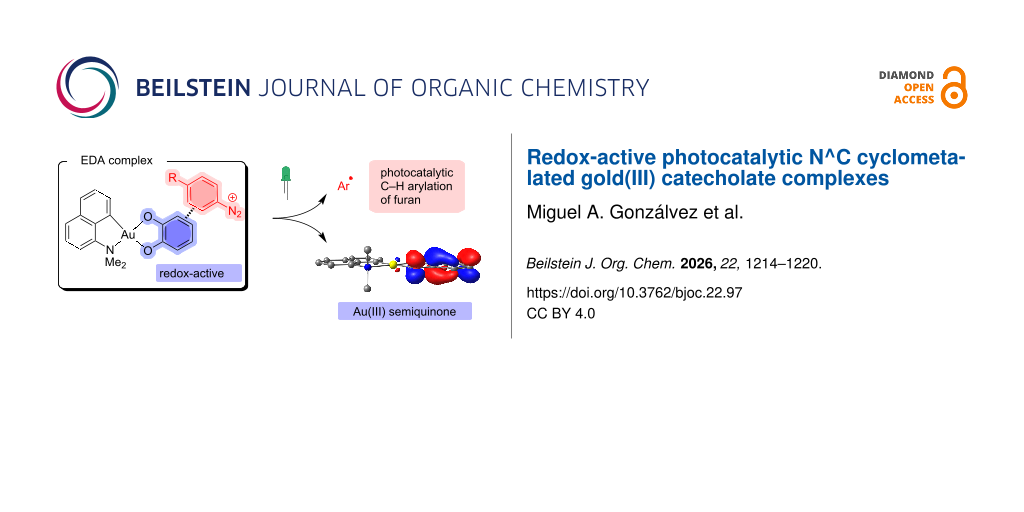
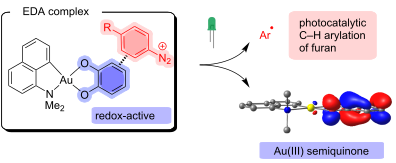
The redox properties and photocatalytic activity of four N^C cyclometalated Au(III) catecholate complexes were investigated. They proved competent for the photocatalytic C–H arylation of furan with aryldiazonium salts under green LED irradiation. UV–vis studies supported the formation of electron donor–acceptor adducts between the Au(III) catecholate complexes and diazonium salts, enabling photoinduced electron transfer and aryl radical generation. Electrochemical, EPR, and DFT studies evidenced ligand-centered redox activity and the formation of Au(III) semiquinone species.
Graphical Abstract
Introduction
Over the last decade, two-electron chemistry of gold complexes, i.e., cycling between Au(I) and Au(III) redox states, has expanded remarkably, notably through the development of bidentate ligands such as P^C, P^P, P^N, and N^C scaffolds [1-4]. In contrast, one-electron processes remain extremely rare with gold complexes, despite the considerable potential of such open-shell pathways to unlock fundamentally distinct and unprecedented mechanistic manifolds [5-9]. Recently, we [10] discovered that P^C and P^P-ligated gold(III) catecholate complexes undergo photoinduced single-electron transfer (PET) with aryldiazoniums to generate synthetically useful aryl radicals, enabling the C–H arylation of furans and other heterocycles [11]. A pivotal feature underlying this reactivity is the redox-active character of the catecholate moiety, whose oxidation generates the key Au(III) semiquinone intermediate.
In parallel, the coordination chemistry and reactivity of Au(III) complexes have also undergone spectacular developments [12,13]. Despite their soft character, P-based ligands have proved efficient and versatile in stabilizing Au(III) complexes and supporting diverse transformations that were rarely observed before or even unprecedented in gold chemistry. However, N-based ligands, in particular N^C-cyclometalated ones, still occupy the forefront position in Au(III) chemistry [13,14]. Besides the harder character of N, which aligns well with the Au(III) oxidation state, N^C-cyclometalated ligands are readily installed at Au(III) and broadly vary structurally. Of note, the distinct electronic properties of N and P confer complementary behavior to N^C and P^C/P^P-ligated Au(III) complexes, as already documented in different systems [15-17]. To date, catalytic applications of cyclometalated Au(III) complexes mostly involve Lewis acid behavior of the metal and activation of π-substrates, with occasional contributions in two-electron redox coupling reactions. Among the previously reported (N^C)Au(III) catecholate complexes, only two studies have examined their catalytic activity, both in π-activation transformations [18,19].
In the present work, we investigated whether N^C-cyclometalated Au(III) catecholate complexes could similarly display redox-active behavior and photocatalytic activity in the arylation of furan with diazonium salts (Figure 1) [20,21]. This would open a new reaction path for N^C Au(III) complexes, and comparison with the P^C and P^P-ligated systems would provide further insight into the influence of the ancillary ligand at Au(III).
![[1860-5397-22-97-1]](/bjoc/content/figures/1860-5397-22-97-1.svg?scale=2.0&max-width=1024&background=FFFFFF)
Figure 1: Catalytic applications of N^C-cyclometalated Au(III) complexes.
Figure 1: Catalytic applications of N^C-cyclometalated Au(III) complexes.
Results and Discussion
The four N^C-cyclometalated gold(III) catecholate complexes 4a,b and 5a,b were targeted in this study. Both the N^C ligand (a phenylpyridine or a naphthylamine) and the O^O ligand (parent and 3,5-di-t-Bu-substituted catecholates) were varied. Complexes 4a,b and 5a,b were conveniently synthesized via the same route as the P^C and P^P-ligated gold(III) complexes, namely through reaction of the corresponding Au(III) dihalogeno precursors 1 [22] and 2 [15] and sodium catecholates (Figure 2). They were obtained in moderate to good yields as air-stable solids. As expected because of the dissymmetry of the N^C ligand and di-tert-butyl catecholate moiety [23,24], complexes 4b and 5b were obtained as mixtures of cis and trans-isomers, whose stereochemistry was ascertained thanks to NOESY NMR experiments (see Supporting Information File 1, Figures S22 and S40). The robustness of this synthetic route foreshadows the possibility of synthesizing other Au(III) complexes bearing different ancillary ligands and catecholate moieties, offering a simple way to fine-tune and customize electrochemical and optical properties.
![[1860-5397-22-97-2]](/bjoc/content/figures/1860-5397-22-97-2.svg?scale=2.0&max-width=1024&background=FFFFFF)
Figure 2: Preparation of the N^C-cyclometalated gold(III) catecholate complexes 4a,b and 5a,b. For the di-tert-butyl-substituted derivatives, only the major isomers 4b and 5b are depicted, and the isomer ratios are given in parentheses.
Figure 2: Preparation of the N^C-cyclometalated gold(III) catecholate complexes 4a,b and 5a,b. For the di-tert...
To assess the accessibility of the corresponding Au(III) semiquinone complexes, complexes 4a,b and 5a,b were then analyzed by cyclic voltammetry (Figure 3 and Table 1, see also Supporting Information File 1, Figure S8). These electrochemical studies revealed an overall behavior similar to that of the related P^C and P^P-ligated complexes [10], i.e., low-potential catecholate-centered oxidation, albeit with some noticeable differences as detailed hereafter. The oxidation of the N^C-cyclometalated parent catecholate Au(III) complexes 4a and 5a is shifted to higher potentials compared to the corresponding P^C-H4 complex (ΔEpa = +0.16 and +0.22 V, respectively). This probably reflects the weaker electron-donating nature of the N^C scaffold, as observed previously in Au(III) π-allyl complexes for example [17,25,26]. In addition, complexes 4a and 5a present an irreversible oxidation (even at 2000 mV/s scan rate) that suggests decreased stability of their oxidized forms. On the other hand, the more electron-rich di-tert-butylcatecholate complexes 4b and 5b exhibit oxidation potentials very similar to that of P^C-H4 (ΔEpa = ±0.05 V, ΔE1/2 = ±0.04 V) and increased stability of the ensuing oxidized forms. Here, the oxidation process is reversible as apparent from the Ipa/Ipc current ratio (0.99 and 1.03 for 4b and 5b, respectively) [24]. These experimental data were further completed and corroborated by DFT calculations (see Supporting Information File 1, Table S8). Indeed, the ionization energies calculated for 4b and 5b are similar to that predicted for P^C-H4 and substantially lower than that found for the parent catecholate complex 5a (Table 1) [10].
![[1860-5397-22-97-3]](/bjoc/content/figures/1860-5397-22-97-3.svg?scale=2.0&max-width=1024&background=FFFFFF)
Figure 3: Cyclic voltammograms of P^C-H4, 4a,b, and 5a,b (0.25 mM, DCM, 0.25 M [Bu4N][PF6], 100 mV/s, Pt disk, Fc+/Fc0).
Figure 3: Cyclic voltammograms of P^C-H4, 4a,b, and 5a,b (0.25 mM, DCM, 0.25 M [Bu4N][PF6], 100 mV/s, Pt disk...
Table 1: Corresponding half-wave potentials (E1/2), anodic potentials (Epa), current ratios (Ipa/Ipc), and ionization energies (IE) calculated at the SMD(DCM)-ZORA-PBE0-D4/SARC-ZORA-TZVP (Au), ZORA-def2-TZVP (other atoms) level of theory. n.d. for not determined.
| Complex | E1/2 (V) | Epa (V) | Ipa/Ipc | IE (kcal/mol) |
| P^C-H4 | 0.14 | 0.20 | 1.01 | 102.6 |
| 4a | n.d. | 0.36 | 1.81 | n.d. |
| 4b | 0.18 | 0.25 | 0.99 | 102.3 |
| 5a | n.d. | 0.42 | 5.01 | 105.6 |
| 5b | 0.10 | 0.15 | 1.03 | 101.5 |
The photocatalytic activity of the N^C-cyclometalated Au(III) catecholate complexes in the C–H arylation of furan with aryldiazonium salts was then investigated. The four complexes 4a,b and 5a,b were evaluated and compared under the same conditions (1 mol %, green light, 5 W, 20 °C) to P^C-H4 as well as the benchmark catalyst eosin Y used by König et al. [10,11]. A small library of diazonium salts p-RPhN2+BF4− with diverse electronic characters was employed (R = MeO, Me, H, F, Br, O2N). In each case, the reaction afforded the mono-2-arylated furan as the major product, with a minor amount of the 2,5-diarylated by-product (0–12%) (see Supporting Information File 1, Tables S1–S6). The four N^C-cyclometalated Au(III) complexes proved active (45% average yield over 24 reactions, Table 2). For the pristine diazonium salt PhN2+BF4−, complexes 4a,b, and 5b led to similar yields to P^C-H4 and eosin Y (20–32%) but required longer reaction times (18 h instead of 6–8 h), while complex 5a proved inferior (14% yield). With electron-deficient diazonium salts (p-F, p-Br, p-O2N), the N^C-cyclometalated Au(III) catecholate complexes all turned out to be less efficient than P^C-H4 and eosin Y, giving lower yields and performing slower. Better results were obtained with the more challenging electron-rich diazonium salts (p-Me and p-MeO). Here, the di-tert-butylcatecholate complexes 4b and 5b performed best, approaching the results obtained with P^C-H4 and eosin Y, i.e., 60% yield for p-MeOPhN2+BF4– and 48% yield for p-MePhN2+BF4– within 14 h with 1 mol % of 5b. As for the P^C and P^P-ligated Au(III) complexes, substitution of the catecholate moiety by alkyl groups thus tends to improve the catalytic performance. We surmise this mainly results from increased stability of the corresponding Au(III) semiquinone complexes (as apparent from the CV studies). The formation of tighter electron donor–acceptor (EDA) adducts with the aryldiazonium substrate may also play a role (see below).
Table 2: Photocatalytic C–H arylation of furan. NMR yields (internal standard: 1,3,5-trimethoxybenzene) are given with the corresponding reaction times (at 100% conversion) in parentheses. Reaction times correspond to the point of maximum product yield (determined by 1H NMR).
![[Graphic 1]](/bjoc/content/inline/1860-5397-22-97-i1.svg?max-width=637&scale=1.0)
|
||||||
| Catalyst |
![[Graphic 2]](/bjoc/content/inline/1860-5397-22-97-i2.svg?max-width=637&scale=1.0)
|
![[Graphic 3]](/bjoc/content/inline/1860-5397-22-97-i3.svg?max-width=637&scale=1.0)
|
![[Graphic 4]](/bjoc/content/inline/1860-5397-22-97-i4.svg?max-width=637&scale=1.0)
|
![[Graphic 5]](/bjoc/content/inline/1860-5397-22-97-i5.svg?max-width=637&scale=1.0)
|
![[Graphic 6]](/bjoc/content/inline/1860-5397-22-97-i6.svg?max-width=637&scale=1.0)
|
![[Graphic 7]](/bjoc/content/inline/1860-5397-22-97-i7.svg?max-width=637&scale=1.0)
|
| eosin Y | 66 (10 h) | 52 (10 h) | 32 (6 h) | 78 (1 h) | 79 (2 h) | 84 (20 min) |
| P^C-H4 | 65 (14 h) | 30 (14 h) | 25 (8 h) | 79 (2 h) | 81 (3 h) | 82 (20 min) |
| 4a | 27 (24 h) | 24 (18 h) | 20 (18 h) | 38 (12 h) | 54 (6 h) | 71 (1 h) |
| 4b | 54 (14 h) | 46 (14 h) | 31 (18 h) | 49 (12 h) | 70 (6 h) | 67 (1 h) |
| 5a | 23 (18 h) | 21 (18 h) | 14 (18 h) | 40 (6 h) | 67 (6 h) | 58 (1 h) |
| 5b | 60 (14 h) | 48 (14 h) | 23 (18 h) | 52 (12 h) | 73 (6 h) | 54 (1 h) |
From a mechanistic viewpoint, we surmise that the N^C-cyclometalated complexes operate similarly to their P^C and P^P-ligated analogs [10], via a four-step sequence as depicted in Figure 4: I) formation of an EDA adduct between the Au(III) catecholate complex and the diazonium salt, II) photoinduced electron transfer (PET) from the Au(III) catecholate complex to the aryldiazonium followed by N2 dissociation, and release of the aryl radical, III) addition of the aryl radical to furan, IV) oxidation of the ensuing furanyl radical by a photoredox (IVa) or radical-chain (IVb) path, followed by deprotonation.
![[1860-5397-22-97-4]](/bjoc/content/figures/1860-5397-22-97-4.svg?scale=2.0&max-width=1024&background=FFFFFF)
Figure 4: Mechanism proposed to account for the photocatalytic C–H arylation of furan with the N^C Au(III) catecholate complexes.
Figure 4: Mechanism proposed to account for the photocatalytic C–H arylation of furan with the N^C Au(III) ca...
To support this mechanistic scenario, we first investigated the ability of the N^C-cyclometalated Au(III) catecholate complexes to form EDA adducts with aryldiazoniums. Upon mixing 5a with different diazonium salts (10 equiv), a distinct color change was observed in each case (to reddish with p-O2NPhN2+ and yellowish for p-BrPhN2+, for example) which was accompanied by a clearly identifiable charge-transfer band in the UV–vis spectra (Figure 5a). In line with the donor–acceptor nature of the formed adducts, the red-shift of the absorption band is the largest with the most electron-deficient p-O2NPhN2+BF4– salt. In addition, the 1:1 stoichiometry of the EDA adduct was established in the case of p-BrPhN2+BF4– thanks to a UV–vis Job plot experiment (see Supporting Information File 1, Figure S9).
![[1860-5397-22-97-5]](/bjoc/content/figures/1860-5397-22-97-5.png?scale=2.0&max-width=1024&background=FFFFFF)
Figure 5: a) UV–vis spectra of the N^C-cyclometalated Au(III) catecholate complex 5a (10−3 M) in the absence and in the presence of different aryldiazonium salts (10 equiv). Colors of the analytes are shown in the inset. b) X-band EPR spectra of (P^C-H4)-sq and 5a-sq measured at 193 K (experimental data in black, fit in red). c) Calculated spin-density distribution in 5a-sq.
Figure 5: a) UV–vis spectra of the N^C-cyclometalated Au(III) catecholate complex 5a (10−3 M) in the absence ...
Next, we aimed to generate and characterize N^C-cyclometalated Au(III) semiquinone complexes. The one deriving from oxidation of the parent catecholate complex 4a with the p-tolylpyridine ligand proved too unstable to be simply observed by EPR spectroscopy, in line with the irreversible oxidation wave observed by CV. Gratifyingly, the Au(III) semiquinone complexes 4b-sq, 5a-sq, and 5b-sq could be conveniently prepared by chemical oxidation (using AgBF4) and successfully characterized by EPR spectroscopy (see Supporting Information File 1, Figures S5–S7). The EPR spectrum of 5a-sq is shown in Figure 5b, along with that of the analogous (P^C-H4)-sq complex, for comparison [10]. The obtained triplet-like signal was conveniently fitted using EasySpin. The obtained values (giso = 1.9998, AH1 = 2.8 MHz, AH2 = 8.1 MHz, AH3 = 6.8 MHz, AH4 = 1.7 MHz) match well those computed by DFT calculations (giso = 1.9992, AH1 = 2.85 MHz, AH2 = 13.9 MHz, AH3 = 8.6 MHz, AH4 = 1.1 MHz) and confirm the Au(III) semiquinone nature of the oxidized complex. This picture is further supported by the optimized geometry of 5a-sq which corresponds to a metrical oxidation state (MOS) [27] value of −1.10(5). Consistently, the computed spin-density distribution (Figure 5c) shows spin concentration on the semiquinone (98.8%), negligible contribution of gold (1.2%), and no contribution of the N^C ligand. Interestingly, the electronic dissymmetry of the N^C ligand (stronger trans influence of C versus N) translates into the Au–O bond lengths (that differ by >10 pm) but not in the semiquinone moiety that remains essentially symmetric, both geometrically and electronically (see the O–C/C–C bond lengths and atomic spin populations, Table S7 and Figure S11 in Supporting Information File 1).
Conclusion
Four N^C-cyclometalated Au(III) catecholate complexes were prepared and their redox properties and photocatalytic activity examined. Cyclic voltammetry and EPR spectroscopy revealed catechol-based redox-active character. According to DFT calculations, the geometry of the semiquinone moiety and the associated spin distribution remain largely unperturbed, despite the electronic dissymmetry of the N^C ligand. The N^C-cyclometalated Au(III) catecholate complexes proved competent catalysts for the C–H arylation of furan with aryldiazonium salts under green LED irradiation. They do not compete with P^C and P^P-ligated systems, but di-tert-butyl substitution of the catecholate moiety improves performance.
These results demonstrate that N^C-cyclometalated Au(III) catecholate complexes can engage in PET processes and constitute a promising platform for open-shell photocatalysis. Given the high modularity of both the redox-active catecholate ligand and the ancillary N-based ligand, further optimization should enable to improve catalytic efficiency and expand the scope of such PET-based catalytic transformations. To this end, several factors come into play and should be taken into account, in particular the stability of the Au(III) semiquinone complexes, and the properties of the EDA adduct formed between the Au(III) catecholate complex and the aryldiazonium salt.
Supporting Information
| Supporting Information File 1: Experimental procedures, analytical data, computational details, Cartesian coordinates of the computed structures, cyclic voltammograms, UV–vis, EPR, and NMR spectra. | ||
| Format: PDF | Size: 3.4 MB | Download |
Acknowledgements
The authors thank M. Vedrenne and C. Andreu (ICT) as well as B. Martin (LCC) for their assistance with advanced NMR and EPR analyses, respectively.
Funding
Financial support from the Centre National de la Recherche Scientifique, the Université de Toulouse and the European Union (ERC Advanced Grant to D.B., Project Gold-Redox, 101097537) is gratefully acknowledged. The “Direction du Numérique” of the Université de Pau et des Pays de l’Adour and the Mésocentre de Calcul Intensif Aquitain (MCIA) are acknowledged for the support of computational facilities. This work was also granted access to the HPC resources of IDRIS under the allocation 2025-[AD010800045R4] made by GENCI. S. D.-A. thanks for the support from the Agencia Estatal de Investigación (AEI) through the FPI predoctoral fellowship PRE2021-099873.
Data Availability Statement
All data that supports the findings of this study is available in the published article and/or the supporting information of this article.
References
-
Joost, M.; Amgoune, A.; Bourissou, D. Angew. Chem., Int. Ed. 2015, 54, 15022–15045. doi:10.1002/anie.201506271
Return to citation in text: [1] -
Huang, B.; Hu, M.; Toste, F. D. Trends Chem. 2020, 2, 707–720. doi:10.1016/j.trechm.2020.04.012
Return to citation in text: [1] -
Font, P.; Valdés, H.; Ribas, X. Angew. Chem., Int. Ed. 2024, 63, e202405824. doi:10.1002/anie.202405824
Return to citation in text: [1] -
McCallum, T. Org. Biomol. Chem. 2023, 21, 1629–1646. doi:10.1039/d3ob00002h
Return to citation in text: [1] -
Preiß, S.; Förster, C.; Otto, S.; Bauer, M.; Müller, P.; Hinderberger, D.; Hashemi Haeri, H.; Carella, L.; Heinze, K. Nat. Chem. 2017, 9, 1249–1255. doi:10.1038/nchem.2836
Return to citation in text: [1] -
Vreeken, V.; Siegler, M. A.; van der Vlugt, J. I. Chem. – Eur. J. 2017, 23, 5585–5594. doi:10.1002/chem.201700360
Return to citation in text: [1] -
Vreeken, V.; Broere, D. L. J.; Jans, A. C. H.; Lankelma, M.; Reek, J. N. H.; Siegler, M. A.; van der Vlugt, J. I. Angew. Chem., Int. Ed. 2016, 55, 10042–10046. doi:10.1002/anie.201603938
Return to citation in text: [1] -
Pintus, A.; Rocchigiani, L.; Fernandez‐Cestau, J.; Budzelaar, P. H. M.; Bochmann, M. Angew. Chem., Int. Ed. 2016, 55, 12321–12324. doi:10.1002/anie.201607522
Return to citation in text: [1] -
Salvador-Gil, D.; Herrera, R. P.; Gimeno, M. C. Dalton Trans. 2023, 52, 7797–7808. doi:10.1039/d3dt00079f
Return to citation in text: [1] -
Gonzálvez, M. A.; Léon, F.; Martin‐Diaconescu, V.; Martin, B.; Mallet‐Ladeira, S.; Gamboa‐Carballo, J. J.; Miqueu, K.; Szalóki, G.; Bourissou, D. Angew. Chem., Int. Ed. 2026, 65, e9925350. doi:10.1002/anie.9925350
Return to citation in text: [1] [2] [3] [4] [5] [6] -
Hari, D. P.; Schroll, P.; König, B. J. Am. Chem. Soc. 2012, 134, 2958–2961. doi:10.1021/ja212099r
Return to citation in text: [1] [2] -
Herrera, R. P.; Gimeno, M. C. Chem. Rev. 2021, 121, 8311–8363. doi:10.1021/acs.chemrev.0c00930
Return to citation in text: [1] -
Rocchigiani, L.; Bochmann, M. Chem. Rev. 2021, 121, 8364–8451. doi:10.1021/acs.chemrev.0c00552
Return to citation in text: [1] [2] -
Kumar, R.; Nevado, C. Angew. Chem., Int. Ed. 2017, 56, 1994–2015. doi:10.1002/anie.201607225
Return to citation in text: [1] -
Blons, C.; Mallet‐Ladeira, S.; Amgoune, A.; Bourissou, D. Angew. Chem., Int. Ed. 2018, 57, 11732–11736. doi:10.1002/anie.201807106
Return to citation in text: [1] [2] -
Serra, J.; Font, P.; Sosa Carrizo, E. D.; Mallet-Ladeira, S.; Massou, S.; Parella, T.; Miqueu, K.; Amgoune, A.; Ribas, X.; Bourissou, D. Chem. Sci. 2018, 9, 3932–3940. doi:10.1039/c7sc04899h
Return to citation in text: [1] -
Vesseur, D.; Holmsen, M. S. M.; Bourissou, D. ChemCatChem 2023, 15, e202300851. doi:10.1002/cctc.202300851
Return to citation in text: [1] [2] -
Kilpin, K. J.; Jarman, B. P.; Henderson, W.; Nicholson, B. K. Appl. Organomet. Chem. 2011, 25, 810–814. doi:10.1002/aoc.1842
Return to citation in text: [1] -
Jiang, J.-J.; Cui, J.-F.; Yang, B.; Ning, Y.; Lai, N. C.-H.; Wong, M.-K. Org. Lett. 2019, 21, 6289–6294. doi:10.1021/acs.orglett.9b02171
Return to citation in text: [1] -
Witzel, S.; Hashmi, A. S. K.; Xie, J. Chem. Rev. 2021, 121, 8868–8925. doi:10.1021/acs.chemrev.0c00841
Return to citation in text: [1] -
Zidan, M.; Rohe, S.; McCallum, T.; Barriault, L. Catal. Sci. Technol. 2018, 8, 6019–6028. doi:10.1039/c8cy01765d
Return to citation in text: [1] -
Shaw, A. P.; Tilset, M.; Heyn, R. H.; Jakobsen, S. J. Coord. Chem. 2011, 64, 38–47. doi:10.1080/00958972.2010.521818
Return to citation in text: [1] -
León, F.; García-Rodeja, Y.; Mallet-Ladeira, S.; Miqueu, K.; Szalóki, G.; Bourissou, D. Chem. Sci. 2024, 15, 16651–16659. doi:10.1039/d4sc04374j
Return to citation in text: [1] -
Smith, T. S.; Lane, J. R.; Mucalo, M. R.; Henderson, W. Transition Met. Chem. 2016, 41, 581–589. doi:10.1007/s11243-016-0056-1
Return to citation in text: [1] [2] -
Rodríguez, J.; Szalóki, G.; Sosa Carrizo, E. D.; Saffon-Merceron, N.; Miqueu, K.; Bourissou, D. Angew. Chem., Int. Ed. 2020, 59, 1511–1515. doi:10.1002/anie.201912314
Return to citation in text: [1] -
Holmsen, M. S. M.; Nova, A.; Øien‐Ødegaard, S.; Heyn, R. H.; Tilset, M. Angew. Chem., Int. Ed. 2020, 59, 1516–1520. doi:10.1002/anie.201912315
Return to citation in text: [1] -
Brown, S. N. Inorg. Chem. 2012, 51, 1251–1260. doi:10.1021/ic202764j
Return to citation in text: [1]
| 10. | Gonzálvez, M. A.; Léon, F.; Martin‐Diaconescu, V.; Martin, B.; Mallet‐Ladeira, S.; Gamboa‐Carballo, J. J.; Miqueu, K.; Szalóki, G.; Bourissou, D. Angew. Chem., Int. Ed. 2026, 65, e9925350. doi:10.1002/anie.9925350 |
| 10. | Gonzálvez, M. A.; Léon, F.; Martin‐Diaconescu, V.; Martin, B.; Mallet‐Ladeira, S.; Gamboa‐Carballo, J. J.; Miqueu, K.; Szalóki, G.; Bourissou, D. Angew. Chem., Int. Ed. 2026, 65, e9925350. doi:10.1002/anie.9925350 |
| 11. | Hari, D. P.; Schroll, P.; König, B. J. Am. Chem. Soc. 2012, 134, 2958–2961. doi:10.1021/ja212099r |
| 10. | Gonzálvez, M. A.; Léon, F.; Martin‐Diaconescu, V.; Martin, B.; Mallet‐Ladeira, S.; Gamboa‐Carballo, J. J.; Miqueu, K.; Szalóki, G.; Bourissou, D. Angew. Chem., Int. Ed. 2026, 65, e9925350. doi:10.1002/anie.9925350 |
| 1. | Joost, M.; Amgoune, A.; Bourissou, D. Angew. Chem., Int. Ed. 2015, 54, 15022–15045. doi:10.1002/anie.201506271 |
| 2. | Huang, B.; Hu, M.; Toste, F. D. Trends Chem. 2020, 2, 707–720. doi:10.1016/j.trechm.2020.04.012 |
| 3. | Font, P.; Valdés, H.; Ribas, X. Angew. Chem., Int. Ed. 2024, 63, e202405824. doi:10.1002/anie.202405824 |
| 4. | McCallum, T. Org. Biomol. Chem. 2023, 21, 1629–1646. doi:10.1039/d3ob00002h |
| 12. | Herrera, R. P.; Gimeno, M. C. Chem. Rev. 2021, 121, 8311–8363. doi:10.1021/acs.chemrev.0c00930 |
| 13. | Rocchigiani, L.; Bochmann, M. Chem. Rev. 2021, 121, 8364–8451. doi:10.1021/acs.chemrev.0c00552 |
| 24. | Smith, T. S.; Lane, J. R.; Mucalo, M. R.; Henderson, W. Transition Met. Chem. 2016, 41, 581–589. doi:10.1007/s11243-016-0056-1 |
| 11. | Hari, D. P.; Schroll, P.; König, B. J. Am. Chem. Soc. 2012, 134, 2958–2961. doi:10.1021/ja212099r |
| 10. | Gonzálvez, M. A.; Léon, F.; Martin‐Diaconescu, V.; Martin, B.; Mallet‐Ladeira, S.; Gamboa‐Carballo, J. J.; Miqueu, K.; Szalóki, G.; Bourissou, D. Angew. Chem., Int. Ed. 2026, 65, e9925350. doi:10.1002/anie.9925350 |
| 10. | Gonzálvez, M. A.; Léon, F.; Martin‐Diaconescu, V.; Martin, B.; Mallet‐Ladeira, S.; Gamboa‐Carballo, J. J.; Miqueu, K.; Szalóki, G.; Bourissou, D. Angew. Chem., Int. Ed. 2026, 65, e9925350. doi:10.1002/anie.9925350 |
| 10. | Gonzálvez, M. A.; Léon, F.; Martin‐Diaconescu, V.; Martin, B.; Mallet‐Ladeira, S.; Gamboa‐Carballo, J. J.; Miqueu, K.; Szalóki, G.; Bourissou, D. Angew. Chem., Int. Ed. 2026, 65, e9925350. doi:10.1002/anie.9925350 |
| 5. | Preiß, S.; Förster, C.; Otto, S.; Bauer, M.; Müller, P.; Hinderberger, D.; Hashemi Haeri, H.; Carella, L.; Heinze, K. Nat. Chem. 2017, 9, 1249–1255. doi:10.1038/nchem.2836 |
| 6. | Vreeken, V.; Siegler, M. A.; van der Vlugt, J. I. Chem. – Eur. J. 2017, 23, 5585–5594. doi:10.1002/chem.201700360 |
| 7. | Vreeken, V.; Broere, D. L. J.; Jans, A. C. H.; Lankelma, M.; Reek, J. N. H.; Siegler, M. A.; van der Vlugt, J. I. Angew. Chem., Int. Ed. 2016, 55, 10042–10046. doi:10.1002/anie.201603938 |
| 8. | Pintus, A.; Rocchigiani, L.; Fernandez‐Cestau, J.; Budzelaar, P. H. M.; Bochmann, M. Angew. Chem., Int. Ed. 2016, 55, 12321–12324. doi:10.1002/anie.201607522 |
| 9. | Salvador-Gil, D.; Herrera, R. P.; Gimeno, M. C. Dalton Trans. 2023, 52, 7797–7808. doi:10.1039/d3dt00079f |
| 17. | Vesseur, D.; Holmsen, M. S. M.; Bourissou, D. ChemCatChem 2023, 15, e202300851. doi:10.1002/cctc.202300851 |
| 25. | Rodríguez, J.; Szalóki, G.; Sosa Carrizo, E. D.; Saffon-Merceron, N.; Miqueu, K.; Bourissou, D. Angew. Chem., Int. Ed. 2020, 59, 1511–1515. doi:10.1002/anie.201912314 |
| 26. | Holmsen, M. S. M.; Nova, A.; Øien‐Ødegaard, S.; Heyn, R. H.; Tilset, M. Angew. Chem., Int. Ed. 2020, 59, 1516–1520. doi:10.1002/anie.201912315 |
| 20. | Witzel, S.; Hashmi, A. S. K.; Xie, J. Chem. Rev. 2021, 121, 8868–8925. doi:10.1021/acs.chemrev.0c00841 |
| 21. | Zidan, M.; Rohe, S.; McCallum, T.; Barriault, L. Catal. Sci. Technol. 2018, 8, 6019–6028. doi:10.1039/c8cy01765d |
| 15. | Blons, C.; Mallet‐Ladeira, S.; Amgoune, A.; Bourissou, D. Angew. Chem., Int. Ed. 2018, 57, 11732–11736. doi:10.1002/anie.201807106 |
| 18. | Kilpin, K. J.; Jarman, B. P.; Henderson, W.; Nicholson, B. K. Appl. Organomet. Chem. 2011, 25, 810–814. doi:10.1002/aoc.1842 |
| 19. | Jiang, J.-J.; Cui, J.-F.; Yang, B.; Ning, Y.; Lai, N. C.-H.; Wong, M.-K. Org. Lett. 2019, 21, 6289–6294. doi:10.1021/acs.orglett.9b02171 |
| 23. | León, F.; García-Rodeja, Y.; Mallet-Ladeira, S.; Miqueu, K.; Szalóki, G.; Bourissou, D. Chem. Sci. 2024, 15, 16651–16659. doi:10.1039/d4sc04374j |
| 24. | Smith, T. S.; Lane, J. R.; Mucalo, M. R.; Henderson, W. Transition Met. Chem. 2016, 41, 581–589. doi:10.1007/s11243-016-0056-1 |
| 15. | Blons, C.; Mallet‐Ladeira, S.; Amgoune, A.; Bourissou, D. Angew. Chem., Int. Ed. 2018, 57, 11732–11736. doi:10.1002/anie.201807106 |
| 16. | Serra, J.; Font, P.; Sosa Carrizo, E. D.; Mallet-Ladeira, S.; Massou, S.; Parella, T.; Miqueu, K.; Amgoune, A.; Ribas, X.; Bourissou, D. Chem. Sci. 2018, 9, 3932–3940. doi:10.1039/c7sc04899h |
| 17. | Vesseur, D.; Holmsen, M. S. M.; Bourissou, D. ChemCatChem 2023, 15, e202300851. doi:10.1002/cctc.202300851 |
| 13. | Rocchigiani, L.; Bochmann, M. Chem. Rev. 2021, 121, 8364–8451. doi:10.1021/acs.chemrev.0c00552 |
| 14. | Kumar, R.; Nevado, C. Angew. Chem., Int. Ed. 2017, 56, 1994–2015. doi:10.1002/anie.201607225 |
| 22. | Shaw, A. P.; Tilset, M.; Heyn, R. H.; Jakobsen, S. J. Coord. Chem. 2011, 64, 38–47. doi:10.1080/00958972.2010.521818 |
© 2026 Gonzálvez et al.; licensee Beilstein-Institut.
This is an open access article licensed under the terms of the Beilstein-Institut Open Access License Agreement (https://www.beilstein-journals.org/bjoc/terms), which is identical to the Creative Commons Attribution 4.0 International License (https://creativecommons.org/licenses/by/4.0). The reuse of material under this license requires that the author(s), source and license are credited. Third-party material in this article could be subject to other licenses (typically indicated in the credit line), and in this case, users are required to obtain permission from the license holder to reuse the material.