


Search results
Search for "BDE" in Full Text gives 31 result(s) in Beilstein Journal of Organic Chemistry.
Atherton–Todd reaction: mechanism, scope and applications
Beilstein J. Org. Chem. 2014, 10, 1166–1196, doi:10.3762/bjoc.10.117



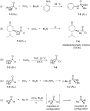


3-Pyridinols and 5-pyrimidinols: Tailor-made for use in synergistic radical-trapping co-antioxidant systems
Beilstein J. Org. Chem. 2013, 9, 2781–2792, doi:10.3762/bjoc.9.313
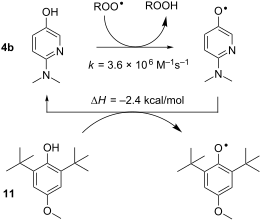
- synergism to occur among equilibrating phenolic antioxidants it is necessary that the principal antioxidant has both a higher reactivity with peroxyl radicals (kinh) and a higher O–H bond dissociation enthalpy (BDE), as compared to the co-antioxidant. Unfortunately, this is a very demanding requirement
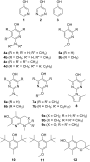
- since kinh and the O–H BDE are inversely correlated according to well-established Evans–Polanyi relationships [2][10]. Over the years, our research groups have developed novel air-stable and highly reactive radical-trapping chain-breaking antioxidants based on either 3-pyridinol (1) or 5-pyrimidinol (2
- sufficiently high O–H BDE to be regenerated by the co-antioxidant, co-AH (vide supra), which was selected among the conventional phenols 10–12. The autoxidation of an organic substrate (e.g. styrene) thermally initiated at a constant rate, Ri, by an azo-initiator will consume oxygen at a constant rate in the




Damage of polyesters by the atmospheric free radical oxidant NO3•: a product study involving model systems
Beilstein J. Org. Chem. 2013, 9, 1907–1916, doi:10.3762/bjoc.9.225

- studies by Coote et al. clearly revealed that polymers possessing only saturated alkyl chains, for example polyesters, will not propagate autoxidation, particularly because the ROO–H bond-dissociation energy (BDE) is usually less than the BDE for unactivated R–H bonds [6]. Polymer surface coatings, which
- • as propagating step. Thus, although NO3• is not only much more reactive than ROO• [7][8], and the BDE for the O2NO–H bond is with 427 kJ mol−1 also considerably higher than that of the ROO–H bond (which is about 360 ± 20 kJ mol−1) [21], the fact that no hydrogen abstraction from the ester units was


Metal-free aerobic oxidations mediated by N-hydroxyphthalimide. A concise review
Beilstein J. Org. Chem. 2013, 9, 1296–1310, doi:10.3762/bjoc.9.146
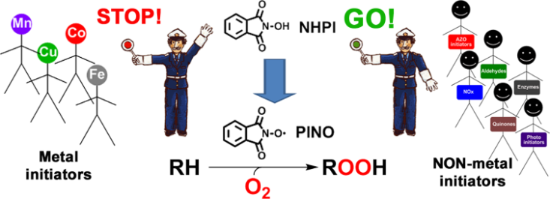
- oxidation of organic substrates [7][8][9][10][11]. NHPI acts as a precursor of the phthalimide N-oxyl (PINO) radical, which is the effective catalyst promoting hydrogen-abstraction processes (Scheme 1). The reactivity of NHPI and PINO is related to the bond dissociation energy (BDE) of the O–H group, which
- was estimated at 88.1 kcal/mol [12]. This value is similar to the BDE of O–H in hydroperoxides, suggesting that the faster reactivity of PINO compared to peroxyl radicals should be attributed to an enhanced polar effect involved in the hydrogen abstraction by this nitroxyl radical [13]. Furthermore
- BDE value (79.2 kcal/mol [12]), NMBHA turned out to be a better candidate than NHPI to act both as autoxidation catalyst, promoting the hydrogen abstraction from the bisallylic C–H position of the fatty esters by means of the corresponding amidoxyl radical, and as a good hydrogen donor (kH = 1.2 × 10⁵


Part 3. Triethylborane- air: a suitable initiator for intermolecular radical additions of S-2-oxoalkyl- thionocarbonates (S-xanthates) to olefins
Beilstein J. Org. Chem. 2007, 3, No. 47, doi:10.1186/1860-5397-3-47

- . Fortunately, such an increase of reaction temperature enhances route c much more than route b. For planar radicals, Rüchardt and Beckwith established that the C-H bond dissociation energy (BDE) for H-CXYZ compounds displays a good linear correlation with the measured α and β-proton ESR hyperfine splitting
- constants. [17][18][19] When Y = Me, Z = H, the H-C BDE follows the order for X: CH=CH2 < Ph < PhCO = MeCO < CN < CO2Et < Me (Table 3, entries 1–7). The BDE for compounds where Y = Z = H follows the same order, albeit the value is of course slightly higher when compared to their methylated counterparts
- presence of Et3B. Addition of xanthate 1a to decene at r.t., catalysed by Et3B/air Et3B/air catalysed intermolecular radical additions to olefins Selected values of H-C BDE for compounds H-CXYZ from references [17][18][19]. Supporting Information Supporting Information File 117: General procedure for



Part 2. Mechanistic aspects of the reduction of S-alkyl- thionocarbonates in the presence of triethylborane and air
Beilstein J. Org. Chem. 2007, 3, No. 46, doi:10.1186/1860-5397-3-46
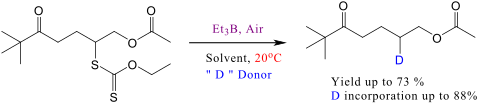
- found. A more seemly hypothesis is a hydrogen abstraction from the α-position of the boron atom. This reaction is well documented and energetically acceptable (BDE (C-H) = 80 ± 3 kcal/mol). For example, the methyl radical abstracts α-boronyl hydrogen of Et3B 124 times faster than hydrogen in the methyl
- role of water or alcohols and solvents in the reduction of S-alkylxanthates and related compounds. Hydrogen transfer from the O-H bond present in water or in an alcohol is not an obvious hypothesis in radical chemistry because of the high BDE of the O-H bond. Our results corroborate Wood's findings
- a complexation would lower the BDE of the O-H bond by 30 kcal/mol when compared to free H2O, thus rendering hydrogen abstraction from water a plausible process. The second route implies hydrogen abstraction from •O-O-H radical (O-H BDE 47.6 kcal/mol). The latter could possibly be formed by


Other Beilstein-Institut Open Science Activities



