


Search results
Search for "C–H amination" in Full Text gives 33 result(s) in Beilstein Journal of Organic Chemistry.
Iron complexes of tetramine ligands catalyse allylic hydroxyamination via a nitroso–ene mechanism
Beilstein J. Org. Chem. 2015, 11, 2549–2556, doi:10.3762/bjoc.11.275
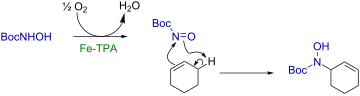
- area of considerable current research interest [1][2][3][4][5]. The development of methods for catalytic C–H amination has attracted particular attention [6][7][8][9][10][11], given the significance of C–N bonds to the structures of biologically active natural products and pharmaceuticals. In this


Recent developments in copper-catalyzed radical alkylations of electron-rich π-systems
Beilstein J. Org. Chem. 2015, 11, 2278–2288, doi:10.3762/bjoc.11.248
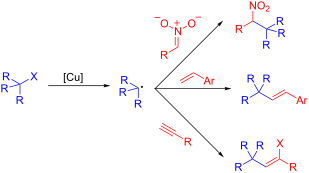
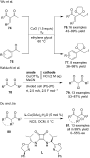
- catalyzed C–H amination reactions, as reported by Warren and co-workers [27][28]. Using this mild copper-catalyzed system, β-arylnitroalkanes were produced in excellent yields (Scheme 3) [16]. The scope of this transformation is remarkably broad with respect to both coupling partners. Electron-rich


Recent advances in copper-catalyzed C–H bond amidation
Beilstein J. Org. Chem. 2015, 11, 2209–2222, doi:10.3762/bjoc.11.240

- sulfonamidation of 2-arylpyridines via C–H activation. Besides the peroxide-free advantage, the C–H amination using aniline was found applicable to allow the synthesis of biarylamine. More recently, based on the DG strategy, the Yu group [59] designed the o-amidation of arylamides with copper catalysis under
- and benzene C–H bonds. Copper-catalyzed C–H amination/amidation of quinoline N-oxides. Copper-catalyzed aldehyde formyl C–H amidation. Copper-catalyzed formamide C–H amidation. Copper-catalyzed sulfonamidation of vinyl C–H bonds. CuCl2-catalyzed amidation/sulfonamidation of alkynyl C–H bonds. Cu(OH)2




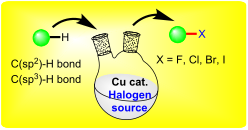
C–H bond halogenation catalyzed or mediated by copper: an overview
Beilstein J. Org. Chem. 2015, 11, 2132–2144, doi:10.3762/bjoc.11.230
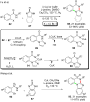
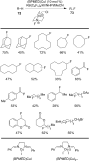
- alkenes via C–H cleavage is much less known in literature. In 2014, Yu and co-workers [66] reported the cascade synthesis of functionalized pyrrolones 66 via the dual C–H functionalization of α-alkenoylketene N,S-acetals 65. The construction of the products involved the oxidative alkene C–H amination and


Copper-catalyzed aerobic radical C–C bond cleavage of N–H ketimines
Beilstein J. Org. Chem. 2015, 11, 1933–1943, doi:10.3762/bjoc.11.209

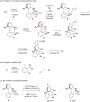
- found to undergo copper-catalyzed aerobic aromatic C–H amination (Scheme 3a) [52] or 1,4-aminooxygenation (spirocyclization) (Scheme 3b) [51], affording phenanthridine derivatives and azaspirocyclohexadienones, respectively, depending on the helical sense of the biaryl axis. Herein we report




Come-back of phenanthridine and phenanthridinium derivatives in the 21st century
Beilstein J. Org. Chem. 2014, 10, 2930–2954, doi:10.3762/bjoc.10.312

- second step under the catalysis of Pd(OAc)2 comprised both cyclisation and oxidation in a single step: a dehydrogenative C–H amination with PhI(OAc)2 as oxidant and removal of the picolinamide group followed by oxidation with Cu(OAc)2. This strategy afforded phenanthridines in moderate to good yields (up


Silver and gold-catalyzed multicomponent reactions
Beilstein J. Org. Chem. 2014, 10, 481–513, doi:10.3762/bjoc.10.46

- R4 was an o-azidobenzene group by a RuCl3 catalyzed C–H amination (Scheme 12, path B). As explained above, A3-MCR is a reaction in which the formation of a metal acetylide and its reaction with an in situ formed iminium cation are the key steps of the process. In the recent literature, there are


Synthesis of phenanthridines via palladium-catalyzed picolinamide-directed sequential C–H functionalization
Beilstein J. Org. Chem. 2013, 9, 891–899, doi:10.3762/bjoc.9.102
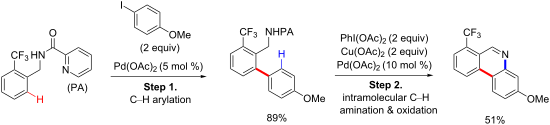
- bond of benzylpicolinamides is first arylated with an aryl iodide. The resulting biaryl compound is then subjected to palladium-catalyzed picolinamide-directed intramolecular dehydrogenative C–H amination with PhI(OAc)2 oxidant to form the corresponding cyclized dihydrophenanthridines. The benzylic
- [26]. In 2012, our laboratory [28] as well as that of Daugulis [27] independently reported that picolinamide substrates can undergo intramolecular dehydrogenative C–H amination reactions to afford medium-sized N-heterocycles under the catalysis of Pd(OAc)2 with PhI(OAc)2 oxidant. These discoveries led
- dihydrophenanthridines, which could be further converted to phenanthridine products under oxidative conditions. Ideally, we hoped to perform both the intramolecular C–H amination and subsequent oxidation in a single step [36]. Arylation of 2-methoxybenzyl picolinamide 1 with 4-iodoanisole (2) under various conditions


Other Beilstein-Institut Open Science Activities



