Search for "Pictet–Spengler" in Full Text gives 41 result(s) in Beilstein Journal of Organic Chemistry.
Beilstein J. Org. Chem. 2016, 12, 1000–1039, doi:10.3762/bjoc.12.98
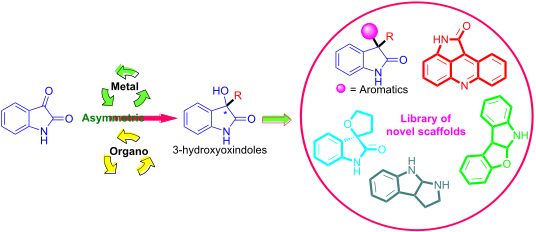
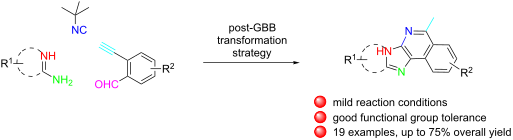
Graphical Abstract
Figure 1: 3-Hydroxyoxindole-containing natural products and biologically active molecules.
Scheme 1: Chiral CNN pincer Pd(II) complex 1 catalyzed asymmetric allylation of isatins.
Scheme 2: Asymmetric allylation of ketimine catalyzed by the chiral CNN pincer Pd(II) complex 2.
Scheme 3: Pd/L1 complex-catalyzed asymmetric allylation of 3-O-Boc-oxindoles.
Scheme 4: Cu(OTf)2-catalyzed asymmetric direct addition of acetonitrile to isatins.
Scheme 5: Chiral tridentate Schiff base/Cu complex catalyzed asymmetric Friedel–Crafts alkylation of isatins ...
Scheme 6: Guanidine/CuI-catalyzed asymmetric alkynylation of isatins with terminal alkynes.
Scheme 7: Asymmetric intramolecular direct hydroarylation of α-ketoamides.
Scheme 8: Plausible catalytic cycle for the direct hydroarylation of α-ketoamides.
Scheme 9: Ir-catalyzed asymmetric arylation of isatins with arylboronic acids.
Scheme 10: Enantioselective decarboxylative addition of β-ketoacids to isatins.
Scheme 11: Ruthenium-catalyzed hydrohydroxyalkylation of olefins and 3-hydroxy-2-oxindoles.
Scheme 12: Proposed catalytic mechanism and stereochemical model.
Scheme 13: In-catalyzed allylation of isatins with stannylated reagents.
Scheme 14: Modified protocol for the synthesis of allylated 3-hydroxyoxindoles.
Scheme 15: Hg-catalyzed asymmetric allylation of isatins with allyltrimethylsilanes.
Scheme 16: Enantioselective additions of organoborons to isatins.
Scheme 17: Asymmetric aldol reaction of isatins with cyclohexanone.
Scheme 18: Enantioselective aldol reactions of aliphatic aldehydes with isatin derivatives and the plausible t...
Scheme 19: Enantioselective aldol reaction of isatins and 2,2-dimethyl-1,3-dioxan-5-one.
Scheme 20: Asymmetric aldol reactions between ketones and isatins.
Scheme 21: Phenylalanine lithium salt-catalyzed asymmetric synthesis of 3-alkyl-3-hydroxyoxindoles.
Scheme 22: Aldolization between isatins and dihydroxyacetone derivatives.
Scheme 23: One-pot asymmetric synthesis of convolutamydine A.
Scheme 24: Asymmetric aldol reactions of cyclohexanone and acetone with isatins.
Scheme 25: Aldol reactions of acetone with isatins.
Scheme 26: Aldol reactions of ketones with isatins.
Scheme 27: Enantioselective allylation of isatins.
Scheme 28: Asymmetric aldol reaction of trifluoromethyl α-fluorinated β-keto gem-diols with isatins.
Scheme 29: Plausible mechanism proposed for the asymmetric aldol reaction.
Scheme 30: Asymmetric aldol reaction of 1,1-dimethoxyacetone with isatins.
Scheme 31: Enantioselective Friedel-Crafts reaction of phenols with isatins.
Scheme 32: Enantioselective addition of 1-naphthols with isatins.
Scheme 33: Enantioselective aldol reaction between 3-acetyl-2H-chromen-2-ones and isatins.
Scheme 34: Stereoselective Mukaiyama–aldol reaction of fluorinated silyl enol ethers with isatins.
Scheme 35: Asymmetric vinylogous Mukaiyama–aldol reaction between 2-(trimethylsilyloxy)furan and isatins.
Scheme 36: β-ICD-catalyzed MBH reactions of isatins with maleimides.
Scheme 37: β-ICD-catalyzed MBH reactions of 7-azaisatins with maleimides and activated alkenes.
Scheme 38: Enantioselective aldol reaction of isatins with ketones.
Scheme 39: Direct asymmetric vinylogous aldol reactions of allyl ketones with isatins.
Scheme 40: Enantioselective aldol reactions of ketones with isatins.
Scheme 41: The MBH reaction of isatins with α,β-unsaturated γ-butyrolactam.
Scheme 42: Reactions of tert-butyl hydrazones with isatins followed by oxidation.
Scheme 43: Aldol reactions of isatin derivatives with ketones.
Scheme 44: Enantioselective decarboxylative cyanomethylation of isatins.
Scheme 45: Catalytic kinetic resolution of 3-hydroxy-3-substituted oxindoles.
Scheme 46: Lewis acid catalyzed Friedel–Crafts alkylation of 3-hydroxy-2-oxindoles with electron-rich phenols.
Scheme 47: Lewis acid catalyzed arylation of 3-hydroxyoxindoles with aromatics.
Scheme 48: Synthetic application of 3-arylated disubstituted oxindoles in the construction of core structures ...
Scheme 49: CPA-catalyzed dearomatization and arylation of 3-indolyl-3-hydroxyoxindoles with tryptamines and 3-...
Scheme 50: CPA-catalyzed enantioselective decarboxylative alkylation of β-keto acids with 3-hydroxy-3-indolylo...
Scheme 51: BINOL-derived imidodiphosphoric acid-catalyzed enantioselective Friedel–Crafts reactions of indoles...
Scheme 52: CPA-catalyzed enantioselective allylation of 3-indolylmethanols.
Scheme 53: 3-Indolylmethanol-based substitution and cycloaddition reactions.
Scheme 54: CPA-catalyzed asymmetric [3 + 3] cycloaddtion reactions of 3-indolylmethanols with azomethine ylide...
Scheme 55: CPA-catalyzed three-component cascade Michael/Pictet–Spengler reactions of 3-indolylmethanols and a...
Scheme 56: Acid-promoted chemodivergent and stereoselective synthesis of diverse indole derivatives.
Scheme 57: CPA-catalyzed asymmetric formal [3 + 2] cycloadditions.
Scheme 58: CPA-catalyzed enantioselective cascade reactions for the synthesis of C7-functionlized indoles.
Scheme 59: Lewis acid-promoted Prins cyclization of 3-allyl-3-hydroxyoxindoles with aldehydes.
Scheme 60: Ga(OTf)3-catalyzed reactions of allenols and phenols.
Scheme 61: I2-catalyzed construction of pyrrolo[2.3.4-kl]acridines from enaminones and 3-indolyl-3-hydroxyoxin...
Scheme 62: CPA-catalyzed asymmetric aza-ene reaction of 3-indolylmethanols with cyclic enaminones.
Scheme 63: Asymmetric α-alkylation of aldehydes with 3-indolyl-3-hydroxyoxindoles.
Scheme 64: Organocatalytic asymmetric α-alkylation of enolizable aldehydes with 3-indolyl-3-hydroxyoxindoles a...
Beilstein J. Org. Chem. 2015, 11, 1997–2006, doi:10.3762/bjoc.11.216
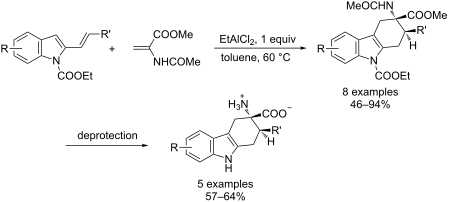
Graphical Abstract
Figure 1: Examples of drugs embodying unnatural amino acids.
Figure 2: Examples of biologically active compounds embodying constrained analogues of tryptophan.
Scheme 1: Planned Diels–Alder reactions for the synthesis of tetrahydrocarbazoles as constrained analogues of...
Figure 3: Structure elucidation of diastereoisomeric tetrahydrocarbazoles 3a and 3’a via NMR experiments.
Scheme 2: Synthesis of unprotected tryptophan derivatives 6a–e.
Scheme 3: Plausible reaction mechanism for the cycloaddition reactions of indoles 1a–h with 2 in toluene.
Scheme 4: Cycloaddition reaction of 2-vinylindole 1k and methyl 2-acetamidoacrylate (2).
Beilstein J. Org. Chem. 2014, 10, 3056–3072, doi:10.3762/bjoc.10.323
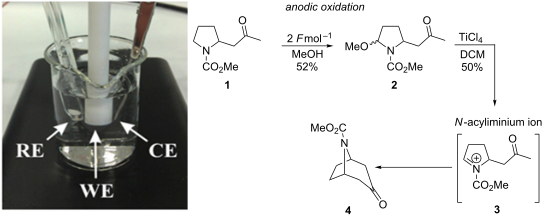
Graphical Abstract
Scheme 1: Application of anodic oxidation to the generation of new carbon-carbon bonds [11].
Scheme 2: The influence of the amino protecting group on the “kinetic” and “thermodynamic” anodic methoxylati...
Scheme 3: Example of the application of the cation pool method [17].
Scheme 4: A thiophenyl electroauxiliary allows for regioselective anodic oxidation [32].
Scheme 5: A diastereoselective cation carbohydroxylation reaction and postulated intermediate 18 [18].
Scheme 6: A radical addition and electron transfer reaction of N-acyliminium ions generated electrosynthetica...
Scheme 7: Catalytic indirect anodic fluorodesulfurization reaction [37].
Figure 1: Schematic of a cation flow system and also shown is the electrochemical microflow reactor reported ...
Figure 2: Example of a parallel laminar flow set-up. Figure redrawn from reference [38].
Figure 3: A catch and release cation pool method [42].
Scheme 8: Micromixing effects on yield 92% vs 36% and ratio of alkylation products [43].
Figure 4: Schematic illustration of the anodic substitution reaction system using acoustic emulsification. Fi...
Scheme 9: Electrooxidation to prepare a chiral oxidation mediator and application to the kinetic resolution o...
Scheme 10: Electrooxidation reactions on 4-membered ring systems [68].
Figure 5: Example of a chiral auxiliary Shono-oxidation intermediate [69].
Scheme 11: An electrochemical multicomponent reaction where a carbon felt anode and platinum cathode were util...
Scheme 12: Preparation of dienes using the Shono oxidation [23].
Scheme 13: Combination of an electroauxiliary mediated anodic oxidation and RCM to afford spirocyclic compound...
Scheme 14: Total synthesis of (+)-myrtine (66) using an electrochemical approach [78].
Scheme 15: Total synthesis of (−)-A58365A (70) and (±)-A58365B (71) [79].
Scheme 16: Anodic oxidation used in the preparation of the poison frog alkaloid 195C [80].
Scheme 17: Preparation of iminosugars using an electrochemical approach [81].
Scheme 18: The electrosynthetic preparation of α-L-fucosidase inhibitors [84,85].
Scheme 19: Enantioselective synthesis of the anaesthetic ropivacaine 85 [71].
Scheme 20: The preparation of synthetically challenging aza-nucleosides employing an electrochemical step [88].
Scheme 21: Synthesis of a bridged tricyclic diproline analogue 93 that induces α-helix conformation into linea...
Scheme 22: Synthesis of (i) a peptidomimetic and (ii) a functionalised peptide from silyl electroauxiliary pre...
Scheme 23: Examples of Phe7–Phe8 mimics prepared using an electrochemical approach [93].
Scheme 24: Preparation of arginine mimics employing an electrooxidation step [96].
Scheme 25: Preparation of chiral cyclic amino acids [20].
Scheme 26: Two-step preparation of Nazlinine 117 using Shono flow electrochemistry [101].
Beilstein J. Org. Chem. 2014, 10, 1848–1877, doi:10.3762/bjoc.10.195
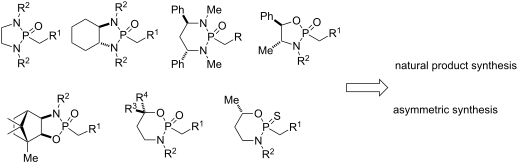
Graphical Abstract
Figure 1: Examples of phosphonamide reagents used in stereoselective synthesis.
Figure 2: Natural products and bioactive molecules synthesized using phosphonamide-based chemistry (atoms, bo...
Scheme 1: Olefination with cyclic phosphonamide anions, mechanistic rationale, and selected examples 27a–d [18].
Scheme 2: Asymmetric olefination with chiral phosphonamide anions and selected examples 31a–d [1,22].
Scheme 3: Synthesis of α-substituted phosphonic acids 33a–e by asymmetric alkylation of chiral phosphonamide ...
Scheme 4: Asymmetric conjugate additions of C2-symmetric chiral phosphonamide anions to cyclic enones, lacton...
Scheme 5: Asymmetric conjugate additions of P-chiral phosphonamide anions generated from 40a and 44a to cycli...
Scheme 6: Asymmetric cyclopropanation with chiral chloroallyl phosphonamide 47, mechanistic rationale, and se...
Scheme 7: Asymmetric cyclopropanation with chiral chloromethyl phosphonamide 28d [59].
Scheme 8: Stereoselective synthesis of cis-aziridines 57 from chiral chloroallyl phosphonamide 47a [62].
Scheme 9: Synthesis of phosphonamides by (A) Arbuzov reaction, (B) condensation of diamines with phosphonic a...
Figure 3: Original and revised structure of polyoxin A (69) [24-26].
Scheme 10: Synthesis of (E)-polyoximic acid (9) [24-26].
Figure 4: Key assembly strategy of acetoxycrenulide (10) [41,42].
Scheme 11: Total synthesis of (+)-acetoxycrenulide (10) [41,42].
Scheme 12: Synthesis squalene synthase inhibitor 19 by asymmetric sulfuration (A) and asymmetric alkylation (B...
Figure 5: Key assembly strategy of fumonisin B2 (20) and its tricarballylic acid fragment 105 [45,46].
Scheme 13: Final steps of the total synthesis of fumonisin B2 (20) [45,46].
Figure 6: Selected examples of two subclasses of β-lactam antibiotics – carbapenems (111 and 112) and trinems...
Scheme 14: Synthesis of tricyclic β-lactam antibiotic 123 [97].
Scheme 15: Total synthesis of (−)-anthoplalone (8) [56].
Figure 7: Protein tyrosine phosphatase (PTP) inhibitors 130, 131 and model compounds 16, 132 and 133 [68].
Scheme 16: Synthesis of model PTP inhibitors 16a,b [68].
Scheme 17: Synthesis of aziridine hydroxamic acid 17 as MMP inhibitor [63].
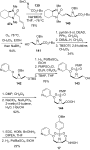
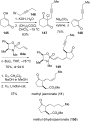
Scheme 18: Synthesis of methyl jasmonate (11) [48].
Figure 8: Structures of nudiflosides A (137) and D (13) [49].
Scheme 19: Total synthesis of the pentasubstituted cyclopentane core 159 of nudiflosides A (151) and D (13) an...
Figure 9: L-glutamic acid (161) and constrained analogues [57,124].
Scheme 20: Stereoselective synthesis of DCG-IV (162) [57].
Scheme 21: Stereoselective synthesis of mGluR agonist 21 [124].
Figure 10: Key assembly strategy of berkelic acid (15) [43].
Scheme 22: Total synthesis of berkelic acid (15) [43].
Figure 11: Key assembly strategy of jerangolid A (22) and ambruticin S (14) [27,28].
Scheme 23: Final assembly steps in the total synthesis of jerangolid A [27].
Scheme 24: Key assembly steps in the total synthesis of ambruticin S (14) [28].
Figure 12: General steroid construction strategy based on conjugate addition of 212 to cyclopentenone 48, exem...
Scheme 25: Total synthesis of estrone (12) [44].
Beilstein J. Org. Chem. 2014, 10, 808–813, doi:10.3762/bjoc.10.76
Graphical Abstract
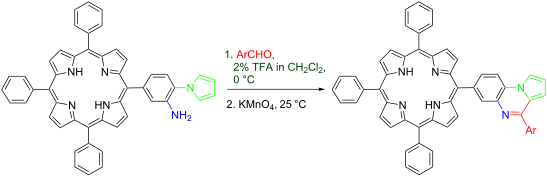
Scheme 1: Synthesis of pyrrolo[1,2-a]quinoxalinoporphyrins (4a–h).
Scheme 2: Synthesis of zinc(II) pyrrolo[1,2-a]quinoxalinoporphyrins 5 and 6.
Figure 1: (a) Electronic absorption spectra of free-base porphyrins 4f, 4g, 4h and TPP in CHCl3 (1 × 10⁻⁶ mol...
Beilstein J. Org. Chem. 2014, 10, 544–598, doi:10.3762/bjoc.10.50
Graphical Abstract
Scheme 1: The proposed mechanism of the Passerini reaction.
Scheme 2: The PADAM-strategy to α-hydroxy-β-amino amide derivatives 7. An additional oxidation provides α-ket...
Scheme 3: The general accepted Ugi-mechanism.
Scheme 4: Three commonly applied Ugi/cyclization approaches. a) UDC-process, b) UAC-sequence, c) UDAC-combina...
Scheme 5: Ugi reaction that involves the condensation of Armstrong’s convertible isocyanide.
Scheme 6: Mechanism of the U-4C-3CR towards bicyclic β-lactams.
Scheme 7: The Ugi 4C-3CR towards oxabicyclo β-lactams.
Scheme 8: Ugi MCR between an enantiopure monoterpene based β-amino acid, aldehyde and isocyanide resulting in...
Scheme 9: General MCR for β-lactams in water.
Scheme 10: a) Ugi reaction for β-lactam-linked peptidomimetics. b) Varying the β-amino acid resulted in β-lact...
Scheme 11: Ugi-4CR followed by a Pd-catalyzed Sn2 cyclization.
Scheme 12: Ugi-3CR of dipeptide mimics from 2-substituted pyrrolines.
Scheme 13: Joullié–Ugi reaction towards 2,5-disubstituted pyrrolidines.
Scheme 14: Further elaboration of the Ugi-scaffold towards bicyclic systems.
Scheme 15: Dihydroxyproline derivatives from an Ugi reaction.
Scheme 16: Diastereoselective Ugi reaction described by Banfi and co-workers.
Scheme 17: Similar Ugi reaction as in Scheme 16 but with different acids and two chiral isocyanides.
Scheme 18: Highly diastereoselective synthesis of pyrrolidine-dipeptoids via a MAO-N/MCR-procedure.
Scheme 19: MAO-N/MCR-approach towards the hepatitis C drug telaprevir.
Scheme 20: Enantioselective MAO-U-3CR procedure starting from chiral pyrroline 64.
Scheme 21: Synthesis of γ-lactams via an UDC-sequence.
Scheme 22: Utilizing bifunctional groups to provide bicyclic γ-lactam-ketopiperazines.
Scheme 23: The Ugi reaction provided both γ- as δ-lactams depending on which inputs were used.
Scheme 24: The sequential Ugi/RCM with olefinic substrates provided bicyclic lactams.
Scheme 25: a) The structural and dipole similarities of the triazole unit with the amide bond. b) The copper-c...
Scheme 26: The Ugi/Click sequence provided triazole based peptidomimetics.
Scheme 27: The Ugi/Click reaction as described by Nanajdenko.
Scheme 28: The Ugi/Click-approach by Pramitha and Bahulayan.
Scheme 29: The Ugi/Click-combination by Niu et al.
Scheme 30: Triazole linked peptidomimetics obtained from two separate MCRs and a sequential Click reaction.
Scheme 31: Copper-free synthesis of triazoles via two MCRs in one-pot.
Scheme 32: The sequential Ugi/Paal–Knorr reaction to afford pyrazoles.
Scheme 33: An intramolecular Paal–Knorr condensation provided under basic conditions pyrazolones.
Scheme 34: Similar cyclization performed under acidic conditions provided pyrazolones without the trifluoroace...
Scheme 35: The Ugi-4CR towards 2,4-disubstituted thiazoles.
Scheme 36: Solid phase approach towards thiazoles.
Scheme 37: Reaction mechanism of formation of thiazole peptidomimetics containing an additional β-lactam moiet...
Scheme 38: The synthesis of the trisubstituted thiazoles could be either performed via an Ugi reaction with pr...
Scheme 39: Performing the Ugi reaction with DMB-protected isocyanide gave access to either oxazoles or thiazol...
Scheme 40: Ugi/cyclization-approach towards 2,5-disubstituted thiazoles. The Ugi reaction was performed with d...
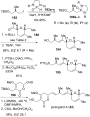
Scheme 41: Further derivatization of the thiazole scaffold.
Scheme 42: Three-step procedure towards the natural product bacillamide C.
Scheme 43: Ugi-4CR to oxazoles reported by Zhu and co-workers.
Scheme 44: Ugi-based synthesis of oxazole-containing peptidomimetics.
Scheme 45: TMNS3 based Ugi reaction for peptidomimics containing a tetrazole.
Scheme 46: Catalytic cycle of the enantioselective Passerini reaction towards tetrazole-based peptidomimetics.
Scheme 47: Tetrazole-based peptidomimetics via an Ugi reaction and a subsequent sigmatropic rearrangement.
Scheme 48: Resin-bound Ugi-approach towards tetrazole-based peptidomimetics.
Scheme 49: Ugi/cyclization approach towards γ/δ/ε-lactam tetrazoles.
Scheme 50: Ugi-3CR to pipecolic acid-based peptidomimetics.
Scheme 51: Staudinger–Aza-Wittig/Ugi-approach towards pipecolic acid peptidomimetics.
Figure 1: The three structural isomers of diketopiperazines. The 2,5-DKP isomer is most common.
Scheme 52: UDC-approach to obtain 2,5-DKPs, either using Armstrong’s isocyanide or via ethylglyoxalate.
Scheme 53: a) Ugi reaction in water gave either 2,5-DKP structures or spiro compounds. b) The Ugi reaction in ...
Scheme 54: Solid-phase approach towards diketopiperazines.
Scheme 55: UDAC-approach towards DKPs.
Scheme 56: The intermediate amide is activated as leaving group by acid and microwave assisted organic synthes...
Scheme 57: UDC-procedure towards active oxytocin inhibitors.
Scheme 58: An improved stereoselective MCR-approach towards the oxytocin inhibitor.
Scheme 59: The less common Ugi reaction towards DKPs, involving a Sn2-substitution.
Figure 2: Spatial similarities between a natural β-turn conformation and a DKP based β-turn mimetic [158].
Scheme 60: Ugi-based syntheses of bicyclic DKPs. The amine component is derived from a coupling between (R)-N-...
Scheme 61: Ugi-based synthesis of β-turn and γ-turn mimetics.
Figure 3: Isocyanide substituted 3,4-dihydropyridin-2-ones, dihydropyridines and the Freidinger lactams. Bio-...
Scheme 62: The mechanism of the 4-CR towards 3,4-dihydropyridine-2-ones 212.
Scheme 63: a) Multiple MCR-approach to provide DHP-peptidomimetic in two-steps. b) A one-pot 6-CR providing th...
Scheme 64: The MCR–alkylation–MCR procedure to obtain either tetrapeptoids or depsipeptides.
Scheme 65: U-3CR/cyclization employing semicarbazone as imine component gave triazine based peptidomimetics.
Scheme 66: 4CR towards triazinane-diones.
Scheme 67: The MCR–alkylation–IMCR-sequence described by our group towards triazinane dione-based peptidomimet...
Scheme 68: Ugi-4CR approaches followed by a cyclization to thiomorpholin-ones (a) and pyrrolidines (b).
Scheme 69: UDC-approach for benzodiazepinones.
Scheme 70: Ugi/Mitsunobu sequence to BDPs.
Scheme 71: A UDAC-approach to BDPs with convertible isocyanides. The corresponding amide is cleaved by microwa...
Scheme 72: microwave assisted post condensation Ugi reaction.
Scheme 73: Benzodiazepinones synthesized via the post-condensation Ugi/ Staudinger–Aza-Wittig cyclization.
Scheme 74: Two Ugi/cyclization approaches utilizing chiral carboxylic acids. Reaction (a) provided the product...
Scheme 75: The mechanism of the Gewald-3CR includes three base-catalysed steps involving first a Knoevnagel–Co...
Scheme 76: Two structural 1,4-thienodiazepine-2,5-dione isomers by U-4CR/cyclization.
Scheme 77: Tetrazole-based diazepinones by UDC-procedure.
Scheme 78: Tetrazole-based BDPs via a sequential Ugi/hydrolysis/coupling.
Scheme 79: MCR synthesis of three different tricyclic BPDs.
Scheme 80: Two similar approaches both involving an Ugi reaction and a Mitsunobu cyclization.
Scheme 81: Mitsunobu–Ugi-approach towards dihydro-1,4-benzoxazepines.
Scheme 82: Ugi reaction towards hetero-aryl fused 5-oxo-1,4-oxazepines.
Scheme 83: a) Ugi/RCM-approach towards nine-membered peptidomimetics b) Sequential peptide-coupling, deprotect...
Scheme 84: Ugi-based synthesis towards cyclic RGD-pentapeptides.
Scheme 85: Ugi/MCR-approach towards 12–15 membered macrocycles.
Scheme 86: Stereoselective Ugi/RCM approach towards 16-membered macrocycles.
Scheme 87: Passerini/RCM-sequence to 22-membered macrocycles.
Scheme 88: UDAC-approach towards 12–18-membered depsipeptides.
Figure 4: Enopeptin A with its more active derivative ADEP-4.
Scheme 89: a) The Joullié–Ugi-approach towards ADEP-4 derivatives b) Ugi-approach for the α,α-dimethylated der...
Scheme 90: Ugi–Click-strategy for 15-membered macrocyclic glyco-peptidomimetics.
Scheme 91: Ugi/Click combinations provided macrocycles containing both a triazole and an oxazole moiety.
Scheme 92: a) A solution-phase procedure towards macrocycles. b) Alternative solid-phase synthesis as was repo...
Scheme 93: Ugi/cyclization towards cyclophane based macrocycles.
Scheme 94: PADAM-strategy towards eurystatin A.
Scheme 95: PADAM-approach for cyclotheanamide.
Scheme 96: A triple MCR-approach affording RGD-pentapeptoids.
Scheme 97: Ugi-MiBs-approach towards peptoid macrocycles.
Scheme 98: Passerini-based MiB approaches towards macrocycles 345 and 346.
Scheme 99: Macrocyclic peptide formation by the use of amphoteric aziridine-based aldehydes.
Beilstein J. Org. Chem. 2014, 10, 471–480, doi:10.3762/bjoc.10.45
Graphical Abstract
Figure 1: Natural products containing the β-carboline skeletal.
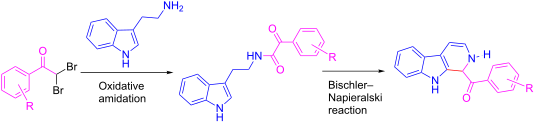
Scheme 1: Retrosynthetic analysis of 6.
Scheme 2: Plausible mechanism of the oxidative amidation for 9.
Scheme 3: Synthesis of α-ketoamide 9.
Scheme 4: Synthesis of dihydroeudistomin Y analogues.
Scheme 5: Plausible mechanism for the formation of 7.
Scheme 6: Rearrangement of 8a into 7a and coupling interactions of 7a.
Figure 2: COSY and HSQC of 8a and 7a.
Beilstein J. Org. Chem. 2013, 9, 2463–2469, doi:10.3762/bjoc.9.285
Graphical Abstract
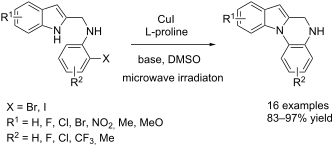
Figure 1: Representative biologically relevant examples of 5,6-dihydroindolo[1,2-a]quinoxaline derivatives.
Scheme 1: Reagents and conditions: (a) CF3COOH, anhydrous dichloromethane, reflux; (b) NaBH4, MeOH.
Beilstein J. Org. Chem. 2013, 9, 2048–2078, doi:10.3762/bjoc.9.243
Graphical Abstract
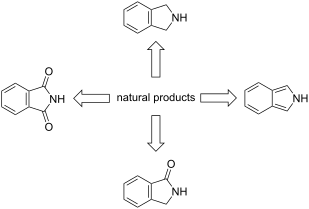
Figure 1: a) Structural features and b) selected examples of non-natural congeners.
Scheme 1: Synthesis of isoindole 18.
Scheme 2: Staining amines with 1,4-diketone 19 (R = H).
Figure 2: Representative members of the indolocarbazole alkaloid family.
Figure 3: Staurosporine (26) bound to the adenosine-binding pocket [19] (from pdb1stc).
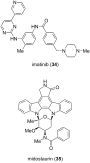
Figure 4: Structure of imatinib (34) and midostaurin (35).
Scheme 3: Biosynthesis of staurosporine (26).
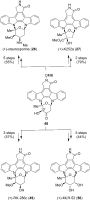
Scheme 4: Wood’s synthesis of K-252a via the common intermediate 48.
Scheme 5: Synthesis of 26, 27, 49 and 50 diverging from the common intermediate 48.
Figure 5: Selected members of the cytochalasan alkaloid family.
Scheme 6: Biosynthesis of chaetoglobosin A (57) [56].
Scheme 7: Synthesis of cytochalasin D (70) by Thomas [63].
Scheme 8: Synthesis of L-696,474 (78).
Scheme 9: Synthesis of aldehyde 85 (R = TBDPS).
Scheme 10: Synthesis of (+)-aspergillin PZ (79) by Tanis.
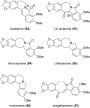
Figure 6: Representative Berberis alkaloids.
Scheme 11: Proposed biosynthetic pathway to chilenine (93).
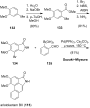
Scheme 12: Synthesis of magallanesine (97) by Danishefsky [84].
Scheme 13: Kurihara’s synthesis of magallanesine (85).
Scheme 14: Proposed biosynthesis of 113, 117 and 125.
Scheme 15: DNA lesion caused by aristolochic acid I (117) [102].
Scheme 16: Snieckus’ synthesis of piperolactam C (131).
Scheme 17: Synthesis of aristolactam BII (104).
Figure 7: Representative cularine alkaloids.
Scheme 18: Proposed biosynthesis of 136.
Scheme 19: The syntheses of 136 and 137 reported by Castedo and Suau.
Scheme 20: Synthesis of 136 by Couture.
Figure 8: Representative isoindolinone meroterpenoids.
Scheme 21: Postulated biosynthetic pathway for the formation of 156 (adopted from George) [143].
Scheme 22: Synthesis of stachyflin (156) by Katoh [144].
Figure 9: Selected examples of spirodihydrobenzofuranlactams.
Scheme 23: Synthesis of stachybotrylactam I (157).
Scheme 24: Synthesis of pestalachloride A (193) by Schmalz.
Scheme 25: Proposed mechanism for the BF3-catalyzed metal-free carbonyl–olefin metathesis [149].
Scheme 26: Preparation of the isoindoline core of muironolide A (204).
Scheme 27: Proposed biosynthesis of 208.
Scheme 28: Model for the biosynthesis of 215 and 217.
Scheme 29: Synthesis of lactonamycin (215) and lactonamycin Z (217).
Figure 10: Hetisine alkaloids 225–228.
Scheme 30: Biosynthetic proposal for the formation of the hetisine core [167].
Scheme 31: Synthesis of nominine (225).
Beilstein J. Org. Chem. 2013, 9, 1235–1242, doi:10.3762/bjoc.9.140
Graphical Abstract
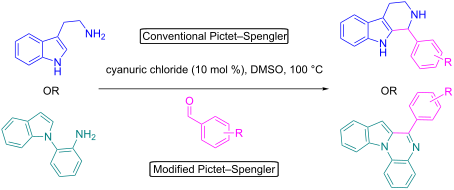
Scheme 1: The Pictet–Spengler reaction of tryptamine with 4-tolualdehyde.
Figure 1: The two Pictet–Spengler substrates employed in the TCT catalyzed cyclization.
Scheme 2: Synthesis of the Pictet–Spengler substrate 4. Reaction conditions: (a) K2CO3, DMF, 80 °C, 3 h; (b) ...
Beilstein J. Org. Chem. 2013, 9, 147–154, doi:10.3762/bjoc.9.17
Graphical Abstract
Figure 1: THBC-DKP-based natural and synthetically made compounds.
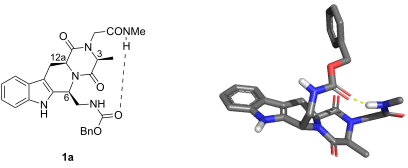
Figure 2: THBC-DKP-based peptidomimetic 1a.
Figure 3: Geometric parameters for mimics 1a,b.
Figure 4: Perspective view of the low-energy conformers of 1a,b. Hydrogen atoms are omitted for clarity.
Scheme 1: Synthesis of the THBC-DKP-based peptidomimetic 1a.
Beilstein J. Org. Chem. 2012, 8, 1901–1908, doi:10.3762/bjoc.8.220
Graphical Abstract
Figure 1: Structure of meridianins A–G.
Scheme 1: Synthesis of functionalized meridianin with an amino group at position 5.
Scheme 2: Synthesis of a functionalized meridianin with an amino group at position 5.
Scheme 3: Synthesis of substrate for the modified Pictet–Spengler reaction.
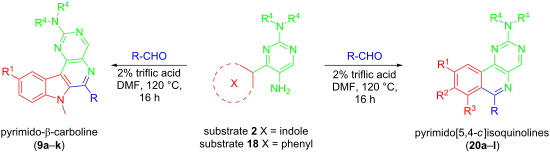
Scheme 4: The Pictet–Spengler reaction involving substrate 2a. Reagents and conditions: (i) RCHO, 2% triflic ...
Scheme 5: Synthesis of dihydropyrimido-β-carbolines: (i) R-CHO, 2% triflic acid in DMF, 120 °C, 16 h.
Scheme 6: Synthesis of substrates 18a–c for the modified Pictet–Spengler reaction.
Scheme 7: General strategy for the Pictet–Spengler reaction involving substrates 18. Reagents and conditions:...
Beilstein J. Org. Chem. 2012, 8, 1048–1058, doi:10.3762/bjoc.8.117
Graphical Abstract
Figure 1: Tetrahydro-β-carboline containing scaffolds 1–3.
Figure 2: Library of tetrahydro-β-carboline containing compounds 1–7 and calculated properties (amolecular we...
Figure 3: Results of high-throughput docking analysis. Top: A docking-score matrix arranged by compound IDs a...
Beilstein J. Org. Chem. 2011, 7, 1407–1411, doi:10.3762/bjoc.7.164
Graphical Abstract
Scheme 1: Proposed mechanism for the formation of 6.
Figure 1: Structure of alangiobussinine (7).
Scheme 2: Preparation of compounds 7 and 10. Reagents and conditions: i) LiOH (10 equiv), MeOH–H2O, rt, overn...
Beilstein J. Org. Chem. 2011, 7, 442–495, doi:10.3762/bjoc.7.57
Graphical Abstract
Figure 1: Structures of atorvastatin and other commercial statins.
Figure 2: Structure of compactin.
Scheme 1: Synthesis of pentasubstituted pyrroles.
Scheme 2: [3 + 2] Cycloaddition to prepare 5-isopropylpyrroles.
Scheme 3: Regiospecific [3 + 2] cycloaddition to prepare the pyrrole scaffold.
Scheme 4: Formation of the pyrrole core of atorvastatin via [3 + 2] cycloaddition.
Scheme 5: Formation of pyrrole 33 via the Paal–Knorr reaction.
Scheme 6: Convergent synthesis towards atorvastatin.
Figure 3: Binding pocket of sunitinib in the TRK KIT.
Scheme 7: Synthesis of sunitinib.
Scheme 8: Alternative synthesis of sunitinib.
Scheme 9: Key steps in the syntheses of sumatriptan and zolmitriptan.
Scheme 10: Introduction of the N,N-dimethylaminoethyl side chain.
Scheme 11: Japp–Klingemann reaction in the synthesis of sumatriptan.
Scheme 12: Synthesis of the intermediate sulfonyl chlorides 62 and 63.
Scheme 13: Alternative introduction of the sulfonamide.
Scheme 14: Negishi-type coupling to benzylic sulfonamides.
Scheme 15: Heck reaction used to introduce the sulfonamide side chain of naratriptan.
Scheme 16: Synthesis of the oxazolinone appendage of zolmitriptan.
Scheme 17: Grandberg indole synthesis used in the preparation of rizatriptan.
Scheme 18: Improved synthesis of rizatriptan.
Scheme 19: Larock-type synthesis of rizatriptan.
Scheme 20: Synthesis of eletriptan.
Scheme 21: Heck coupling for the indole system in eletriptan.
Scheme 22: Attempted Fischer indole synthesis of elatriptan.
Scheme 23: Successful Fischer indole synthesis for eletriptan.
Scheme 24: Mechanistic rationale for the Bischler–Möhlau reaction.
Scheme 25: Bischler-type indole synthesis used in the fluvastatin sodium synthesis.
Scheme 26: Palladium-mediated synthesis of ondansetron.
Scheme 27: Fischer indole synthesis of ondansetron.
Scheme 28: Optimised Pictet–Spengler reaction towards tadalafil.
Figure 4: Structures of carvedilol 136 and propranolol 137.
Scheme 29: Synthesis of the carbazole core of carvedilol.
Scheme 30: Alternative syntheses of 4-hydroxy-9H-carbazole.
Scheme 31: Convergent synthesis of etodolac.
Scheme 32: Alternative synthesis of etodolac.
Figure 5: Structures of imidazole-containing drugs.
Scheme 33: Synthesis of functionalised imidazoles towards losartan.
Scheme 34: Direct synthesis of the chlorinated imidazole in losartan.
Scheme 35: Synthesis of trisubstituted imidazoles.
Scheme 36: Preparation of the imidazole ring in olmesartan.
Scheme 37: Synthesis of ondansetron.
Scheme 38: Alternative route to ondansetron and its analogues.
Scheme 39: Proton pump inhibitors and synthesis of esomeprazole.
Scheme 40: Synthesis of benzimidazole core pantoprazole.
Figure 6: Structure of rabeprazole 194.
Scheme 41: Synthesis of candesartan.
Scheme 42: Alternative access to the candesartan key intermediate 216.
Scheme 43: .Medicinal chemistry route to telmisartan.
Scheme 44: Improved synthesis of telmisartan.
Scheme 45: Synthesis of zolpidem.
Scheme 46: Copper-catalysed 3-component coupling towards zolpidem.
Figure 7: Structure of celecoxib.
Scheme 47: Preparation of celecoxib.
Scheme 48: Alternative synthesis of celecoxib.
Scheme 49: Regioselective access to celecoxib.
Scheme 50: Synthesis of pazopanib.
Scheme 51: Syntheses of anastrozole, rizatriptan and letrozole.
Scheme 52: Regioselective synthesis of anastrozole.
Scheme 53: Triazine-mediated triazole formation towards anastrozole.
Scheme 54: Alternative routes to 1,2,4-triazoles.
Scheme 55: Initial synthetic route to sitagliptin.
Figure 8: Binding of sitagliptin within DPP-IV.
Scheme 56: The process route to sitagliptin key intermediate 280.
Scheme 57: Synthesis of maraviroc.
Scheme 58: Synthesis of alprazolam.
Scheme 59: The use of N-nitrosoamidine derivatives in the preparation of fused benzodiazepines.
Figure 9: Structures of itraconazole, ravuconazole and voriconazole.
Scheme 60: Synthesis of itraconazole.
Scheme 61: Synthesis of rufinamide.
Scheme 62: Representative tetrazole formation in valsartan.
Figure 10: Structure of tetrazole containing olmesartan, candesartan and irbesartan.
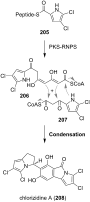
Scheme 63: Early stage introduction of the tetrazole in losartan.
Scheme 64: Synthesis of cilostazol.
Figure 11: Structure of cefdinir.
Scheme 65: Semi-synthesis of cefdinir.
Scheme 66: Thiazole syntheses towards ritonavir.
Scheme 67: Synthesis towards pramipexole.
Scheme 68: Alternative route to pramipexole.
Scheme 69: Synthesis of famotidine.
Scheme 70: Efficient synthesis of the hyperuricemic febuxostat.
Scheme 71: Synthesis of ziprasidone.
Figure 12: Structure of mometasone.
Scheme 72: Industrial access to 2-furoic acid present in mometasone.
Scheme 73: Synthesis of ranitidine from furfuryl alcohol.
Scheme 74: Synthesis of nitrofurantoin.
Scheme 75: Synthesis of benzofuran.
Scheme 76: Synthesis of amiodarone.
Scheme 77: Synthesis of raloxifene.
Scheme 78: Alternative access to the benzo[b]thiophene core of raloxifene.
Scheme 79: Gewald reaction in the synthesis of olanzapine.
Scheme 80: Alternative synthesis of olanzapine.
Figure 13: Access to simple thiophene-containing drugs.
Scheme 81: Synthesis of clopidogrel.
Scheme 82: Pictet–Spengler reaction in the preparation of tetrahydrothieno[3,2-c]pyridine (422).
Scheme 83: Alternative synthesis of key intermediate 422.
Figure 14: Co-crystal structures of timolol (left) and carazolol (right) in the β-adrenergic receptor.
Scheme 84: Synthesis of timolol.
Scheme 85: Synthesis of tizanidine 440.
Scheme 86: Synthesis of leflunomide.
Scheme 87: Synthesis of sulfamethoxazole.
Scheme 88: Synthesis of risperidone.
Figure 15: Relative abundance of selected transformations.
Figure 16: The abundance of heterocycles within top 200 drugs (5-membered rings).
Beilstein J. Org. Chem. 2009, 5, No. 80, doi:10.3762/bjoc.5.80
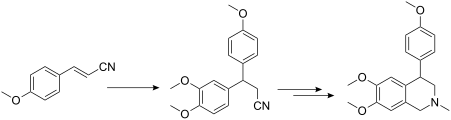
Graphical Abstract
Figure 1: Aryl-1,2,3,4-tetrahydroisoquinolines.
Scheme 1: Retrosynthetic analysis of 5.
Scheme 2: (a) 1,2-Dimethoxybenzene, TFA, reflux, 3 h, 90%; (b) DIBAL-H, CH2Cl2, −78 °C, 3 h, 65%; (c) (i) NaN3...