


Search results
Search for "active methylene compounds" in Full Text gives 31 result(s) in Beilstein Journal of Organic Chemistry.
Approaches towards the synthesis of 5-aminopyrazoles
Beilstein J. Org. Chem. 2011, 7, 179–197, doi:10.3762/bjoc.7.25
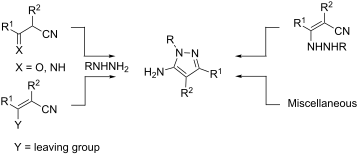
- in the presence of base to yield the desired compounds 162 (Scheme 46). Abdelhamid et al. [89][90] have reported the synthesis of substituted 5-aminopyrazoles 164 by the treatment of active methylene compounds such as malononitrile, ethyl cyanoacetate etc. with hydrazonoyl halides 163 in ethanolic



A new and facile synthetic approach to substituted 2-thioxoquinazolin-4-ones by the annulation of a pyrimidine derivative
Beilstein J. Org. Chem. 2010, 6, 1056–1060, doi:10.3762/bjoc.6.120
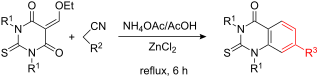
- derivatives of 1,3-diarylthiobarbituric acids (DTBA) with active methylene compounds, such as malononitrile and ethyl cyanoacetate, in presence of ZnCl2 has been developed. Keywords: benzenoid; ethylcyanoacetate; malononitrile; pyrimidine; 2-thioxoquinazolin-4-ones; Introduction Quinazolines and derivatives
- active methylene compounds, such as, malononitrile and ethylcyanoacetate. Results and Discussion DTBA are among the simplest synthetic intermediates and can be easily prepared in a one-pot reaction by treating 1,3-diaryl thioureas with malonic acid in the presence of acetyl chloride. DTBA undergoes
- catalyst afforded 7-hydroxy-2,3-dihydro-2-thioxo-1,3-diarylquinazolin-4(1H)-ones 3 in 76–87% overall yields (Scheme 3) [32][33] and these results are listed in Table 4. Conclusion The cyclocondensation of ethoxymethylene thiobarbituric acids with active methylene compounds under the above noted catalytic


C-Arylation reactions catalyzed by CuO-nanoparticles under ligand free conditions
Beilstein J. Org. Chem. 2010, 6, No. 35, doi:10.3762/bjoc.6.35
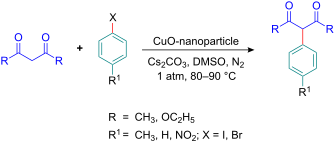
- Mazaahir Kidwai Saurav Bhardwaj Roona Poddar Green Research Laboratory, Department ofChemistry, University of Delhi, Delhi, India 110007 10.3762/bjoc.6.35 Abstract CuO-nanoparticles were found to be an excellent heterogeneous catalyst for C-arylation of active methylene compounds using various
- aryl halides. The products were obtained in good to excellent yield. The catalyst can be recovered and reused for four cycles with almost no loss in activity. Keywords: active methylene compounds; C-arylation; heterogeneous catalyst; recyclability; Introduction Carbon-carbon (C–C) bond formation is


Synthesis of some novel annulated pyrido[2,3-d]pyrimidines via stereoselective intramolecular hetero Diels–Alder reactions of 1-oxa-1,3-butadienes
Beilstein J. Org. Chem. 2010, 6, No. 11, doi:10.3762/bjoc.6.11
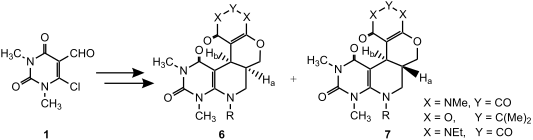
- lone pair on the allyl nitrogen through the formyl group which makes it less electrophilic towards the active methylene compounds. However, the use of a stronger base, e.g. N,N-diisopropylethylamine (DIPEA) under refluxing conditions in ethanol for 3 h gave quite satisfactory results in all cases. In


Hydroxyapatite supported caesium carbonate as a new recyclable solid base catalyst for the Knoevenagel condensation in water
Beilstein J. Org. Chem. 2009, 5, No. 68, doi:10.3762/bjoc.5.68

- catalytic activity was observed which may be attributed to the microscopic changes in the structure of the catalyst. Conclusion An efficient Knoevenagel condensation was achieved between a range of aromatic aldehydes and active methylene compounds in short time periods by using HAP–Cs2CO3 as the catalyst


The tert- amino effect in heterocyclic chemistry: Synthesis of new fused pyrazolinoquinolizine and 1,4-oxazinopyrazoline derivatives
Beilstein J. Org. Chem. 2007, 3, No. 43, doi:10.1186/1860-5397-3-43

- effect, which generalizes cyclization of certain derivatives of 3-methyl-1-phenyl-2-pyrazolin-5-ones. Using this strategy a variety of fused heterocycles is obtained by the Knoevenagel condensation of 5-tert-amino-3-methyl-1-phenylpyrazolone-4-carboxal-dehyde 3 with active methylene compounds such as


Other Beilstein-Institut Open Science Activities



