


Search results
Search for "acyl radical" in Full Text gives 30 result(s) in Beilstein Journal of Organic Chemistry.
A construction of 4,4-spirocyclic γ-lactams by tandem radical cyclization with carbon monoxide
Beilstein J. Org. Chem. 2013, 9, 1340–1345, doi:10.3762/bjoc.9.151
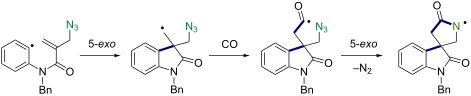
- -lactams in which CO was introduced as the lactam carbonyl moiety [17][18][19][20][21][22][23]. Our approach consists of a sequence of aryl radical cyclization, radical carbonylation [24][25][26][27], and spirocyclization of the resulting acyl radical onto an azide group, which can give 4,4-spirocyclic γ
- radical A gives an alkyl radical B, which adds to CO to give an acyl radical C. Finally, the 5-exo addition of acyl radical C onto an azide group takes place with the liberation of dinitrogen to give a cyclized amidyl radical D [29][30], which abstracts hydrogen from TTMSS, affording the 4,4-spirocyclic


Exploration of an epoxidation–ring-opening strategy for the synthesis of lyconadin A and discovery of an unexpected Payne rearrangement
Beilstein J. Org. Chem. 2013, 9, 1179–1184, doi:10.3762/bjoc.9.132
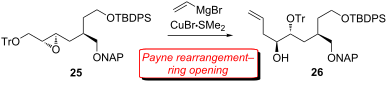
- efficiently furnish its bicyclo[5.4.0]undecane system, which is shown in bold in Figure 1. Subsequent to this observation, we performed model studies that demonstrated the viability of highly stereoselective 7-exo-trig acyl radical–6-exo-trig alkyl radical cyclizations as a means of preparing bicyclo[5.4.0


Radical carbonylations using a continuous microflow system
Beilstein J. Org. Chem. 2009, 5, No. 34, doi:10.3762/bjoc.5.34
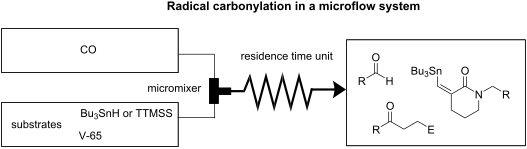
- acyl radical traps (entries 6 and 7 ). Gratifyingly, in both cases, good yields of the three-component coupling products were formed by using reduced CO pressure. Conclusion We have developed a facile platform to conduct radical carbonylation under CO pressure in a flow system comprised of a T-shaped


Part 3. Triethylborane- air: a suitable initiator for intermolecular radical additions of S-2-oxoalkyl- thionocarbonates (S-xanthates) to olefins
Beilstein J. Org. Chem. 2007, 3, No. 47, doi:10.1186/1860-5397-3-47

- ][10][11][12][13][14] Trapping with benzaldehyde gave aldol 1d (48%, Scheme 1) and thus confirmed that a boron enolate is a plausible intermediate in the reduction of compound 1a into 1b. One cannot put aside the possibility that the reduction of the transient α-acyl radical may also occur, to a minor
- in which Et3B is implicated not only in the generation of the α-acyl radical but also in the reaction with the latter, in a stoichiometric manner, to afford an intermediate boron enolate. Lowering the amount of Et3B would therefore minimise the premature unwanted reduction. This hypothesis was then
- to stabilised radical B. The latter fragments either to xanthate A and Et• or, more easily, to stabilised α-acyl radical C and dithiocarbonate D. From the intermediate radical C, three possible routes determine the outcome of the reaction. Route a1 represents the xanthate group transfer between



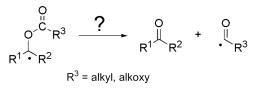
Do α-acyloxy and α-alkoxycarbonyloxy radicals fragment to form acyl and alkoxycarbonyl radicals?
Beilstein J. Org. Chem. 2006, 2, No. 10, doi:10.1186/1860-5397-2-10
- fragmentation of radical 13a to release an acyl radical 16a. However, the ratios of 15/14a do not fit well with the standard model of competing unimolecular (fragmentation) and bimolecular (reduction) reactions in Figure 4. For example, the 10-fold dilution in going from entry 4 to entry 5 should have resulted




Other Beilstein-Institut Open Science Activities



