


Search results
Search for "diselenide" in Full Text gives 31 result(s) in Beilstein Journal of Organic Chemistry.
Electrochemical selenium- and iodonium-initiated cyclisation of hydroxy-functionalised 1,4-dienes
Beilstein J. Org. Chem. 2015, 11, 174–183, doi:10.3762/bjoc.11.18

- -dienols were transformed into cyclic phenylselenoethers by intramolecular cyclisation using selenium cations generated by indirect electrolysis. The reaction was carried out by electrolysing a mixture of the 1,4-dienol, diphenyl diselenide and tetraethylammonium bromide in CH3CN at room temperature in an
- undivided cell, using platinum foil electrodes (constant current 10 mA). In this investigation only diphenyl diselenide was used as selenium source. These reaction conditions led to the formation of products of type 3 as exclusive diastereomers (Scheme 2). The cyclisation of 2 could lead to a number of
- desired 1,4-diene. General procedure for the electrochemical seleno-alkoxylation of 1,4-dienols An undivided electrolysis cell was charged with diphenyl diselenide (78 mg, 0.25 mmol, 0.5 equiv), tetraethylammonium bromide (11 mg, 0.05 mmol, 0.1 equiv), the 1,4-diene (0.5 mmol, 1.0 equiv) and 10 mL


Selenium halide-induced bridge formation in [2.2]paracyclophanes
Beilstein J. Org. Chem. 2014, 10, 2550–2555, doi:10.3762/bjoc.10.266
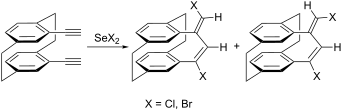
- . Surprisingly, the addition of 2 equiv of PhSeCl to bis(acetylene) 1 again provided a mixture of dienes 2 and 3 along with diphenyl diselenide, in a 70% total isolated yield (Scheme 2). The ratio of isomeric dienes 2 and 3 was again 1:1.5, as resulted from the SeCl2 addition to 4,13-bis(ethynyl)[2.2
- ]paracyclophane. Moreover, an important experimental observation was the fact that diphenyl diselenide was formed in an equimolar amount with the isomeric dienes. This indicates a common intermediate for the reaction products from which elimination of diphenyl diselenide provides dienes 2 and 3. Based on
- . The reaction of 10 with the second equivalent of PhSeCl leads to selenonium ion 11; once the diphenyl diselenide leaving group is formed, the addition of chloride counter-anions from both directions is accompanied by the formation of [2.3.2](1,2,4)cyclophane derivatives 2 and 3. Most probably compound


Magnesium bis(monoperoxyphthalate) hexahydrate as mild and efficient oxidant for the synthesis of selenones
Beilstein J. Org. Chem. 2014, 10, 1267–1271, doi:10.3762/bjoc.10.127
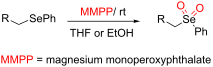
- handling and easier to use. Furthermore, the water soluble reaction byproducts magnesium phthalate and benzeneseleninate anion are generally easy to separate during work-up; the former could be recovered without additional purification as phthalic acid up to 85%, and the latter as diphenyl diselenide [21


Photoinduced synthesis of unsymmetrical diaryl selenides from triarylbismuthines and diaryl diselenides
Beilstein J. Org. Chem. 2013, 9, 1141–1147, doi:10.3762/bjoc.9.127
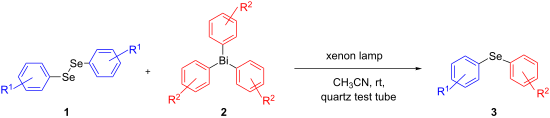
- ). In 1999, Barton and co-workers reported that diaryl selenide was obtained by the reaction of triarylbismuthine with diphenyl diselenide under heating at high temperature (140 °C) [65], but the photoinduced reaction was not investigated. In this letter, we will report the radical reaction of diaryl
- diselenides with triarylbismuthines from the viewpoint of a photoinduced reaction in the synthesis of unsymmetrical diaryl selenides. Results and Discussion First, we investigated the photoinduced reaction of diphenyl diselenide with triphenylbismuthine. Diphenyl diselenide (1a, 0.1 mmol) and
- ( = 9 mm) contributed to the increase in the yield of 3aa (Table 1, entries 8 and 9). Next, we investigated the scope of the synthesis of unsymmetrical diaryl selenides by using different diaryl diselenides and triarylbismuthines (Table 2). The employed diaryl diselenides were diphenyl diselenide (1a


Isotopically labeled sulfur compounds and synthetic selenium and tellurium analogues to study sulfur metabolism in marine bacteria
Beilstein J. Org. Chem. 2013, 9, 942–950, doi:10.3762/bjoc.9.108
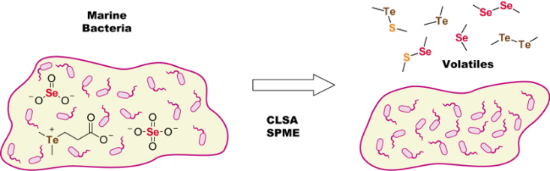
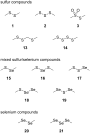
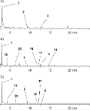
- including dimethyl diselenide (20) and dimethyl triselenide (21). In addition, the mixed sulfur/selenium compounds dimethylselenyl sulfide (15), bis(methylthio) selenide (16), methylseleno disulfide (17), methyl methylthio diselenide (18), and bis(methylseleno) sulfide (19) were found. A similar headspace



Substituent effect on the energy barrier for σ-bond formation from π-single-bonded species, singlet 2,2-dialkoxycyclopentane-1,3-diyls
Beilstein J. Org. Chem. 2013, 9, 925–933, doi:10.3762/bjoc.9.106
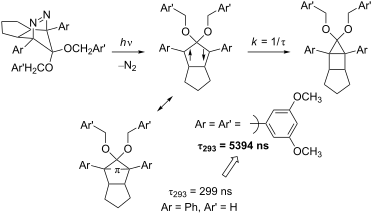
- (s, COCH3), 185.47 (s, OC=O); ESIMS (m/z): [M + Na]+ calcd for C19H20O6Na, 367.11521; found, 367.11456. 1,3-Bis(3,5-dimethoxyphenyl)-2,2-dimethoxypropane-1,3-dione (5). 1,3-Dione 4 (2.76 g, 8 mmol) and diphenyl diselenide (1.25 g, 4 mmol) were dissolved in methanol (50 mL), and ammonium persulfate


Other Beilstein-Institut Open Science Activities



