


Search results
Search for "no solvent" in Full Text gives 32 result(s) in Beilstein Journal of Organic Chemistry.
Properties of PTFE tape as a semipermeable membrane in fluorous reactions
Beilstein J. Org. Chem. 2015, 11, 980–993, doi:10.3762/bjoc.11.110
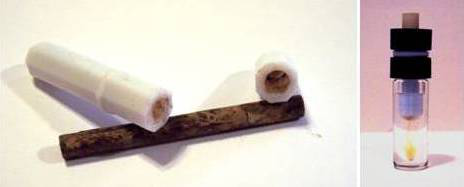
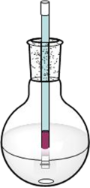
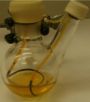
- considerable solvent uptake. (b) The delivery tube is just touching the surface of the solution and there was almost no solvent uptake. Transport of dyed dimethyl phthalate in dichloromethane after (a) 0 h, (b) 1 h, (c) 2 h, (d) 3 h and dyed dimethyl phthalate in hexanes after (e) 0 h, (f) 1 h, (g) 2 h, (h) 3




![[Graphic 1]](/bjoc/content/inline/1860-5397-11-110-i3.png?max-width=637&scale=1.18182) ), in the presence of a n...
), in the presence of a n...
Silver and gold-catalyzed multicomponent reactions
Beilstein J. Org. Chem. 2014, 10, 481–513, doi:10.3762/bjoc.10.46
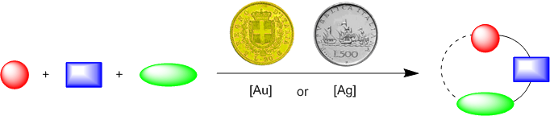
- an effective KA2-MCR, that is, the substitution of aldehyde partners with less reactive ketones. This issue was partially solved by Ji and co-workers, who found with AuBr3 (4 mol %), no-solvent and 60 °C the best conditions to react alkyl ketones, secondary amines and aryl/alkylacetylenes to give the


Acid, silver, and solvent-free gold-catalyzed hydrophenoxylation of internal alkynes
Beilstein J. Org. Chem. 2013, 9, 2002–2008, doi:10.3762/bjoc.9.235
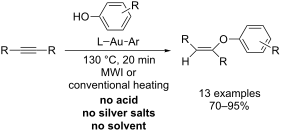
- . aChlorogold precursor (0.32–0.37 mmol), 2 equiv arylboronic acid, 2 equiv Cs2CO3, 50 °C, 20 min, iPrOH (1.5 mL), microwave irradiation. bIsolated yields. cTHF was used as the solvent. Hydrophenoxylation of alkynesa,b. aAlkyne (0.28 mmol), phenol (0.56 mmol), 130 °C, 20 min, no solvent. bIsolated yields
- . cMicrowave heating with 1 as the catalyst (14.0 μmol, 5%). dConventional heating with 7 as the catalyst (14.0 μmol, 5%). Microwave assisted synthesis of arylgold compounds. Regioselectivity of the addition reaction using arylgold precatalysts. Alkyne (0.28 mmol), phenol (0.56 mmol), 130 °C, 20 min, no
- solvent. Microwave heating with 1 or 7 as the catalyst (14.0 μmol, 5%). The yield of the addition product and ratio of regioisomers was determined by 1H NMR spectroscopy using anisole as an internal standard. Hydrophenoxylation of unactivated internal alkynes.a Supporting Information Supporting


Preparation of optically active bicyclodihydrosiloles by a radical cascade reaction
Beilstein J. Org. Chem. 2013, 9, 1326–1332, doi:10.3762/bjoc.9.149
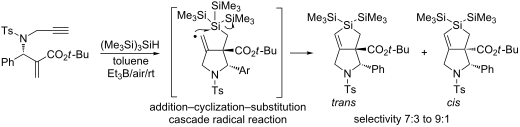
- ), 122.8, 82.1, 75.2, 72.5, 53.7, 27.9 (3C), 21.6, 17.4, 0.3 (3C), −1.4 (3C); HRMS–ESI (positive mode; M + Na) m/z 622.2292, calcd for C30H45NNaO4SSi3, 622.2275. Preparation of 2a under no solvent conditions (Scheme 3, neat condition). A solution of 1a (85 mg, 0.201 mmol), (Me3Si)3SiH (0.07 mL, 0.228 mmol


Metal-mediated aminocatalysis provides mild conditions: Enantioselective Michael addition mediated by primary amino catalysts and alkali-metal ions
Beilstein J. Org. Chem. 2013, 9, 155–165, doi:10.3762/bjoc.9.18
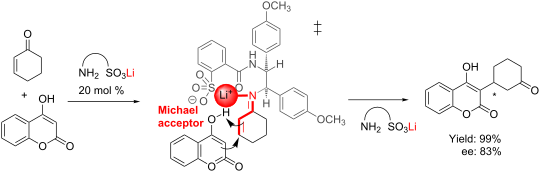
- )-enantiomer of 17 should be generated in majority. The experimentally favored enantiomer is indeed (R)-configured with 83% ee (Table 2, entry 7). This value is in good agreement with an energetic differentiation of the enantio-determining transition states of 2.3 kcal/mol although no solvent dependent effects



A ferrocene redox-active triazolium macrocycle that binds and senses chloride
Beilstein J. Org. Chem. 2012, 8, 246–252, doi:10.3762/bjoc.8.25
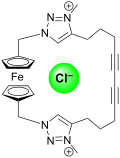
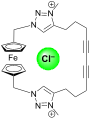
- larger size of 4 gives a much more open structure, with a diameter of approximately 17 Å (Figure 1). Despite this open structure, no solvent cocrystallises with the macrocycle, with the structure being tightly packed due to a series of intermolecular hydrogen bonds between triazole C–H donors and


Synthesis and self-assembly of 1-deoxyglucose derivatives as low molecular weight organogelators
Beilstein J. Org. Chem. 2011, 7, 234–242, doi:10.3762/bjoc.7.31
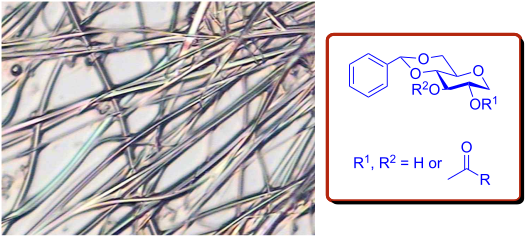
- is formed, then the vial is inverted; if no solvent flows while the gel is inverted, then it is called a stable gel. If the gel falls apart during inversion and by gentle shaking, then it is called an unstable gel or gel-like particulate. If a stable gel is formed, serial dilution is performed until




Other Beilstein-Institut Open Science Activities



