


Search results
Search for "quinuclidine" in Full Text gives 34 result(s) in Beilstein Journal of Organic Chemistry.
Addition of H-phosphonates to quinine-derived carbonyl compounds. An unexpected C9 phosphonate–phosphate rearrangement and tandem intramolecular piperidine elimination
- Łukasz Górecki,
- Artur Mucha and
- Paweł Kafarski
Beilstein J. Org. Chem. 2014, 10, 883–889, doi:10.3762/bjoc.10.85
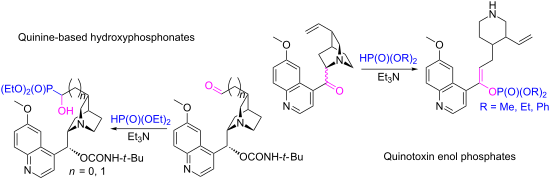
- : aromatic quinoline and chiral aliphatic quinuclidine, and a hydroxy function on the stereogenic carbon atom. Such an architecture combined with the presence of nucleophilic and electrophilic centers buried in a hydrophobic environment predestinates the molecule to asymmetric applications, such as: chiral
- (R/S). The homologous aldehyde can be prepared by oxidation of the double bond in a hydroboration–oxidation sequence, however, the presence of the nitrogen atoms, particularly that of the tertiary amino group of quinuclidine, may be troubleshooting [28][29]. Borane complexes with heteroaromatic and
- with trimethylamine oxide [31]. As the oxide also released the borane–quinuclidine complex at elevated temperature the free alcohol was obtained in a satisfactory yield. This alcohol was subjected to Swern oxidation, recommended for multifunctional compounds [32], to produce the target aldehyde 8 in 65

Graphical Abstract

Scheme 1: Quinine (1) and O-9-t-butylcarbamoylquinine (2) as the substrates for oxidation of the C9 hydroxy a...
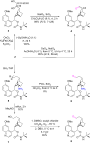
Scheme 2: Oxidation of the vinyl group of 9-O-tert-butylcarbamoylquinine to homologous aldehydes.
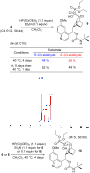
Scheme 3: Addition of diethyl phosphite to aldehydes obtained in oxidation of the vinyl group.

Scheme 4: Oxidation of quinine to quininone and quinidinone and addition of phosphites to the ketones yieldin...

Scheme 5: Spectroscopic features that confirmed the structure of the phosphate ester product of rearrangement...

Scheme 6: Tentative mechanism of the phosphonate–phosphate rearrangement associated with tandem quinuclidine ...
Total synthesis of (+)-grandiamide D, dasyclamide and gigantamide A from a Baylis–Hillman adduct: A unified biomimetic approach
- Andivelu Ilangovan and
- Shanmugasundar Saravanakumar
Beilstein J. Org. Chem. 2014, 10, 127–133, doi:10.3762/bjoc.10.9
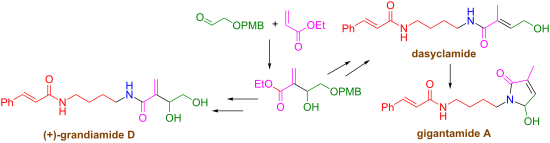
- (14) [11]. In order to reduce the amount of acrylate and to increase the yield of compound (±)-16, the Baylis–Hillman reaction between the aldehyde 14 and ethyl acrylate (15) was tried using different catalysts such as DBU, quinuclidine [12] and n-Bu3P. DABCO was found to be a better catalyst and the

Graphical Abstract

Figure 1: Bisamides as building blocks for flavaglins.

Figure 2: (+)-Grandiamide D, gigantamide A and dasyclamide.

Scheme 1: Retrosynthetic analysis: A unified synthetic approach for the synthesis of grandiamide D, dasyclami...

Scheme 2: Preparation of N-(4-aminobutyl)cinnamamide.

Scheme 3: Synthesis of (±)-grandiamide D.

Scheme 4: Asymmetric synthesis of natural (+)-grandiamide D.

Scheme 5: Various approaches for the synthesis of (E)-N-(4-cinnamamidobutyl)-4-((4-methoxybenzyl)oxy)-2-methy...

Scheme 6: Synthesis of dasyclamide.
An overview of the synthetic routes to the best selling drugs containing 6-membered heterocycles
- Marcus Baumann and
- Ian R. Baxendale
Beilstein J. Org. Chem. 2013, 9, 2265–2319, doi:10.3762/bjoc.9.265
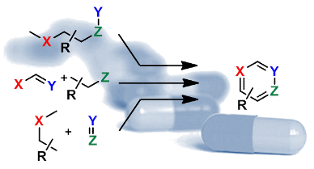
- scientists and consists of a chiral hydroisoquinoline linked to a (R)-quinuclidinol unit through a carbamate linkage (Figure 6). Upon protonation the tertiary amine of the quinuclidine is expected to resemble the ammonium substructure of muscarine (2.58) [76]. This molecule can be prepared by direct coupling
- racemic quinuclidinol. However, an improved approach makes use of a Noyori-type asymmetric reduction employing a BINAP ligated RuCl2 and a chiral diamine to yield the desired (R)-quinuclidine in high yield and enantioselectivity [78]. The enantioselective synthesis of the tetrahydroisoquinoline fragment

Graphical Abstract

Scheme 1: Scaled industrial processes for the synthesis of simple pyridines.

Scheme 2: Synthesis of nicotinic acid from 2-methyl-5-ethylpyridine (1.11).

Scheme 3: Synthesis of 3-picoline and nicotinic acid.

Scheme 4: Synthesis of 3-picoline from 2-methylglutarodinitrile 1.19.

Scheme 5: Picoline-based synthesis of clarinex (no yields reported).

Scheme 6: Mode of action of proton-pump inhibitors and structures of the API’s.

Scheme 7: Hantzsch-like route towards the pyridine rings in common proton pump inhibitors.

Figure 1: Structures of rosiglitazone (1.40) and pioglitazone (1.41).

Scheme 8: Synthesis of rosiglitazone.

Scheme 9: Syntheses of 2-pyridones.

Scheme 10: Synthesis and mechanism of 2-pyrone from malic acid.

Scheme 11: Polymer-assisted synthesis of rosiglitazone.

Scheme 12: Synthesis of pioglitazone.

Scheme 13: Meerwein arylation reaction towards pioglitazone.

Scheme 14: Route towards pioglitazone utilising tyrosine.

Scheme 15: Route towards pioglitazone via Darzens ester formation.

Scheme 16: Syntheses of the thiazolidinedione moiety.

Scheme 17: Synthesis of etoricoxib utilising Negishi and Stille cross-coupling reactions.

Scheme 18: Synthesis of etoricoxib via vinamidinium condensation.

Figure 2: Structures of nalidixic acid, levofloxacin and moxifloxacin.

Scheme 19: Synthesis of moxifloxacin.

Scheme 20: Synthesis of (S,S)-2,8-diazabicyclo[4.3.0]nonane 1.105.

Scheme 21: Synthesis of levofloxacin.

Scheme 22: Alternative approach to the levofloxacin core 1.125.

Figure 3: Structures of nifedipine, amlodipine and clevidipine.

Scheme 23: Mg3N2-mediated synthesis of nifedipine.

Scheme 24: Synthesis of rac-amlodipine as besylate salt.

Scheme 25: Aza Diels–Alder approach towards amlodipine.

Scheme 26: Routes towards clevidipine.

Figure 4: Examples of piperidine containing drugs.

Figure 5: Discovery of tiagabine based on early leads.

Scheme 27: Synthetic sequences to tiagabine.

Figure 6: Structures of solifenacin (2.57) and muscarine (2.58).

Scheme 28: Enantioselective synthesis of solifenacin.

Figure 7: Structures of DPP-4 inhibitors of the gliptin-type.

Scheme 29: Formation of inactive diketopiperazines from cis-rotameric precursors.

Figure 8: Co-crystal structure of carmegliptin bound in the human DPP-4 active site (PDB 3kwf).

Scheme 30: Improved route to carmegliptin.

Figure 9: Structures of lamivudine and zidovudine.

Scheme 31: Typical routes accessing uracil, thymine and cytosine.

Scheme 32: Coupling between pyrimidones and riboses via the Vorbrüggen nucleosidation.

Scheme 33: Synthesis of lamivudine.

Scheme 34: Synthesis of raltegravir.

Scheme 35: Mechanistic studies on the formation of 3.22.

Figure 10: Structures of selected pyrimidine containing drugs.

Scheme 36: General preparation of pyrimidines and dihydropyrimidones.

Scheme 37: Synthesis of imatinib.

Scheme 38: Flow synthesis of imatinib.

Scheme 39: Syntheses of erlotinib.

Scheme 40: Synthesis of erlotinib proceeding via Dimroth rearrangement.

Scheme 41: Synthesis of lapatinib.

Scheme 42: Synthesis of rosuvastatin.

Scheme 43: Alternative preparation of the key aldehyde towards rosuvastatin.

Figure 11: Structure comparison between nicotinic acetylcholine receptor agonists.

Scheme 44: Syntheses of varenicline and its key building block 4.5.

Scheme 45: Synthetic access to eszopiclone and brimonidine via quinoxaline intermediates.

Figure 12: Bortezomib bound in an active site of the yeast 20S proteasome ([114], pdb 2F16).

Scheme 46: Asymmetric synthesis of bortezomib.

Figure 13: Structures of some prominent piperazine containing drugs.

Figure 14: Structural comparison between the core of aplaviroc (4.35) and a type-1 β-turn (4.36).

Scheme 47: Examplary synthesis of an aplaviroc analogue via the Ugi-MCR.

Scheme 48: Syntheses of azelastine (5.1).

Figure 15: Structures of captopril, enalapril and cilazapril.

Scheme 49: Synthesis of cilazapril.

Figure 16: Structures of lamotrigine, ceftriaxone and azapropazone.

Scheme 50: Synthesis of lamotrigine.

Scheme 51: Alternative synthesis of lamotrigine (no yields reported).

Figure 17: Structural comparison between imiquimod and the related adenosine nucleoside.

Scheme 52: Conventional synthesis of imiquimod (no yields reported).

Scheme 53: Synthesis of imiquimod.

Scheme 54: Synthesis of imiquimod via tetrazole formation (not all yields reported).

Figure 18: Structures of various anti HIV-medications.

Scheme 55: Synthesis of abacavir.

Figure 19: Structures of diazepam compared to modern replacements.

Scheme 56: Synthesis of ocinaplon.

Scheme 57: Access to zaleplon and indiplon.

Scheme 58: Different routes towards the required N-methylpyrazole 6.65 of sildenafil.

Scheme 59: Polymer-supported reagents in the synthesis of key aminopyrazole 6.72.

Scheme 60: Early synthetic route to sildenafil.

Scheme 61: Convergent preparations of sildenafil.

Figure 20: Comparison of the structures of sildenafil, tadalafil and vardenafil.

Scheme 62: Short route to imidazotriazinones.

Scheme 63: Alternative route towards vardenafils core imidazotriazinone (6.95).

Scheme 64: Bayer’s approach to the vardenafil core.

Scheme 65: Large scale synthesis of vardenafil.

Scheme 66: Mode of action of temozolomide (6.105) as methylating agent.

Scheme 67: Different routes to temozolomide.

Scheme 68: Safer route towards temozolomide.

Figure 21: Some unreported heterocyclic scaffolds in top market drugs.
Mechanochemistry assisted asymmetric organocatalysis: A sustainable approach
- Pankaj Chauhan and
- Swapandeep Singh Chimni
Beilstein J. Org. Chem. 2012, 8, 2132–2141, doi:10.3762/bjoc.8.240
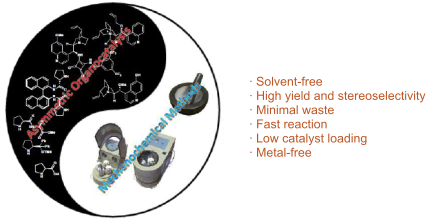
- traditional stirring proceeds at a slower reaction rate as compared to ball-milling [47]. The transition state (TS 4) for this transformation involves a hydrogen-bonded ternary complex of catalyst and substrates in which two NH groups of the squaramide moiety activate the nitroalkene and the quinuclidine

Graphical Abstract

Scheme 1: Proline-catalysed aldol reaction in a ball-mill.

Scheme 2: Proline-catalysed aldol reaction between solid substrates (1b and 2a).

Scheme 3: (S)-Binam-L-prolinamide catalysed asymmetric aldol reaction by using a ball-mill. aConversion.

Scheme 4: Asymmetric aldol reaction assisted by ball-milling catalysed by dipeptides (A) with III and (B) wit...

Scheme 5: Thiodipeptide-catalysed asymmetric aldol reaction of (A) ketones with aldehydes and (B) acetone wit...

Scheme 6: Enantioselective Michael reaction of aldehydes with nitroalkenes catalysed by pyrrolidine-derived o...

Scheme 7: Chiral squaramide catalysed asymmetric Michael reaction assisted by ball-milling.

Scheme 8: Asymmetric organocatalytic Michael reaction assisted by pestle and mortar grinding.

Scheme 9: C-2 symmetric thiourea catalysed enantioselective MBH reaction.

Scheme 10: Quinine-catalysed ring opening of meso-anhydride by ball-milling.

Scheme 11: Ball-milling-assisted (A) synthesis of glycine schiff bases and (B) their organocatalytic asymmetri...

Scheme 12: Enantioselective amination of β-ketoester by using pestle and mortar.
Reactions of nitroxides XIII: Synthesis of the Morita–Baylis–Hillman adducts bearing a nitroxyl moiety using 4-acryloyloxy-2,2,6,6-tetramethylpiperidine-1-oxyl as a starting compound, and DABCO and quinuclidine as catalysts
- Jerzy Zakrzewski
Beilstein J. Org. Chem. 2012, 8, 1515–1522, doi:10.3762/bjoc.8.171
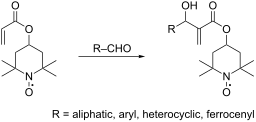
- aldehydes. Keywords: 4-acryloyloxy-2,2,6,6-tetramethylpiperidine-1-oxyl; DABCO; Morita–Baylis–Hillman reaction; nitroxides; quinuclidine; Introduction In the Morita–Baylis–Hillman (MBH) reaction, aldehydes react with a double bond activated by an electron-withdrawing group (EWG). The vinylic carbon
- bearing an EWG undergoes substitution. The reaction is carried out in the presence of either a tertiary amine (e.g., DABCO [2][3][4][5][6], quinuclidine and its derivatives [7][8][9][10][11][12], DBU [13][14], DBN [13], DMAP and its derivatives [4][15][16], urotropine [17], brucine N-oxide [18]) or a
- obtain a compound bearing both nitroxyl and ferrocenyl moiety) ferrocenyl aldehyde (4o). Two catalytic systems were tested: DABCO, and quinuclidine with methanol as a cocatalyst. The latter system was chosen because it has been described as an excellent rate enhancer for the MBH reaction [9][11

Graphical Abstract

Scheme 1: MBH adducts 5a–o from 4-acryloyloxy-2,2,6,6-tetramethylpiperidine-1-oxyl.
Organocatalytic asymmetric addition of malonates to unsaturated 1,4-diketones
- Sergei Žari,
- Tiiu Kailas,
- Marina Kudrjashova,
- Mario Öeren,
- Ivar Järving,
- Toomas Tamm,
- Margus Lopp and
- Tõnis Kanger
Beilstein J. Org. Chem. 2012, 8, 1452–1457, doi:10.3762/bjoc.8.165
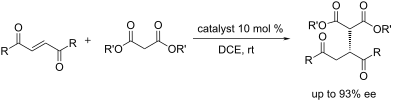
- simultaneously coordinates electrophilic unsaturated 1,4-diketone via hydrogen bonding and activates the nucleophilic malonate via the tertiary amine of the quinuclidine moiety. Due to the symmetry of the substrate, there is no regioselectivity problem. A face selection is determined by the different access of

Graphical Abstract

Figure 1: The conjugated addition to unsaturated 1,4-diketone 1.

Figure 2: Organocatalysts screened.

Figure 3: Proposed transition state.

Figure 4: Calculated (red) and experimental (blue) IR (A) and VCD spectrum (B) of compound (R)-3a.
Cation affinity numbers of Lewis bases
- Christoph Lindner,
- Raman Tandon,
- Boris Maryasin,
- Evgeny Larionov and
- Hendrik Zipse
Beilstein J. Org. Chem. 2012, 8, 1406–1442, doi:10.3762/bjoc.8.163
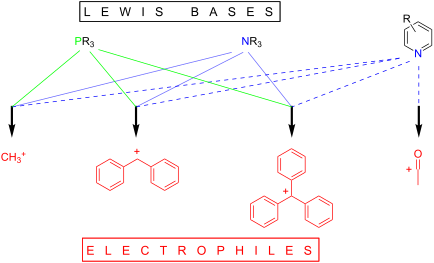
- to the respective mono-substituted amine (e.g., NMe2n-Pr (27) with MCA(27) = 552.1 kJ/mol). However, even in systems with linear alkyl substituents unfavorable steric effects appear to exist between the alkyl substituents, and confining the alkyl groups to a bicyclic cage structure as in quinuclidine
- –N distance in pyridine-trityl adduct (1TT), which amounts to 1.57 Å, can be used. A slightly increased C–N bond length can be found for the TCA-adduct of quinuclidine 53 (1.76 Å), which is in distinct contrast to the structurally similar DABCO. It should be added that all other electrophiles

Graphical Abstract

Scheme 1: Reactions for the methyl cation affinity (MCA) of a neutral Lewis base (1a), an anionic Lewis base ...

Figure 1: MCA values of monosubstituted amines of general formula Me2N(CH2)nH (n = 1–7, in kJ/mol).

Scheme 2: Systematic dependence of MCA.

Scheme 3: Trends in amine MCA values.

Figure 2: Eclipsing interactions in the best conformation of N+Me(iPr)3 (16Me) (left), and the corresponding ...

Scheme 4: General expression for the chain-length dependence of MCA values.

Figure 3: MCA values of monosubstituted phosphanes of general formula Me2P(CH2)nH (n = 1–8, in kJ/mol).

Figure 4: MCA values of monosubstituted phosphanes of general formula PMe2(CH(CH2)n+1) (n = 1–8, in kJ/mol).

Figure 5: The MCA values of n-butyldiphenylphosphane (102) and its (αα-/ββ-/γγ-) dimethylated analogues.

Figure 6: MCA values of phosphanes Me2P–NR2 with cyclic and acyclic amine substituents.

Figure 7: MCA values of phosphanes PMe2R connected to α,α- and β,β-position of nitrogen containing cyclic sub...

Scheme 5: Reactions for the benzhydryl cation affinity (BHCA) of a Lewis base (5a) and pyridine (5b).

Figure 8: Comparison of BHCA values (kJ/mol) and nucleophilicity parameters N for sterically unbiased pyridin...

Scheme 6: Reactions for the trityl cation affinity (THCA) of a Lewis base (6a) and pyridine (6b).

Figure 9: Comparison of MCA, BHCA, and TCA values of selected Lewis bases.

Scheme 7: Correlations of BHCA/TCA values with the respective MCA data for sterically unbiased systems (exclu...

Figure 10: Scheme for the angle d(RXRR) measurements.

Scheme 8: Reactions for the Mosher's cation affinity (MOSCA) of a Lewis base.

Scheme 9: Reactions for the acetyl cation affinity (ACA) of a Lewis base (9a) and pyridine (9b).

Figure 11: Structure of the acetylated pyridine 380 (380Ac).

Scheme 10: Reaction for the Michael-acceptor affinity (MAA) of a Lewis base.

Figure 12: Inverted reaction free energies for the addition of N- and P-based Lewis bases to three different M...

Figure 13: Correlation between MCA values and affinity values towards three different Michael acceptors.

Scheme 11: (a) General definition for a methyl cation transfer reaction between Lewis bases LB1 and LB2, and (...

Figure 14: The energetically best conformations of Pn-Bu3 (120_1, top) and (120_2, bottom).

Figure 15: Relative order of the conformations 120_1 to 120_7 depending on the level of theory.

Figure 16: The structure of the energetically best conformations of 120Me.
Development of the titanium–TADDOLate-catalyzed asymmetric fluorination of β-ketoesters
- Lukas Hintermann,
- Mauro Perseghini and
- Antonio Togni
Beilstein J. Org. Chem. 2011, 7, 1421–1435, doi:10.3762/bjoc.7.166
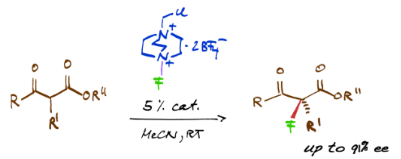
- (tetrafluoroborate); TEDA = triethylenediamine) [27][28][29] marked some important discoveries: First, a new generation of highly enantioselective chiral fluorinating reagents, derived by fluorine transfer [30] from F–TEDA to the quinuclidine portion of cinchona-alkaloids, was introduced by the groups of Cahard [31

Graphical Abstract

Figure 1: Fluorinated substances of biomedical relevance.

Scheme 1: Enantioselective electrophilic fluorination catalyzed by TADDOLates K1, K2. TADDOL = α,α,α',α'-tetr...
Scheme 2: Halogenation of β-ketocarbonyl compounds: Importance of enolization and the potential role of a met...

Figure 2: Model substrates for catalytic fluorinations, with the degree of enolization determined by 1H NMR m...

Figure 3: 1H NMR (250 MHz) spectra of fluorination reaction mixtures diluted with CDCl3 and filtered. a) Full...

Scheme 3: Qualitative ordering of catalytic activity of several Lewis acids in the fluorination 1→1-F.

Scheme 4: Catalysis of the “neutral” fluorination of β-ketoesters with F–TEDA by Lewis acidic titanium comple...

Figure 4: Structure of the chiral ansa-metallocene [(EBTHI)Ti(OTf)2].
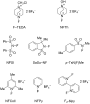
Figure 5: Electrophilic fluorinating reagents of the N–F-type. F–TEDA [27]; NFTh = 1-fluoro-4-hydroxy-1,4-diazoni...

Scheme 5: Synthesis of trifluoromethyl-substituted TADDOL ligands.

Scheme 6: Correlation experiments for the assignment of absolute configuration to fluorination products 11-F, ...

Scheme 7: Mechanistic scheme proposed, based on visual and spectroscopic observations. L = solvent, counterio...

Figure 6: 1H NMR spectra of a species of the type A, generated in CD3CN solution from K1 by ionization in the...

Figure 7: Steric model explaining the face selectivity observed in the titanium–TADDOLate complex catalyzed f...

Figure 8: Excerpt from the X-ray structure of a catalyst/substrate complex [Ti(1-naphthyl-TADDOLato)(β-ketoen...
Molecular recognition of organic ammonium ions in solution using synthetic receptors
- Andreas Späth and
- Burkhard König
Beilstein J. Org. Chem. 2010, 6, No. 32, doi:10.3762/bjoc.6.32
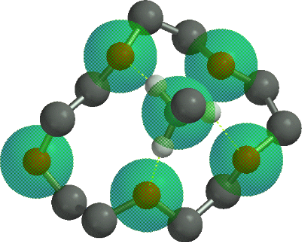

Graphical Abstract

Figure 1: Biologically important amines and quaternary ammonium salts: histamine (1), dopamine (2) and acetyl...

Figure 2: Crown ether 18-crown-6.

Figure 3: Conformations of 18-crown-6 (4) in solvents of different polarity.

Figure 4: Binding topologies of the ammonium ion depending on the crown ring size.
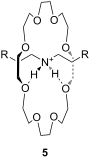
Figure 5: A “pseudorotaxane” structure consisting of 24-crown-8 and a secondary ammonium ion (5); R = Ph.

Figure 6: Typical examples of azacrown ethers, cryptands and related aza macrocycles.

Figure 7: Binding of ammonium to azacrown ethers and cryptands [111-113].

Figure 8: A 19-crown-6-ether with decalino blocking groups (11) and a thiazole-dibenzo-18-crown-6-ether (12).

Figure 9: 1,3-Bis(6-oxopyridazin-1-yl)propane derivatives 13 and 14 by Campayo et al.

Figure 10: Fluorescent azacrown-PET-sensors based on coumarin.

Figure 11: Two different pyridino-cryptands (17 and 18) compared to a pyridino-crown (19); chiral ammonium ion...

Figure 12: Pyridino-18-crown-6 ligand (21), a similar acridino-18-crown-6 ligand (22) and a structurally relat...

Figure 13: Ciral pyridine-azacrown ether receptors 24.

Figure 14: Chiral 15-crown-5 receptors 26 and an analogue 18-crown-6 ligand 27 derived from amino alcohols.

Figure 15: C2-symmetric chiral 18-crown-6 amino alcohol derivatives 28 and related macrocycles.

Figure 16: Macrocycles with diamide-diester groups (30).

Figure 17: C2-symmetric chiral aza-18-crown-6 ethers (31) with phenethylamine residues.

Figure 18: Chiral C-pivot p-methoxy-phenoxy-lariat ethers.

Figure 19: Chiral lariat crown ether 34.

Figure 20: Sucrose-based chiral crown ether receptors 36.
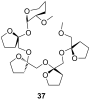
Figure 21: Permethylated fructooligosaccharide 37 showing induced-fit chiral recognition.

Figure 22: Biphenanthryl-18-crown-6 derivative 38.

Figure 23: Chiral lariat crown ethers derived from binol by Fuji et al.

Figure 24: Chiral phenolic crown ether 41 with “aryl chiral barriers” and guest amines.
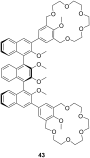
Figure 25: Chiral bis-crown receptor 43 with a meso-ternaphthalene backbone.

Figure 26: Chromogenic pH-dependent bis-crown chemosensor 44 for diamines.

Figure 27: Triamine guests for binding to receptor 44.

Figure 28: Chiral bis-crown phenolphthalein chemosensors 46.

Figure 29: Crown ether amino acid 47.

Figure 30: Luminescent receptor 48 for bis-alkylammonium guests.

Figure 31: Luminescent CEAA (49a), a bis-CEAA receptor for amino acids (49b) and the structure of lysine bindi...

Figure 32: Luminescent CEAA tripeptide for binding small peptides.

Figure 33: Bis crown ether 51a self assembles co-operatively with C60-ammonium ion 51b.

Figure 34: Triptycene-based macrotricyclic dibenzo-[24]-crown-8 ether host 52 and guests.

Figure 35: Copper imido diacetic acid azacrown receptor 53a and the suggested His-Lys binding motif; a copper ...

Figure 36: Urea (54) and thiourea (55) benzo crown receptor for transport and extraction of amino acids.

Figure 37: Crown pyryliums ion receptors 56 for amino acids.

Figure 38: Ditopic sulfonamide bridged crown ether receptor 57.

Figure 39: Luminescent peptide receptor 58.

Figure 40: Luminescent receptor 59 for the detection of D-glucosamine hydrochloride in water/ethanol and lumin...

Figure 41: Guanidinium azacrown receptor 61 for simple amino acids and ditopic receptor 62 with crown ether an...

Figure 42: Chiral bicyclic guanidinium azacrown receptor 63 and similar receptor 64 for the enantioselective t...

Figure 43: Receptors for zwitterionic species based on luminescent CEAAs.

Figure 44: 1,10-Azacrown ethers with sugar podand arms and the anticancer agent busulfan.

Figure 45: Benzo-18-crown-6 modified β-cyclodextrin 69 and β-cyclodextrin functionalized with diaza-18-crown-6...

Figure 46: Receptors for colorimetric detection of primary and secondary ammonium ions.

Figure 47: Porphyrine-crown-receptors 72.

Figure 48: Porphyrin-crown ether conjugate 73 and fullerene-ammonium ion guest 74.

Figure 49: Calix[4]arene (75a), homooxocalix[4]arene (75b) and resorcin[4]arene (75c) compared (R = H, alkyl c...

Figure 50: Calix[4]arene and ammonium ion guest (R = H, alkyl, OAcyl etc.), possible binding sites; A: co-ordi...

Figure 51: Typical guests for studies with calixarenes and related molecules.
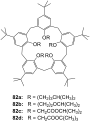
Figure 52: Lower rim modified p-tert-butylcalix[5]arenes 82.

Figure 53: The first example of a water soluble calixarene.

Figure 54: Sulfonated water soluble calix[n]arenes that bind ammonium ions.
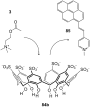
Figure 55: Displacement assay for acetylcholine (3) with a sulfonato-calix[6]arene (84b).

Figure 56: Amino acid inclusion in p-sulfonatocalix[4]arene (84a).

Figure 57: Calixarene receptor family 86 with upper and lower rim functionalization.

Figure 58: Calix[6]arenes 87 with one carboxylic acid functionality.
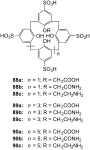
Figure 59: Sulfonated calix[n]arenes with mono-substitution at the lower rim systematically studied on their r...

Figure 60: Cyclotetrachromotropylene host (91) and its binding to lysine (81c).

Figure 61: Calixarenes 92 and 93 with phosphonic acids groups.

Figure 62: Calix[4]arene tetraphosphonic acid (94a) and a double bridged analogue (94b).

Figure 63: Calix[4]arene tetraphosphonic acid ester (92c) for surface recognition experiments.

Figure 64: Calixarene receptors 95 with α-aminophosphonate groups.

Figure 65: A bridged homocalix[3]arene 95 and a distally bridged homocalix[4]crown 96.

Figure 66: Homocalix[3]arene ammonium ion receptor 97a and the Reichardt’s dye (97b) for colorimetric assays.

Figure 67: Chromogenic diazo-bridged calix[4]arene 98.

Figure 68: Calixarene receptor 99 by Huang et al.

Figure 69: Calixarenes 100 reported by Parisi et al.

Figure 70: Guest molecules for inclusion in calixarenes 100: DAP × 2 HCl (101a), APA (101b) and Lys-OMe × 2 HC...

Figure 71: Different N-linked peptido-calixarenes open and with glycol chain bridges.

Figure 72: (S)-1,1′-Bi-2-naphthol calixarene derivative 104 published by Kubo et al.

Figure 73: A chiral ammonium-ion receptor 105 based on the calix[4]arene skeleton.

Figure 74: R-/S-phenylalaninol functionalized calix[6]arenes 106a and 106b.

Figure 75: Capped homocalix[3]arene ammonium ion receptor 107.

Figure 76: Two C3 symmetric capped calix[6]arenes 108 and 109.

Figure 77: Phosphorous-containing rigidified calix[6]arene 110.

Figure 78: Calix[6]azacryptand 111.

Figure 79: Further substituted calix[6]azacryptands 112.

Figure 80: Resorcin[4]arene (75c) and the cavitands (113).

Figure 81: Tetrasulfonatomethylcalix[4]resorcinarene (114).
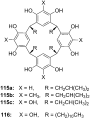
Figure 82: Resorcin[4]arenes (115a/b) and pyrogallo[4]arenes (115c, 116).
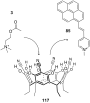
Figure 83: Displacement assay for acetylcholine (3) with tetracyanoresorcin[4]arene (117).

Figure 84: Tetramethoxy resorcinarene mono-crown-5 (118).

Figure 85: Components of a resorcinarene based displacement assay for ammonium ions.

Figure 86: Chiral basket resorcin[4]arenas 121.

Figure 87: Resorcinarenes with deeper cavitand structure (122).

Figure 88: Resorcinarene with partially open deeper cavitand structure (123).

Figure 89: Water-stabilized deep cavitands with partially structure (124, 125).
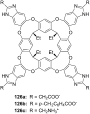
Figure 90: Charged cavitands 126 for tetralkylammonium ions.

Figure 91: Ditopic calix[4]arene receptor 127 capped with glycol chains.

Figure 92: A calix[5]arene dimer for diammonium salt recognition.

Figure 93: Calixarene parts 92c and 129 for the formation molecular capsules.
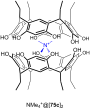
Figure 94: Encapsulation of a quaternary ammonium cation by two resorcin[4]arene molecules (NMe4+@[75c]2 × Cl−...

Figure 95: Encapsulation of a quaternary ammonium cation by six resorcin[4]arene molecules (NMe3D+@[130]6 × Cl−...

Figure 96: Structure and schematic of cucurbit[6]uril (CB[6], 131a).
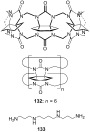
Figure 97: Cyclohexanocucurbit[6]uril (CB′[6], 132) and the guest molecule spermine (133).

Figure 98: α,α,δ,δ-Tetramethylcucurbit[6]uril (134).

Figure 99: Structure of the cucurbituril-phthalhydrazide analogue 135.

Figure 100: Organic cavities for the displacement assay for amine differentiation.

Figure 101: Displacement assay methodology for diammonium- and related guests involving cucurbiturils and some ...

Figure 102: Nor-seco-Cucurbituril (±)-bis-ns-CB[6] (140) and guest molecules.

Figure 103: The cucurbit[6]uril based complexes 141 for chiral discrimination.
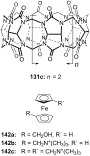
Figure 104: Cucurbit[7]uril (131c) and its ferrocene guests (142) opposed.

Figure 105: Cucurbit[7]uril (131c) guest inclusion and representative guests.

Figure 106: Cucurbit[7]uril (131c) binding to succinylcholine (145) and different bis-ammonium and bis-phosphon...

Figure 107: Paraquat-cucurbit[8]uril complex 149.
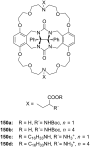
Figure 108: Gluconuril-based ammonium receptors 150.
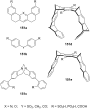
Figure 109: Examples of clefts (151a), tweezers (151b, 151c, 151d) and clips (151e).

Figure 110: Kemp’s triacid (152a), on example of Rebek’s receptors (152b) and guests.

Figure 111: Amino acid receptor (154) by Rebek et al.

Figure 112: Hexagonal lattice designed hosts by Bell et al.

Figure 113: Bell’s amidinium receptor (156) and the amidinium ion (157).
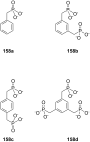
Figure 114: Aromatic phosphonic acids.

Figure 115: Xylene phosphonates 159 and 160a/b for recognition of amines and amino alcohols.
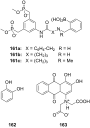
Figure 116: Bisphosphonate recognition motif 161 for a colorimetric assay with alizarin complexone (163) for ca...

Figure 117: Bisphosphonate/phosphate clip 164 and bisphosphonate cleft 165.

Figure 118: N-Methylpyrazine 166a, N-methylnicotinamide iodide (166b) and NAD+ (166c).

Figure 119: Bisphosphate cavitands.
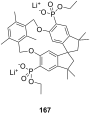
Figure 120: Bisphosphonate 167 of Schrader and Finocchiaro.
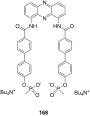
Figure 121: Tweezer 168 for noradrenaline (80b).

Figure 122: Different tripods and heparin (170).
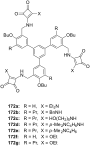
Figure 123: Squaramide based receptors 172.
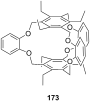
Figure 124: Cage like NH4+ receptor 173 of Kim et al.

Figure 125: Ammonium receptors 174 of Chin et al.

Figure 126: 2-Oxazolin-based ammonium receptors 175a–d and 176 by Ahn et al.

Figure 127: Racemic guest molecules 177.

Figure 128: Tripods based on a imidazole containing macrocycle (178) and the guest molecules employed in the st...

Figure 129: Ammonium ion receptor 180.

Figure 130: Tetraoxa[3.3.3.3]paracyclophanes 181 and a cyclophanic tetraester (182).

Figure 131: Peptidic bridged paraquat-cyclophane.
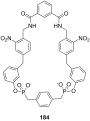
Figure 132: Shape-selective noradrenaline host.

Figure 133: Receptor 185 for binding of noradrenaline on surface layers from Schrader et al.

Figure 134: Tetraphosphonate receptor for binding of noradrenaline.

Figure 135: Tetraphosphonate 187 of Schrader and Finocchiaro.

Figure 136: Zinc-Porphyrin ammonium-ion receptors 188 and 189 of Mizutani et al.
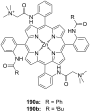
Figure 137: Zinc porphyrin receptor 190.

Figure 138: Zinc porphyrin receptors 191 capable of amino acid binding.

Figure 139: Zinc-porphyrins with amino acid side chains for stereoinduction.

Figure 140: Bis-zinc-bis-porphyrin based on Tröger’s base 193.

Figure 141: BINAP-zinc-prophyrin derivative 194 and it’s guests.

Figure 142: Bisaryl-linked-zinc-porphyrin receptors.
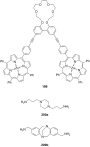
Figure 143: Bis-zinc-porphyrin 199 for diamine recognition and guests.

Figure 144: Bis-zinc-porphyrin crown ether 201.

Figure 145: Bis-zinc-porphyrin 202 for stereodiscrimination (L = large substituent; S = small substituent).

Figure 146: Bis-zinc-porphyrin[3]rotaxane and its copper complex and guests.

Figure 147: Dien-bipyridyl ligand 206 for co-ordination of two metal atoms.

Figure 148: The ligand and corresponding tetradentate co-complex 207 serving as enantioselective receptor for a...

Figure 149: Bis(oxazoline)–copper(II) complex 208 for the recognition of amino acids in aqueous solution.

Figure 150: Zinc-salen-complexes 209 for the recognition tertiary amines.

Figure 151: Bis(oxazoline)–copper(II) 211 for the recognition of amino acids in aqueous solution.

Figure 152: Zn(II)-complex of a C2 terpyridine crown ether.

Figure 153: Displacement assay and receptor for aspartate over glutamate.

Figure 154: Chiral complex 214 for a colorimetric displacement assay for amino acids.

Figure 155: Metal complex receptor 215 with tripeptide side arms.

Figure 156: A sandwich complex 216 and its displaceable dye 217.

Figure 157: Lanthanide complexes 218–220 for amino acid recognition.
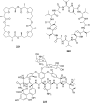
Figure 158: Nonactin (221), valinomycin (222) and vancomycin (223).

Figure 159: Monesin (224a) and a chiral analogue for enantiodiscrimination of ammonium guests (224b).

Figure 160: Chiral podands (226) compared to pentaglyme-dimethylether (225) and 18-crown-6 (4).

Figure 161: Lasalocid A (228).

Figure 162: Lasalocid derivatives (230) of Sessler et al.

Figure 163: The Coporphyrin I tetraanion (231).

Figure 164: Linear and cyclic peptides for ammonium ion recognition.

Figure 165: Cyclic and bicyclic depsipeptides for ammonium ion recognition.
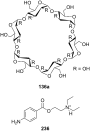
Figure 166: α-Cyclodextrin (136a) and novocaine (236).
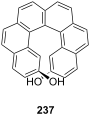
Figure 167: Helical diol receptor 237 by Reetz and Sostmann.

Figure 168: Ammonium binding spherand by Cram et al. (238a) and the cyclic[6]metaphenylacetylene 238b in compar...

Figure 169: Receptor for peptide backbone and ammonium binding (239).

Figure 170: Anion sensor principle with 3-hydroxy-2-naphthanilide of Jiang et al.

Figure 171: 7-bromo-3-hydroxy-N-(2-hydroxyphenyl)naphthalene 2-carboxamide (241) and its amine binding.

Figure 172: Naturally occurring catechins with affinity to quaternary ammonium ions.

Figure 173: Spiropyran (244) and merocyanine form (244a) of the amino acid receptors of Fuji et al.

Figure 174: Coumarin aldehyde (245) and its iminium species with amino acid bound (245a) by Glass et al.
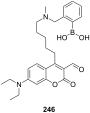
Figure 175: Coumarin aldehyde appended with boronic acid.

Figure 176: Quinolone aldehyde dimers by Glass et al.

Figure 177: Chromogenic ammonium ion receptors with trifluoroacetophenone recognition motifs.

Figure 178: Chromogenic ammonium ion receptor with trifluoroacetophenone recognition motif bound on different m...



