


Search results
Search for "host–guest interactions" in Full Text gives 63 result(s) in Beilstein Journal of Organic Chemistry.
Structure elucidation of β-cyclodextrin–xylazine complex by a combination of quantitative 1H–1H ROESY and molecular dynamics studies
Beilstein J. Org. Chem. 2013, 9, 1917–1924, doi:10.3762/bjoc.9.226
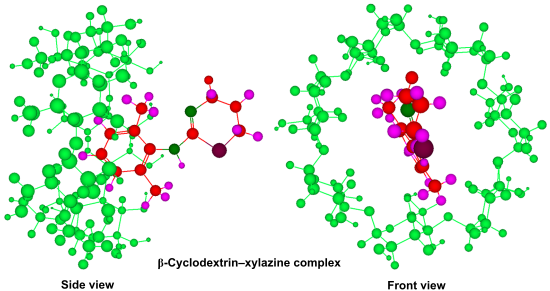
- . 1H–1H ROESY studies ROESY is an important tool for the study of large molecules and provides information on the through-space proximity of protons [19]. The host–guest interactions are displayed as intermolecular peaks between cavity protons and part of the guest involved in complexation. The




Linkage of α-cyclodextrin-terminated poly(dimethylsiloxanes) by inclusion of quasi bifunctional ferrocene
Beilstein J. Org. Chem. 2013, 9, 1278–1284, doi:10.3762/bjoc.9.144
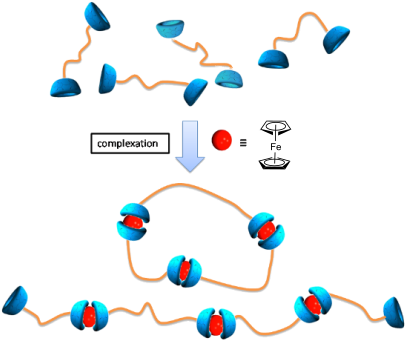
- interactions of the siloxane derivatives with ferrocene Linking of the obtained polydimethyl and disiloxane derivatives through host–guest interactions with single ferrocene molecules generates supramolecular, connected siloxane chains. The guest molecule ferrocene was therefore dissolved in chloroform and
- strands can be linked with each other through the host–guest interactions of the terminal α-CD units and pure ferrocene without the need for covalent bonds. In order to complete the characterization of these host–guest interactions of the novel compounds, they were also examined by 2D ROESY NMR
- chloroform as solvent, by host–guest interactions of terminally attached α-CD with ferrocene as a quasi-bifunctional single guest molecule. The formation of noncovalent linkages was proved by the use of NMR spectroscopy and TEM images. However, it turned out that the stability of linking functions is


Space filling of β-cyclodextrin and β-cyclodextrin derivatives by volatile hydrophobic guests
Beilstein J. Org. Chem. 2013, 9, 1185–1191, doi:10.3762/bjoc.9.133
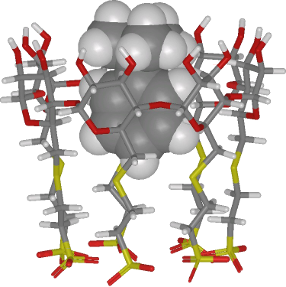
- was still inferior to unity (0.69), which indicated that the host–guest interactions were partially compensated by reduced solvation and loss of freedom of the host–guest system. One way to further improve the hydrophobic binding potential of a host in water is to add a salt such as NaCl [42]. From


Superstructures of fluorescent cyclodextrin via click-reaction
Beilstein J. Org. Chem. 2013, 9, 827–831, doi:10.3762/bjoc.9.94
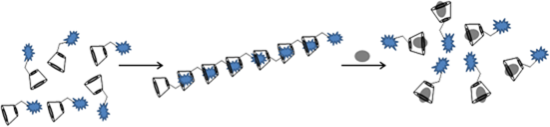
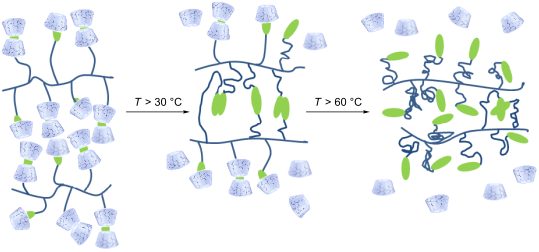
- shape, through poly(host–guest)-interactions, was found. Furthermore, we were able to show the collapse of the supramolecular polymers upon addition of potassium adamantane-1-carboxylate. Experimental General remarks All reagents used were commercially available (Sigma-Aldrich, Acros Organics) and used
- , Humboldtstr. 10, 07743 Jena, Germany 10.3762/bjoc.9.94 Abstract Mono-(6-azido-6-deoxy)-β-cyclodextrin (CD) was covalently attached to an alkyne-modified 5-methyl-2-(pyridin-2-yl)thiazol-4-ol yielding a fluorophore containing CD in a click-type reaction. Intermolecular complexes were formed by poly(host–guest
- )-interactions. The supramolecular structures were characterized by 1H NMR-ROESY spectroscopy, dynamic light scattering, UV–vis spectroscopy, fluorescence spectroscopy, and asymmetric flow field-flow fractionation. By adding potassium adamantane-1-carboxylate, the thiazol dye is displaced from the CD-cavity and


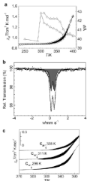
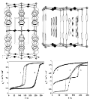
Spin state switching in iron coordination compounds
Beilstein J. Org. Chem. 2013, 9, 342–391, doi:10.3762/bjoc.9.39
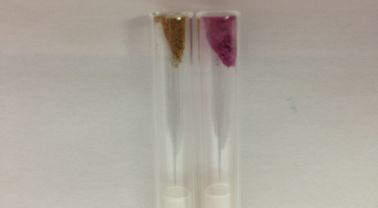


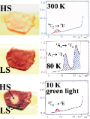
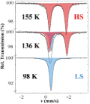


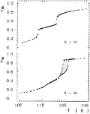

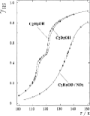


![[Graphic 1]](/bjoc/content/inline/1860-5397-9-39-i3.png?max-width=637&scale=1.18182) ) modes versus the anion volu...
) modes versus the anion volu...






Influence of cyclodextrin on the solubility and the polymerization of (meth)acrylated Triton® X-100
Beilstein J. Org. Chem. 2012, 8, 2176–2183, doi:10.3762/bjoc.8.245
- –guest interactions. The successful polymerization of 10–13 was demonstrated, e.g., by 1H NMR spectroscopy. The signals of the olefinic protons between 5.5 and 6.2 ppm vanished; whereas the signals of the polymer backbone at 0.67 ppm were clearly visible. As expected, the signals of the protons of the
- possible after the complexation of (meth)acrylated Triton® X-100 (2 and 3) with RAMEB-CD (Scheme 3). The polymers 10 and 12 complexed with 1 equiv of RAMEB-CD precipitated during the polymerization, whereas the double complexed polymers 11 and 13 did not precipitate, as a consequence of the stronger host


Mannose-decorated cyclodextrin vesicles: The interplay of multivalency and surface density in lectin–carbohydrate recognition
Beilstein J. Org. Chem. 2012, 8, 1543–1551, doi:10.3762/bjoc.8.175
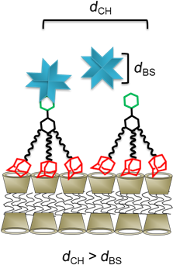
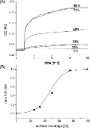
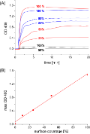
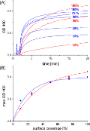
- be modified by host–guest interactions with functional guest molecules. In this article, we investigate the multivalent interaction of the lectin concanavalin A (ConA) with cyclodextrin vesicles decorated with mannose–adamantane conjugates with one, two or three adamantane units as well as one or two
- in Table 1. According to a quantitative treatment of multivalent host–guest interactions at surfaces, it may be expected that for a 1:1 monovalent interaction with a binding constant of ≈104 M−1, a divalent interaction can have an apparent binding constant of ≈107 M−1 and a trivalent interaction can





Synthesis of mesomeric betaine compounds with imidazolium-enolate structure
Beilstein J. Org. Chem. 2012, 8, 390–397, doi:10.3762/bjoc.8.42
- relatively low values of the formation constant calculated for both a 1:1 complex (K1 = 1.6 × 10² M−1) and a 1:2 complex (K2 = 0.2 × 10² M−1) indicates only weak host/guest interactions and therefore only a slight increase of solubility in water was achieved. However, the value of K1 is in good agreement




Supramolecular chemistry II
Beilstein J. Org. Chem. 2011, 7, 1541–1542, doi:10.3762/bjoc.7.181
- devoted to quantifying host–guest interactions, aiming at a more profound understanding of the subtle entropic and enthalpic effects that govern the interactions between host and guest. A first Thematic Series devoted to supramolecular chemistry was assembled about two years ago and published by the
Fluorometric recognition of both dihydrogen phosphate and iodide by a new flexible anthracene linked benzimidazolium-based receptor
Beilstein J. Org. Chem. 2011, 7, 254–264, doi:10.3762/bjoc.7.34
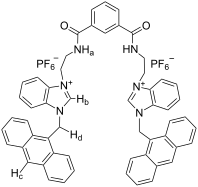
- the polar C+–H bond of benzimidazolium motif and reduces the possibility of host–guest interactions [46]. This is clearly reflected in the binding constant values in Table 1. Due to the presence of a minimum amount of CH3CN in CHCl3 the binding constant values for the selected anions are greater in


Free radical homopolymerization of a vinylferrocene/cyclodextrin complex in water
Beilstein J. Org. Chem. 2010, 6, No. 60, doi:10.3762/bjoc.6.60
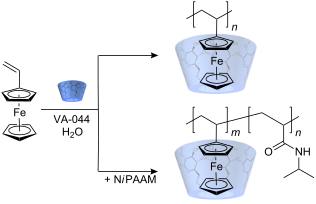
- water-soluble polymer is obtained due to the host guest interactions. Those polymeric complexes are stable in water up to about 90 °C. Above this temperature the polymer precipitates due to decomplexation. The complex was investigated by 1H NMR spectrometry, dynamic light scattering (DLS), differential


Synthesis of deep- cavity fluorous calix[4]arenes as molecular recognition scaffolds
Beilstein J. Org. Chem. 2008, 4, No. 36, doi:10.3762/bjoc.4.36
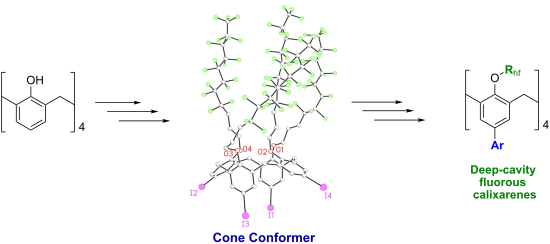
- enhance the formation of a single conformer [12]. Of the four possible conformations, the cone is the most desirable for molecular recognition and sensing applications because it has the largest available surface area for host-guest interactions [10]. With appropriate functionality and conformation, the
- , thus limiting the scope of possible host-guest interactions. Increasing the depth of the cavity by coupling 5 with aromatic rings to give 9 allows for host-guest interactions involving larger substrates. This modification increases the versatility of the scaffold and the variety of host-guest
- interactions that can occur in ion binding [8] and capsule formation [34]. Likewise, introduction of hydrogen bonding groups like those of 9 are crucial for achieving interactions with various substrates [35][36]. Coupling an aromatic ring onto the upper-rim of the fluorous calixarene led to an increase in


Molecular recognition. 1. Crystal structures of hexaazamacrocyclic amines containing p-xylylene spacers and their adducts with acids
Beilstein J. Org. Chem. 2005, 1, No. 16, doi:10.1186/1860-5397-1-16
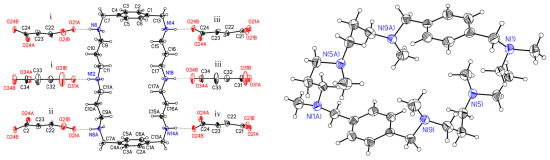
- hexaprotonated cation is produced.[6][13] The supramolecular assemblies which are formed between the receptor 1 and the anionic guests under participation of solvent molecules are kept together by two main types of interactions: Coulombic forces and hydrogen bonding. Host-guest interactions depend also strongly





