


Search results
Search for "low catalyst loading" in Full Text gives 55 result(s) in Beilstein Journal of Organic Chemistry.
A comparative study of the Au-catalyzed cyclization of hydroxy-substituted allylic alcohols and ethers
Beilstein J. Org. Chem. 2011, 7, 802–807, doi:10.3762/bjoc.7.91
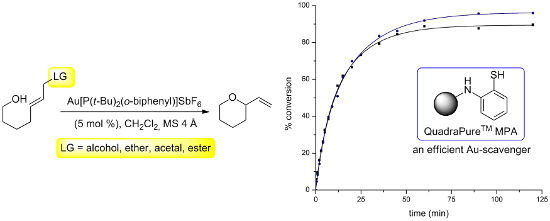
- easily accomplished with monoallylic diol substrates, as illustrated in Scheme 1 [23][24][25]. The reactions are generally rapid and high yielding with low catalyst loading and can be carried out at low reaction temperatures. Additionally, they are stereospecific, as changing the olefin geometry provides


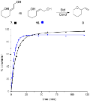
![[Graphic 1]](/bjoc/content/inline/1860-5397-7-91-i3.png?max-width=637&scale=0.59091) = quenched after 1 min;
= quenched after 1 min; ![[Graphic 2]](/bjoc/content/inline/1860-5397-7-91-i4.png?max-width=637&scale=0.709092) = quenched after 3 min;
= quenched after 3 min; ![[Graphic 3]](/bjoc/content/inline/1860-5397-7-91-i5.png?max-width=637&scale=0.709092) = quenched after ...
= quenched after ...

Highly efficient gold(I)-catalyzed Overman rearrangement in water
Beilstein J. Org. Chem. 2011, 7, 781–785, doi:10.3762/bjoc.7.88
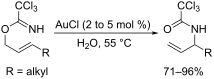
- substituted allylic trichloroacetamides. This transformation was performed in water under very mild reaction conditions and could be carried out on the gram-scale with low catalyst loading and simple work-up procedure, making it potentially applicable to the industrial community for large-scale synthesis


Palladium- and copper-mediated N-aryl bond formation reactions for the synthesis of biological active compounds
Beilstein J. Org. Chem. 2011, 7, 59–74, doi:10.3762/bjoc.7.10
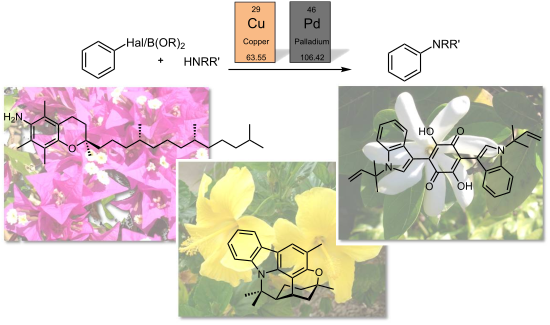
- conducted under an inert atmosphere; toluene is a favourite solvent and BINAP a commonly used ligand. Strong bases are required and water is added to dissolve them. Substituents in the starting material, which are base labile are not tolerated. With low catalyst loading and good availability of the


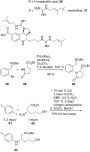
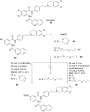


The cross-metathesis of methyl oleate with cis-2-butene-1,4-diyl diacetate and the influence of protecting groups
Beilstein J. Org. Chem. 2011, 7, 1–8, doi:10.3762/bjoc.7.1
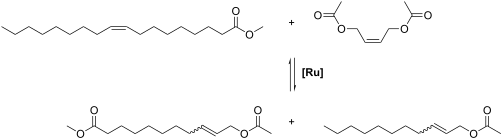
- -metathesis of methyl oleate (1) with cis-2-butene-1,4-diyl diacetate (2) was feasible with the relatively low catalyst loading of the Schiff base ruthenium catalyst [Ru]-7 to yield two value-added and sustainable intermediates in one step. Methyl 11-acetoxyundec-9-enoate (3) and undec-2-enyl acetate (4) are


Large- scale ruthenium- and enzyme- catalyzed dynamic kinetic resolution of (rac)-1-phenylethanol
Beilstein J. Org. Chem. 2007, 3, No. 50, doi:10.1186/1860-5397-3-50
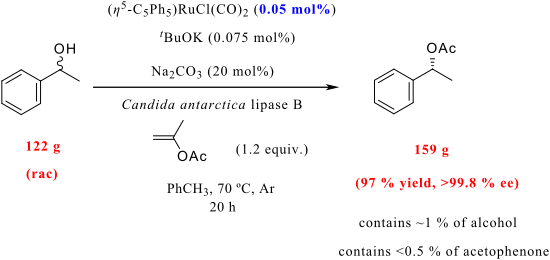
- mixture afforded enantiopure acetate 3 in 97% yield after 20 h. Careful analysis of the enantiomeric purity of acetate 3 revealed that it was >99.8% ee. This result is remarkable since only a very low catalyst loading is employed and in addition, only 150 mL of toluene as the solvent is used to produce


Other Beilstein-Institut Open Science Activities



