


Search results
Search for "uracil" in Full Text gives 61 result(s) in Beilstein Journal of Organic Chemistry.
Natural product biosyntheses in cyanobacteria: A treasure trove of unique enzymes
Beilstein J. Org. Chem. 2011, 7, 1622–1635, doi:10.3762/bjoc.7.191
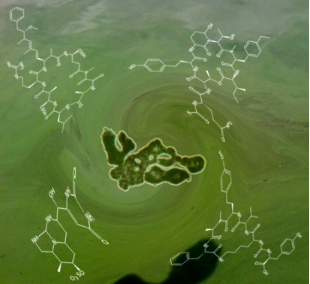
- responsible for uracil ring formation, although biochemical evidence is currently missing. The final hydroxylation step towards cylindrospermopsin has been shown to be catalyzed by CyrI, a 2-oxoglutarate-dependent iron oxygenase [31]. Interestingly, two epimers were described for the corresponding hydroxyl


Synthesis, reactivity and biological activity of 5-alkoxymethyluracil analogues
Beilstein J. Org. Chem. 2011, 7, 678–698, doi:10.3762/bjoc.7.80
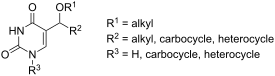
- specific and much less toxic for organisms. One of those groups of investigated derivatives is a group of uracil analogues modified at the 5 position by an ether or ester moiety. Since a vast number of C-5 modified pyrimidine analogues are known, this review is focused on a group of selected compounds with
- . Synthesis Synthesis of alkoxy-haloalkyl derivatives The most numerous and also the most investigated group of the above mentioned derivatives is a group of alkoxy-haloalkyl compounds derived either from uracil or nucleosides (Figure 2). With regard to the high variability of sugar moiety, the description of
- all the compounds is divided into sections according to the nature of the furanose present. 2'-Deoxyuridine analogues: The earliest article describing 2'-deoxyuridine analogues was focused on uracil analogues modified at position 5 by a fluorine containing moiety [6]. Bases or nucleosides substituted


Heavy atom effects in the Paternò–Büchi reaction of pyrimidine derivatives with 4,4’-disubstituted benzophenones
Beilstein J. Org. Chem. 2011, 7, 113–118, doi:10.3762/bjoc.7.16
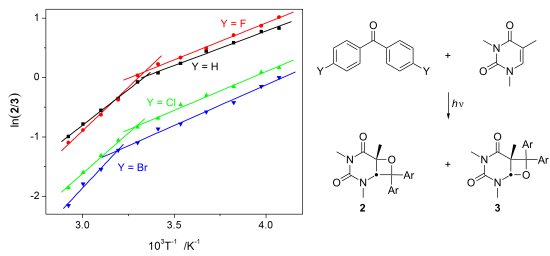
- less efficient Paternò–Büchi reaction. Experimental Materials 1,3-Dimethylthymine (DMT) and 1,3-dimethyluracil (DMU) were was prepared from thymine and uracil, respectively. 4,4’-Dimethoxybenzophenone, 4,4’-dichlorobenzophenone, 4,4’-dibromobenzophenone and 4,4’-dicyanobenzophenone were prepared


Synthesis of a novel analogue of DPP-4 inhibitor Alogliptin: Introduction of a spirocyclic moiety on the piperidine ring
Beilstein J. Org. Chem. 2010, 6, No. 71, doi:10.3762/bjoc.6.71

- compound C indicates that the key step would involve the condensation of two key intermediates, i.e., the piperidinyl derivative 9 and the appropriately substituted 6-chloro uracil derivative 11 (Figure 2). The intermediate 9 in turn could be synthesized via functional group manipulations of the spiro


Symmetrical and unsymmetrical α,ω-nucleobase amide-conjugated systems
Beilstein J. Org. Chem. 2010, 6, No. 34, doi:10.3762/bjoc.6.34
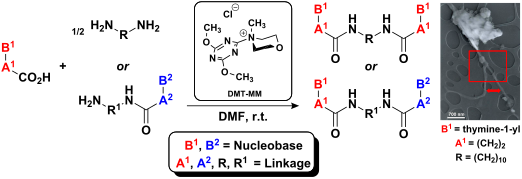
- via amide bond(s) from two subunits containing nucleobases or their analogues (B1, B2) bearing various linkages (A1, A2). We have previously reported compounds containing 5-substituted uracil-1-yl subunits bound via short (I, II) or extra-short (III) amide-linkages [1]. These compounds exhibited
- against it within the group tested. Very recently, Accetta et al. reported remarkable symmetrical amide-conjugated bis-α,ω-uracil based systems (IV). These compounds exhibited antiproliferative and erythroid differentiation induction properties towards human chronic myelogenous leukaemia K562 cells [3
- groups were obtained by acidic hydrolysis of N-1 Michael adducts of uracils or N-9 Michael adducts of 6-chloropurine with methyl acrylate (Scheme 1A) [1]. Uracil derivatives were obtained via the fully regioselective one-step procedure as previously reported [11][12]. To construct systems containing


Synthesis of some novel annulated pyrido[2,3-d]pyrimidines via stereoselective intramolecular hetero Diels–Alder reactions of 1-oxa-1,3-butadienes
Beilstein J. Org. Chem. 2010, 6, No. 11, doi:10.3762/bjoc.6.11
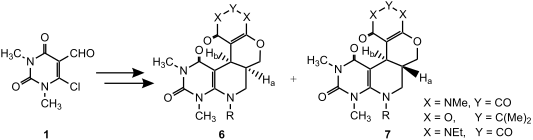
- Diels–Alder reactions involving 1-oxa-1,3-butadienes. Keywords: β-halo aldehydes; hetero Diels–Alder reaction; 1-oxa-1,3-butadiene; pyrido[2,3-d]pyrimidines; uracil; Introduction The importance of uracil and its annulated derivatives is well recognized by synthetic as well as biological chemists [1][2
- ], antihypertensive [13], bronchiodilator [15] and vasodilator [16] properties. Additionally, some compounds of this type exhibit antialergic [17], antimalarial [18], analgesic [19][20] and antifungal [21] activity. Consequently, much effort has been directed towards the synthetic manipulation of uracil for the
- complex annulated pyrido[2,3-d]pyrimidines by intramolecular hetero Diels–Alder reactions involving 1-oxa-1,3-butadienes (Scheme 1). The key intermediate, the 2-chloro-3-formyl uracil derivative 1 (β-halo aldehyde), was prepared by the reaction of N,N-dimethyl barbituric acid with Vielsmeier reagent (DMF


N-1 regioselective Michael- type addition of 5-substituted uracils to (2-hydroxyethyl) acrylate
Beilstein J. Org. Chem. 2007, 3, No. 40, doi:10.1186/1860-5397-3-40
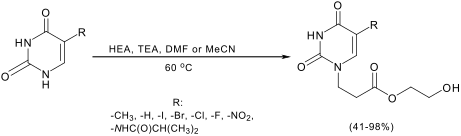
- -hydroxyethyl) acrylate is presented. The reactions were performed in polar aprotic solvents and with avoidance of polymerization of acrylic substrate. The obtained adducts may serve as versatile substrates for further functionalization, e.g. into (3-uracil-1-yl)propanoic acids or transformations, with
- against numerous DNA-viruses.[5] One of the most convenient methods of uracil ring N-alkylation is the Michael-type addition. Other general ways of alkylation are: nucleophilic substitution of halogenoalkyl substrates by activated uracil rings (in the N-anionic or O-persililated derivatives);[6][7
- ] Mitsunobu reaction;[8] or reactions that operate through ANRORC-mechanisms that require the presence of strongly electron-withdrawing groups.[9] Recently, we have described an N1- and N3-regioselective Michael-type addition of 5-substituted uracil derivatives to methyl acrylate and acrylonitrile.[10


A hydrogen- bonded channel structure formed by a complex of uracil and melamine
Beilstein J. Org. Chem. 2007, 3, No. 17, doi:10.1186/1860-5397-3-17
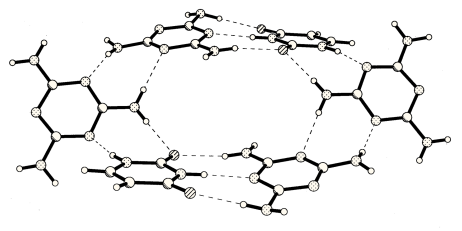
- Reji Thomas G. U. Kulkarni Chemistry and Physics of Materials Unit, Jawaharlal Nehru Centre for Advanced Scientific Research, Jakkur (P.O), Bangalore – 560064, India 10.1186/1860-5397-3-17 Abstract The structure of a 1:1 complex of uracil and melamine obtained by cocrystallization has been
- channel structure with 4,4'-bipyridyl. [5] Although hydrogen bonding aspects of cyanuric acid have been studied in detail, similar structures formed by uracil possessing two imide groups has not been studied adequately, except for its hydrogen bonding with adenine in RNA. [6] In RNA, uracil forms cyclic
- dimers comprising of N-H...O and N-H...N bonds with adenine. The 1:1 molecular complex of 9-ethyladenine and N-methylcyanuric acid has a hydrogen-bonded layer structure. [7] In view of the above, it was our interest to study the hydrogen-bonded structure of cocrystals of uracil and melamine, with the




Microwave- assisted ring closure reactions: Synthesis of 8-substituted xanthine derivatives and related pyrimido- and diazepinopurinediones
Beilstein J. Org. Chem. 2006, 2, No. 20, doi:10.1186/1860-5397-2-20
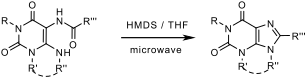
- medicinal chemistry. Substitution at the 8-position of the purine ring is generally accessible by ring closure of a carboxamido-substituted uracil precursor. Although several procedures to accomplish this synthetic step have been suggested, it still remains difficult in many cases. Results Ring closure
- recently reported on the upscaling of the synthesis of the 8-styrylxanthine derivatives MSX-2 (2), MSX-3 (3), and KW-6002 (1) [14]. In the present study we have investigated whether the critical cyclization step to obtain the purine ring from a uracil precursor could be further improved by applying
- of xanthine derivatives, especially if uracil derivatives containing polar groups are used as precursors [3][6]. Previous experiments have shown that reaction times can be considerably shortened if HMDS is used at very high temperatures under elevated pressure (e.g. 170°C in a sealed pressure tube


An efficient synthesis of novel pyrano[2,3-d]- and furopyrano[2,3-d]pyrimidines via indium- catalyzed multi- component domino reaction
Beilstein J. Org. Chem. 2006, 2, No. 11, doi:10.1186/1860-5397-2-11
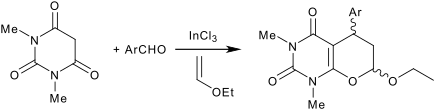
- efficiently at ambient temperature in excellent yields (Scheme 1). Pyrimidine derivatives continue to be of great interest due to their wide range of biological activities.[12] Preparation of naturally occuring complex molecules containing a uracil ring pose significant synthetic challenges.[13] The
- bond of uracil is an undeveloped field in view of a great variety of potential products. [27][28][29] Although a variety of routes for the synthesis of these compounds have been appeared in the literature, [30][31][32][33] the majority of them involve a number of steps, drastic conditions, long
- reaction time and low yields. Thus new routes for the synthesis of these molecules have attracted considerable attention in search for a rapid entry to these heterocycles and their diverse biological properties. In search of an efficient method and in continuation to our studies on uracil analogues [34][35


One-pot synthesis of novel 1H-pyrimido[4,5-c][1,2]diazepines and pyrazolo[3,4-d]pyrimidines
Beilstein J. Org. Chem. 2006, 2, No. 5, doi:10.1186/1860-5397-2-5

- ]diazepines 3 & 4 and pyrazolo [3,4-d]pyrimidines 6 were regioselectively synthesised by the reaction of 1,3-dimethyl-6-hydrazinouracils 1 with various α,β-unsaturated compounds 2 and α-ketoalkynes 8 in excellent yields. Introduction The importance of uracil and its annelated substrates is well recognized by
- exploitation of the nucleophilic double bond of uracil is an undeveloped field in view of a great variety of potential products. [9][10][11][12] There have been reports for direct functionalisation of uracil using the C5-C6 double bond via thermolytic[13] and photocycloaddition reactions.[14][15] The
- ), an effective xanthine oxidase inhibitor,[20] is in clinical use for controlling gout and related metabolic disorders.[21] In continuation of our studies on uracil analogues [22][23][24] we describe the results of our study on the reaction of 1,3-dimethyl-6-hydrazino uracils 1 with various α,β





