


Search results
Search for "GC–MS analysis" in Full Text gives 91 result(s) in Beilstein Journal of Organic Chemistry.
Activation of cryptic metabolite production through gene disruption: Dimethyl furan-2,4-dicarboxylate produced by Streptomyces sahachiroi
Beilstein J. Org. Chem. 2013, 9, 1768–1773, doi:10.3762/bjoc.9.205
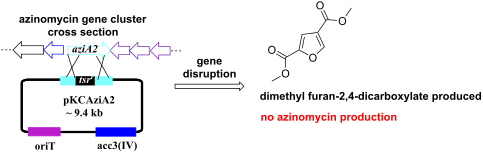
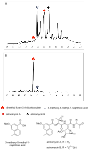
- flow rate of 0.75 mL/min in 254 nm UV. The same program was used for LC–APCI analysis. For GC–MS analysis, the sample was diluted 1:10 in DCM and was performed on an Ultra GC/DSQ (ThermoElectron, Waltham, MA). A Rxi-5ms gas chromatographic column was utilized with dimensions of 60 m length, 0.25 mm i.d


The preparation of several 1,2,3,4,5-functionalized cyclopentane derivatives
Beilstein J. Org. Chem. 2013, 9, 1705–1712, doi:10.3762/bjoc.9.195
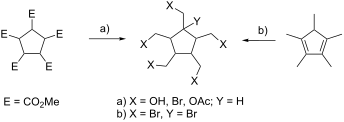
- derivatives of 16, it should also be mentioned that attempts to prepare the corresponding pentachloride (by treatment with either SOCl2 or PCl3) and pentaiodide (red P/iodine) also failed. In all these experiments complex product mixtures resulted, the GC–MS analysis of which demonstrated that only partially
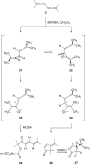
- 5). Finally, the hydrogenation of 28 over Pd/C in methanol furnished a mixture of the saturated pentaesters 26 and 27 (ratio 4:1, capillary GC–MS-analysis) in practically quantitative yield (98%). Although we were unable to separate the two components quantitatively by column chromatography on



Palladium-catalyzed synthesis of N-arylated carbazoles using anilines and cyclic diaryliodonium salts
Beilstein J. Org. Chem. 2013, 9, 1202–1209, doi:10.3762/bjoc.9.136
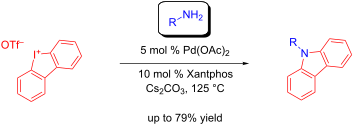
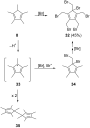
- GC–MS analysis, we could detect 2-iodobiphenyl, 2,2'-diiodobiphenyl, 2-(2,5-dimethylphenyl)-2'-iodobiphenyl, and 2'-iodo-N-phenylbiphenyl-2-amine in the absence of any produced 3a. Contrary to that observation, when we conducted an analogous experiment without aniline, we observed no decomposition or
- equal or better in efficiency and yield. Changing Pd2(dba)3 to Pd(OAc)2 had no significant impact on product yields (Table 1, entry 12). Further increase of the catalyst ratio from 5 to 10 mol % had little effect (Table 1, entry 15). Next, we decided to analyze the byproducts of this reaction by GC–MS
- analysis. For this experiment the reaction was performed according to conditions given in entry 12, Table 1. Besides the desired product 3a (56%), we could identify the masses of 2-iodobiphenyl (22%), 2,2'-diiodobiphenyl (4%), 2-(2,5-dimethylphenyl)-2'-iodobiphenyl (5%), and 2'-iodo-N-phenylbiphenyl-2




Polar reactions of acyclic conjugated bisallenes
Beilstein J. Org. Chem. 2013, 9, 36–48, doi:10.3762/bjoc.9.5
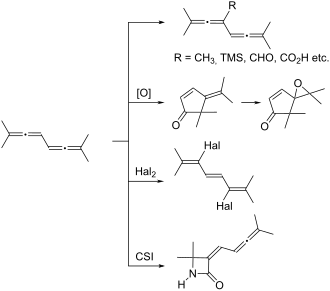
- trimethylsilyl substituent. As it turned out, 3 is considerably less reactive than 2: after comparable reactions times (see Supporting Information File 1) only 37% of the substrate had been converted into products. As shown by GC–MS analysis the reaction mixture contained four mono silylated products (m/z = 206
- Scheme 6 all of these experiments failed. Neither could we prepare the “coupling product” 27 by treatment of 4 with the biselectrophile dimethylysilyl dichloride nor the dimer 28 by the direct action of iodine on the organolithium compound 4. In this latter case we noted after work-up and GC–MS analysis
- (GC–MS-analysis of the raw product mixture): two, produced in 9 and 7% yield, were isomers of the starting material. We assume that they are hydrocarbons comparable to 57 (R = CH3); however, their separation was unsuccessful. The other two products, produced in 70 and 8% yield, are monochlorides. They






Chemical–biological characterization of a cruzain inhibitor reveals a second target and a mammalian off-target
Beilstein J. Org. Chem. 2013, 9, 15–25, doi:10.3762/bjoc.9.3
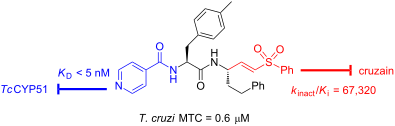
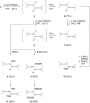
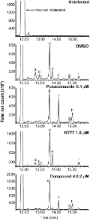
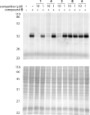
- . Synthesis of the additional control compound 6–8, the reduced forms of analogues 1, 3, and 4 respectively. GC/MS analysis of lipid extracts from T. cruzi parasites treated with test compounds. DMSO and K777 (1) were used as negative controls; posaconazole served as a positive control. The analysis of 4 was




Stereoselective synthesis of trans-fused iridoid lactones and their identification in the parasitoid wasp Alloxysta victrix, Part II: Iridomyrmecins
Beilstein J. Org. Chem. 2012, 8, 1256–1264, doi:10.3762/bjoc.8.141
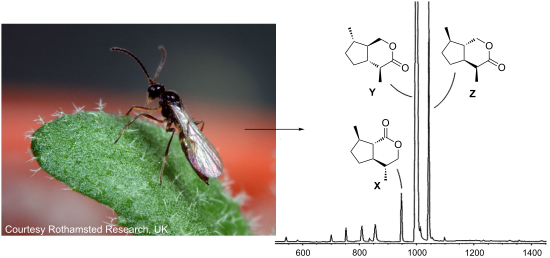
- iridomyrmecins with corresponding data of the volatile substances Y and Z – which are present in pentane extracts of heads of Alloxysta victrix – allowed their unambiguous identification as trans-fused iridomyrmecins. Coupled GC/MS analysis using FFAP as the stationary phase revealed the natural iridoid lactones



Algicidal lactones from the marine Roseobacter clade bacterium Ruegeria pomeroyi
Beilstein J. Org. Chem. 2012, 8, 941–950, doi:10.3762/bjoc.8.106
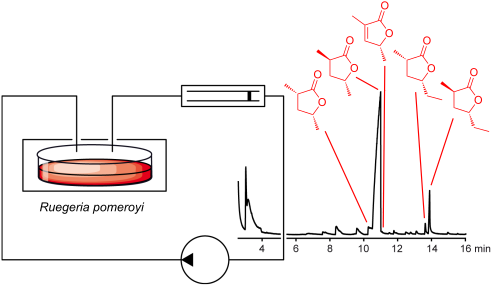
- material used for the synthesis, the solvent was not completely removed. The product (+)-11 was identical to racemic 11 by GC–MS analysis (lit.: [α]D25 +91.5 (c 1.24, CHCl3), [34]). Compound 11 (6 mg) was dissolved in methanol (1 mL) and a small amount of Pd(OH)2 (ca. 1 mg, 10% Pd) was added. The catalytic


Volatile organic compounds produced by the phytopathogenic bacterium Xanthomonas campestris pv. vesicatoria 85-10
Beilstein J. Org. Chem. 2012, 8, 579–596, doi:10.3762/bjoc.8.65
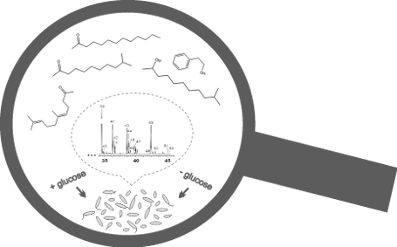
- volatiles of different Xanthomonas campestris species/isolates on Caenorhabditis elegans and on bacteria was also shown [20][37]. Volatile emissions of Xanthomonas campestris pv. vesicatoria 85-10 GC/MS analysis of volatiles released by X. c. pv. vesicatoria 85-10 The volatiles emitted by X. c. pv
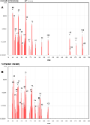
- is impossible. However, the tentative assignments of some volatiles are strongly supported by the results obtained during GC/MS analysis (Figure 2, Table 1). The intensive signal at m/z 157 may be attributed to the sum of decan-2-one (28), 7-methylnonan-2-one (25) and 8-methylnonan-2-one (24); that
- day 3 on NBG), indicating that the same metabolic pathways were active and only larger quantities/fluxes of the volatiles were emitted under the four different growth conditions. Similarly, as performed with the GC/MS analysis, PTR–MS volatile profiles where obtained when X. c. pv. vesicatoria was




Novel fatty acid methyl esters from the actinomycete Micromonospora aurantiaca
Beilstein J. Org. Chem. 2011, 7, 1697–1712, doi:10.3762/bjoc.7.200
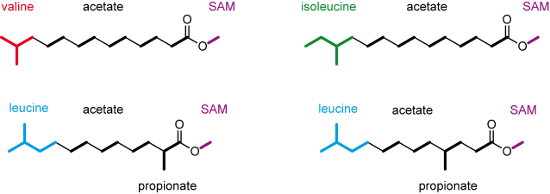
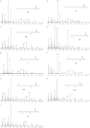
- comparison to library spectra and subsequent GC–MS analysis of synthetic standards. Mass spectra of unbranched FAMEs (for mass spectrum of methyl dodecanoate see Figure 5A) are characterised by fragment ions at m/z = 74 (McLafferty rearrangement, Scheme 2), m/z = 87 (β-cleavage), and [M − 31]+ (loss of OMe




Highly efficient cyclosarin degradation mediated by a β-cyclodextrin derivative containing an oxime-derived substituent
Beilstein J. Org. Chem. 2011, 7, 1543–1554, doi:10.3762/bjoc.7.182
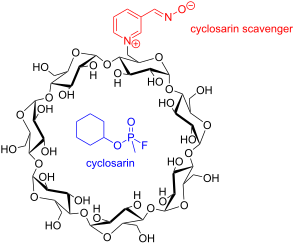
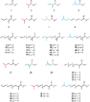
- and subjected to GC–MS analysis by using d11-GF (GF with a perdeuterated cyclohexyl residue) as the internal standard. The use of a chiral stationary phase allowed independent evaluation of the effect of the cyclodextrin on both GF enantiomers. The results of these measurements are shown in Figure 3





A new phenylethyl alkyl amide from the Ambrostoma quadriimpressum Motschulsky
Beilstein J. Org. Chem. 2011, 7, 1342–1346, doi:10.3762/bjoc.7.158
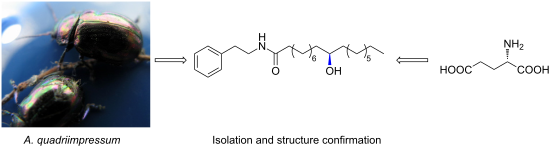
- . Fraction 4 was further separated into seven fractions on a silica gel column (PE/AcOEt 10:1→1:1). GC–MS analysis showed that fractions 4-4 and 4-5 included derivatives of a fatty acid amide. Fraction 4-5 was further purified by crystallization in diethyl ether to yield compound 1 (3 mg) as a white solid


Meta-metallation of N,N-dimethylaniline: Contrasting direct sodium-mediated zincation with indirect sodiation-dialkylzinc co-complexation
Beilstein J. Org. Chem. 2011, 7, 1234–1248, doi:10.3762/bjoc.7.144

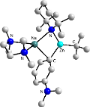
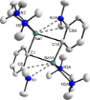
- instrument at an operating frequency of 100.62 MHz. Elemental analyses were carried out on a Perkin-Elmer 2400 elemental analyser. Due to the extreme air and moisture sensitivity of 3, 4/5 and 6, ideal analyses could not be obtained. GC–MS analysis was performed on an Agilent 7890A apparatus, GC with 5975C





Evaluation of a commercial packed bed flow hydrogenator for reaction screening, optimization, and synthesis
Beilstein J. Org. Chem. 2011, 7, 1141–1149, doi:10.3762/bjoc.7.132
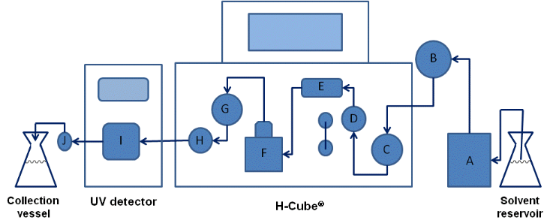
- 1.0 mL/min, at 30 °C, with 1.9 mL per injection and 10 mL product solution collected. The conversion was determined by GC–MS analysis with decane as an internal standard; n = 5 unless otherwise indicated. Data represented in blue correspond to 0.50 M styrene in MeOH. Data represented in red correspond
- injection, and 10 mL product solution collected. The conversion was determined by GC–MS analysis with decane as an internal standard. Cartridge-to-cartridge variability of the substrate conversion based on the reduction of styrene to ethylbenzene. All reactions were carried out at 2.0 M in MeOH, at a flow
- rate of 1.0 mL/min, at 30 °C, with 1.9 mL per injection, and 10 mL product solution collected; n = 3 experiments for each cartridge. The conversion was determined by GC–MS analysis with decane as an internal standard. Commercial 10% Pd/C 30 mm CatCart® cartridges were used; numbers 1, 2, and 3 from lot


Oxidative allylic rearrangement of cycloalkenols: Formal total synthesis of enantiomerically pure trisporic acid B
Beilstein J. Org. Chem. 2011, 7, 421–425, doi:10.3762/bjoc.7.54
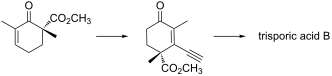
- = quadruplet). IR spectra were recorded with a Nicolet 510 FT-IR spectrometer, and GC–MS analysis was performed with a Finnigan MAT Magnum System 240, Varian GC 3400 DB 5. Elemental analysis was carried out with a PerkinElmer elemental analysator 240 at the University of Paderborn, Germany. Methyl (−)-(1R)-1,3


About the activity and selectivity of less well-known metathesis catalysts during ADMET polymerizations
Beilstein J. Org. Chem. 2010, 6, 1149–1158, doi:10.3762/bjoc.6.131
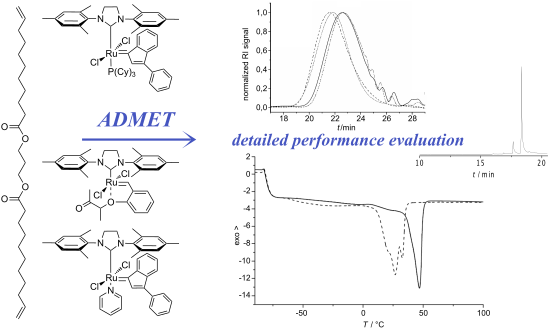
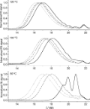
- room temperature. The crude product was purified by precipitation into cold methanol. Final polymer molecular weights were determined after precipitation with the above mentioned GPC system. Transesterification of the obtained polymers (P1-P26) and GC-MS analysis The respective polymer (30 mg), excess



Phase- vanishing halolactonization of neat substrates
Beilstein J. Org. Chem. 2008, 4, No. 29, doi:10.3762/bjoc.4.29
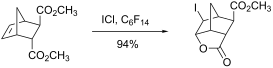
- apparently unstable. Thus, the corresponding iodolactone 5, along with a number of unidentified byproducts, was observed in GC-MS analysis of the reaction mixture. Isolation of the reaction product was not attempted. When iodine monochloride was used in place of iodine, the reaction was fast and the
- one pair and 12.5 and 12.6 min for the other pair). Furthermore, GC-MS analysis indicated that the byproducts were the corresponding dibromo compounds. They were tentatively assigned structures 9–12. It was expected that one pair of the dibromo compounds (11 and 12) would form as exo-5-norbornene-2
- GC-MS analysis). Thus, formation of dibromo products decreased compared to 4-pentenoic acid. Interestingly, no dibromo derivatives at all were observed in bromolactonizations of diacid 14 and diesters 17 and 20 (Table 1, entries 3, 6 and 8). Iodine monochloride also worked very well on the same





