


Search results
Search for "anomers" in Full Text gives 80 result(s) in Beilstein Journal of Organic Chemistry.
(Pseudo)amide-linked oligosaccharide mimetics: molecular recognition and supramolecular properties
Beilstein J. Org. Chem. 2010, 6, No. 20, doi:10.3762/bjoc.6.20
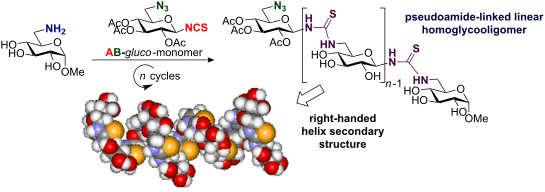
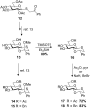
- activities, probably due to the presence of a hydrophilic sugar substituent at the nitrogen atom of the nor-tropane ring [71][72]. Several groups have shown that disaccharide ureas and carbamates with different bridging positions as α/β-anomers are readily accessible by the coupling reaction of aminosugars



Benzyne arylation of oxathiane glycosyl donors
Beilstein J. Org. Chem. 2010, 6, No. 19, doi:10.3762/bjoc.6.19
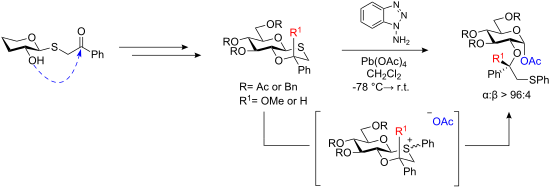
- occasion as a 96:4 (α:β) mixture of anomers (Scheme 4d). This slight drop in stereoselectivity is consistent with the increased reactivity of benzylated relative to acetylated thioglycoside donors [13][32], commonly attributed to greater stabilisation of the developing positive charge on an oxacarbenium



Recognition properties of receptors consisting of imidazole and indole recognition units towards carbohydrates
Beilstein J. Org. Chem. 2010, 6, No. 9, doi:10.3762/bjoc.6.9
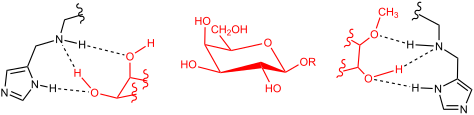
- observed for 4 and 5 are quite different to those of the recently described phenanthroline/aminopyridine-based receptors 22 and 23 (see Figure 4) [27][29], which show a strong preference for α-glucoside and α-galactoside vs. the β-anomers. Thus, depending on the nature of the recognition units used as
- and 5 with these monosaccharides to be much more favorable than those with the α-anomers 7a and 9. The curve fitting of the titration data for 4 and β-glucoside 6a suggested the existence of 1:1 and 2:1 receptor–sugar complexes in CDCl3 solutions with a stronger association constant for 1:1 binding




Synthesis of phosphonate and phostone analogues of ribose-1-phosphates
Beilstein J. Org. Chem. 2009, 5, No. 37, doi:10.3762/bjoc.5.37
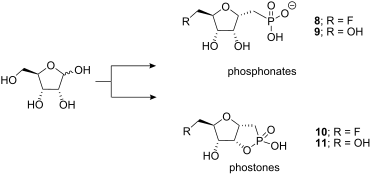
- -phosphate is described. Preparations of both the α- and β-phosphonate anomers are reported for the ribose and 5-fluoro-5-deoxyribose series and a synthesis of the corresponding cyclic phostones of each α-ribose is also reported. These compounds have been prepared as tools to probe the details of


Methods for the synthesis of polyhydroxylated piperidines by diastereoselective dihydroxylation: Exploitation in the two-directional synthesis of aza-C-linked disaccharide derivatives
Beilstein J. Org. Chem. 2005, 1, No. 2, doi:10.1186/1860-5397-1-2
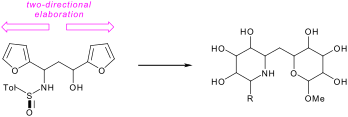
- substitution under the reaction conditions. In each case, the required products (26 and 30) were obtained in moderate (30–37% i.e. 67–71% per step) yield over the three synthetic steps as 66:34 mixtures of anomers. Nevertheless, the yields were deemed acceptable because, over the three steps, significant
- highly (>95:<5) diastereoselective. Fortunately, the anomers of the bis-allylic alcohols 27, 29 and 33 were separable by careful column chromatography. The stereochemical outcome of the Luche reduction had been remarkable: although the reaction had been highly diastereoselective in both heterocyclic





Other Beilstein-Institut Open Science Activities



