


Search results
Search for "glycan" in Full Text gives 81 result(s) in Beilstein Journal of Organic Chemistry.
Cyanoethylation of the glucans dextran and pullulan: Substitution pattern and formation of nanostructures and entrapment of magnetic nanoparticles
Beilstein J. Org. Chem. 2012, 8, 551–566, doi:10.3762/bjoc.8.63
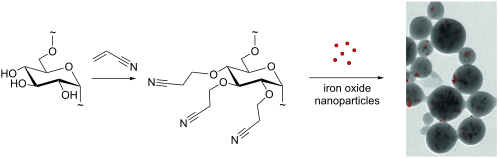
- spectroscopy (PEELS). Keywords: cyanoethyldextran; cyanoethylpullulan; ferromagnetic nanoparticles; glycan nanostructures; substitution pattern; Introduction Cyanoethylation has been widely applied to polysaccharides, e.g., to cellulose [1], inulin [2], and starch [3]. Onda reported on cyanoethylation of


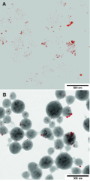
Synthesis of glycoconjugate fragments of mycobacterial phosphatidylinositol mannosides and lipomannan
Beilstein J. Org. Chem. 2011, 7, 369–377, doi:10.3762/bjoc.7.47
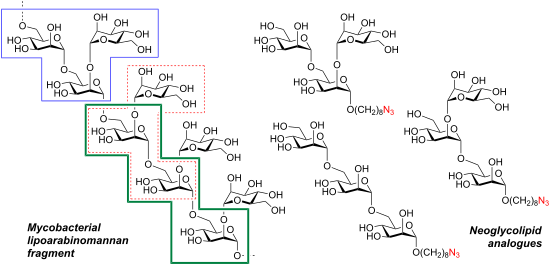
- PIM/LM/LAM substructures are useful biochemical tools to delineate and dissect the fine details of mannose glycophospholipid biosynthesis and their interactions with host cells. We report the efficient synthesis of a series of azidooctyl di- and trimannosides possessing the following glycan structures


Preparation of aminoethyl glycosides for glycoconjugation
Beilstein J. Org. Chem. 2010, 6, 699–703, doi:10.3762/bjoc.6.81

- overall yields. These aminoethyl glycosides are now readily accessible for incorporation into glycan arrays. Aminoethyl glycosides (1–9) which were synthesised in this study. General reaction scheme for generation of aminoethyl glycosides. X = OAc, Br or Cl. Deprotection protocols. Results of


Synthesis of glycosylated β3-homo-threonine conjugates for mucin-like glycopeptide antigen analogues
Beilstein J. Org. Chem. 2010, 6, No. 47, doi:10.3762/bjoc.6.47
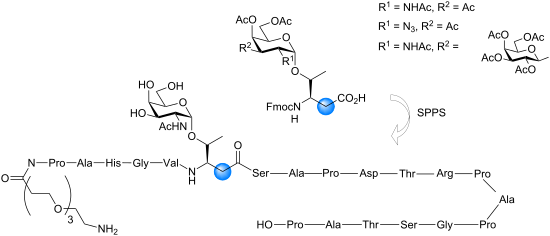
- cell surface glycoproteins is associated with various pathological incidents, e.g., autoimmune and infectious diseases and cancer. In the latter case, unusual glycan structures composed of truncated O-linked oligosaccharides of carcinoma-derived mucin glycoproteins can be used as markers of the
- reduction and acetylation led to the formation of conjugate 2a in 56% yield. During biosynthesis TN antigen acts as an immediate precursor of the TF antigen. As a consequence, a biomimetic approach towards larger TACA structures via stepwise assembly of the glycan chain has been pursued in various antigen
- chain protective groups was achieved upon treatment with a mixture of TFA, triisopropylsilane and water. The resulting partially deblocked glycopeptide 7 was isolated after purification by semi-preparative RP-HPLC in a yield of 36%, based on the loaded resin 5. The final de-O-acetylation of the glycan


Bioorthogonal metabolic glycoengineering of human larynx carcinoma (HEp-2) cells targeting sialic acid
Beilstein J. Org. Chem. 2010, 6, No. 24, doi:10.3762/bjoc.6.24
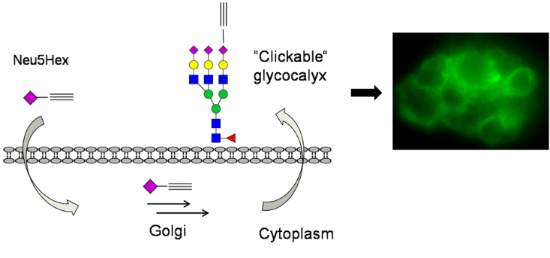
- glycan structures of various types forming the individual, dynamic glycocalyx of each cell type. These glycolipids and glycoproteins often carry sialic acids, in humans N-acetylneuraminic acid (Neu5Ac, 1, Scheme 1), at their terminal position which mediate cell-cell recognition and signal transduction
- through the membrane of eukaryotic cells [3]. Neu5Hex (3) is a new substrate for metabolic glycoengineering which is proposed to be incorporated into the cell surface glycan structures. It was shown that carbohydrates in growth media contribute to alterations in glycosylation patterns in human cells [8
- Neu5Hex 3 guarantees its direct incorporation into the cell surface glycan patterns bypassing metabolic bottlenecks. Furthermore, the described genetic feedback inhibition by sialic acid leading to an accumulation of the fed Neu5Hex 3 ensures an efficient integration into the cell surface glycocalyx. A




Acid- mediated reactions under microfluidic conditions: A new strategy for practical synthesis of biofunctional natural products
Beilstein J. Org. Chem. 2009, 5, No. 40, doi:10.3762/bjoc.5.40
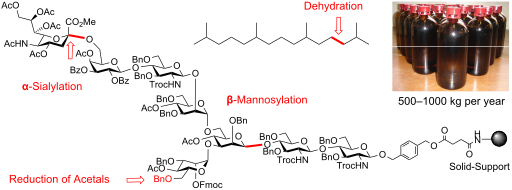
- conditions enabled the preparation of key synthetic intermediates for oligosaccharides on a multi-gram scale, eventually leading to a total synthesis of the asparagine-linked oligosaccharide (N-glycan) [32]. A significant improvement has also been achieved for dehydration, which resulted in the industrial
- of mammalian N-glycans of the diverse structures, have motivated us to establish a practical and library-directed synthesis of the complex-type N-glycans on solid-support [32]; the initial target of our strategy is a sialic acid-containing N-glycan with asymmetric branching chains (Figure 1), which
- is difficult to obtain from natural sources. To prepare the target N-glycan as well as other diverse structures of this family in an efficient manner, we designed fragments a–d with N-phenyltrifluoroacetimidate as the leaving group, which can be efficiently glycosylated on solid-support to construct


Other Beilstein-Institut Open Science Activities



