


Search results
Search for "maleimide" in Full Text gives 82 result(s) in Beilstein Journal of Organic Chemistry.
Recyclable fluorous cinchona alkaloid ester as a chiral promoter for asymmetric fluorination of β-ketoesters
Beilstein J. Org. Chem. 2012, 8, 1233–1240, doi:10.3762/bjoc.8.138
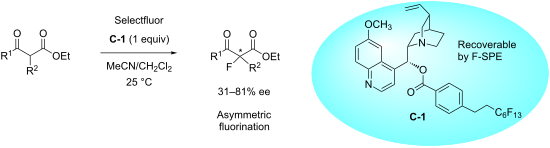
- % ee. The nonsubstituted benzoylacetate 1e gave product 2e in good yield 69% but low ee (31%). Ethyl 2-cyclohexanonecarboxylate (1f) afforded product 2f in 73% yield and 63% ee. Reactions of ethyl benzoylacetates with bigger substitution groups, such as phenylsulfonyl and maleimide derivatives, were


Chiral multifunctional thiourea-phosphine catalyzed asymmetric [3 + 2] annulation of Morita–Baylis–Hillman carbonates with maleimides
Beilstein J. Org. Chem. 2012, 8, 1098–1104, doi:10.3762/bjoc.8.121
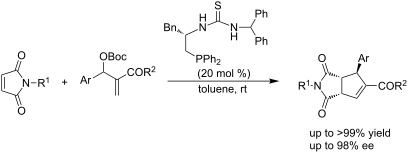
- results were studied by using 31P NMR spectroscopy (Figure 2, also see Figure SI-1 in the Supporting Information File 1). The NMR studies revealed that catalyst TP seems to react with N-phenylmaleimide (1a) to form a new species (Figure 2, spectra b), which costs some maleimide 1a. Thus, the excess 1a has
- to be added in order to make the reaction complete. This is why increasing the ratio of 1a/2a raised the yield of product 3a (Table 1, entry 5). On the other hand, if too much maleimide 1a is used in this reaction, it will waste some of the catalyst TP, leading to a decrease in the yield of product
- , which attacked the maleimide to produce intermediate II (Scheme 2). Since there is a steric effect between the phenyl group and the benzyl group in intermediate II-B, allylic phosphorus ylide I using its Si-face to attack maleimide is favored (intermediate II-A). Undergoing Michael addition and




Control over molecular motion using the cis–trans photoisomerization of the azo group
Beilstein J. Org. Chem. 2012, 8, 1071–1090, doi:10.3762/bjoc.8.119
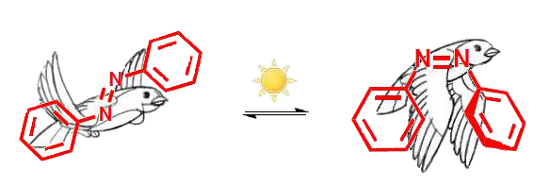
- , the cis isomer brings the aromatic rings closer, shortening its length, and hence the channel blocking is inefficient, allowing the passage of ions. The development of systems capable of photoregulating the activity of ion channels is extremely important in neurobiology. Recently, a maleimide
- , azobenzene and glutamate derivative (MAG) was used as a photochromic agonist of an ionotropic glutamate receptor (iGluR) (Figure 5a) [89][90][91]. The chromophore consists of a terminal maleimide unit, which is associated covalently to the protein via a cysteine residue, a central azobenzene unit and a


Formation of carbohydrate-functionalised polystyrene and glass slides and their analysis by MALDI-TOF MS
Beilstein J. Org. Chem. 2012, 8, 753–762, doi:10.3762/bjoc.8.86
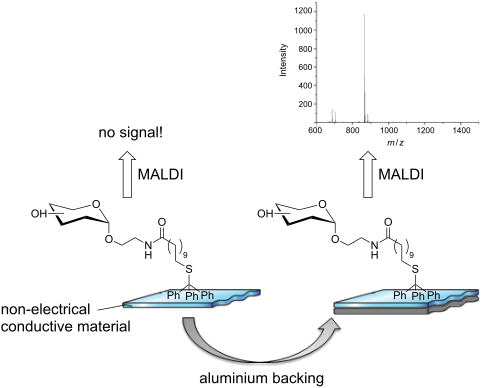
- generally compatible with other platforms in our laboratories, such as through the formation of SAMs on gold [18] or by coupling into maleimide-functionalised surfaces in a chemoselective fashion [19]. For the initial studies two carbohydrate derivatives, 5 and 7, were synthesised. The α-D-mannoside 5 would


A concise synthesis of 3-(1-alkenyl)isoindolin-1-ones and 5-(1-alkenyl)pyrrol-2-ones by the intermolecular coupling reactions of N-acyliminium ions with unactivated olefins
Beilstein J. Org. Chem. 2012, 8, 192–200, doi:10.3762/bjoc.8.21

- reduction of the parent phthalimide [35] and maleimide [36] derivatives. In order to explore the effects of the experimental conditions on the coupling reactions, the reaction of 1a with styrene (2a) was selected as a representative and carried out at room temperature under different conditions (Table 1


Synthesis of rigidified flavin–guanidinium ion conjugates and investigation of their photocatalytic properties
Beilstein J. Org. Chem. 2009, 5, No. 26, doi:10.3762/bjoc.5.26
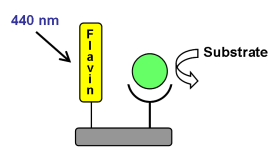
- for the cycloaddition of maleimide to anthracene in toluene (Scheme 5). Table 3 summarizes the results. A significantly higher yield of the cycloaddition product was obtained after 8 h at 40 °C in the presence of compound 2 (entry 3), if compared to the control reaction (entry 6). Upon irradiation
- reaction (entry 4). Blue light irradiated flavins accelerate the anthracene maleimide cycloaddition significantly, but flavins 1 and 2 do not provide additional benefit if compared to tetraacetyl flavin 3. Conclusion We have prepared new flavin derivatives that bear an acyl guanidinium group, which is




C2- symmetric bisamidines: Chiral Brønsted bases catalysing the Diels- Alder reaction of anthrones
Beilstein J. Org. Chem. 2008, 4, No. 28, doi:10.3762/bjoc.4.28
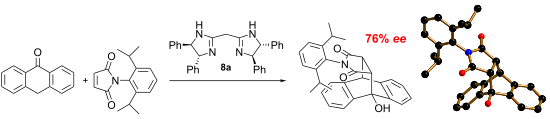
- compounds 2 could be introduced by a Mitsunobu alkylation of maleimide [12]. Alternatively, substituted maleimides were prepared by reaction of maleic anhydride with the corresponding amines followed by ring closure [13][14]. Cycloaddition kinetics of 1a and 2a was examined first by 1H NMR in CD2Cl2 at room
- yields and with moderate values of ee. A remarkable increase in enantioselectivity was observed using maleimide 2i. The steric hindrance imposed by the large 2,6-diisopropylphenyl moiety of 2i resulted in 76% ee at −70 °C but also lowered reaction rates. Only 13% yield could be obtained under such


Other Beilstein-Institut Open Science Activities



