Search results
Search for "recyclability" in Full Text gives 86 result(s) in Beilstein Journal of Organic Chemistry.
New library of aminosulfonyl-tagged Hoveyda–Grubbs type complexes: Synthesis, kinetic studies and activity in olefin metathesis transformations
Beilstein J. Org. Chem. 2010, 6, 1159–1166, doi:10.3762/bjoc.6.132
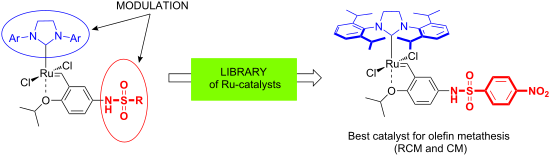
- . [14]. Nevertheless, some difficulties remain, for instance: Lower yields are observed when successive silica gel chromatography is performed and some scavengers are very toxic (PbOAc2, DMSO…) [15]. Another strategy aims to control the catalyst activity in order to improve recyclability. Recently
- with excellent recyclability (up to 60% at 0.3 mol %). Extremely low levels of Ru-contamination in the final products were determined by ICP-MS analyses (below 6 ppm) after silica gel chromatography. Additionally, a recent study in the synthesis of natural products involving a library of precatalysts 3


Suzuki–Miyaura cross-coupling reaction of 1-aryltriazenes with arylboronic acids catalyzed by a recyclable polymer-supported N-heterocyclic carbene–palladium complex catalyst
Beilstein J. Org. Chem. 2010, 6, No. 70, doi:10.3762/bjoc.6.70
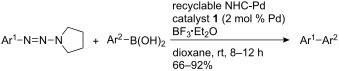
- at different temperatures, which suggested that the reaction temperature did not apparently influence the final reaction yield (Table 3, entry 7). After optimizing the amount of catalyst, solvent, substrate ratio and temperature, the recyclability of the polymer-supported Pd–NHC catalyst for the
- demonstrate the general recyclability of the catalyst, the recovered catalysts from the first, fifth and eighth runs of the reaction of 1-(3-nitrophenyl)-2-(pyrrolidin-1-yl)diazene and phenylboronic acid were also used to catalyze the reaction of 1-phenyl-2-(pyrrolidin-1-yl)diazene and 4-methoxyphenylboronic
- still retains high activity, which reflects its high stability and recyclability. Advantages of this method also include good substrate generality, good chemoselectivity over arylhalides and mild reaction conditions. Experimental General All chemicals were obtained from commercial sources and were, in


C-Arylation reactions catalyzed by CuO-nanoparticles under ligand free conditions
Beilstein J. Org. Chem. 2010, 6, No. 35, doi:10.3762/bjoc.6.35
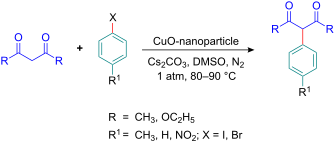
- aryl halides. The products were obtained in good to excellent yield. The catalyst can be recovered and reused for four cycles with almost no loss in activity. Keywords: active methylene compounds; C-arylation; heterogeneous catalyst; recyclability; Introduction Carbon-carbon (C–C) bond formation is


Ring opening metathesis polymerization-derived block copolymers bearing chelating ligands: synthesis, metal immobilization and use in hydroformylation under micellar conditions
Beilstein J. Org. Chem. 2010, 6, No. 28, doi:10.3762/bjoc.6.28
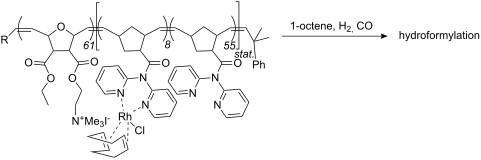
- their MS spectra as well as by their retention times using commercially available compounds as reference material. Recyclability studies with poly(M1-b-M2)-Rh: Hydroformylations were carried out as described above. For recycling, the product was extracted with diethyl ether (4 × 10 mL). Fresh 1-octene


Hydroxyapatite supported caesium carbonate as a new recyclable solid base catalyst for the Knoevenagel condensation in water
Beilstein J. Org. Chem. 2009, 5, No. 68, doi:10.3762/bjoc.5.68

- . Thus, the use of aqueous solvents in chemical reactions has proved a cleaner and safer alternative to organic solvents [2]. Heterogeneous catalysis, which has the immediate advantage of easy recoverability and recyclability of the catalyst – sometimes with the further advantage of increased selectivity
- acid with this mild procedure was 88% (3b, Table 2). The protocol described above provides an efficient method for Knoevenagel condensation between aromatic aldehydes and active methylene groups using HAP–Cs2CO3 as a new recyclable solid base catalyst in water. Moreover, the recyclability of this
- catalyst (HAP–Cs2CO3) makes the method very cost-effective. Heterogeneity and recyclability of the catalyst When using supported heterogeneous catalysts, there are two important points to consider: heterogeneity and recyclability. To rule out the possibility of homogeneous catalysis, a reaction between 4


Can we measure catalyst efficiency in asymmetric chemical reactions? A theoretical approach
Beilstein J. Org. Chem. 2009, 5, No. 67, doi:10.3762/bjoc.5.67
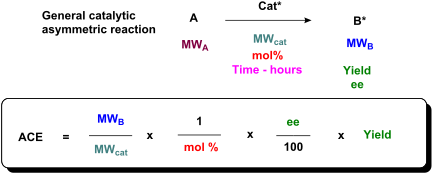
- considered here will be important in explaining the adoption of a catalyst, or a particular chemical route, by industry. Cost of starting materials, and the hazards involved in a process are key considerations from a manufacturing perspective. Aqueous or air compatibility and recyclability are two features


Polyionic polymers – heterogeneous media for metal nanoparticles as catalyst in Suzuki–Miyaura and Heck–Mizoroki reactions under flow conditions
Beilstein J. Org. Chem. 2009, 5, No. 21, doi:10.3762/bjoc.5.21
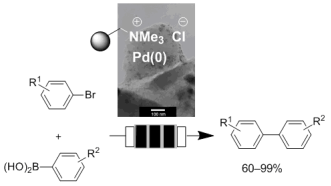
- ; microreactor; monolith; palladium; Suzuki–Miyaura reaction; Introduction Functionalized solid supports like polymers loaded with homogeneous catalysts are well established in organic synthesis [1][2][3][4]. Simple purification of the products and easy recyclability of the catalysts are major advantages of


A biphasic oxidation of alcohols to aldehydes and ketones using a simplified packed- bed microreactor
Beilstein J. Org. Chem. 2009, 5, No. 17, doi:10.3762/bjoc.5.17
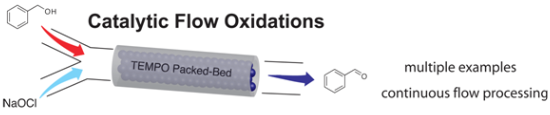
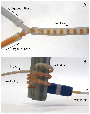
- to afford higher conversions and yields. For the purposes of this paper however, we were solely testing the generality of the method and, therefore, did not optimize every substrate. Similar to our previous packed-bed systems, these AO-TEMPO microchannels showed a high degree of recyclability, in




Silica- bound benzoyl chloride mediated the solid- phase synthesis of 4H-3,1-benzoxazin- 4-ones
Beilstein J. Org. Chem. 2009, 5, No. 13, doi:10.3762/bjoc.5.13
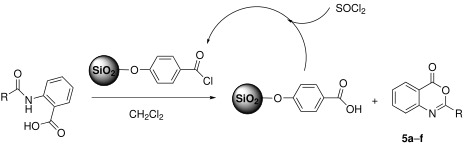
- developed for preparation of 2-substituted 4H-3,1-benzoxazin-4-ones. The main advantages of this process are the recyclability of the solid support and self release of products from the linker as a concomitant with their formation. Therefore, good yields of the products are obtained under relatively mild


Zeolite catalyzed solvent- free one-pot synthesis of dihydropyrimidin- 2(1H)-ones – A practical synthesis of monastrol
Beilstein J. Org. Chem. 2009, 5, No. 4, doi:10.3762/bjoc.5.4
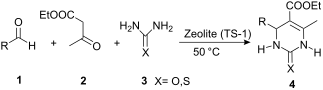
- -hydroxybenzaldehyde, thiourea, ethyl acetoacetate and TS-1 under the above mentioned reaction conditions. Monastrol was obtained in 94% yield. The most important and salient feature of the present reaction is the recyclability of the catalyst and the scaleability of the reaction. It was observed that the catalyst


Study of thioglycosylation in ionic liquids
Beilstein J. Org. Chem. 2006, 2, No. 12, doi:10.1186/1860-5397-2-12
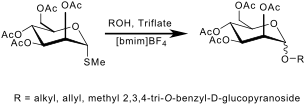
- carbohydrates in [bmim]BF4 per se was not quenched with low molar equivalents of water, and [bmim]BF4 acted not only as reaction media, but may also performed like "molecular sieves" at the same time. The recyclability of [bmim]BF4 for thioglycosylation reactions was accessed by repeating the synthesis of 3a