


Search results
Search for "DFT" in Full Text gives 668 result(s) in Beilstein Journal of Organic Chemistry. Showing first 200.
Copper-catalyzed yne-allylic substitutions: concept and recent developments
Beilstein J. Org. Chem. 2024, 20, 2739–2775, doi:10.3762/bjoc.20.232
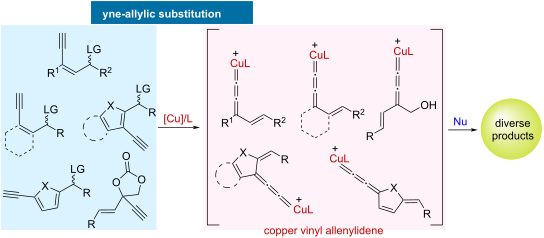
- ). Further control experiments and DFT calculations show that during the catalytic process, tertiary amine directly participates as a nucleophilic reagent to give the ammonium salt, which then releases dimethylaminium to provide the final product (Scheme 12). Chiral allylic sulfone compounds can be easily








Deciphering the mechanism of γ-cyclodextrin’s hydrophobic cavity hydration: an integrated experimental and theoretical study
Beilstein J. Org. Chem. 2024, 20, 2635–2643, doi:10.3762/bjoc.20.221

- properties of γ-CD (the largest of the three most abundant native CDs), the main experimental methods applied in this study were differential scanning calorimetry (DSC) and thermogravimetric analysis (TGA). By coupling these techniques with density functional theory (DFT) calculations we try to shed some
- of interactions (i.e., water–water and/or water–CD walls) contribute to the stability of the water assemble; (iv) how does the mechanism of the γ-CD hydration compare with those of its α-CD and β-CD counterparts. Keywords: cyclodextrin; DFT calculation; DSC/TG; hydration; thermodynamic
- the γ-CD cavity, i.e., what is the saturation point of the γ-CD internal hydration as determined by DFT modeling of possible γ-CD–nH2O complexes? In general, the gas-phase calculations at the two levels of theory (and in aqueous media at the M062X/6-31G(d,p) level) show that the sequential insertion


Anion-dependent ion-pairing assemblies of triazatriangulenium cation that interferes with stacking structures
Beilstein J. Org. Chem. 2024, 20, 2567–2576, doi:10.3762/bjoc.20.215
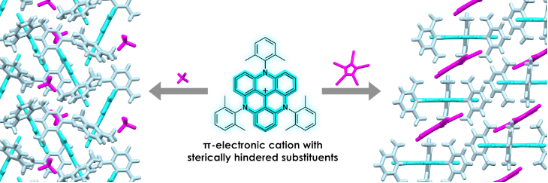
- ]. In each structure, the non-hydrogen atoms were refined anisotropically. CIF files (CCDC-2364292–2364296) can be obtained free of charge from the Cambridge Crystallographic Data Centre via https://www.ccdc.cam.ac.uk/data_request/cif. DFT calculations. DFT calculations for the geometrical optimizations



Machine learning-guided strategies for reaction conditions design and optimization
Beilstein J. Org. Chem. 2024, 20, 2476–2492, doi:10.3762/bjoc.20.212

- of molecules using density functional theory (DFT) calculations, which are computationally expensive and time-consuming [62]. To overcome this challenge, some studies have proposed to pre-generate QM properties datasets and train ML models to serve as fast feature generators for new molecules [16
- ]. However, this approach requires careful validation of the training data coverage and the extrapolation ability of the surrogate models. Reaction-level descriptors based on DFT calculations of the TS structures of chemical reactions can provide valuable insights for predicting rate constants [113][114][115
- solvent effects may complicate the results [122]. Therefore, reaction-level DFT-based descriptors are not widely used for reaction featurization. A more popular alternative is the differential reaction fingerprint (DRFP) developed by Probst et al. [123], which converts a reaction SMILES sequence into a


Hypervalent iodine-mediated cyclization of bishomoallylamides to prolinols
Beilstein J. Org. Chem. 2024, 20, 2455–2460, doi:10.3762/bjoc.20.209
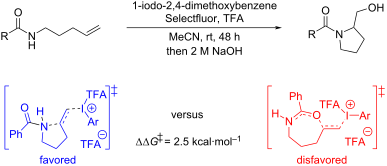
- the alkene and the amide increased from two to three atoms. In the latter case, cyclization at the amide nitrogen to form the pyrrolidine ring was favored over cyclization at the amide oxygen. A DFT study was undertaken to rationalize the change in mechanism of this cyclization process. In addition
- , reaction conditions were developed, and the scope of this cyclization studied. Keywords: cyclization; DFT; hypervalent iodine; mechanism; proline; Introduction Proline is one of the 20 DNA-encoded proteinogenic amino acids that are essential to life [1][2]. In addition, the pyrrolidine core is present in
- was the five-membered prolinol 7a rather than the initially assigned isomeric seven-membered tetrahydrooxazepine 6 [16]. Subsequently, we set out to understand the O- versus N-chemoselectivity by DFT modelling, and to develop an effective synthetic protocol for the preparation of prolinols 7 in high


Synthesis and conformational analysis of pyran inter-halide analogues of ᴅ-talose
Beilstein J. Org. Chem. 2024, 20, 2442–2454, doi:10.3762/bjoc.20.208
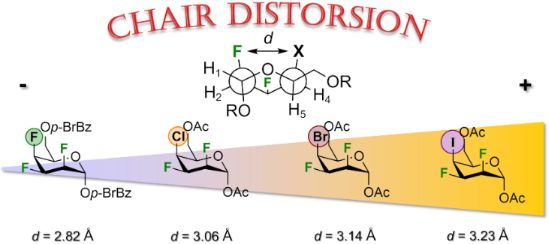
- and nonbonding interactions for the halogen at C4. Finally, density functional theory (DFT) calculations corroborate the preference of talose analogues to adopt a 4C1-like conformation and a natural bonding orbital (NBO) analysis demonstrates the effects of hyperconjugation from C–F antibonding
- ) [24]. The solution and the solid-state conformational analysis were supplemented with DFT calculations to understand key conformational drivers. This study adds more data to the field of nuclear magnetic resonance (NMR) spectroscopy of polyhalogenated molecules. It should be noted that the NMR
- -halides motivated us to use density functional theory (DFT) calculations to understand the preference of talose analogues to adopt 4C1-like conformations. DFT computations were performed using Gaussian 16 revision B.01 [67] with the CAM-B3LYP [68][69][70] functional and the Def2TZVP basis set [71], which


Asymmetric organocatalytic synthesis of chiral homoallylic amines
Beilstein J. Org. Chem. 2024, 20, 2349–2377, doi:10.3762/bjoc.20.201
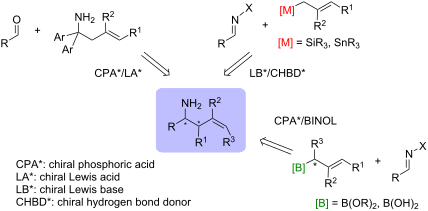
- ]-rearrangement of ene-aldimines 149, catalysed by the BINOL-derived chiral phosphoric acid (CPA) (R)-151 (Scheme 31) [46]. DFT computational analysis suggested that the reaction proceeds via a complex cascade that involves the fragmentation of ene-aldimine 149 to form an imine methylene cation, which in turn






Synthesis and reactivity of the di(9-anthryl)methyl radical
Beilstein J. Org. Chem. 2024, 20, 2254–2260, doi:10.3762/bjoc.20.193
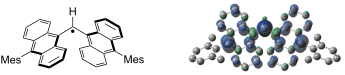
- two anthryl moieties (Figure 3b, Supporting Information File 1, Figure S1). DFT calculations for structural optimization revealed that the energy difference between two DAntM radical structures with different spin positions, spin localization at the central sp2 carbon and on the anthryl group, is
- Figure 6a and 6b, respectively. The DAntM radical exhibited a forbidden near-IR (NIR) band centered at 900 nm and relatively intense bands at 580 and 540 nm, whose spectral pattern is similar to the spectrum pattern of the TAntM radical [17]. The result of TD-DFT calculations could reproduce the obtained
- . Decomposition pathway of the DAntM radical under air conditions. Supporting Information Supporting Information File 81: Synthetic procedure and compound characterization data (1H, 13C NMR, MS, melting point, X-ray crystallography) of new compounds. DFT calculation results and optimized structural Cartesian


Metal-free double azide addition to strained alkynes of an octadehydrodibenzo[12]annulene derivative with electron-withdrawing substituents
Beilstein J. Org. Chem. 2024, 20, 2234–2241, doi:10.3762/bjoc.20.191
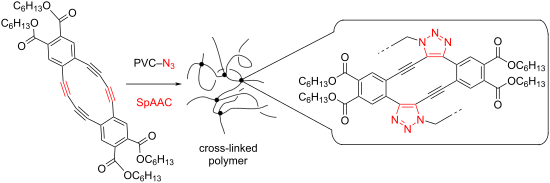
- substituents has a lower Ea than DBA with electron-donating substituents. DFT calculations The reaction mechanism was investigated by computational calculations. The reaction mechanism between 5 and benzyl azide was supported by the ωB97X-D/6-31G(d,p) calculations with the CH2Cl2 polarizable continuum model
- previously reported electron-donating hexyloxy substituents. The addition pattern was experimentally investigated by 2D NMR, which was also supported by DFT calculations. The bistriazole product displayed fluorescence in the visible range with a fluorescence quantum yield of 7.0%. Finally, the developed
- recorded on a JASCO FP-8500. All calculations were carried out using the Gaussian 16 program [21]. The DFT calculations were carried out using the long-range and dispersion-corrected ωB97X-D functional [22]. The 6-31G(d,p) basis set was used for H, C, O, and S atoms [23][24]. The solvent effect of CH2Cl2




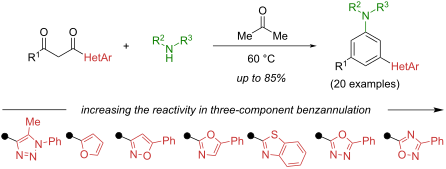
Heterocycle-guided synthesis of m-hetarylanilines via three-component benzannulation
Beilstein J. Org. Chem. 2024, 20, 2208–2216, doi:10.3762/bjoc.20.188
- Russian Federation (FSNF-2023-0004). The DFT calculations were supported by the RUDN University Scientific Projects Grant System, project № 021342-2-000.


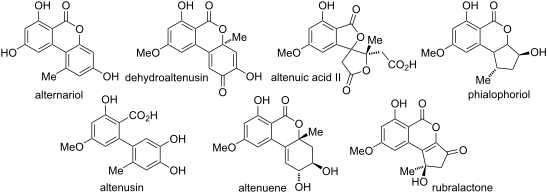
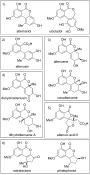
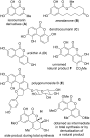
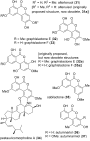
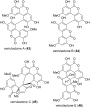
Natural resorcylic lactones derived from alternariol
Beilstein J. Org. Chem. 2024, 20, 2171–2207, doi:10.3762/bjoc.20.187






Allostreptopyrroles A–E, β-alkylpyrrole derivatives from an actinomycete Allostreptomyces sp. RD068384
Beilstein J. Org. Chem. 2024, 20, 1981–1987, doi:10.3762/bjoc.20.174
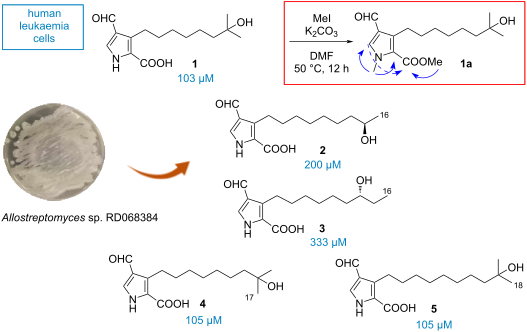
- : Allostreptomyces; β-alkylpyrrole; conformer; cytotoxic; DFT; 4-formylpyrrole-2-carboxylic acid; Introduction β-Alkylpyrroles are key structural motifs in biomolecules and functional organic materials [1]. For instance, β-alkylpyrroles are the main building blocks for the life-essential tetrapyrrole pigments
- to their populations [25]. The calculated specific rotations −11.4 and +16.1 were obtained for R-configured 2 and 3 from the DFT computations (see DFT methodology section), respectively, which were in good agreement with the experimentally obtained values, −6.1 for 2 and +15 for 3. Thus, R
- monitored by TLC. The solution was diluted with water and extracted with EtOAc three times. The organic layer was washed with brine and evaporated to dryness to afford bismethylated derivative of 1 (1a, 1.9 mg, 88% yield). DFT methodology Prior to the calculations of the molecular properties of compounds 2


Radical reactivity of antiaromatic Ni(II) norcorroles with azo radical initiators
Beilstein J. Org. Chem. 2024, 20, 1967–1972, doi:10.3762/bjoc.20.172
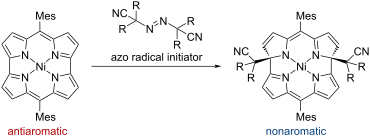
- ) norcorrole. The radical reactivity of Ni(II) norcorroles was investigated by density functional theory (DFT) calculations. Keywords: 16π; antiaromatic; norcorrole; porphyrinoid; radical; Introduction Considerable attention has been directed toward antiaromatic norcorroles [1][2][3] due to the fascinating
- presented. We also discuss the selectivity of the radical addition to Ni(II) norcorroles using DFT calculations. Results and Discussion Reactivity with azo radical initiators We selected 2,2'-azobis(isobutyronitrile) (AIBN) as a radical source. Ni(II) dimesitylnorcorrole 1 was treated with AIBN in refluxing
- 2a obtained by TD DFT calculations at the M06/6-31G(d)+SDD//B3LYP-D3/6-31G(d)+SDD level of theory was consistent with the experimental results. Therein, the absorption band at 670 nm (f = 0.0026) was attributed to the transition from HOMO to LUMO+1. Next, the electrochemical properties of 2a in


Regioselective alkylation of a versatile indazole: Electrophile scope and mechanistic insights from density functional theory calculations
Beilstein J. Org. Chem. 2024, 20, 1940–1954, doi:10.3762/bjoc.20.170
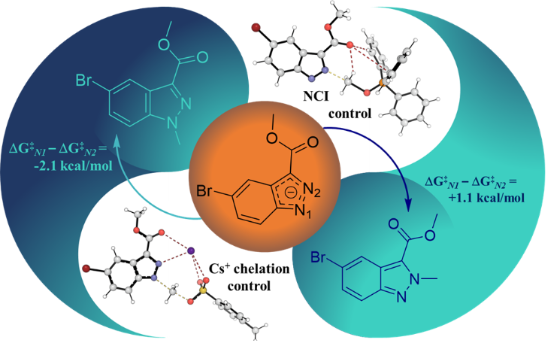
- -carboxylate (6) and the use of density functional theory (DFT) to evaluate their mechanisms. Over thirty N1- and N2-alkylated products were isolated in over 90% yield regardless of the conditions. DFT calculations suggest a chelation mechanism produces the N1-substituted products when cesium is present and
- compounds 6, 18, and 21 via natural bond orbital (NBO) analyses which further support the suggested reaction pathways. Keywords: DFT; indazole; indazole substitution; mechanism; N1-substituted indazole; N2-substituted indazole; regioselectivity; Introduction Indazoles constitute an important class of
- isolated in >99% yield under conditions B albeit with low conversion. Both conditions provided >98:2 regioselectivity for their respective major products as determined by LC–MS. We again turned to DFT calculations to explore the mechanisms of these reactions and found very similar results to the parent


The Groebke–Blackburn–Bienaymé reaction in its maturity: innovation and improvements since its 21st birthday (2019–2023)
Beilstein J. Org. Chem. 2024, 20, 1839–1879, doi:10.3762/bjoc.20.162
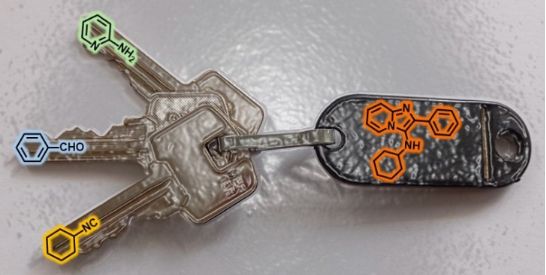
- diaryliodonium triflates such as 8 and 9 [13]. They studied a model reaction with 2-aminopyridine (1), p-tolualdehyde (10) and cyclohexyl isocyanide (11) both experimentally (by binding and kinetic studies) and theoretically (by density functional theory (DFT) calculations) (Scheme 5). Catalyst 8 was found to be






Hetero-polycyclic aromatic systems: A data-driven investigation of structure–property relationships
Beilstein J. Org. Chem. 2024, 20, 1817–1830, doi:10.3762/bjoc.20.160
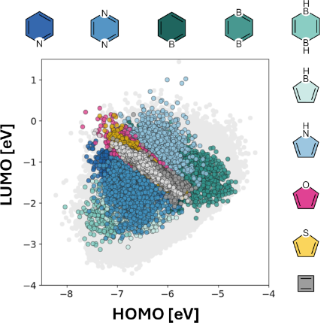
- ][33] level, including the D3 dispersion correction [29] by Grimme with Becke-Johnson damping [30]. We used the DFT-calculated dataset to generate fitting functions, such that all xTB-generated data was corrected to near DFT-level accuracy [9]. It is these corrected data that we use in this report to


Oxidative fluorination with Selectfluor: A convenient procedure for preparing hypervalent iodine(V) fluorides
Beilstein J. Org. Chem. 2024, 20, 1785–1793, doi:10.3762/bjoc.20.157
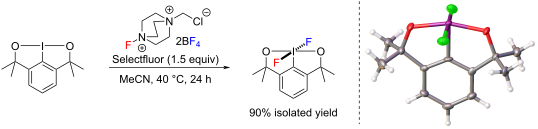
- (1–3 % spectroscopic yield) when BF3·OEt2 was added to the reaction mixture. X-ray crystallography and DFT calculations The solid-state structure of difluoroiodane 6 is shown in Figure 2 and displays the expected square pyramidal geometry around the iodine atom, with only minor distortion (τ5 = 0.191
- Supporting Information File 1). DFT calculations were carried out to gain further insight into the structures of iodine(V) fluorides 21 and 22 whose X-ray structures could not be obtained, and hypothetical iodine(V) amides 7a and 7b which could not be made. Comparisons were made with iodine(V) compounds 6
- . The only major difference between the bicyclic and monocyclic iodine(V) fluorides is the much smaller O–I–O bond angle (161.4(2) °) in difluoroiodane 6 compared to the F’–I–O bond angle (167.9(2) ° in 20) in the monocyclic iodanes 20–22. In fact, DFT calculations predicted that hypothetical


pKalculator: A pKa predictor for C–H bonds
Beilstein J. Org. Chem. 2024, 20, 1614–1622, doi:10.3762/bjoc.20.144
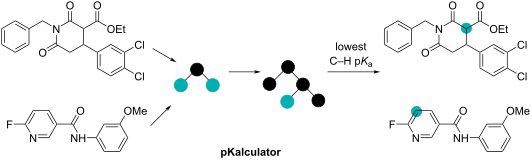
- identify the lowest-energy conformer. We then conduct re-optimization in ORCA (v. 5.0.4) [22][23], using the dispersion D4-corrected DFT functional CAM-B3LYP [24][25], the Karlsruhe [26][27] triple-ζ basis set, def2-TZVPPD, and the conductor-like polarizable continuum model (CPCM) [28] as the implicit
- solvation models. CAM-B3LYP is chosen as the optimal functional based on a benchmark study that evaluates the accuracy of different levels of theory, ranging from semiempirical methods (xTB) [21] over composite electronic structure methods (r2SCAN-3c) [29] to DFT methods (CAM-B3LYP) [24][25]. All these
- the XGBoost pKa predictor by Yang et al. [5]. Roszak et al. [3] used a mix of experimental data (414 compounds) [7], manually curated DFT data (212 compounds), and previously reported DFT data (194 C–H sites) [11]; they obtained a MAE of 2.18 pKa units for their test set. Yang et al. [5] used filtered


![[Graphic 9]](/bjoc/content/inline/1860-5397-20-144-i12.svg?max-width=637&scale=1.3000021)


Divergent role of PIDA and PIFA in the AlX3 (X = Cl, Br) halogenation of 2-naphthol: a mechanistic study
Beilstein J. Org. Chem. 2024, 20, 1580–1589, doi:10.3762/bjoc.20.141
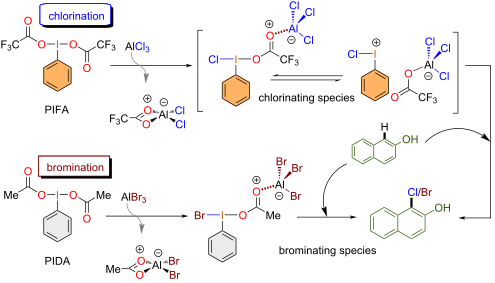
- halogenation via PhIX2. Keywords: aromatic bromination; aromatic chlorination; density functional theory (DFT); hypervalent iodine; iodine(III); Introduction Hypervalent iodine(III) reagents have gained attention as strong oxidants with a low toxicity [1][2][3][4][5][6][7][8] and due to the ability to mimic
- , and transition-state structures were optimized by density functional theory (DFT) calculations employing the software Gaussian 16 [34]. Although the B3LYP functional could be suitable for these calculations, e.g., for tracing reaction pathways, nitrations, halogenations, or FC acylations in solution


Regio- and stereochemical stability induced by anomeric and gauche effects in difluorinated pyrrolidines
Beilstein J. Org. Chem. 2024, 20, 1572–1579, doi:10.3762/bjoc.20.140
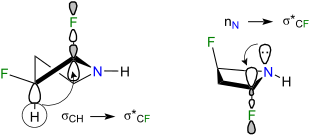
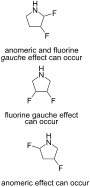
- each be subjected to quantum-chemical analysis. Results and Discussion In order to achieve the most accurate conformational depiction of the difluorinated pyrrolidines through density functional theory (DFT), a benchmark study was conducted. This study compares the crystallographic geometry of a
- pyrrolidinium salt [11] with the CCSD/DGTZVP geometry of the pyrrolidinium cation (with an exclusively axial C–F bond) and the energy of 3-fluoropyrrolidine conformations. Various combinations of DFT methods (B3LYP-D3BJ, ωB97XD, and PBEPBE) and basis sets (DGTZVP and 6-311++G**) were evaluated. The selection of
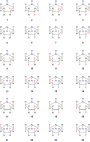
- (nN→σ*CF anomeric and σCH→σ*CF fluorine gauche effects) on the conformation of different stereoisomers is explored. MAE comparing the geometry parameters (bond length, bond angle, and dihedral angle) obtained from DFT calculations at the CCSD/DGTZVP level. The MAE for the crystal structure compared to





Predicting bond dissociation energies of cyclic hypervalent halogen reagents using DFT calculations and graph attention network model
Beilstein J. Org. Chem. 2024, 20, 1444–1452, doi:10.3762/bjoc.20.127
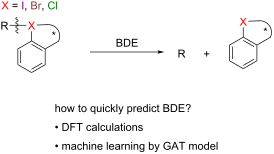
- both homolytic and heterolytic bond dissociation energies (BDEs) critical for assessing the chemical stability and functional group transfer capability of cyclic hypervalent halogen compounds using density functional theory (DFT) analysis. A moderate linear correlation was observed between the
- results of this study could aid in estimating the chemical stability and functional group transfer capabilities of hypervalent bromine(III) and chlorine(III) reagents, thereby facilitating their development. Keywords: BDE; cyclic hypervalent halogen reagents; DFT calculation; graph attention network
- DFT calculations for predicting key properties of organic molecules such as BDE, nucleophilicity, and electrophilicity [48][49][50][51][52][53][54][55][56][57][58][59][60]. Recently, applications of the Elastic Net model with Avalon fingerprints [55] and the deployment of artificial neural network


A comparison of structure, bonding and non-covalent interactions of aryl halide and diarylhalonium halogen-bond donors
Beilstein J. Org. Chem. 2024, 20, 1428–1435, doi:10.3762/bjoc.20.125
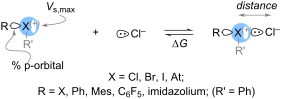
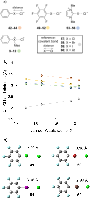
- , monovalent, and hypervalent have been developed and studied. In this work we used density functional theory (DFT), natural bond orbital (NBO) theory, and quantum theory of atoms in molecules (QTAIM) to analyze aryl halogen-bond donors that are neutral, cationic, monovalent and hypervalent and in each series
- Cl, Br, I, and At. We have used density functional theory (DFT) to uncover periodic trends in the orbitals used by the central halogen atom in forming covalent and non-covalent interactions and how this impacts the interatomic distance and energy of halogen-bond interactions (Scheme 1c). Results and
- Discussion This study evolved from a parallel exploration of reactions involving unsymmetrical phenyl(mesityl)halonium salts, i.e., Ph(Mes)X+. DFT analysis revealed similar structural trends to our previous work [21] when we expanded the halogens to include astatine (At). Due to its radioactivity and short




Synthesis of cyclic β-1,6-oligosaccharides from glucosamine monomers by electrochemical polyglycosylation
Beilstein J. Org. Chem. 2024, 20, 1421–1427, doi:10.3762/bjoc.20.124

- disaccharide 16 was obtained as an exclusive product. The optimized structure of 15 calculated by DFT (B3LYP/6-31G(d)) suggested that the pyran ring preferred the boat conformation because the chair conformation of the pyran ring was controlled by the introduction of the 2,3-oxazolidinone protecting group (see
- DFT calculations in Supporting Information File 1). Therefore, it was proven that the 2,3-oxazolidinone protecting group was powerful enough to prevent intramolecular glycosylation of monomer 14. However, it did not prevent intramolecular glycosylation of the linear disaccharide and promote the
- monomers 6 with a 2-PhthN group. Electrochemical polyglycosylation of monomers 17 with a 2-azido group. Supporting Information Supporting Information File 18: Synthetic details, DFT calculations, and compound characterization data. Acknowledgements We thank Koganei Corporation (Tokyo, Japan) for donation


Computation-guided scaffold exploration of 2E,6E-1,10-trans/cis-eunicellanes
Beilstein J. Org. Chem. 2024, 20, 1320–1326, doi:10.3762/bjoc.20.115

- rearrangement; DFT calculations; diterpene; electrophilic cyclization; eunicellane; Introduction The eunicellane diterpenoids are a family of nearly 400 natural products that present a conserved 6/10-bicyclic hydrocarbon framework [1][2][3]. Mostly known from soft corals [2], but with a growing number of
- anticipated that 1 would similarly undergo Cope rearrangement. However, when we heated 1 up to 200 °C for 5 h, we did not observe any Cope rearrangement products and we were able to recover >90% of 1. DFT calculations [mPW1PW91/6–31+G(d/p)/SMD(toluene)] on the Cope rearrangement of 2 revealed a free energy
- activation energy may allow for oxy-Cope rearrangement at 28 °C. DFT calculations (in toluene) of 5-hydroxyalbireticulene for both the pseudo-axial and pseudo-equatorial conformations of the C5 hydroxy moiety suggest that there is not a significant difference in the free energy barriers for the oxy-Cope


Sustainable tandem acylation/Diels–Alder reaction toward versatile tricyclic epoxyisoindole-7-carboxylic acids in renewable green solvents
Beilstein J. Org. Chem. 2024, 20, 1308–1319, doi:10.3762/bjoc.20.114
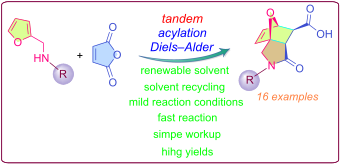
- (Figure 3, path I) [132]. Similarly, Tomberg et al., note that in such reactions, amide is formed rapidly by opening the maleic anhydride ring first, followed by a slower cyclization [133]. On the other hand, according to the results of some DFT calculations, Naguib et al., state that [4 + 2





