


Search results
Search for "RCM" in Full Text gives 106 result(s) in Beilstein Journal of Organic Chemistry.
A short stereoselective synthesis of (+)-(6R,2′S)-cryptocaryalactone via ring- closing metathesis
Beilstein J. Org. Chem. 2009, 5, No. 14, doi:10.3762/bjoc.5.14
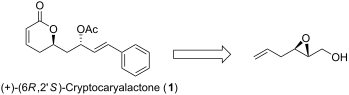
- . Retrosynthetic approach. Synthesis of chiral propargyl secondary hydroxyl group. Determination of the stereochemistry of the 1,3-anti diols. Synthesis of cryptocaryalactone by RCM. Asymmetric alkynylation with phenylacetylene. Supporting Information Supporting Information File 20: Experimental Data


Recent progress on the total synthesis of acetogenins from Annonaceae
Beilstein J. Org. Chem. 2008, 4, No. 48, doi:10.3762/bjoc.4.48
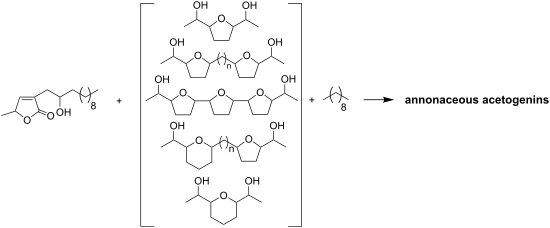
- (57), Mioskowski’s group [40] reported the first application of the RCM reaction using a ruthenium catalyst thus demonstrating the efficiency of this reaction for the construction of ACGs (Scheme 9). Both allyl alcohol 63 and vinyl-substituted epoxide 66 were synthesized via alkyne reduction yielding
- of 67 to 1,3-dimesitylimidazol-2-ylidene ruthenium benzylidene catalyst (RuCl2(=C(H)-Ph)(PCy3)(IMes)) after protection of the free hydroxyl group afforded the RCM product 68. Hydrogenation of the double bond of dihydrofuran 68 and iodination of the primary alcohol gave 69, which was then utilized to
- 2005, Hanessian’s group [50] reported the first total synthesis, stereochemical assignment, and structural confirmation of longicin (101) (Scheme 15). The strategy involved the use of Grubbs’ RCM reaction as a “chain elongation” strategy for the synthesis of acetogenin-type structures and a new


Understanding the mechanism of Pd-catalyzed allylic substitution of the cyclic difluorinated carbonates
Beilstein J. Org. Chem. 2008, 4, No. 18, doi:10.3762/bjoc.4.18
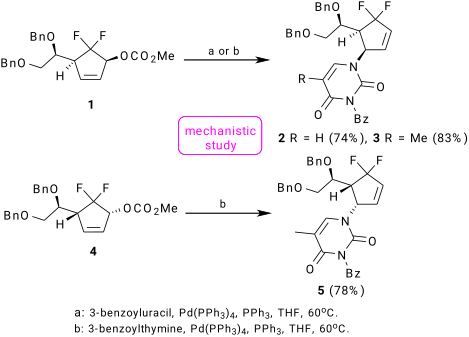
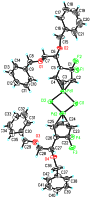
- prepare potential bioactive fluorinated nucleosides, our group recently described the stereoselective synthesis of 3',3'-difluoro-4',5'-unsaturated OTCs 2–3 and 5 [11]. The whole synthesis highlighted the stereoselective Reformatskii-Claisen rearrangement, ring-closing metathesis (RCM), and Pd-catalyzed



Desymmetrization of 7-azabicycloalkenes by tandem olefin metathesis for the preparation of natural product scaffolds
Beilstein J. Org. Chem. 2007, 3, No. 48, doi:10.1186/1860-5397-3-48
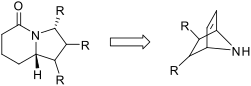
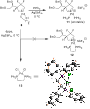
- , ring closing metathesis (RCM) and tandem metatheses [10][11][12][13] have been particularly successful strategies for the assembly of common natural product scaffolds. [14][15][16][17][18][19][20][21][22] A general advantage of these approaches is that ring closure and/or scaffold-rearrangements can be
- accomplished while generating a double bond as a valuable functional group for further manipulations. In addition, the common ruthenium (Figure 1) and molybdenum based catalysts for olefin metathesis are well known for their broad functional group tolerance. The application of RCM to the synthesis of
- and submitted to a ring closing metathesis (RCM). As a part of a general synthetic concept using azabicycloalkenes as masked analogs of functionalized pyrrolidines or piperidines [32][33][34][35][36][37][38][39] we have previously applied the concept of intramolecular ring-opening/ring-closing


Synthesis of densely functionalized enantiopure indolizidines by ring- closing metathesis (RCM) of hydroxylamines from carbohydrate- derived nitrones
Beilstein J. Org. Chem. 2007, 3, No. 44, doi:10.1186/1860-5397-3-44

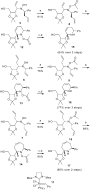
- . To establish new straightforward accesses to these molecules is therefore highly desirable. Results The ring closing metathesis (RCM) of enantiopure hydroxylamines bearing suitable unsaturated groups cleanly afforded piperidine derivatives in good yields. Further cyclization and deprotection of the
- straightforward access to indolizidine derivatives and a pyrroloazepine analogue through a key ring closing metathesis (RCM) of sugar derived hydroxylamines 1 and 3 bearing suitable unsaturated substituents at the α and α' positions. Results and discussion Unsymetrically α,α'-disubstituted hydroxylamines 5 and 6
- diastereomeric mixture, while 6 was obtained from an equimolecular mixture with its diastereoisomer.[24] Assignment of configuration has been secured by comparison with the double adducts of the one-pot process and by careful NMR studies of the final cyclic products after RCM. The scarce stereoselectivity of the



Reaction of benzoxasilocines with aromatic aldehydes: Synthesis of homopterocarpans
Beilstein J. Org. Chem. 2007, 3, No. 5, doi:10.1186/1860-5397-3-5
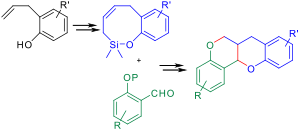
- Starting materials The starting material required for this synthesis is the novel heterocycle 3,6-dihydro-2,2-dimethyl-2H-benzo [g][1,2]oxasilocine (5), which can be prepared through ring closing metathesis (RCM), as has been previously reported for the non-benzofused system. [17][18][19] Thus, silylation
- of 2-allylphenol (3) (or conveniently functionalized derivatives) with allylchlorodimethylsilane followed by RCM with 2nd generation Grubbs catalyst [20] leads to the cyclic siloxane with high yields (Scheme 2). The good results in the cyclization step make this approach an excellent way of


Other Beilstein-Institut Open Science Activities



