


Search results
Search for "azide–alkyne cycloaddition" in Full Text gives 107 result(s) in Beilstein Journal of Organic Chemistry.
Antifreeze glycopeptide diastereomers
Beilstein J. Org. Chem. 2012, 8, 1657–1667, doi:10.3762/bjoc.8.190
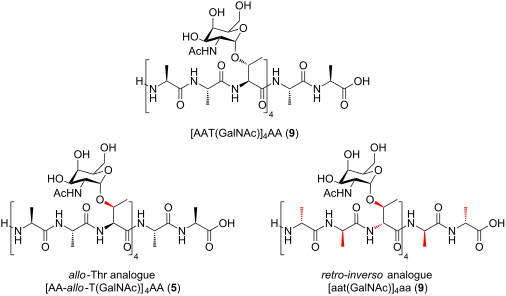
- proline replacements [5]. These peptides exhibit less antifreeze activity than monosaccharide-substituted AFGP analogues without proline residues. Peptoid glycoconjugates with carbohydrate moieties attached by CuI catalyzed azide-alkyne cycloaddition (CuAAC) were devoid of antifreeze activity [17


High-affinity multivalent wheat germ agglutinin ligands by one-pot click reaction
Beilstein J. Org. Chem. 2012, 8, 819–826, doi:10.3762/bjoc.8.91
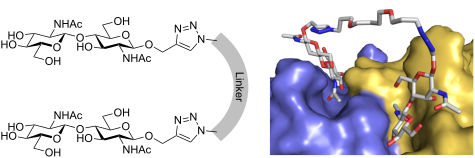
- conveniently prepared by employing a one-pot procedure for Cu(II)-catalyzed diazo transfer and Cu(I)-catalyzed azide–alkyne cycloaddition (CuAAC) starting from commercially available amines. These glycoclusters were probed for their binding potencies to the plant lectin wheat germ agglutinin (WGA) from
- ligands. In this report, we describe the preparation of such a series of multivalent WGA ligands by a one-pot procedure for diazo transfer and azide–alkyne cycloaddition [48] starting from commercially available di- and triamines and the propargyl glycoside of N,N’-diacetylchitobiose. Binding potencies
- scaffolds [52][53][54]. Recently, we reported a convenient one-pot procedure for diazo transfer and azide–alkyne cycloaddition [48] giving access to multivalent triazole-linked structures starting from amines. For the synthesis of triazole-linked glycoclusters, commercially available amines A1–A6 (Figure 1




Azobenzene dye-coupled quadruply hydrogen-bonding modules as colorimetric indicators for supramolecular interactions
Beilstein J. Org. Chem. 2012, 8, 486–495, doi:10.3762/bjoc.8.55
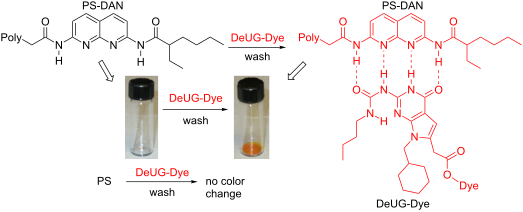
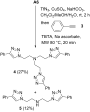
- produced crude 16, which was used directly in the next step without purification. Coupling of azide 16 with the known 17 [34] was successfully effected under standard conditions for the copper-catalyzed azide–alkyne cycloaddition [55]. Azobenzene dye-coupled DeUG module 18 was obtained as an orange–yellow
- -diamido-1,8-naphthyridine (DAN) unit was linked to azobenzene dyes through one of its amide groups, giving compounds 5, 8, and 10, and the 7-deazaguanine urea (DeUG) unit was linked to an azobenzene dye by a Steglich esterification, giving 12, or by the copper-catalyzed azide–alkyne cycloaddition (click


Synthesis of 2-amino-3-arylpropan-1-ols and 1-(2,3-diaminopropyl)-1,2,3-triazoles and evaluation of their antimalarial activity
Beilstein J. Org. Chem. 2011, 7, 1745–1752, doi:10.3762/bjoc.7.205
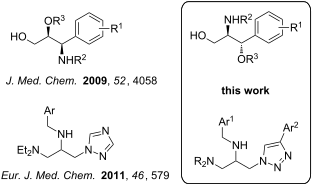
- )methyl]aziridines by Cu(I)-catalyzed azide-alkyne cycloaddition, followed by microwave-assisted, regioselective ring opening by dialkylamine towards 1-(2,3-diaminopropyl)-1,2,3-triazoles. Although most of these compounds exhibited weak antiplasmodial activity, six representatives showed moderate
- -triazol-1-yl)methyl]aziridines by Cu(I)-catalyzed azide-alkyne cycloaddition, followed by microwave-assisted, regioselective ring opening by diethyl- or dimethylamine towards the corresponding 1-(2,3-diaminopropyl)-1,2,3-triazoles. From a synthetic viewpoint, new insights were provided concerning the
- water-induced ring opening of nonactivated cis- and trans-2-aryl-3-(hydroxymethyl)aziridines and with respect to the synthesis and use of 1-arylmethyl-2-(azidomethyl)aziridines for azide-alkyne cycloaddition reactions. From a biological viewpoint, most of these compounds exhibited weak antiplasmodial


Highly efficient cyclosarin degradation mediated by a β-cyclodextrin derivative containing an oxime-derived substituent
Beilstein J. Org. Chem. 2011, 7, 1543–1554, doi:10.3762/bjoc.7.182
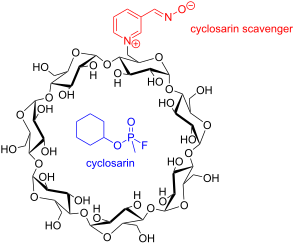
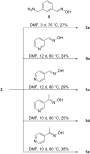
- with 2-formylpyridine oxime or 2-acetylpyridine oxime, unfortunately failed to produce the desired products. The cyclodextrin derivatives 2a–d contain 1,4-disubstituted 1,2,3-triazole moieties as the linking units. Accordingly, they were prepared by copper(I)-catalyzed azide–alkyne cycloaddition





Advances in synthetic approach to and antifungal activity of triazoles
Beilstein J. Org. Chem. 2011, 7, 668–677, doi:10.3762/bjoc.7.79
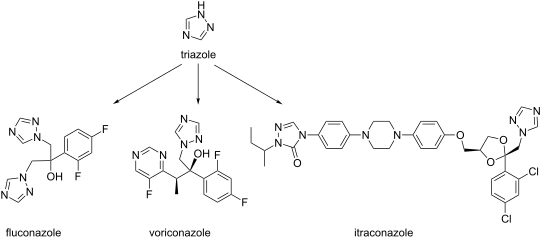
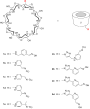
- ). Itraconazole (10). Voriconazole (11). Posaconazole (12). Ravuconazole (13). Copper catalyzed azide–alkyne cycloaddition. Ruthenium catalyzed azide–alkyne cycloaddition. Copper-sulfate catalyzed azide–alkyne cycloaddition. Azide–dimethylbut-2-yne-dioate cycloaddition.




Synthesis of glycoconjugate fragments of mycobacterial phosphatidylinositol mannosides and lipomannan
Beilstein J. Org. Chem. 2011, 7, 369–377, doi:10.3762/bjoc.7.47
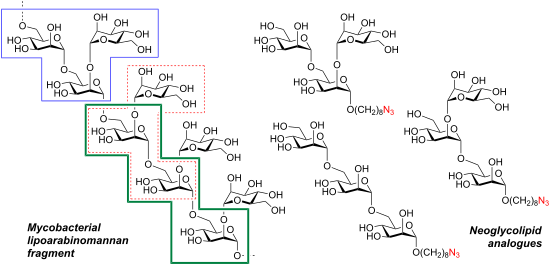
- –alkyne cycloaddition (CuAAC) reaction [33][34]. Results and Discussion Since their introduction by Palcic and co-workers [35], hydrophobic alkyl glycosides have proven to be valuable derivatives for enzymatic assays, as their lipophilic nature allows easy product isolation by either reversed-phase
- ) lipophilicity allowing biphasic partitioning between butanol/water or purification by reversed-phase extraction, (ii) ability to be reduced to an aminooctyl chain for use in squarate conjugation chemistry, and (iii) capacity to be conjugated with fluorescent terminal alkynes using the Cu(I)-catalyzed azide


Other Beilstein-Institut Open Science Activities



