


Search results
Search for "differential scanning calorimetry" in Full Text gives 109 result(s) in Beilstein Journal of Organic Chemistry.
Molecular length distribution and the formation of smectic phases
Beilstein J. Org. Chem. 2009, 5, No. 65, doi:10.3762/bjoc.5.65
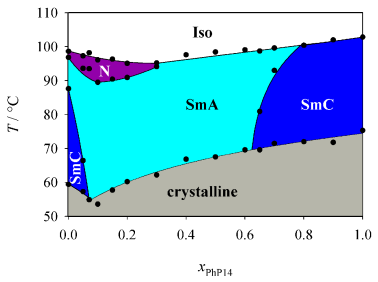
- opposite signs of E. A Netzsch DSC-204 Phoenix instrument was used for differential scanning calorimetry analyses at a scan rate of 5 K min−1. Structure of different liquid crystalline phases build with two kinds of hard spherocylinders with strongly differing lengths. Molecular structure of the mesogens




Influence of spacer chain lengths and polar terminal groups on the mesomorphic properties of tethered 5-phenylpyrimidines
Beilstein J. Org. Chem. 2009, 5, No. 63, doi:10.3762/bjoc.5.63
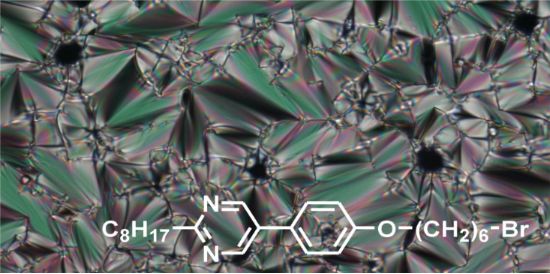
- nucleophilic substitution. The mesomorphic behaviour of these compounds was investigated by differential scanning calorimetry (DSC), polarizing optical microscopy (POM) and X-ray diffraction (WAXS and SAXS) and revealed smectic A mesophases for bromides, chlorides and azides 3, 4 and 6. For these compounds a
- the monochromator. The diffraction patterns were recorded on a real-time 2D-detector (HI-STAR, Bruker). The calibration of the patterns occurred with the powder pattern of Ag-Behenate. Differential scanning calorimetry (DSC) was performed using a Mettler Toledo DSC822, and polarizing optical
- deprotonation of hydroxy derivative 8 with NaH in DMF for 40 min at 0 °C followed by addition of 1-bromo-3-propionitrile at room temperature. After 12 h, the cyanide 7b was obtained in 33% yield. Mesomorphic properties: Mesomorphic properties of compounds 3–10 were investigated by differential scanning


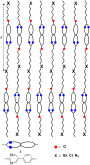
1-(4-Alkyloxybenzyl)-3-methyl-1H-imidazol-3-ium organic backbone: A versatile smectogenic moiety
Beilstein J. Org. Chem. 2009, 5, No. 62, doi:10.3762/bjoc.5.62
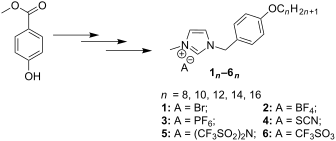
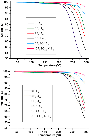
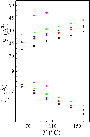
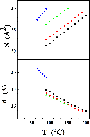
- temperature). The mesomorphic properties were studied by polarizing optical microscopy, differential scanning calorimetry and X-ray diffraction. With the support of dilatometry, models for the lamellar supramolecular arrangement of the salts are proposed and its evolution is discussed as a function of the
- ][25][26][27][28][29][30]. Their characterization was the result of the combination and interpretation of thermal studies (Thermogravimetry Analysis or TGA, Differential Scanning Calorimetry or DSC), direct polarized optical microscopy (POM) observation and small angle X-ray diffraction studies (SAXS






Coaxial electrospinning of liquid crystal-containing poly(vinylpyrrolidone) microfibres
Beilstein J. Org. Chem. 2009, 5, No. 58, doi:10.3762/bjoc.5.58
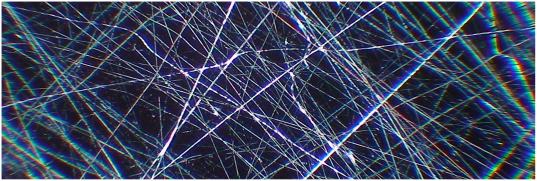
- through a polarising optical microscope (POM) and follow the phase sequence (Figure 2). The fibres are thermally stable enough to allow repeated heating into the isotropic phase of the contained liquid crystal and cooling to room temperature again without any change in appearance. In differential scanning
- calorimetry (DSC) investigations only the transitions of the liquid crystal are found up to about 100 °C, where decomposition of the PVP sheath starts to take place. When fully dried the fibres also show good mechanical stability so that they can be pulled from the glass slide and folded or rolled together




![[Graphic 1]](/bjoc/content/inline/1860-5397-5-58-i1.png?max-width=637&scale=1.18182) in...
in...




Saddle-shaped tetraphenylenes with peripheral gallic esters displaying columnar mesophases
Beilstein J. Org. Chem. 2009, 5, No. 57, doi:10.3762/bjoc.5.57
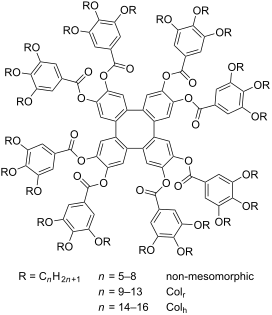
- purification the desired gallic ester-substituted tetraphenylenes 2a–l in 19–72%. In some cases purification turned out to be rather tedious resulting in decreased yields. Mesomorphic properties of compounds 2 were studied by differential scanning calorimetry (DSC), polarizing optical microscopy (POM) and X
- patterns recorded with an imaging plate detector (Fuji BAS SR). In the flat-film camera, the sample was placed in a small hole of a brass block, the temperature of which was controlled by a Lakeshore controller and kept in a 1.5 T magnetic field for alignment. Differential scanning calorimetry (DSC) was


Novel banana-discotic hybrid architectures
Beilstein J. Org. Chem. 2009, 5, No. 52, doi:10.3762/bjoc.5.52
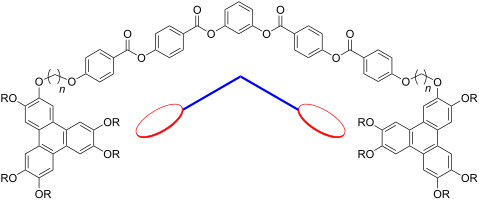
- discotic dimers. The chemical structures have been characterized by spectral techniques and elemental analysis. The thermal behaviors of the compounds have been investigated by polarizing optical microscopy and differential scanning calorimetry. None of these synthesized compounds exhibit any liquid
- behavior of the novel compounds have been observed by polarizing optical microscopy and differential scanning calorimetry. All the solvent crystallized compounds pass from crystalline state to isotropic liquid state on heating, and on cooling they crystallize into the solid state without any intervening
- differential scanning calorimetry measurements. The absence of either B-phase or discotic columnar mesophase in compound 6 may be explained as follows: since the five-ring banana unit, which otherwise exhibits mesophase with two terminal alkyl chains, is now attached with two bulky triphenylene units at the


A convenient method for preparing rigid-core ionic liquid crystals
Beilstein J. Org. Chem. 2009, 5, No. 51, doi:10.3762/bjoc.5.51
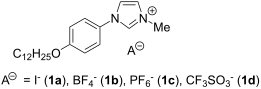
- , differential scanning calorimetry and X-ray diffraction. In addition its lamellar crystal structure, electrochemical behaviour and UV (absorption and emission) properties are reported. Keywords: imidazolium; ionic liquid crystals; Ullman reaction; Introduction Over the past decade extensive studies of ionic
- general stability order to be I−< BF4− ≈ PF6−< CF3SO3−< (CF3SO2)2N− (Figure 4). For all the compounds, the mesomorphic behaviour and phase transition temperatures were investigated by polarized optical microscopy (POM), differential scanning calorimetry (DSC), and powder X-ray diffractometry (XRD). To
- were studied with a Leitz polarizing microscope equipped with a Mettler FP80 hot stage and an FP80 central processor. The TGA measurements were carried out on a SDTQ 600 apparatus at scanning rate of 10 °C·min−1. The transition temperatures and enthalpies were measured by differential scanning




Synthesis of mesogenic phthalocyanine-C60 donor–acceptor dyads designed for molecular heterojunction photovoltaic devices
Beilstein J. Org. Chem. 2009, 5, No. 49, doi:10.3762/bjoc.5.49
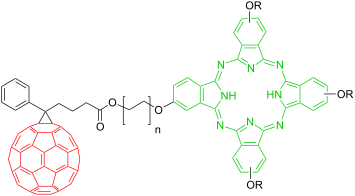
- ) mesophases. Upon heating, transitions to isotropic liquid were observed at 120 °C and 90 °C for 2c and 2d, respectively. For 2c this transition was only detectable by POM and not by differential scanning calorimetry (DSC), while for 2d DSC on heating revealed an endothermic peak at 90 °C [enthalpy 2.7 kJ/mol


Pd/C- Mediated synthesis of indoles in water
Beilstein J. Org. Chem. 2009, 5, No. 46, doi:10.3762/bjoc.5.46
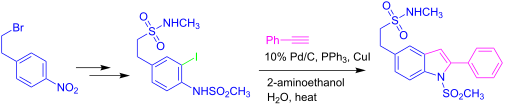
- ) are given in hertz. Infrared spectra were recorded on a FTIR spectrometer. Melting points were determined by using thermal analysis and differential scanning calorimetry (DSC) was generated with the help of DSC-60A dector. MS spectra were obtained on a mass spectrometer. Chromatographic (HPLC) purity


Other Beilstein-Institut Open Science Activities



