Search results
Search for "fluorescence emission" in Full Text gives 111 result(s) in Beilstein Journal of Organic Chemistry.
Fluorescent hexaaryl- and hexa-heteroaryl[3]radialenes: Synthesis, structures, and properties
Beilstein J. Org. Chem. 2012, 8, 71–80, doi:10.3762/bjoc.8.7
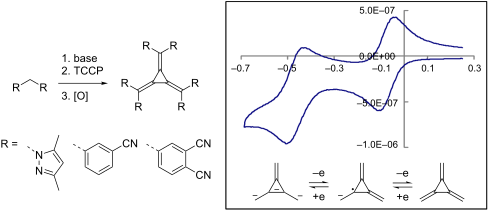
- calculations that show intramolecular charge transfer character in the lowest excited states for hexaaryl[3]radialene derivatives [42]. In the excited state, rotation about the exocyclic bonds of the cyclopropane ring is also possible. The fluorescence emission of the hexaaryl[3]radialenes, coupled with the
- )[3]radialene in acetone. Synthesis of (a) hexakis(3-cyanophenyl)[3]radialene (2) and (b) hexakis(3,4-dicyanophenyl)[3]radialene (3). Electrochemical potentials for the synthesised [3]radialenes 1–3 and related compounds. Visible absorption maxima, molar extinction coefficient ε and fluorescence
- emission maxima for various hexaaryl[3]radialene compounds. Supporting Information Supporting Information File 9: 1H and 13C NMR spectra of all compounds, cyclic voltammograms of hexaaryl[3]radialenes, crystal data and structure refinement for 3. Supporting Information File 10: Crystallographic


Synthesis of dye/fluorescent functionalized dendrons based on cyclotriphosphazene
Beilstein J. Org. Chem. 2011, 7, 1577–1583, doi:10.3762/bjoc.7.186
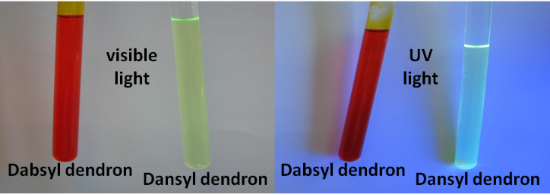
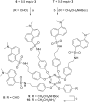
- ), fluorescence emission (excitation wavelength 347 nm) (λem), and quantum yield (Φ) (reference: quinine sulfate) of compound 10 in mixtures of water/dioxane with different molar fractions (x) of water in 1,4-dioxane. Supporting Information Supporting Information File 289: Experimental details. Supporting




Ratiometric fluorescent probe for enantioselective detection of D-cysteine in aqueous solution
Beilstein J. Org. Chem. 2011, 7, 1508–1515, doi:10.3762/bjoc.7.176
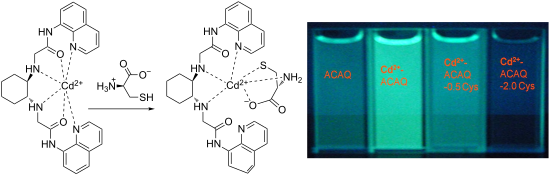
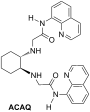
- enantioselectivity on Cys for the first time. Experimental Proton NMR spectra were recorded on a Bruker Avance-III 400 spectrometer at 400 MHz in DMSO-d6. Fluorescence emission spectra and UV–vis spectra were collected on a PE LS50B and a Cary UV-100 spectrometer, respectively. All inorganic reagents and amino acid




Fluorometric recognition of both dihydrogen phosphate and iodide by a new flexible anthracene linked benzimidazolium-based receptor
Beilstein J. Org. Chem. 2011, 7, 254–264, doi:10.3762/bjoc.7.34
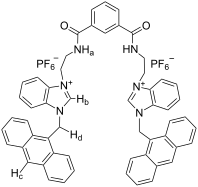
- optimized geometry of 1 with H2PO4− (E = 92.14 kcal/mol, a = 2.45 Å, b = 1.94 Å, c = 2.34 Å, d = 2.82 Å). Change in fluorescence emission of 1 (c = 5.78 × 10⁻⁵ M) in the presence of 2 equiv of tetrabutylammonium salts of different guests in CH3CN. Change in emission spectra of 1 (c = 5.78 × 10⁻⁵ M) in
- with H2PO4−. Change in fluorescence emission of 2 (c = 3.93 × 10⁻⁵ M) in the presence of 1 equiv of tetrabutylammonium salts of different guests in CH3CN. Stern–Volmer plots for 1 (c = 5.78 × 10⁻⁵ M) with H2PO4−, F−, Br− and I− at 420 nm (up to the addition of 2 equiv of guest) in CH3CN. Change in UV
- –vis spectra of 1 (c = 5.78 × 10⁻⁵ M) in presence of increasing amounts of H2PO4− in CH3CN. Change in fluorescence emission of 1 (c = 5.78 × 10⁻⁵ M) in the presence of 2 equiv of tetrabutylammonium salts of different guests in CHCl3 containing 0.1% CH3CN. Stern–Volmer plots for 1 (c = 5.78 × 10⁻⁵ M


An easy assembled fluorescent sensor for dicarboxylates and acidic amino acids
Beilstein J. Org. Chem. 2011, 7, 75–81, doi:10.3762/bjoc.7.11
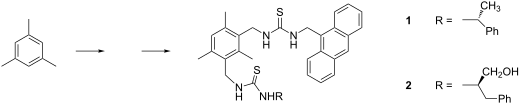
- intensity limit on adding excess anion, CA is the concentration of the anion added, and CH is the concentration of the host molecule. The changes in the fluorescence emission spectra of sensor 1 (5.0 × 10⁻⁶ M) upon addition of isophthalate in acetonitrile. λex = 366 nm. (Inset) Quenching ratio of sensor 1


A new fluorescent chemosensor for fluoride anion based on a pyrrole–isoxazole derivative
Beilstein J. Org. Chem. 2011, 7, 46–52, doi:10.3762/bjoc.7.8
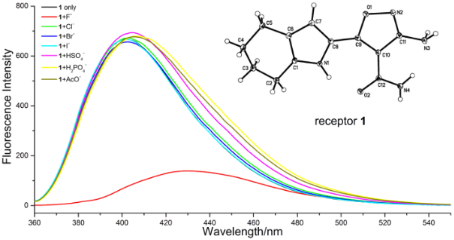
- deprotonation rather than the formation of hydrogen bond. Figure 6 shows the changes of fluorescence emission of 1 upon addition of F− in CH3CN where the emission maximum was red-shifted to 432 nm. With increasing F− concentration, the emission intensity was quenched by about 90% when 50 equiv of F− was added
- log K2 = 6.38 ± 0.15, respectively [17][18] (Figure 7). Studies on reaction with hydroxide (OH−) Tetrabutylammonium hydroxide was added to the solution of 1 in CH3CN to investigate the above process. Changes in fluorescence emission of 1 upon addition of F− and OH− in CH3CN were almost the same
- , except for the degree of quenching, as shown in Figure 8. Upon the addition of 5 equiv of OH− the fluorescence emission of receptor 1 displayed λmax at 408 nm and the intensity was quenched by about 51%. On the other hand, upon addition of F− the emission displayed λmax at 405 nm but the intensity was


Donor-acceptor substituted phenylethynyltriphenylenes – excited state intramolecular charge transfer, solvatochromic absorption and fluorescence emission
Beilstein J. Org. Chem. 2010, 6, 992–1001, doi:10.3762/bjoc.6.112
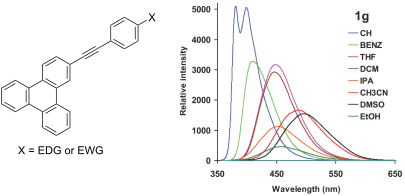
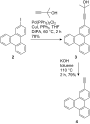
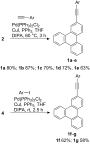
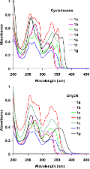
- absorption and fluorescence emission properties of these molecules have been studied in solvents of different polarity. For a given derivative, solvent polarity had minimal effect on the absorption maxima. However, for a given solvent the absorption maxima red shifted with increasing conjugation of the
- substituent. The fluorescence emission of these derivatives was very sensitive to solvent polarity. In the presence of strongly electron withdrawing (–CN) and strongly electron donating (–NMe2) substituents large Stokes shifts (up to 130 nm, 7828 cm−1) were observed in DMSO. In the presence of carbonyl
- . These results indicate that the fluorescence emission arises from excited state intramolecular charge transfer in these molecules where the triphenylene chromophore acts either as a donor or as an acceptor depending upon the nature of the substituent on the phenyl ring. HOMO–LUMO energy gaps have been




Chromo- and fluorophoric water-soluble polymers and silica particles by nucleophilic substitution reaction of poly(vinyl amine)
Beilstein J. Org. Chem. 2010, 6, No. 79, doi:10.3762/bjoc.6.79
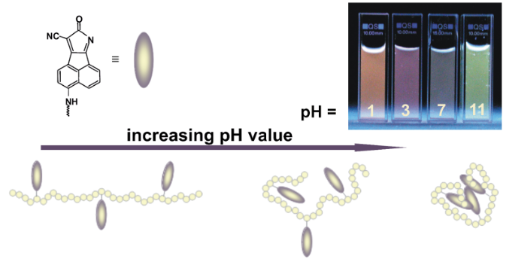
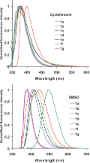
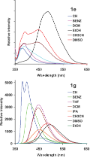
- -dimethylcyclodextrin or by pre-adsorption onto silica particles. Furthermore, 1 was converted with isopropylamine into the model compound 1-M. All new compounds were characterized by NMR, FTIR, UV–vis and fluorescence spectroscopy. The solvent-dependent UV–vis absorption and fluorescence emission band positions of the
- possible [32]. The fluorescence emission maxima of 1-M and 1-P are shown in Table 4. Figure 5 shows an UV–vis absorption spectrum and a fluorescence emission spectrum of 1-M and 1-P measured in methanol as well as a photograph of solutions of these compounds. Similar to the UV–vis measurements, 1-M shows
- the longest-wavelength emission maximum in DMSO at λmax = 595 nm and 1-P in ethanol at λmax = 586 nm. The longest hypsochromic shifts of the fluorescence emission maximum were observed at λmax(1-M) = 577 nm in HFIP and λmax(1-P) = 561 nm in DMMA. These band shifts correspond to a small solvatochromic




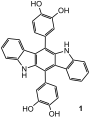
Synthesis of indolo[3,2-b]carbazole-based new colorimetric receptor for anions: A unique color change for fluoride ions
Beilstein J. Org. Chem. 2010, 6, No. 12, doi:10.3762/bjoc.6.12
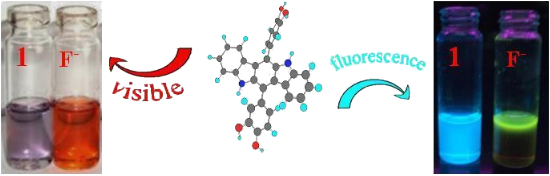
- a quenching results from a hydrogen bond interaction of phenolic OH with anions, which leads to the stabilization of the nπ* state with respect to the ππ* state and a subsequent decrease in the fluorescence emission intensity [51]. Analogous investigation of fluorescence was carried out with other




Quinoline based receptor in fluorometric discrimination of carboxylic acids
Beilstein J. Org. Chem. 2008, 4, No. 52, doi:10.3762/bjoc.4.52
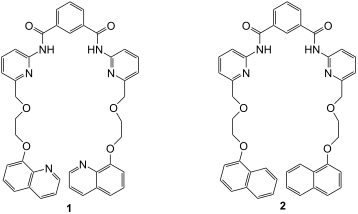
- compounds were characterized using 1H NMR, 13C, mass, IR and UV spectroscopic methods. Interaction studies UV-vis study The sensitivity and selectivity of the receptors 1 and 2 were evaluated by observing the changes in 1H NMR, UV-vis and fluorescence emission in CHCl3. Initially, the photophysical


Synthesis of deep- cavity fluorous calix[4]arenes as molecular recognition scaffolds
Beilstein J. Org. Chem. 2008, 4, No. 36, doi:10.3762/bjoc.4.36
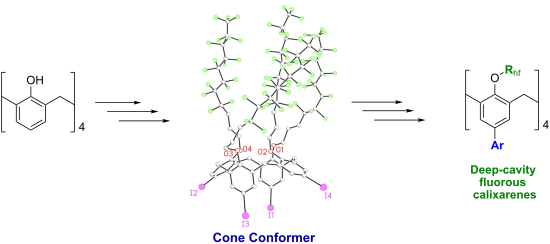
- fluorescence emission (as observed qualitatively on TLC). An increase in fluorescence emission was observed with 7, 8, and 9 as compared to the single aryl ring analogs, and allows for better applications of the scaffold as a sensor [8][37]. Conclusion Deep-cavity functionalized fluorous calix[4]arenes that