


Search results
Search for "alkoxide" in Full Text gives 134 result(s) in Beilstein Journal of Organic Chemistry.
Synthesis, reactivity and biological activity of 5-alkoxymethyluracil analogues
Beilstein J. Org. Chem. 2011, 7, 678–698, doi:10.3762/bjoc.7.80
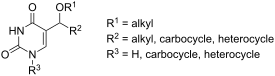
- )pyrimidines 68 and 69. The latter readily underwent nucleophilic attack by alkoxide ions to yield alicyclic or cyclic acetals 70–73 and 74, respectively, depending on the alcohol used. Uridine and arabinofuranosyl analogues: 5-Substituted uracil nucleosides where the sugar component is ribose or arabinose


Recent advances in the development of alkyne metathesis catalysts
Beilstein J. Org. Chem. 2011, 7, 82–93, doi:10.3762/bjoc.7.12
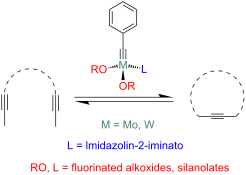
- established a different design strategy for the development of novel alkyne metathesis catalysts. Inspired both by a report of Johnson and co-workers, who found that molybdenum and tungsten nitride complexes 24 with fluorinated alkoxide ligands react with alkynes to generate the corresponding metal


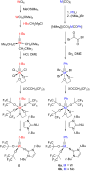


A novel and efficient method to prepare 2-aryltetrahydrofuran-2-ylphosphonic acids
Beilstein J. Org. Chem. 2010, 6, No. 63, doi:10.3762/bjoc.6.63
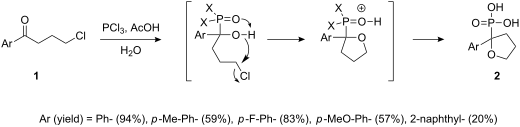
- conditions [16] or at elevated temperatures [17]. A plausible explanation for the cyclization occurring at room temperature without an alkoxide intermediate would be to invoke anchimeric assistance of the P=O group, which could serve as a general base to facilitate cyclization leading to the formation of 7


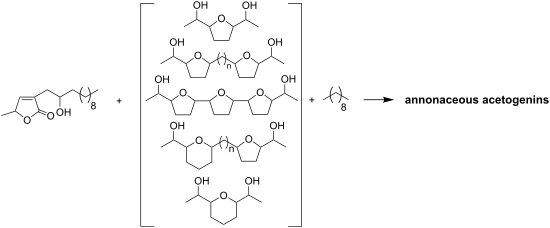
Recent progress on the total synthesis of acetogenins from Annonaceae
Beilstein J. Org. Chem. 2008, 4, No. 48, doi:10.3762/bjoc.4.48


Solvent- controlled regioselective protection of allyl- 4,6-benzylidene glucopyranosides
Beilstein J. Org. Chem. 2007, 3, No. 26, doi:10.1186/1860-5397-3-26

- allyl ether at the C1 position of the glucoside. It can be postulated that in THF, regioselectivity depends on the relative acidity of the secondary hydroxyl groups and the nucleophilicity of the resulting alkoxide. The acidity is modulated by intramolecular H-bonds while steric effects control the


Conformational rigidity of silicon- stereogenic silanes in asymmetric catalysis: A comparative study
Beilstein J. Org. Chem. 2007, 3, No. 9, doi:10.1186/1860-5397-3-9
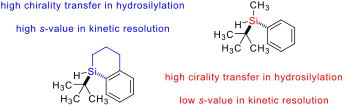
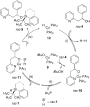
- kinetic resolution of alcohols (Scheme 4). The phosphine-stabilized copper hydride 12 [17] is likely to be the catalytically active species, which is generated by alkoxide exchange (9 → 10) followed by a single catalytic turnover. The actual catalytic cycle then proceeds in a four-step propagation: (i
- metathesis [19] establishing the silicon-oxygen linkage in 5 and regenerating copper hydride 12 after coordination of another phosphine ligand (11 → 12). With steps (ii) and (iii) being reversible and chelate 10 being capable of alkoxide exchange, that is exchange of the optical antipodes of 4, one


Pd-catalysed [3 + 3] annelations in the stereoselective synthesis of indolizidines
Beilstein J. Org. Chem. 2007, 3, No. 8, doi:10.1186/1860-5397-3-8
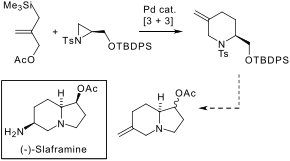
- reasons for this difference in catalyst activity are unclear at present, we speculate that n-BuLi may be responsible for the formation of hitherto uncharacterised phosphine ligands BunP(OiPr)3-n that promote the annelation over simple P(OiPr)3. Indeed, analogous alkoxide substitution reactions of


Investigation of acetyl migrations in furanosides
Beilstein J. Org. Chem. 2006, 2, No. 14, doi:10.1186/1860-5397-2-14
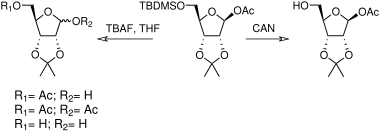
- acetyl moieties. Such direct transesterification is intermolecular and while it has been observed in nucleoside-phosphoramidite and glycoside chemistry,[20][21][22][23] this alkoxide-promoted intermolecular acetyl migration process has been overlooked in furanosides. The isolated quantities of 1c and 1d
- , pyridine, DMAP (98%). Synthesis of riboside 5. a) BnBr, NaH, THF (82%); b) TBAF, THF (84%); c) PivCl, pyridine/DCM, DMAP (95%); d) TFA/H2O (8/2) (78%); e) MeOH, H2SO4 (73%); f) MeONa/MeOH (85%); g) TBDMSCl, pyridine/DCM, DMAP (78%); h) Ac2O, pyridine, DMAP(98%). Alkoxide promoted transesterification. 1H


Reagent controlled addition of chiral sulfur ylides to chiral aldehydes
Beilstein J. Org. Chem. 2005, 1, No. 4, doi:10.1186/1860-5397-1-4
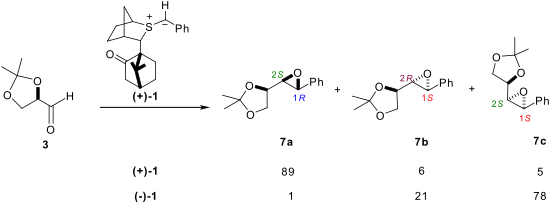
- earlier studies we had established that the degree of reversibility in betaine formation could be influenced by the degree of solvation of the intermediate alkoxide. The initially formed betaine 9 with charges gauche to each other can either undergo bond rotation to betaine 10 followed by ring closure to
- give the epoxide 7a or reversion to the ylide and the aldehyde. Solvation of the alkoxide 9 reduces the barrier to bond rotation rendering reactions less reversible. We therefore examined the same reactions in the presence of LiCl (Table 1, entries 4, 6). Now increased C1 selectivity (C1(R):C1(S), 96:4
- that influenced reversibility in betaine formation included ylide stability, solvation of the metal alkoxide and steric hindrance around the aldehyde and ylide.[2] We now add another factor to this growing list: stereochemistry of the aldehyde. Evidently, in one isomer, the groups between the aldehyde


Other Beilstein-Institut Open Science Activities



