


Search results
Search for "electrochemistry" in Full Text gives 132 result(s) in Beilstein Journal of Organic Chemistry.
Structure and reactivity in neutral organic electron donors derived from 4-dimethylaminopyridine
Beilstein J. Org. Chem. 2010, 6, No. 73, doi:10.3762/bjoc.6.73
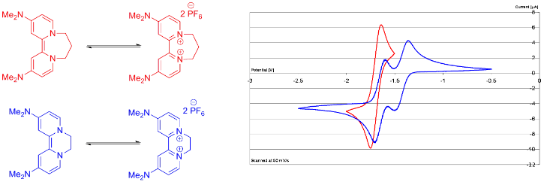
- by adding deoxygenated solutions of the oxidized disalts 16′–18′ (rather than the electron donors) to the electrochemical cell and then carrying out the electrochemistry under an inert gas. The donors themselves are highly sensitive to traces of oxygen, and so are less convenient to weigh out than


Synthesis, electronic properties and self-assembly on Au{111} of thiolated (oligo)phenothiazines
Beilstein J. Org. Chem. 2010, 6, No. 72, doi:10.3762/bjoc.6.72
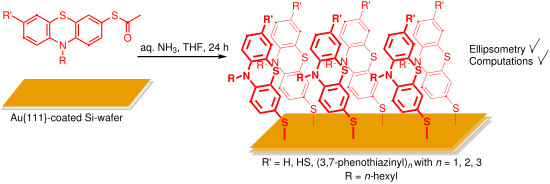
- = 876 mV (Figure 2). However, the electrochemistry of the tetrad 2e is more complicated. Only three distinctly separated, reversible oxidations were evident. The first oxidations at E00/+1 = 597 mV and E0+1/+2 = 690 mV are in accordance with Nernstian behavior, while the third oxidation at E0 = 842 mV
- , Germany. Electrochemistry Cyclic voltammetry experiments (EG & G potentiostatic instrumentation) were performed under an argon atmosphere in dry and degassed CH2Cl2 at room temperature and at scan rates of 100, 250, 500, and 1000 mV/s. The electrolyte was Bu4NPF6 (0.025 M). The working electrode was a 1


Prediction of reduction potentials from calculated electron affinities for metal-salen compounds
Beilstein J. Org. Chem. 2009, 5, No. 82, doi:10.3762/bjoc.5.82
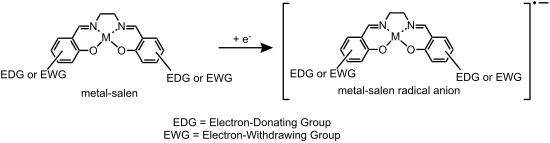
- could be used to predict the reduction potentials of a variety of metal-salen compounds, an important class of coordination compounds used in synthetic organic electrochemistry as electrocatalysts. Keywords: density functional theory; electron affinity; metal-salen; reduction potential; Introduction
- discover if there were other metal-salen compounds that also fall within an “electrochemical potential window” in which effective ERC would occur. The electrochemistry of a few metal-salens is known in the literature; however, there are a great many possible metal-salens that we would like to investigate
- as electrocatalysts that have unknown electrochemistry. Fry demonstrated that the density functional B3LYP/6-31G(d) level of theory can be used to accurately predict the reduction potentials for a series of chalcones [7]. The electron affinities (EAs) of a training set of 29 monosubstituted chalcones


A convenient method for preparing rigid-core ionic liquid crystals
Beilstein J. Org. Chem. 2009, 5, No. 51, doi:10.3762/bjoc.5.51
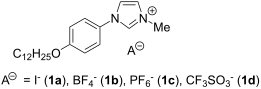
- -arylation of imidazole as a means of expanding the aromatic core and obtaining unsymmetrical imidazolium liquid crystals (Scheme 1). We also describe the influence of the counter anion on the mesomorphism, electrochemistry and the UV properties of these imidazolium salts. Results and Discussion Synthesis



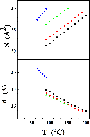

Synthesis of mesogenic phthalocyanine-C60 donor–acceptor dyads designed for molecular heterojunction photovoltaic devices
Beilstein J. Org. Chem. 2009, 5, No. 49, doi:10.3762/bjoc.5.49
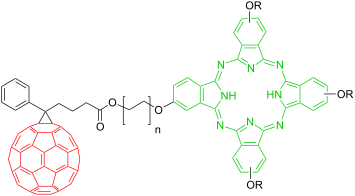
- was controlled by a Linkam Scientific Instruments GS350 hot stage. For DSC, a Perkin Elmer Diamond DSC calorimeter was used. Electrochemistry. Cyclic voltammetry experiments were performed with a computer controlled Autolab potentiostat. Measurements were carried out at room temperature in a three


Synthesis and redox behavior of new ferrocene- π-extended- dithiafulvalenes: An approach for anticipated organic conductors
Beilstein J. Org. Chem. 2009, 5, No. 6, doi:10.3762/bjoc.5.6
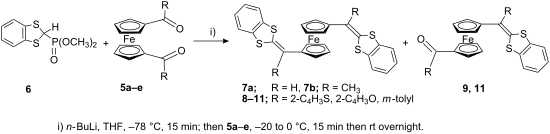
- product was identified as 1,1′-bis(1,3-DTF)Fc 11 in 24% yield in addition to the (1,3-DTF)Fc 12 as a major product (76% isolated yield) (Scheme 4). Electrochemistry The electrochemical redox properties of the newly synthesized Fc-DTFs 9 and 12, the 1,1′-bis(1,3-DTF)Fc’s 8, 10, 11, and the acylferrocenes
- . Their electrochemistry was studied and compared to the previously reported derivative 9. In CH2Cl2 on a Pt electrode and at ambient temperature, compound 12 showed two oxidation waves associated with two reduction waves with peak potentials of 698, 1158 mV at scan rates 100 mV s−1. In contrast the


Study of thioglycosylation in ionic liquids
Beilstein J. Org. Chem. 2006, 2, No. 12, doi:10.1186/1860-5397-2-12
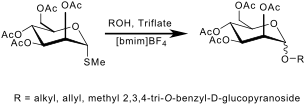
- ILs can be used in place of conventional organic solvents in synthesis, catalysis, electrochemistry, and liquid/liquid extractions.[1] Commonly reported ILs rely on organic cations, including: tetraalkylammonium, tetraalkylphosphonium, N-alkylpyridinium, 1,3-dialkylimidazolium, or trialkylsulfonium


Other Beilstein-Institut Open Science Activities



