


Search results
Search for "benzylidene" in Full Text gives 160 result(s) in Beilstein Journal of Organic Chemistry.
Backbone tuning in indenylidene–ruthenium complexes bearing an unsaturated N-heterocyclic carbene
Beilstein J. Org. Chem. 2010, 6, 1120–1126, doi:10.3762/bjoc.6.128
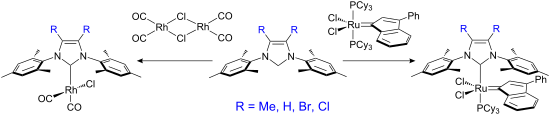
- precursors [22] and their straightforward synthesis. The higher steric hindrance and improved electronic donor ability of the indenylidene moiety also contribute to the observed increased stability compared to benzylidene congeners. This family of complexes displayed interesting stability even when forcing


Synthesis of 6-PEtN-α-D-GalpNAc-(1–>6)-β-D-Galp-(1–>4)-β-D-GlcpNAc-(1–>3)-β-D-Galp-(1–>4)-β-D-Glcp, a Haemophilus influenzae lipopolysacharide structure, and biotin and protein conjugates thereof
Beilstein J. Org. Chem. 2010, 6, 704–708, doi:10.3762/bjoc.6.80
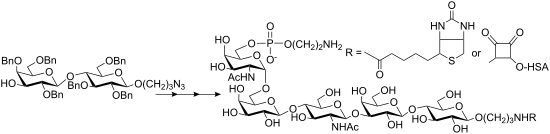
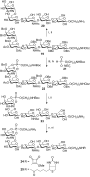
- designed and synthesised (Scheme 1). Reductive ring opening, with BH3/Bu2BOTf [12], of the benzylidene acetal in the known ethyl thioglycoside 1 [13] gave the 6-hydroxy derivative 2 (85%), which was then silylated to afford donor 3 (90%). Regioselective silylation of the 2-azido-galactose ethyl
- are often used as acceptors for regioselective glycosidations in the 3-position. However, the selectivity is dependent on the donor, promoter and conditions employed [15], e.g., it has been shown that donors containing a 4,6-O-benzylidene acetal can give a mixture of products [16]. Hence, the diol 7
- [17] was transformed using benzaldehyde dimethyl acetal and camphorsulfonic acid stereo-selectively into the corresponding 3,4-endo-benzylidene derivative 8 which was in turn converted to the 3-hydroxy derivative 9 by NaBH3CN/HCl-mediated reductive opening of the acetal ring [18] (80% overall yield


Synthesis and crossover reaction of TEMPO containing block copolymer via ROMP
Beilstein J. Org. Chem. 2010, 6, No. 59, doi:10.3762/bjoc.6.59
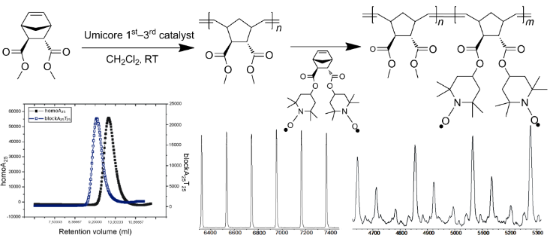
- (benzylidene)] G1 (PCy3 = tricyclohexylphosphine), [(H2IMes)(PCy3)Cl2Ru(benzylidene)] G2 (H2IMes = 1,3-bis(mesityl)-2-imidazolidinylidene), [(H2IMes)(py)2Cl2Ru(benzylidene)] G3 (py = pyridine or 3-bromopyridine) and Umicore type initiators [(PCy3)2Cl2Ru(3-phenylinden-1-ylidene)] U1 (PCy3
- polymer synthesis. Alternatively, Grubbs’ third generation catalyst G3 introduced by Grubbs et al. [10] has an ultrafast initiating ruthenium benzylidene. The rate of reaction of G3 with ethyl vinyl ether thus is six orders of magnitude higher than for G2 [10], leading to a faster initiation and often
- lower polydispersities of the resulting polymers. Recently, structural variations of G1–G3 catalysts generated a new series of catalysts U1–U3 bearing indenyl-carbenes instead of benzylidene-carbenes. These new catalysts are now commercially available and are well known as the Umicore catalysts (NEOLYST


Bis(oxazolines) based on glycopyranosides – steric, configurational and conformational influences on stereoselectivity
Beilstein J. Org. Chem. 2010, 6, No. 23, doi:10.3762/bjoc.6.23
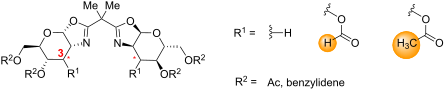
- have introduced new glucosamine-derived bis(oxazolines) 2a–c with uniform protective groups on all oxygen functions [19][20][21] and derivatives 3a–f with cyclic 4,6-O-benzylidene protection as well as various other 3-O-substituents that differ in steric demand and electronic nature [20][21]. These
- conformation of the pyranose scaffold – a twist conformation for ligands 2a–c without 4,6-O-benzylidene protection (Scheme 1, conformer A) and a partially chair-like conformation for ligands 3a–f (Scheme 1, conformer B) fixed by the annulated 4,6-O-benzylidene group – has a direct impact on the
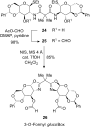
- presence of 15-crown-5 [27][28] to afford 10 in similar yields as the oxidation-reduction sequence (Scheme 2). After deprotection of the phthalimide (phthN) [29], the free amine 11 was transformed into the 4,6-O-benzylidene protected ligand by our standard protocol for the preparation of carbohydrate bis



Chemical synthesis using enzymatically generated building units for construction of the human milk pentasaccharides sialyllacto-N-tetraose and sialyllacto-N-neotetraose epimer
Beilstein J. Org. Chem. 2010, 6, No. 18, doi:10.3762/bjoc.6.18
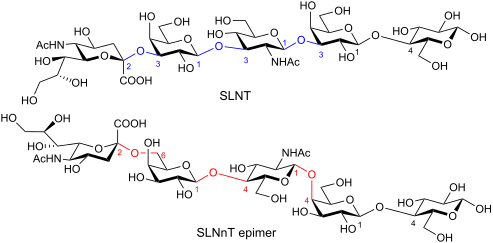
- ′-benzylidene-protected derivative 11 in almost quantitative yield by transacetalization with benzaldehyde dimethylacetal in acetonitrile under p-toluenesulfonic acid catalysis. Subsequent peracetylation with acetic anhydride/pyridine, selective cleavage of the benzylidene group with 80% acetic acid at 90 °C


Convergent syntheses of LeX analogues
Beilstein J. Org. Chem. 2010, 6, No. 17, doi:10.3762/bjoc.6.17
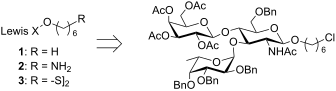
- , peracetate 10 was deacetylated (NaOMe/MeOH) and converted to the benzylidene acetal 11 by reaction with benzaldehyde dimethyl acetal under camphorsulfonic acid (CSA) catalysis. Chloroacetylation of alcohol 11 gave the intermediate 12 which was converted to acceptor 4 via the reductive opening of the
- benzylidene acetal using NaCNBH3 and HCl·Et2O in anhydrous THF at 0 °C. Both 6-azidohexyl acceptors 6 and 5 were prepared from the anomeric mixture of the known tetraacetate 13 [44]. Thus, tetraacetate 13 was reacted with 6-chlorohexanol (4 equiv) in the presence of BF3·OEt2 (5 equiv). To promote coupling
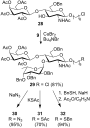
- (NaN3, DMF, 80 °C) gave the known [46] 6-azidohexyl glycoside 15 quantitatively. Zemplén deacetylation of triacetate 15 followed by conversion of the triol to the 4,6-benzylidene acetal (16) and then chloroacetylation at O-3 gave intermediate 17 that was submitted to reductive opening of the benzylidene



Acid- mediated reactions under microfluidic conditions: A new strategy for practical synthesis of biofunctional natural products
Beilstein J. Org. Chem. 2009, 5, No. 40, doi:10.3762/bjoc.5.40
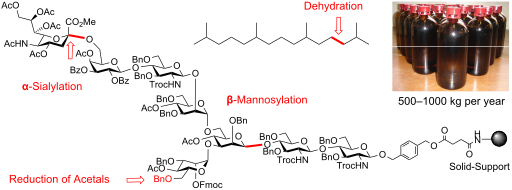
- benzylidene acetal groups, and dehydration, which are the keys to the practical synthesis of N-glycans and the immunostimulating natural product, pristane. A distinctly different reactivity from that in conventional batch stirring was found; the vigorous micromixing of the reactants with the concentrated
- preparing bioactive natural products [27][28][29][30][31][32][33]. Our successful examples are cation-mediated reactions, such as α-sialylation [28][32], β-mannosylation [31], and reductive opening of the benzylidene acetal groups in sugars [30], for which improved procedure under the microfluidic
- of benzylidene acetal group, for the large-scale preparation of the fragment b [30] could also be circumvented under the microfluidic conditions, as will be discussed in the following sections. Microfluidic α-sialylation We have previously developed an efficient α-sialylation by utilizing the highly


Recent progress on the total synthesis of acetogenins from Annonaceae
Beilstein J. Org. Chem. 2008, 4, No. 48, doi:10.3762/bjoc.4.48
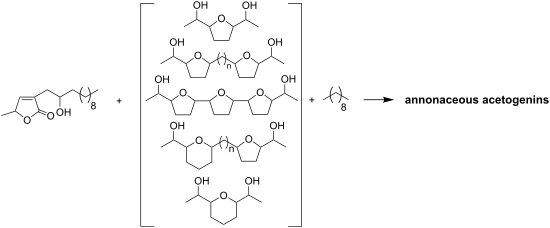
- of 67 to 1,3-dimesitylimidazol-2-ylidene ruthenium benzylidene catalyst (RuCl2(=C(H)-Ph)(PCy3)(IMes)) after protection of the free hydroxyl group afforded the RCM product 68. Hydrogenation of the double bond of dihydrofuran 68 and iodination of the primary alcohol gave 69, which was then utilized to


Solvent- controlled regioselective protection of allyl- 4,6-benzylidene glucopyranosides
Beilstein J. Org. Chem. 2007, 3, No. 26, doi:10.1186/1860-5397-3-26

- silylation at the 2-position of allyl 4,6-O-benzylidene α-D-glucopyranoside in high yields and which does not require the use of catalysts. Background Numerous syntheses of oligosaccharides incorporating glucose moieties have been reported. In most cases, a limiting synthetic factor is the number of
- benzylation of methyl 4,6-O-benzylidene glucopyranoside claim isolated yields ranging from the 37% and below [9] to 75% and above [10]. Others reported multi-step procedures to achieve introduction of a suitable protecting group at the 2-position of the 4,6-O-benzylidene 1-O-alkyl protected glucose [11] or
- used enzymes to achieve selectivity [12]. Results and discussion While preparing the partially protected glucose 1 from α-allyl-4,6-benzylidene glucoside 2 (Scheme 1), we observed that mono-benzylation could be achieved, if instead of DMF and the usual reagents' combination (i.e. NaH, BnBr, Bu4NI), THF


An efficient synthesis of novel pyrano[2,3-d]- and furopyrano[2,3-d]pyrimidines via indium- catalyzed multi- component domino reaction
Beilstein J. Org. Chem. 2006, 2, No. 11, doi:10.1186/1860-5397-2-11
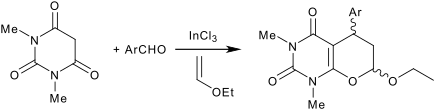
- summarized in the Table 1. Remarkably, this Diels-Alder reaction was also proceeded similarly when 5-benzylidene barbituric acid was employed directly with 2,3-dihydrofuran in presence of 1 mol% of indium(III) chloride. The corresponding furopyrano [2,3-d]pyrimidine derivatives 7 were obtained in almost


Other Beilstein-Institut Open Science Activities



