Search results
Search for "concentration" in Full Text gives 1454 result(s) in Beilstein Journal of Organic Chemistry. Showing first 200.
Supramolecular assemblies of amphiphilic donor–acceptor Stenhouse adducts as macroscopic soft scaffolds
Beilstein J. Org. Chem. 2024, 20, 1590–1603, doi:10.3762/bjoc.20.142
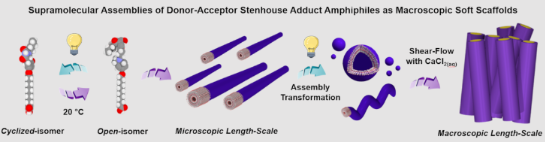
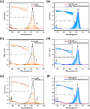
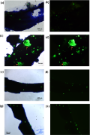
- , was further diluted to prepare various aliquots with a concentration ranging from 1.0 × 10⁻⁴–0.1 mM in order to estimate the critical aggregation concentration (CAC) by using static light scattering (SLS). An aqueous solution of DA11 was estimated to have a CAC of <6.0 μM (Figure S5, Supporting
- normalized by the concentration of the solution to yield the molar scattering intensity. Ten replications were performed, and the data was averaged to show the molar scattering intensity and the error standard deviation. WAXD WAXD of DA scaffolds was measured on a sapphire substrate (φ = 2.0 cm) using a




Benzylic C(sp3)–H fluorination
Beilstein J. Org. Chem. 2024, 20, 1527–1547, doi:10.3762/bjoc.20.137

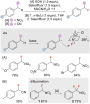
- attributed this to the increased solubility and concentration of NFSI in the AIBN conditions, which were performed at elevated temperatures, promoting facile trapping of a primary radical. In contrast, the decatungstate conditions, which operated at room temperature where NFSI is not completely dissolved and








Primary amine-catalyzed enantioselective 1,4-Michael addition reaction of pyrazolin-5-ones to α,β-unsaturated ketones
Beilstein J. Org. Chem. 2024, 20, 1518–1526, doi:10.3762/bjoc.20.136
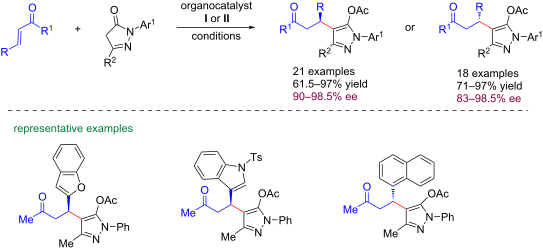
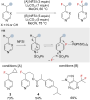
- (Table 1, entry 11). Subsequently, the effect of concentration on the reaction outcome was also studied. In dilute conditions, both the yield and enantioselectivity of the product 3aa were improved to 80% and 94%, respectively, at room temperature (Table 1, entry 12). Taking into account the results of




Towards an asymmetric β-selective addition of azlactones to allenoates
Beilstein J. Org. Chem. 2024, 20, 1504–1509, doi:10.3762/bjoc.20.134
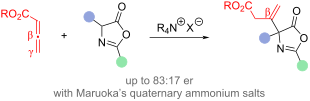
- L1000 at 589 nm ([α]D values are listed in deg/(dm(g/cm3)); concentration c is given in g/100 mL). Unless otherwise stated, all chemicals were purchased from commercial suppliers and used without further purification. Dry solvents were obtained from an MBraun-SPS-800 solvent purification system. All


Photoswitchable glycoligands targeting Pseudomonas aeruginosa LecA
Beilstein J. Org. Chem. 2024, 20, 1486–1496, doi:10.3762/bjoc.20.132
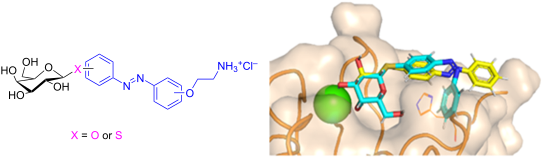
- a final concentration of 5% or 10% DMSO. The 200 μL sample cell containing LecA (concentrations ranging from 200 to 300 μM) was subjected to injections of ligand solution: 20 injections of 2 μL (2–3 mM, depending on the ligand) at intervals of 120 s while stirring at 850 rpm. Control experiments
- total heat released as a function of total ligand concentration for the titration shown in the upper panel. The solid line represents the best least-square fit to experimental data using a one site model. (A) Enthalpy–entropy compensation plot of compounds 1–5 from ITC analysis. The dotted green line


Synthesis of 2-benzyl N-substituted anilines via imine condensation–isoaromatization of (E)-2-arylidene-3-cyclohexenones and primary amines
Beilstein J. Org. Chem. 2024, 20, 1468–1475, doi:10.3762/bjoc.20.130
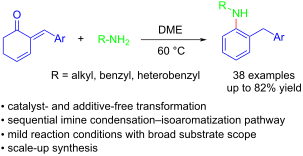
- reaction media led to higher yields. More precisely, dimethoxyethane (DME) gave a superior result to THF, affording 4aa in 82% yield (Table 1, entries 10–16). Subsequently, modification of the reaction temperature or concentration turned out to be unsatisfactory (Table 1, entries 17–19). We also added 4 Å


Challenge N- versus O-six-membered annulation: FeCl3-catalyzed synthesis of heterocyclic N,O-aminals
Beilstein J. Org. Chem. 2024, 20, 1412–1420, doi:10.3762/bjoc.20.123
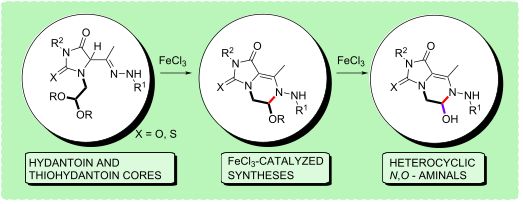
- , in this case, the formation of carbinolamine 6a becomes predominant (45%), despite a small quantity of N,O-aminal 5j (14%) is also produced, by virtue of the alcohol released from the starting acetal 4j. Probably, the higher water concentration in acetonitrile shifts the equilibrium in favour of 6a


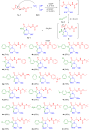


Hypervalent iodine-catalyzed amide and alkene coupling enabled by lithium salt activation
Beilstein J. Org. Chem. 2024, 20, 1405–1411, doi:10.3762/bjoc.20.122

- the reaction efficiency, we screened several additional parameters including solvents and concentration. In these cases, we found that while both acetonitrile and MeNO2 (0.25 M) were suitable solvents, other solvents in general afforded no product formation (Table 1, entries 2–6). Lower catalyst

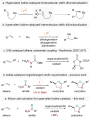


Synthetic applications of the Cannizzaro reaction
Beilstein J. Org. Chem. 2024, 20, 1376–1395, doi:10.3762/bjoc.20.120
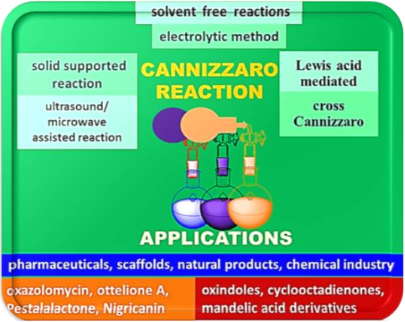
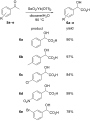
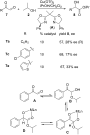
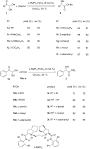
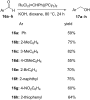
- in the appropriate vicinity for the reaction to take place in appreciably good yields (84%). The barium cation template is the key for the reaction, as is the base concentration for effective hydride transfer (Scheme 14) [29]. They also extended the scope of the intramolecular Cannizzaro reaction to

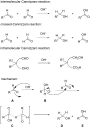







Mechanistic investigations of polyaza[7]helicene in photoredox and energy transfer catalysis
Beilstein J. Org. Chem. 2024, 20, 1236–1245, doi:10.3762/bjoc.20.106
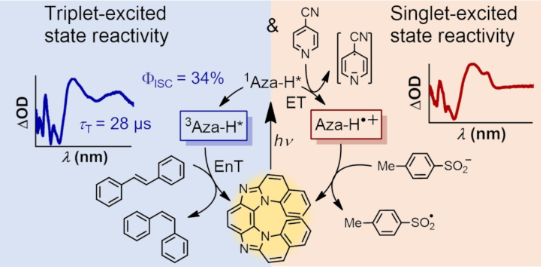
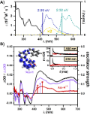
- overall small extinction coefficient of the radical anion (Figure S6 in Supporting Information File 1 and the corresponding discussion). To investigate the triplet reactivity of Aza-H, a lower concentration of 4CP (5 mM) was used, quenching the singlet excited photocatalyst only partially (η ≈ 25%) and
- solution of Aza-H with a lower concentration of TsNa (200 µM). We presumed this would enable us to exclusively monitor Aza-H•+ quenching by TsNa, since any triplet Aza-H would be deactivated by oxygen (see above). The ionization efficiency of Aza-H exhibits a quadratic dependence on the laser intensity
- . Consequently, focussing the laser on a narrow excitation spot on the sample ensured a significant generation of Aza-H•+ while minimizing the concentration of triplet-excited Aza-H. Initially, the same amount of radical cation is detected after the addition of TsNa, but the Aza-H•+ signal at 460 nm decays much




Competing electrophilic substitution and oxidative polymerization of arylamines with selenium dioxide
Beilstein J. Org. Chem. 2024, 20, 1221–1235, doi:10.3762/bjoc.20.105
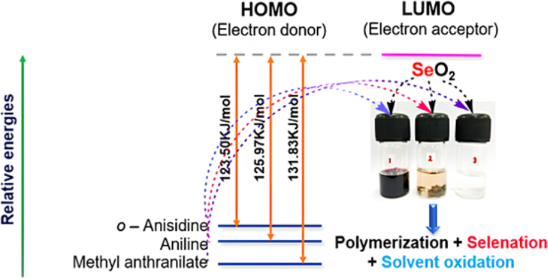
- the amount of solvent was doubled. We used a higher concentration of reactants in our studies as the yield of soluble products obtained at lower concentration of reactants was not satisfactory. However, under both conditions, a blackish purple polymeric solid was isolated as major product, labelled


The Ugi4CR as effective tool to access promising anticancer isatin-based α-acetamide carboxamide oxindole hybrids
Beilstein J. Org. Chem. 2024, 20, 1213–1220, doi:10.3762/bjoc.20.104
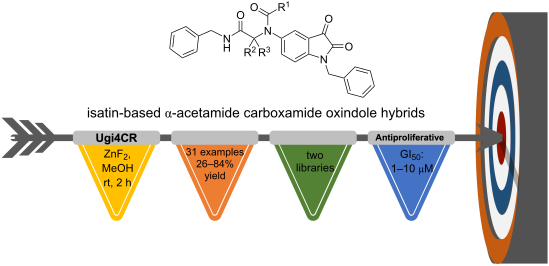
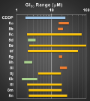
- . The half-maximal growth inhibitory concentration (GI50) values after 48 hours of exposure were calculated for each compound (Table S1, Supporting Information File 1). The standard anticancer drug cisplatin (CDDP) was used as positive control. The results are viewed as GI50 range plot (Figure 3). The




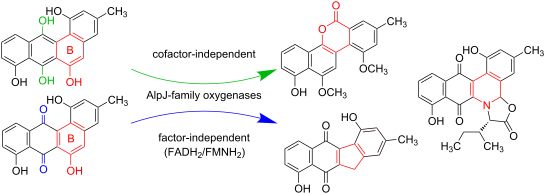
Cofactor-independent C–C bond cleavage reactions catalyzed by the AlpJ family of oxygenases in atypical angucycline biosynthesis
Beilstein J. Org. Chem. 2024, 20, 1198–1206, doi:10.3762/bjoc.20.102
- , 30 min) in 10 kDa ultrafiltration tubes (Centriplus YM series, Merck Millipore). Protein concentration was quantified by the Bradford method. AlpJ, JadG, JadH, and E. coli flavin reductase (Fre) were overproduced and purified by Ni-NTA agarose chromatography as described previously [10][11][43][44




Bismuth(III) triflate: an economical and environmentally friendly catalyst for the Nazarov reaction
Beilstein J. Org. Chem. 2024, 20, 1167–1178, doi:10.3762/bjoc.20.99
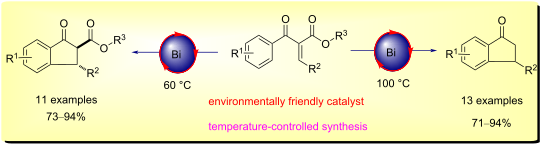
- inhibitory concentration (IC50) of 10 ng/mL, lepistatin A (3), along with two other new chlorinated analogs, that were isolated from Basidiomycete Lepista sordida culture, pauciflorol F (4), isolated from Vatica pauciflora, which is an important building block for the biosynthesis of bioactive polyphenols
- achieved. Under both conditions, virtually no product mixtures were observed. Preliminary biological evaluation To investigate the cytotoxic activity of the indanone derivatives, in total 20 compounds were tested at a concentration of 5 and 50 μg/mL for 72 h in a panel of four histologically unrelated
- ) being active at 5 μg/mL, using a 75% cutoff inhibition at each concentration. On the other hand, MCF-7 and SK-MEL-28 cells were the most resistant ones, with no compound being active at the lower concentration (Figure 5). This evidence of selective cytotoxicity for a specific histological tumor subtype


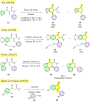


Manganese-catalyzed C–C and C–N bond formation with alcohols via borrowing hydrogen or hydrogen auto-transfer
Beilstein J. Org. Chem. 2024, 20, 1111–1166, doi:10.3762/bjoc.20.98
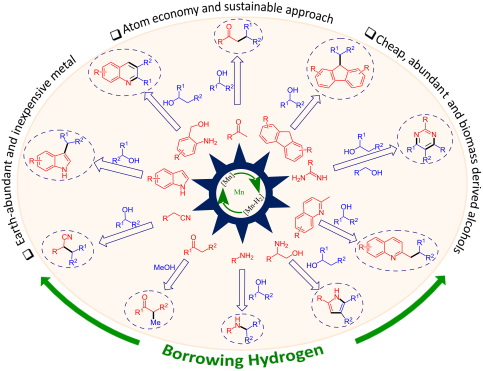
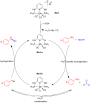
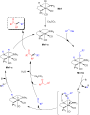
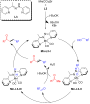
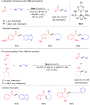
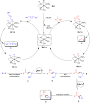
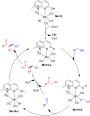
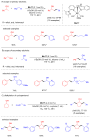
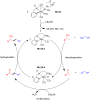
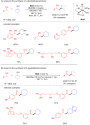
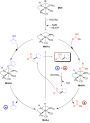
- investigated using four different well-defined phosphine substituents-containing Mn complexes with acetophenone and benzyl alcohol as model substrates. Among these, complex Mn1 showed better results with 2 mol % loading and at low base concentration (Cs2CO3; 5 mol %) in tert-amyl alcohol at 140 °C for 22 h























Synthesis of 1,4-azaphosphinine nucleosides and evaluation as inhibitors of human cytidine deaminase and APOBEC3A
Beilstein J. Org. Chem. 2024, 20, 1088–1098, doi:10.3762/bjoc.20.96
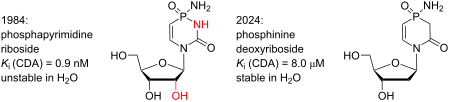
- (A3BCTD), originally called A3BCTD-QM-∆L3-AL1swap [54], in which loop 3 is deleted and loop 1 is replaced with the corresponding loop 1 from A3A. The residual activity of the A3A mimic on the unmodified oligonucleotide 5'-TTTTCAT as a substrate in the presence of a known concentration of inhibitor was
- measured using the NMR-based assay (Figure 2). The results revealed that both anomers of Va do not inhibit engineered A3A mimic even at elevated concentration in comparison to a control ODN containing FdZ (IId) at pH 6.0. It is very likely that a negative charge in nucleobase Va prevents binding to the
- resulting DNA hairpin. The β-anomer of Va was introduced instead of the target dC in the DNA hairpin with TTC loop and tested in the 1H NMR-based assay monitoring A3A-catalysed deamination of dC hairpin (T(GC)2TTC(GC)2T, wherein C is deaminated) at a 150 mM salt concentration at pH 7.4. Recently, FdZ (IId


Light on the sustainable preparation of aryl-cored dibromides
Beilstein J. Org. Chem. 2024, 20, 1076–1087, doi:10.3762/bjoc.20.95
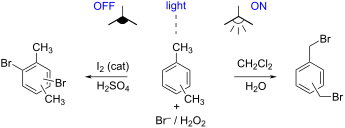
- CCl4 to prevent undesired solvent degradation. Furthermore, the direct use of Br2, even if used in low concentration, exhibits limited selectivity towards benzylic bromination, primarily due to co-bromination occurring on the aromatic ring. This side process produces awkward halogenated byproducts that


Structure–property relationships in dicyanopyrazinoquinoxalines and their hydrogen-bonding-capable dihydropyrazinoquinoxalinedione derivatives
Beilstein J. Org. Chem. 2024, 20, 1037–1052, doi:10.3762/bjoc.20.92
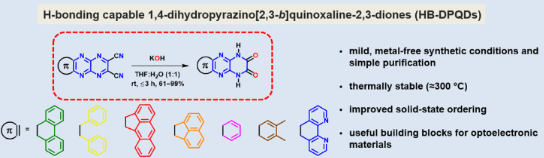
- illustrated in Figures S37–S41 (Supporting Information File 1). This serves as good evidence that the synthesized compounds exhibit no signs of aggregation in DMSO within the assessed concentration range (i.e., 2.5–45 μM). Electronic structure calculations Gas-phase computational investigations were conducted
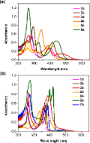
- 40 μM solutions of the DCPQs and DPQDs on a Cary 100 Bio spectrophotometer using 1 cm quartz cells. All solvents were HPLC grade (purchased from Fisher) and stored over 4 Å molecular sieves. The absorption intensity at λmax was then plotted against the concentration in all cases to confirm, by




Novel analogues of a nonnucleoside SARS-CoV-2 RdRp inhibitor as potential antivirotics
Beilstein J. Org. Chem. 2024, 20, 1029–1036, doi:10.3762/bjoc.20.91
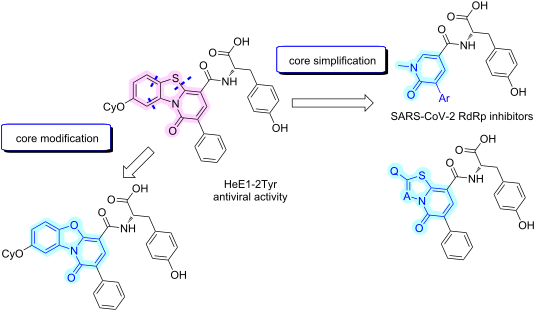
- most successful modification. The potential of the truncated derivatives was further illustrated by the thiazolopyridone and thiadiazolopyridone compounds 4a,b, which showed inhibition with IC50 = 88.1 μM and 128.7 μM, respectively. Even though the measured inhibitory concentration was higher than that
- antivirals. Structure of HeE1-2Tyr (1) and of the derivatives synthesized in this work. Analysis of inhibitory activity against SARS-CoV-2 RdRp using primer extension assay. A) Gel-based polymerase assay with a constant concentration of fluorescently labeled template/primer RNA (0.5 µM) and the polymerase
- ) Graphical representation of the inhibitory activity of selected compounds evaluated from the gels obtained in the primer extension assay. The percentage of inhibition (against control) was plotted against the logarithm of the concentration of compounds. The results were fitted to sigmoidal dose–response


Auxiliary strategy for the general and practical synthesis of diaryliodonium(III) salts with diverse organocarboxylate counterions
Beilstein J. Org. Chem. 2024, 20, 1020–1028, doi:10.3762/bjoc.20.90
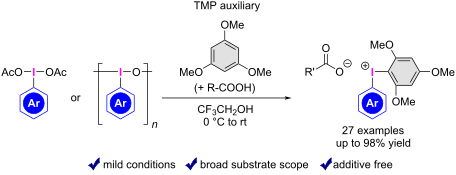
- % yield. It is worth noting that the products yielded by these protocols were easily separated as white amorphous solids by concentration and trituration of the obtained residue with diethyl ether. The color of the products indicates that the reactions proceeded without any signs of decomposition


Spin and charge interactions between nanographene host and ferrocene
Beilstein J. Org. Chem. 2024, 20, 1011–1019, doi:10.3762/bjoc.20.89
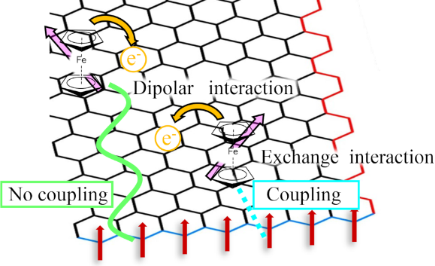
- Fe2p peaks and the increase in shake-up peak intensity of the C1s in the XPS spectrum proved the emergence of charge-transfer host–guest interaction in FeCp2-ACFs-150, supported by the red-shift of the G-band in the Raman spectrum. The six-times enhancement in the spin concentration in FeCp2-ACFs-150
- compared with ACFs indicates the spin magnetism of the non-magnetic guest FeCp2+ molecule induced by a charge-transfer host–guest interaction in the nanographene host. The larger ESR linewidth than that expected from the dipolar interaction estimated by the localized spin concentration suggests the
- constant. The spin concentration Nspin for each sample was calculated from the Curie constant. ESR measurements were performed using a conventional ESR X-band spectrometer (JEOL, JES-FA300) at room temperature, where ca 1 mg of samples vacuum-sealed in glass tubes were used. In order to prevent the skin


A Diels–Alder probe for discovery of natural products containing furan moieties
Beilstein J. Org. Chem. 2024, 20, 1001–1010, doi:10.3762/bjoc.20.88
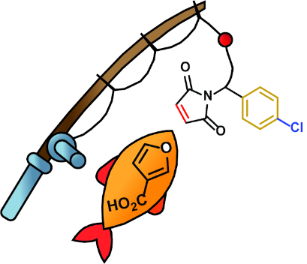
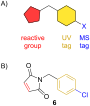
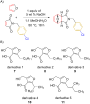
- 14 (69 µM and 18 mM, respectively), suggesting that the probe will be highly useful for detecting lower concentration furans. The maleimide probe was then tested for its ability to detect the naturally produced MMF compounds (Figure 5). Two strains of Streptomyces coelicolor were tested: S
- times) to observe the molecules in their native producers. While this is not ideal, it is still significantly better than the concentration needed without probe (≈260,000 times). Conclusion MMFs are important signaling hormones that induce the production of methylenomycin A. Bioinformatics data suggests
- figure were run at 25-times the extracted concentration. Representative data from three experiments is shown. Conversion of various synthetic substrates when reacted with the maleimide probe.a Conversion of various natural product substrates when reacted with the maleimide probe.a Supporting Information




Direct synthesis of acyl fluorides from carboxylic acids using benzothiazolium reagents
Beilstein J. Org. Chem. 2024, 20, 921–930, doi:10.3762/bjoc.20.82
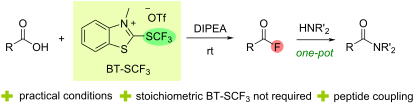
- the efficiency of the reaction, whereas a 19F NMR yield of only 11% was achieved in DMF (Table 1, entries 10–12). Increasing the reaction concentration to 0.2 M in DCM led to a reduction in the 19F NMR yield of 2a to 74% (Table 1, entry 13). Finally, optimisation of the reaction time revealed the



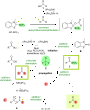
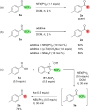
Three-component N-alkenylation of azoles with alkynes and iodine(III) electrophile: synthesis of multisubstituted N-vinylazoles
Beilstein J. Org. Chem. 2024, 20, 891–897, doi:10.3762/bjoc.20.79
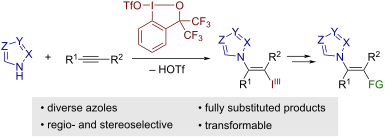
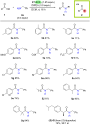
- , entry 1). Decreasing or increasing the concentration did not improve the yield of 4aa (Table 1, entries 2 and 3). The reaction became rather sluggish in different solvents such as HFIP and Et2O (Table 1, entries 4 and 5). By reducing the equivalents of 2a to 3 equiv and 2 equiv, the yield of 4aa dropped



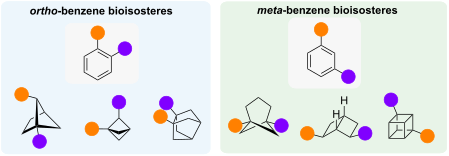
(Bio)isosteres of ortho- and meta-substituted benzenes
Beilstein J. Org. Chem. 2024, 20, 859–890, doi:10.3762/bjoc.20.78
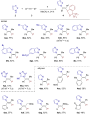
- 50% inhibition concentration of selected CYP450 enzymes (IC50). Cis-2,6-disubstituted [2]-ladderanes Brown and co-workers recently proposed cis-2,6-disubstituted bicyclo[2.2.0]hexanes ([2]-ladderanes) as isosteric replacements for meta-benzenes. An exit vector analysis indicated that the substituent
- potential explanation for these observations is an increase in heterocycle basicity on bioisosteric switch of a neighbouring aromatic group. However, the drug-specific half-maximal rescue concentration (RC50 CFTR, lower indicates higher biological activity), indicative of the biological activity, increased
- both 189 and iso-189 in form of the inhibition of prostaglandin PGE2 synthesis by cyclooxygenase-2 (COX-2). Their investigation showed that while 1,3-cuneane 189 requires a 100-fold increase in concentration to reach inhibitory rates comparable to ketoprofen, its isomer iso-189 is inactive against COX