


Search results
Search for "control" in Full Text gives 1627 result(s) in Beilstein Journal of Organic Chemistry. Showing first 200.
Chemical glycobiology
Beilstein J. Org. Chem. 2025, 21, 8–9, doi:10.3762/bjoc.21.2

- methods that underlie modern glycobioinformatics approaches [15]. Validation of glycoprotein structure is an important aspect of contemporary structural biology, and Dialpuri et al. present the Privateer database to allow for facile quality control of such structures [16]. Finally, Barillot et al. bridge
Reactivity of hypervalent iodine(III) reagents bearing a benzylamine with sulfenate salts
Beilstein J. Org. Chem. 2024, 20, 3281–3289, doi:10.3762/bjoc.20.272
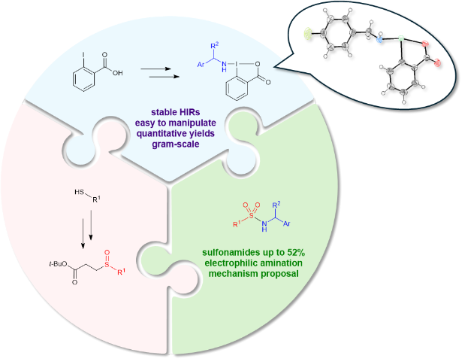
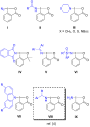
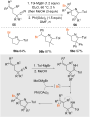
- scavengers capable of abstracting the radical species that could emerge in the reaction media. The use of galvinoxyl proved to be insufficient to conclude since a control experiment showed that HIRs 2 decompose in the presence of galvinoxyl. When using TEMPO (Scheme 5), sulfinamide 6aa was not detected, but
- recognized ionic character of the sulfenate ion generated in the retro-Michael addition, on the results obtained with TEMPO (Scheme 5), and also on the results obtained when the reaction was carried out in the absence and presence of light, as well as the control experiments in the absence of BBX (see



Giese-type alkylation of dehydroalanine derivatives via silane-mediated alkyl bromide activation
Beilstein J. Org. Chem. 2024, 20, 3274–3280, doi:10.3762/bjoc.20.271
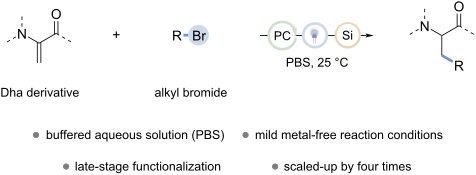
- -protected Michael acceptor, derived from proline, allowed for preparation of compound 27 with a 35% yield in 4 hours without control of diastereoselectivity (dr = 1:1). Finally, to prove that the optimized reaction also works at a larger scale, the model reaction was carried out on a 2.2 mmol scale (Figure



Non-covalent organocatalyzed enantioselective cyclization reactions of α,β-unsaturated imines
Beilstein J. Org. Chem. 2024, 20, 3221–3255, doi:10.3762/bjoc.20.268
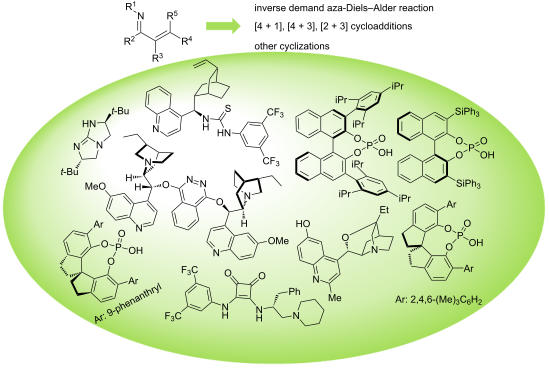
- derivatives 3 in yields up to 99%, up to 20:1 dr, and up to 99% ee [24]. This work represents the first enantioselective bifunctional catalytic inverse electron demand Diels–Alder reaction that occurs with a dual control of the dienophile HOMO and diene LUMO energies of the substrates. The amino group of the
- calculations also revealed that due to kinetic control the activation of the C2 carbon of the dienolate is preferred vs the C4 atom, therefore only one regioisomer is observed. Additionally, the asymmetric IEDADA reaction could be performed at a higher scale (1 mmol) leading to the synthesis of the









Discovery of ianthelliformisamines D–G from the sponge Suberea ianthelliformis and the total synthesis of ianthelliformisamine D
Beilstein J. Org. Chem. 2024, 20, 3205–3214, doi:10.3762/bjoc.20.266
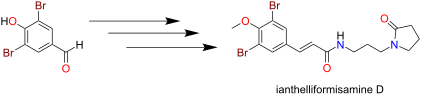
- OD600 and resazurin (RSZ) metabolic assay, respectively. The final concentration of DMSO in the assays was 1% (v/v). The negative controls consisted of inoculum and 1% DMSO. The antibiotic tobramycin (Sigma-Aldrich; 16 µg/mL) was used as a positive control. The initial OD600 and final OD600 were read


![[Graphic 1]](/bjoc/content/inline/1860-5397-20-266-i2.svg?max-width=637&scale=1.18182)
![[Graphic 2]](/bjoc/content/inline/1860-5397-20-266-i3.svg?max-width=637&scale=1.18182)
![[Graphic 3]](/bjoc/content/inline/1860-5397-20-266-i4.svg?max-width=637&scale=1.18182)

![[Graphic 4]](/bjoc/content/inline/1860-5397-20-266-i5.svg?max-width=637&scale=1.18182)
![[Graphic 5]](/bjoc/content/inline/1860-5397-20-266-i6.svg?max-width=637&scale=1.18182)

Synthesis of extended fluorinated tripeptides based on the tetrahydropyridazine scaffold
Beilstein J. Org. Chem. 2024, 20, 3174–3181, doi:10.3762/bjoc.20.262
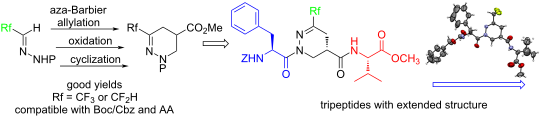
- stabilizes their secondary structure and their metabolic stability, which is useful for numerous applications [3][4][5]. Indeed, the cyclic structure considerably reduces the number of possible rotational conformers, allowing a rational control of the 3D conformational space. Among these cyclic structures
- strategy, the control of the stereoselectivity of the intramolecular aza-Michael addition could be envisaged with various chiral catalysts in further studies. These heterocyclic hydrazino acids, when incorporated into the peptidic structure, appear to confer an extended conformation. These interesting


Multicomponent reactions driving the discovery and optimization of agents targeting central nervous system pathologies
Beilstein J. Org. Chem. 2024, 20, 3151–3173, doi:10.3762/bjoc.20.261

- conducted at a concentration of 10 μM, with donepezil serving as a positive control. To measure their impact on cellular tau oligomerization, the fluorescence resonance energy transfer (FRET) signal intensity was quantified in a cellular tau FRET assay at the same 10 μM concentration, using MK-886, a known
- tau-oligomerization inhibitor, as the positive control. Two compounds (7a and 7b, Figure 7) demonstrated a high inhibitory activity against AChE and tau-oligomerization, which were selected for further exploration. The neuroprotective effects of the compounds were assessed in comparison to MK-886 and
- deacetylase substrate MAL to determine the inhibitory activity, and using sirtinol as positive control. When compared to sirtinol (IC50 = 67 µM), selected compounds showed moderate affinity towards SIRT2, with IC50 values ranging from 118 to 126 µM (Figure 10). Gewald reaction: Cannabinoid receptors have been


Controlled oligomerization of [1.1.1]propellane through radical polarity matching: selective synthesis of SF5- and CF3SF4-containing [2]staffanes
Beilstein J. Org. Chem. 2024, 20, 3134–3143, doi:10.3762/bjoc.20.259
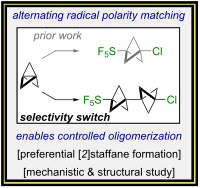
- oligomerizations involving [1.1.1]propellane – i.e., to make [n]staffanes – has been notoriously challenging to control when n > 1 is desired. Herein, we report selective syntheses of SF5- and CF3SF4-containing [2]staffanes from SF5Cl and CF3SF4Cl, demonstrating cases whereby oligomerization is preferentially
- is conceptually appealing, radical additions of X–Y across 1 in practice can be challenging to control and often lead to complex mixtures of functionalized [n]staffanes, n = 1–5 (Figure 1, top) [2][31][32][33][34]. Even though [n]staffanes are often separable by column chromatography, the yields for


Hypervalent iodine-mediated intramolecular alkene halocyclisation
Beilstein J. Org. Chem. 2024, 20, 3113–3133, doi:10.3762/bjoc.20.258
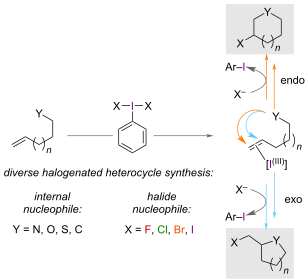
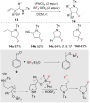
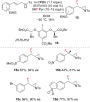
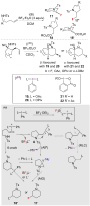
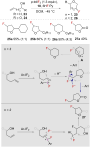
- reductive ligand coupling (RLC) pathway would be suppressed due to reduced fluxionality of the carboxylate ligand on I(III). These important findings are expected to enhance the use of aryl iodane(III)-dicarboxylates for constructing fluorinated azaheterocycles with improved selectivity and control. Oxygen
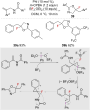
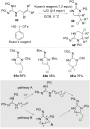
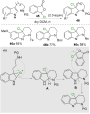
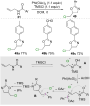
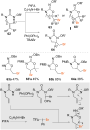
- aminofluorination using BF3·Et2O with a chiral aryliodide 16 catalyst (Scheme 20) [44]. The study successfully obtained various chiral fluorinated oxazine products 38 with high enantioselectivity (up to >99% ee) and diastereoselectivity (up to >20:1 dr). Control experiments showed that using Py·9HF or Et3N·3HF as



















Advances in the use of metal-free tetrapyrrolic macrocycles as catalysts
Beilstein J. Org. Chem. 2024, 20, 3085–3112, doi:10.3762/bjoc.20.257
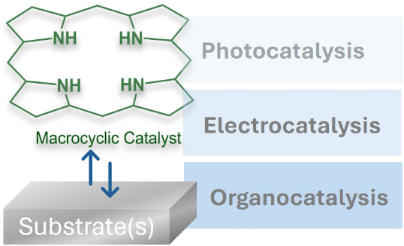
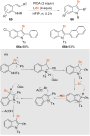
- acetonitrile, calix[4]pyrrole enhanced its solubility, contributing to its indirect activation. Various control experiments, such as using CuI with and without calix[4]pyrrole and using dipyrromethane as another potential co-catalyst, have confirmed the role of calix[4]pyrrole as a promoter. Recently
- , along with electrostatic and hydrogen-bonding interactions. This behavior not only allowed for the selective activation and deactivation of organocatalytic activity but also facilitated efficient catalyst recovery at the end of the catalytic reaction. Notably, control experiments supported the
- optically active form with 16.7% ee for 63a and 11.8% ee for 63b, respectively (Table 4). The pH-induced aggregation does not only enable to control the catalytic activity, but it also allows a straightforward separation and recovery of the catalyst from the reaction mixture by acidification and


Chemical structure metagenomics of microbial natural products: surveying nonribosomal peptides and beyond
Beilstein J. Org. Chem. 2024, 20, 3050–3060, doi:10.3762/bjoc.20.253

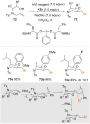
- offloading step always entails the same chemical reaction, wherein nucleophilic attack is promoted by the catalytic triad of a TE via general base catalysis. This is likely why traditional mechanistic studies that focused on the enzyme active site failed to work out how TEs control NRP topology. A priori


Cyclodextrin-based rotaxanes for polymer materials: challenge on simultaneous realization of inexpensive production and defined structures
Beilstein J. Org. Chem. 2024, 20, 3026–3049, doi:10.3762/bjoc.20.252
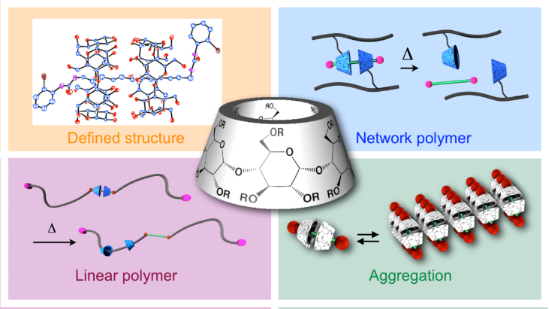
- -0083 Tokyo, Japan 10.3762/bjoc.20.252 Abstract Owing to their dynamic natures, rotaxane-based polymers are attractive motifs for developing stimuli-responsive materials. However, the accurate control of the rotaxane structure, which can be achieved via multistep synthesis, is key to utilizing the
- ][22][23][24][25][26][27][28][29][30]. To maximize the utility of rotaxane-based architectures, the accurate control of their structures is the key, although multistep synthesis is required to implement an elaborate molecular design. However, realizing the material application requires a scalable
- maintaining a structural control that is as high as that in the small-molecule system, where complicated synthesis is more accepted. Employing cyclodextrin (CD) as a ring unit represents a reasonable option for reducing the synthetic cost because of its lower production cost compared with those of other




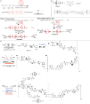


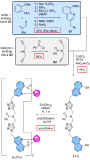
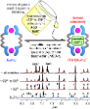
Tailored charge-neutral self-assembled L2Zn2 container for taming oxalate
Beilstein J. Org. Chem. 2024, 20, 3007–3015, doi:10.3762/bjoc.20.250
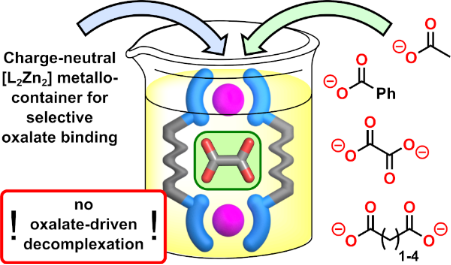
- fashion with an included lever to control the selectivity by an external stimulus. Additionally, the clear take home messages from recent conferences paired with the latest insights from working with such charge-neutral hosts in the laboratory show that one major task is to find a solution for the so far




Recent advances in transition-metal-free arylation reactions involving hypervalent iodine salts
Beilstein J. Org. Chem. 2024, 20, 2891–2920, doi:10.3762/bjoc.20.243

- corresponding products in moderate to good yields. The reaction conditions remained consistent, except K2S2O8 was found to be a superior additive compared to BQ. The reaction exhibited good tolerance even towards strong electron-withdrawing groups. A control experiment was conducted to investigate the reaction


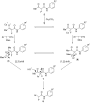


N-Glycosides of indigo, indirubin, and isoindigo: blue, red, and yellow sugars and their cancerostatic activity
Beilstein J. Org. Chem. 2024, 20, 2840–2869, doi:10.3762/bjoc.20.240
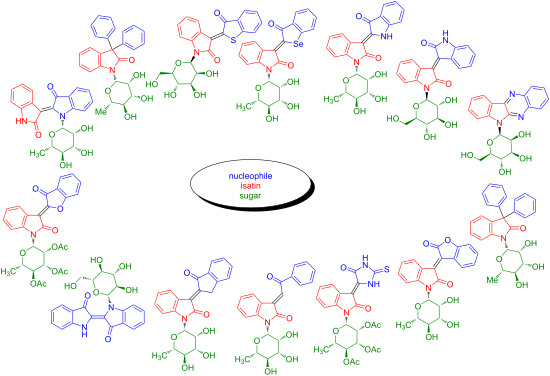
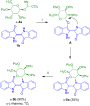
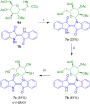
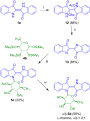
- bond is formed, a thermodynamic control of the E/Z-ratio and influence of the reaction time is unlikely. However, the reported formation of 41e as a single isomer has to be treated with some care. In the publication, no supporting information and compound characterization was given. In addition, the
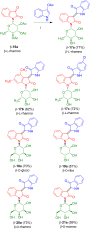
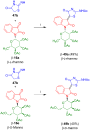
- , the downstream signaling pathways seem to be based on the production of reactive oxygen species [48]. Like E-β-46b, the presence of derivative E-β-46e appears to control apoptosis in melanoma cells which is (again) increased by the presence of TRAIL and results in complete loss of cell viability. As










Mechanochemical difluoromethylations of ketones
Beilstein J. Org. Chem. 2024, 20, 2799–2805, doi:10.3762/bjoc.20.235
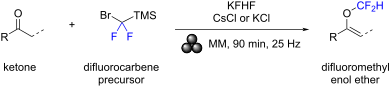
- the gas phase than in solution [32][33], it has remained a challenge to control such reactions. Our group has recently reported a mechanochemical difluoromethylation of primary, secondary, and tertiary alcohols [34], yielding products with difluoromethoxy groups, which are promising organofluorine


Copper-catalyzed yne-allylic substitutions: concept and recent developments
Beilstein J. Org. Chem. 2024, 20, 2739–2775, doi:10.3762/bjoc.20.232
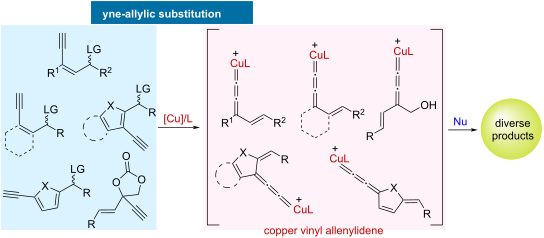
- nucleophiles (Scheme 1b). However, to achieve a highly selective yne-allylic substitution, a range of challenges must be addressed. First, how to achieve the regioselectivity under the coexistence of alkenyl and alkynyl units; second, how to realize the enantioselectivity control that is remote from the
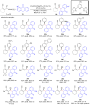
- chelation interaction between the enolate derived from acyclic 1,3-dicarbonyl compounds and copper (Scheme 5, 8a–j). Detailed control experiments indicate that the terminal alkyne moiety is critical and the reaction proceeds through an SN1 mechanism. An outer-sphere nucleophilic attack through copper
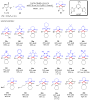
- ). Further control experiments and DFT calculations show that during the catalytic process, tertiary amine directly participates as a nucleophilic reagent to give the ammonium salt, which then releases dimethylaminium to provide the final product (Scheme 12). Chiral allylic sulfone compounds can be easily








Interaction of a pyrene derivative with cationic [60]fullerene in phospholipid membranes and its effects on photodynamic actions
Beilstein J. Org. Chem. 2024, 20, 2732–2738, doi:10.3762/bjoc.20.231

- Instutite for Liberal Arts and Sciences (ILAS), Kyoto University, Sakyo-ku, Kyoto 606-8501, Japan 10.3762/bjoc.20.231 Abstract We have reported that upon visible light irradiation, ferrocene-porphyrin-[60]fullerene triad molecules yield long-lived charge-separated states, enabling the control of the plasma
- membrane potential (Vm) in living cells. These previous studies indicated that the localization of the triad molecules in a specific intra-membrane orientation and the suppression of the photodynamic actions of the [60]fullerene (C60) moiety are likely important to achieve fast and safe control of Vm
- safer control of Vm. Keywords: liposome; π–π interaction; reactive oxygen species; superoxide radical anion; Introduction The [60]fullerene (C60) is known as an excellent electron acceptor [1][2] and is commonly used in organic solar cell applications [3]. Taking advantage of the fact that C60 can be


Computational design for enantioselective CO2 capture: asymmetric frustrated Lewis pairs in epoxide transformations
Beilstein J. Org. Chem. 2024, 20, 2668–2681, doi:10.3762/bjoc.20.224
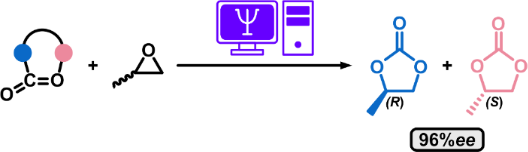
- pairs tailored specifically to control the stereochemistry of the CO2 insertion reaction. Computational evaluations of four distinct FLP scaffolds, incorporating various Lewis acids, Lewis bases, and substituents, identify the most promising catalyst candidates through volcano plot analysis. The volcano


Transition-metal-free decarbonylation–oxidation of 3-arylbenzofuran-2(3H)-ones: access to 2-hydroxybenzophenones
Beilstein J. Org. Chem. 2024, 20, 2655–2667, doi:10.3762/bjoc.20.223
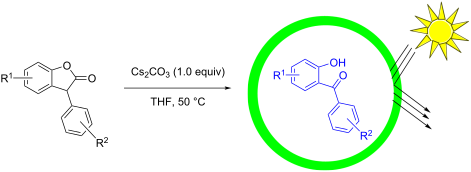
- reported over the years (Figure 2) [2]. Conventionally, benzophenones are synthesized by Friedel–Crafts acylation of benzoyl halides and aromatic compounds. However, the regioselectivity of Friedel–Crafts benzoylation at the desired position is difficult to control [9]. On the other hand, 2
- temperature proved to be advantageous compared to the reported Ni-catalyzed decarbonylation–oxidation method of benzofuranones [2]. Next, to elucidate the mechanism of the decarbonylation–oxidation reaction of 3-arylbenzofuran-2(3H)-ones 3aa–ka, control experiments were performed. The fact that the reaction
- to afford substituted 2-hydroxybenzophenones in good to excellent yields. The method utilizes hydroperoxide-generated in situ autoxidation of tetrahydrofuran. The mechanism of the transformation of benzofuranone to benzophenone are proposed based on control experiments. Further, the UV-protection




Applications of microscopy and small angle scattering techniques for the characterisation of supramolecular gels
Beilstein J. Org. Chem. 2024, 20, 2608–2634, doi:10.3762/bjoc.20.220

- -assembly across many length scales (Figure 1), allowing for the control of properties through not only chemical modifications on the monomer, but also changes to the gelation process [2]. Whilst this tunability is advantageous in that it allows for a wide range of functionality and applications, this also
- minimal change to the materials environment. This allows for structures that are more representative of their typical environment. To achieve this, many specialised cells have been developed to control various environmental parameters including temperature, pressure, irradiation, electromagnetic fields


Transition-metal-free synthesis of arylboronates via thermal generation of aryl radicals from triarylbismuthines in air
Beilstein J. Org. Chem. 2024, 20, 2577–2584, doi:10.3762/bjoc.20.216
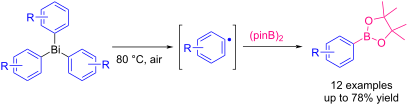
- control experiments were investigated. When the reaction was carried out in an argon atmosphere using the strict Schlenk technique, the desired product 3a was not obtained at all and 93% of 1a was recovered (Scheme 3). Figure 1 shows the comparison of the crude mixture of the reactions under argon
- control experiments and our previous studies, a proposed reaction pathway is shown in Scheme 5. First, thermal activation of triarylbismuthines in air forms aryl radicals together with the bismuth residues (i.e., metal bismuth and bismuth oxide). Alternatively, oxygen in air and/or boron-centered radicals
- arylboronates 3 using triaylbismuthines 1 and diboron 2. Yields were determined by 1H NMR spectroscopy based on 1 as three transferable aryl groups (internal standard: 1,3,5-trioxane). Isolated yield was shown in parentheses. aCHCl3 (0.4 mL) was used as the solvent. Control experiment of the metal-free



A review of recent advances in electrochemical and photoelectrochemical late-stage functionalization classified by anodic oxidation, cathodic reduction, and paired electrolysis
Beilstein J. Org. Chem. 2024, 20, 2500–2566, doi:10.3762/bjoc.20.214
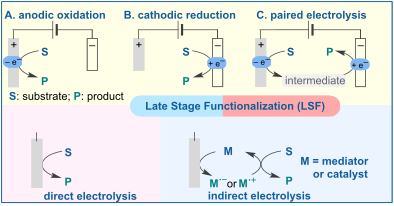
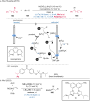
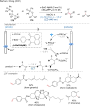
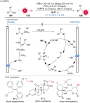
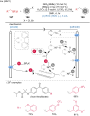
- oxidants or reductants, offer unprecedented control of reactions through the continuous variation of the applied potential and the possibility of combination with photochemical processes. This capability is a substantial advantage for performing electrochemical or photoelectrochemical LSF. Ultimately
- efficient method for C–H functionalization. The continuous flow setup allows for precise control over reaction conditions, enhanced mass transfer, and improved reaction kinetics, leading to higher efficiency and faster reaction times. In 2023, the Chiang group reported the photoelectrochemical homo-coupling




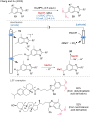


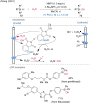


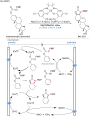


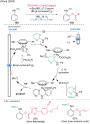
















Visible-light-mediated flow protocol for Achmatowicz rearrangement
Beilstein J. Org. Chem. 2024, 20, 2493–2499, doi:10.3762/bjoc.20.213
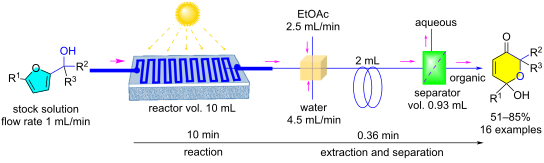
- dihydropyranones due to its ability to better control of reaction conditions, including more uniform light exposure and improved mixing efficiency, which result in higher reaction rates and more consistent product quality. Additionally, the flow system enhances mass transfer and reduces reaction times, leading to



HFIP as a versatile solvent in resorcin[n]arene synthesis
Beilstein J. Org. Chem. 2024, 20, 2469–2475, doi:10.3762/bjoc.20.211
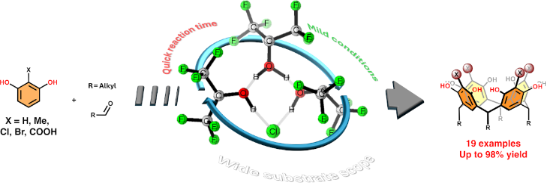
- showed resorcinol in the reaction mixture. This observation led us to run a control experiment in the absence of aldehyde, which showed that HFIP leads to metal-free deiodination of 2-iodoresorcinol (Figure 1a). Finally, while all new compounds reported herein have full spectroscopic characterization
- translated to the formation of other macrocycles as long as they share a similar reaction mechanism. (a) Control experiment testing deiodination of 2-iodoresorcinol. (b) Molecular crystal structure of chlorinated resorcin[4]arenes 1h and 1i, and carboxylic acid-containing 1s at 100 K. Thermal ellipsoids are





