


Search results
Search for "ferrocene" in Full Text gives 156 result(s) in Beilstein Journal of Organic Chemistry.
Ring strain and total syntheses of modified macrocycles of the isoplagiochin type
Beilstein J. Org. Chem. 2009, 5, No. 71, doi:10.3762/bjoc.5.71
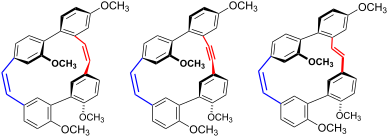
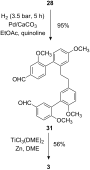
- was obligatory to prevent exclusive pinacolborane reduction. ddppf: 1,1′-bis(diphenylphosphino)ferrocene. Synthesis of the tolane precursors 27 and 28 for cyclization. Synthesis of the modified macrocycles 5–7 from the dialdehyde precursors 28–30. Synthesis of the known macrocycle 3 via McMurry




Iridium-catalyzed asymmetric ring-opening reactions of oxabicyclic alkenes with secondary amine nucleophiles
Beilstein J. Org. Chem. 2009, 5, No. 53, doi:10.3762/bjoc.5.53
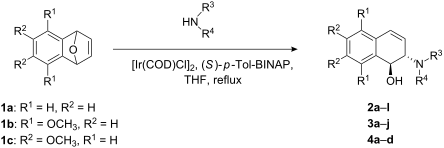
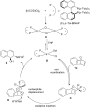
- molecules with the dihydronaphthalene skeleton. Results and Discussion The ARO reaction involves many components of the chemical agents; we first attempted to optimize the ligand to iridium catalyst system (Scheme 1). In our initial experiments, we chose an achiral 1,1′-bis(diphenylphosphino)ferrocene (DPPF


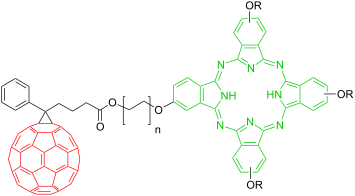
Synthesis of mesogenic phthalocyanine-C60 donor–acceptor dyads designed for molecular heterojunction photovoltaic devices
Beilstein J. Org. Chem. 2009, 5, No. 49, doi:10.3762/bjoc.5.49
- as a working electrode. A spiral platinum wire was employed as counter electrode and an Ag/AgCl/KCl(sat) used as reference electrode was connected to the cell solution via a salt bridge containing a saturated aqueous KCl solution. The Ag/AgCl electrode was checked against the ferrocene/ferrocinium


Synthesis and redox behavior of new ferrocene- π-extended- dithiafulvalenes: An approach for anticipated organic conductors
Beilstein J. Org. Chem. 2009, 5, No. 6, doi:10.3762/bjoc.5.6
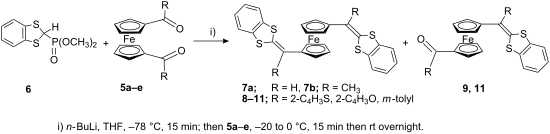
- Abstract A number of new ferrocene-π-extended-dithiafulvalenes were successfully synthesized as new electron donor compounds. The chemical structures and electrochemical behaviors of these compounds were investigated using several spectroscopic methods. The synthesis of these compounds was achieved using
- the modified Wittig–Horner cross-coupling reaction using n-BuLi/THF at temperature varies from −78 °C to 0 °C. These new classes of bis(1,3-dithiafulvalene)ferrocenes have the 1,3-dithiole ring system separated by ferrocene as conjugated spacer. The ferrocene-dithiafulvalenes derivatives 9 and 12 were
- supporting electrolyte compared to ferrocene and the derivative 9. In CH2Cl2 on a Pt working electrode and at ambient temperature, two oxidation waves associated with two reduction waves at scan rates 100 mV s−1 were observed for 9 and 12. In contrast the anodic peak potential of bis(1,3-dithiafulvalene


Aroylketene dithioacetal chemistry: facile synthesis of 4-aroyl- 3-methylsulfanyl- 2-tosylpyrroles from aroylketene dithioacetals and TosMIC
Beilstein J. Org. Chem. 2007, 3, No. 31, doi:10.1186/1860-5397-3-31

- appears to have no major influence on the observed yield of the pyrroles 3. The AKDTAs having electron donating (4-Me, 1b or ferrocene 1g), or electron-withdrawing groups (4-Cl, 1c or 4-Ph, 1d) furnished corresponding pyrroles in good and comparable yield. The 2,3,4-trisubstituted pyrroles having 4


Synthesis of coumarin or ferrocene labeled nucleosides via Staudinger ligation
Beilstein J. Org. Chem. 2006, 2, No. 23, doi:10.1186/1860-5397-2-23
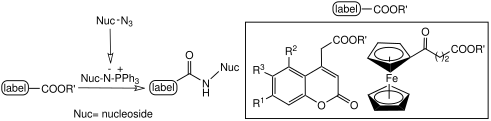
- nucleic acids. Results A new approach for the preparation of labeled nucleosides via intermolecular Staudinger ligation is described. Reaction of azidonucleosides with triphenylphosphine lead to iminophosphorane intermediates, which react subsequently with derivatives of coumarin or ferrocene to form
- coumarin or ferrocene labeled nucleosides. Fluorescent properties of coumarin labeled nucleosides are determined. Conclusion New coumarin and ferrocene labeled nucleosides were prepared via intermolecular Staudinger ligation. This reaction joins the fluorescent coumarin and biospecific nucleoside to the
- , [22][23] including specific labeling of nucleic acids, [24] proteomic studies [25][26] and modification of cell surfaces. [17][18] We applied the Staudinger ligation for nucleoside labeling procedures, using coumarin and ferrocene derivatives as labels. According to our knowledge, applications of this


Other Beilstein-Institut Open Science Activities



