


Search results
Search for "intramolecular" in Full Text gives 1424 result(s) in Beilstein Journal of Organic Chemistry. Showing first 200.
Mechanochemical difluoromethylations of ketones
Beilstein J. Org. Chem. 2024, 20, 2799–2805, doi:10.3762/bjoc.20.235
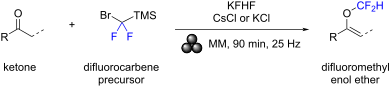
- with the generation of difluorocarbene from TMSCF2Br and KFHF. This is followed by a nucleophilic attack of the oxygen atom of ketone 1 on the difluorocarbene. Subsequently, a protonation–deprotonation sequence occurs, which can either be intermolecular, involving a molecule of HF, or intramolecular
- process. As a result, no H/D-exchange was detected. The experimental results of both experiments suggest that the reaction predominantly proceeds through an intermolecular pathway. The occurrence of the CF2D product may be attributed to a minor intramolecular reaction path or the involvement of DF formed


Copper-catalyzed yne-allylic substitutions: concept and recent developments
Beilstein J. Org. Chem. 2024, 20, 2739–2775, doi:10.3762/bjoc.20.232
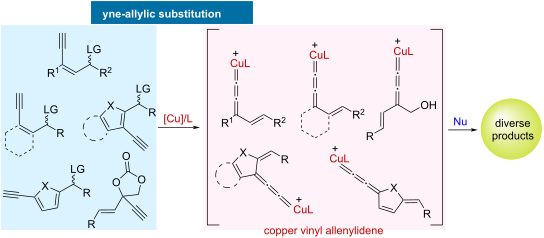
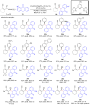
- , 6a–w). Interestingly, both Cu(I) and Cu(II) can promote the reaction and the reaction is not sensitive to water (Scheme 7, 6g). The intramolecular decarboxylative yne-allylic substitution can also be achieved (Scheme 8, 6a–u). O-Nucleophiles and C-nucleophiles are all suitable reactants, yielding
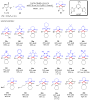
- as Meldrum’s acid and 1,3-dimethylbarbituric acid were used as the nucleophiles, the yne-allylic substitution products underwent further intramolecular cyclizations to give the spiro-cyclic products in high yields (Scheme 31, 30a–f). The generation of products likely begins with an α-attack on the
- yne-allylic cation intermediate, followed by an intramolecular cyclization. The disparity in reactivity could stem from the chelation between acyclic 1,3-dicarbonyl enolates and the copper catalyst, enhancing γ-position attack in an intramolecular manner. Conversely, Meldrum's acid's rigid cyclic






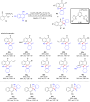


Synthesis of spiroindolenines through a one-pot multistep process mediated by visible light
Beilstein J. Org. Chem. 2024, 20, 2722–2731, doi:10.3762/bjoc.20.230
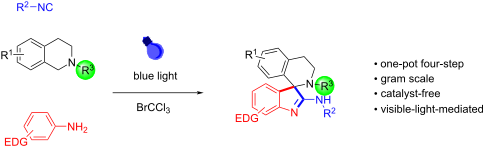
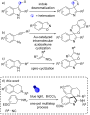
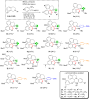
- reacts with an isocyanide and an electron-rich aniline in a three-component Ugi-type reaction to give an α-aminoamidine. This compound might undergo an additional visible light-mediated oxidation to furnish a second iminium intermediate, which acts as electrophile in an intramolecular electrophilic





Synthesis of benzo[f]quinazoline-1,3(2H,4H)-diones
Beilstein J. Org. Chem. 2024, 20, 2708–2719, doi:10.3762/bjoc.20.228
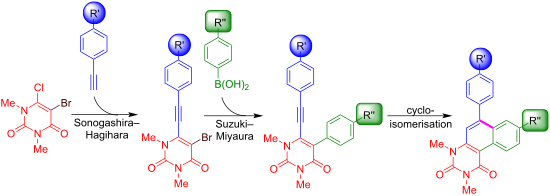
- coefficients and bathochromically shifted absorption bands which might be a result of a certain intramolecular charge transfer between the donating N,N-dimethylamino group and the electron-deficient uracil moiety. Similar effects are observed for the emission spectra. The emission maxima of N,N-dimethylamino




5th International Symposium on Synthesis and Catalysis (ISySyCat2023)
Beilstein J. Org. Chem. 2024, 20, 2704–2707, doi:10.3762/bjoc.20.227
- intramolecular aminocarbonylation using Mo(CO)6. Both catalytic approaches successfully produced the desired DBDAPs. As previously mentioned, organic synthesis is a crucial tool for preparing complex molecules of high value to industry. Frackenpohl et al. [13] designed and synthesized a new library of 2,3

Photoluminescence color-tuning with polymer-dispersed fluorescent films containing two fluorinated diphenylacetylene-type fluorophores
Beilstein J. Org. Chem. 2024, 20, 2682–2690, doi:10.3762/bjoc.20.225
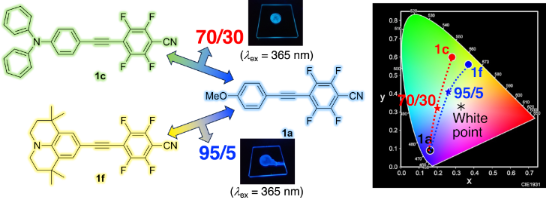
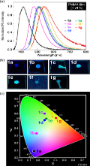
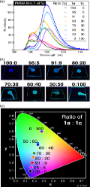
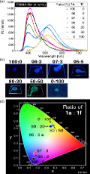
- as electron-donating groups was shown to promote intramolecular charge transfer (ICT) and shifted the PL wavelength to longer wavelengths, resulting in yellow or orange fluorescence in the solid state [21][22]. In addition, cross-linking between the amino group and attached benzene ring effectively
- non-radiative deactivation process. On the other hand, the other derivatives, namely 1b and 1d–f, showed increased ΦPL values in the PMMA films compared with those in the crystalline state, presumably due to a suppression of the formation of non-fluorescent twisted intramolecular charge transfer (TICT


Computational design for enantioselective CO2 capture: asymmetric frustrated Lewis pairs in epoxide transformations
Beilstein J. Org. Chem. 2024, 20, 2668–2681, doi:10.3762/bjoc.20.224
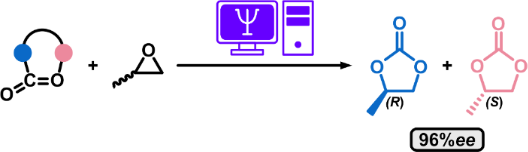
- results, we looked into the literature to explore examples of asymmetric FLPs. This exploration revealed three main types, namely, intramolecular chiral FLPs, intermolecular FLPs composed of a chiral acid and an achiral base, and intermolecular FLPs comprising an achiral acid and a chiral base [61][62


Transition-metal-free decarbonylation–oxidation of 3-arylbenzofuran-2(3H)-ones: access to 2-hydroxybenzophenones
Beilstein J. Org. Chem. 2024, 20, 2655–2667, doi:10.3762/bjoc.20.223
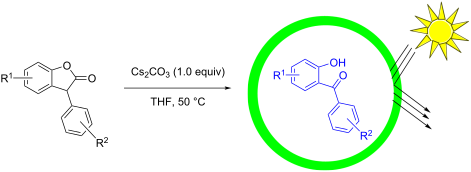
- -absorbing as well as photo-antioxidant properties via an intramolecular hydrogen transfer [5]. The structure–activity relationship between the substituents of 2-hydroxybenzophenones and their UV-absorption properties has been reported previously [6]. It was concluded that the ability to absorb UV light and
- , and 4ma. Whereas compound 4ja and 4ma showed an ideal single crystal behavior, compound 4fb showed a dynamic disordered structure due to intramolecular vibrations in the unit cells, particularly because of the presence of the tert-butyl group, which can assume any rotation angle [24]. Nevertheless




Deciphering the mechanism of γ-cyclodextrin’s hydrophobic cavity hydration: an integrated experimental and theoretical study
Beilstein J. Org. Chem. 2024, 20, 2635–2643, doi:10.3762/bjoc.20.221

- intramolecular hydrogen bonds between themselves, with water molecules in aqueous solution, or with guest molecules that fit into host’s cavity [20]. The primary hydroxy groups in the nonhydrated γ-CD (located in the upper/narrow rim; O6 side of the truncated cone) can be coordinated (arranged) in two ways
- enlarging the aperture (“open” configuration). In the “open” configuration, the primary hydroxy groups are not involved in the intramolecular hydrogen-bonding interactions with neighboring OH groups. Relatively weak hydrogen bonds are formed between the secondary hydroxy groups at the wider/lower rim of the
- groups in intramolecular H-bonds is contradictory and confusing – observations suggest no involvement of secondary hydroxy protons in intramolecular H-bonds and strong exposure of OH-6 groups to the solvent [22]. Our calculations reveal (as expected) that the “closed” narrow-rim arrangement is


Base-promoted cascade recyclization of allomaltol derivatives containing an amide fragment into substituted 3-(1-hydroxyethylidene)tetronic acids
Beilstein J. Org. Chem. 2024, 20, 2585–2591, doi:10.3762/bjoc.20.217
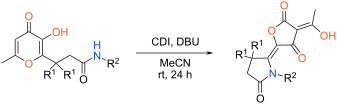
- -hydroxypyran-4-ones with hydrazine are known [30][31]. At the same time all considered recyclizations proceed under action of additional components and the intramolecular variant of this reaction is not described in the literature. It can be supposed that in the case of a substrate containing an allomaltol
- was isolated in unchanged form. It should be mentioned that the key step of the studied recyclization is an intramolecular nucleophilic addition of a nitrogen atom at the double bond of the pyranone ring. Comparing the chemical properties of the considered amides and hydrazides it can be assumed that
- formation of an intramolecular hydrogen bond and the double bond is located in the furanone ring. In contrast to the aforementioned example the considered compounds 4 have an exocyclic enol fragment and the intramolecular hydrogen bond is connected to the carbonyl oxygen atom. Thus, the absence of


A review of recent advances in electrochemical and photoelectrochemical late-stage functionalization classified by anodic oxidation, cathodic reduction, and paired electrolysis
Beilstein J. Org. Chem. 2024, 20, 2500–2566, doi:10.3762/bjoc.20.214
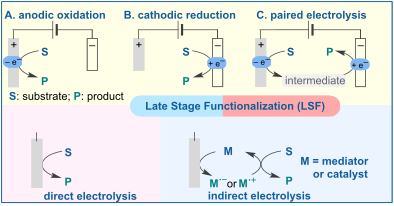
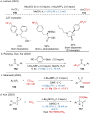
- cross-coupling between these two intermediates, followed by intramolecular cyclization and subsequent deprotonation results in the desired product (Scheme 20). Furthermore, Budny and coworkers demonstrated that (±)-triticonazole and related compounds could be cyclized and alkoxylated to the
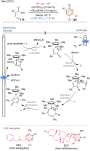
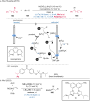
- that dimerize to form iodine (I2). Subsequent anodic oxidation of in-situ formed Et3N produced an α-amino radical. The iodine then reacts with the alkene to form an iodonium intermediate, which undergoes intramolecular cyclization with losing an electron, and a second water attack to yield the desired
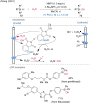
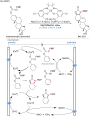
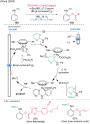
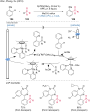
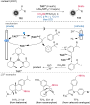
- benzylic position (Scheme 31). 1.3.2 Co-assisted anodic oxidation. In 2021, Xu and colleagues developed an electrocatalytic approach for the intramolecular oxidative allylic amination and C–H alkylation using cobalt–salen complexes as catalysts [43]. In this reaction, the cobalt catalyst [Co(II)] is first


























Photoredox-catalyzed intramolecular nucleophilic amidation of alkenes with β-lactams
Beilstein J. Org. Chem. 2024, 20, 2461–2468, doi:10.3762/bjoc.20.210
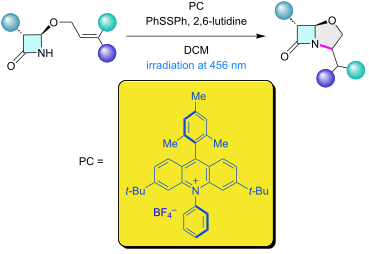
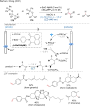
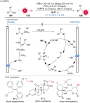
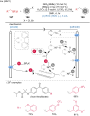
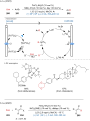
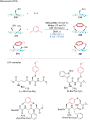
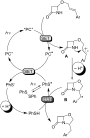
- reactions limit the utility of this approach. Herein, we report an intramolecular photoredox cyclization of alkenes with β-lactams in the presence of an acridinium photocatalyst. The approach uses an intramolecular nucleophilic addition of the β-lactam nitrogen atom to the radical cation photogenerated in
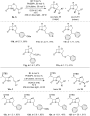
- the linked alkene moiety, followed by hydrogen transfer from the hydrogen atom transfer (HAT) catalyst. This process was used to successfully prepare 2-alkylated clavam derivatives. Keywords: β-lactam; acridinium photocatalyst; alkenes; amides; intramolecular radical reaction; photoredox catalysis
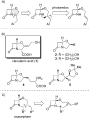
- intramolecular nucleophilic attack induced by photocatalytic oxidation was reported by Yoon et al. with tosylamide derivatives [29]. Specifically, amides were employed in a photoredox cyclization process using a strong photooxidative acridinium catalyst such as the Fukuzumi catalyst (I, Figure 1B) [30][31




Hypervalent iodine-mediated cyclization of bishomoallylamides to prolinols
Beilstein J. Org. Chem. 2024, 20, 2455–2460, doi:10.3762/bjoc.20.209
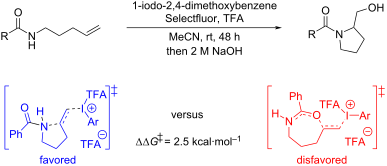
- , the iodane moiety in 12 is eliminated by an intramolecular attack by the amide nitrogen to form the aziridinium 13. Finally, ring-opening by SN2 attack of trifluoroacetate leads to the final product 14 [20]. In this case, the kinetic pyrrolidine product is obtained due to the electron-withdrawing


Synthesis and conformational analysis of pyran inter-halide analogues of ᴅ-talose
Beilstein J. Org. Chem. 2024, 20, 2442–2454, doi:10.3762/bjoc.20.208
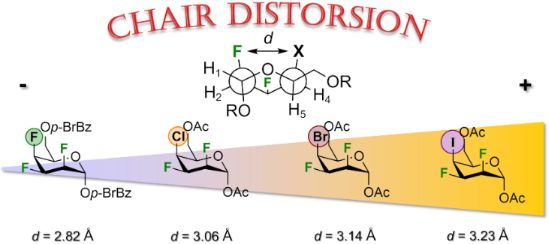
- , intramolecular F2···F3, F2···X4, and F3···X4 contacts are smaller than the sum of the Van der Walls radii [49]. Taking together, all these data clearly demonstrate that the nature of one halogen can have an impact on the solid-state conformation of halogenated pyrans. We also evaluated the Cremer–Pople ring
- for the halogens. Selected bond distances for compounds 13–15, 17, and 18. Selected bond angles for compounds 13–15, 17, and 18. Selected torsion angles for compounds 13–15, 17, and 18. 1,3-Diaxial repulsion between C2–F and C4–X bonds for 13–15 and 17.a Key interatomic distances (intramolecular) for


Facile preparation of fluorine-containing 2,3-epoxypropanoates and their epoxy ring-opening reactions with various nucleophiles
Beilstein J. Org. Chem. 2024, 20, 2421–2433, doi:10.3762/bjoc.20.206
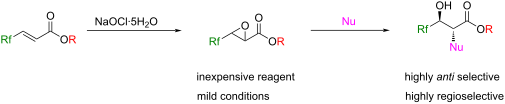
- intramolecular interaction between fluorine and metals would also facilitate the smooth progress of these reactions. Such high potential of 1a allowed us to apply it to nucleophilic epoxidation because the resultant epoxyester 2a is recognized as an intriguing building block (Scheme 1). Another expectation to 2a
- nonfluorinated Rf groups which sometimes suffered from the contamination of the regioisomers as a consequence of the regiorandom attack of nucleophiles [22][23][24][25][26]. Despite such significant advantage, compound 2a was previously prepared only by 1) the LDA-mediated iodination-intramolecular ring closure
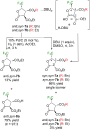
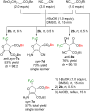
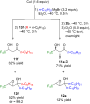
- was confirmed as 2,3-anti-3,4-syn by its X-ray crystallographic analysis [49] (Figure 2) whose construction could be readily understood as the result of a highly stereoselective SN2-type epoxy ring opening of 2a, followed by the intramolecular lactone formation with the pro-R ethoxycarbonyl group





Synthesis, electrochemical properties, and antioxidant activity of sterically hindered catechols with 1,3,4-oxadiazole, 1,2,4-triazole, thiazole or pyridine fragments
Beilstein J. Org. Chem. 2024, 20, 2378–2391, doi:10.3762/bjoc.20.202
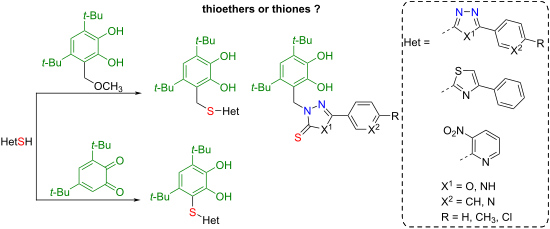
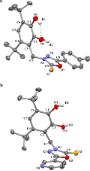
- of neighboring molecules [57][58][59][60][61]. The intra- and intermolecular interactions in crystals 5, 6·0.5CH3CN, and 8 lead to different complex structural motifs in crystals of these compounds. Two intramolecular hydrogen bonds (Figure 1) are observed in the crystal structure of 5: between OH
- neighbouring group O2–H2, and there is no intramolecular hydrogen bond between hydroxy groups in molecule 8 (Figure 2(b)). A π-stalking was found between the pyridine groups in molecules belonging to the neighbouring pairs with the corresponding distance of 3.45(1) Å. Electrochemical properties The study of
- changes. This is confirmed by the appearance of an absorption maximum in the UV–visible spectrum at λ = 490 nm, which is characteristic of thiolated o-benzoquinones. This absorption band corresponds to intramolecular charge transfer between the thioether group and the o-benzoquinone fragment [36][62][63




Asymmetric organocatalytic synthesis of chiral homoallylic amines
Beilstein J. Org. Chem. 2024, 20, 2349–2377, doi:10.3762/bjoc.20.201
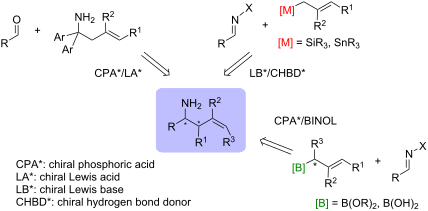
- generated from Togni’s reagent (145) to a double bond of the δ-alkenylamine, followed by intramolecular hydrogen atom transfer and a single-electron oxidation of the intermediate alkyl radical to form an imine that is then reduced by hydrogen donor 147 catalysed by CPA (R)-VAPOL (148). The


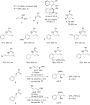


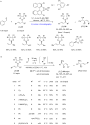


Stereoselective mechanochemical synthesis of thiomalonate Michael adducts via iminium catalysis by chiral primary amines
Beilstein J. Org. Chem. 2024, 20, 2313–2322, doi:10.3762/bjoc.20.198
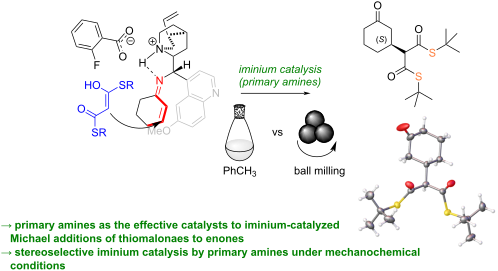
- stabilized by an intramolecular hydrogen bond with a protonated amine unit activates the Michael acceptor (Scheme 4). Moreover, a strong but reversible covalent bond locates the electrophile upon the quinoline unit of the catalyst and thus subsequently blocks the bottom approach of the thiomalonate. Hence


Deuterated reagents in multicomponent reactions to afford deuterium-labeled products
Beilstein J. Org. Chem. 2024, 20, 2270–2279, doi:10.3762/bjoc.20.195
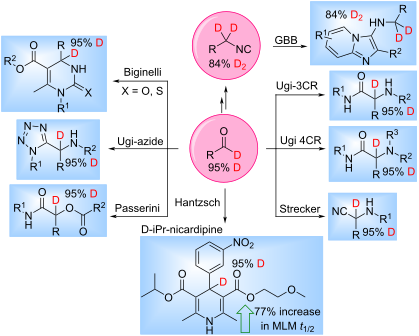
- (Scheme 8) [47]. The Groebke–Blackburn–Bienaymé (GBB) reaction is an intramolecular variant of the Ugi reaction where the intermediate nitrilium ion is intercepted by heteroatoms from the amino-heterocyclic input. Discovered in 1998, and reported independently by three different research groups, it is a


Heterocycle-guided synthesis of m-hetarylanilines via three-component benzannulation
Beilstein J. Org. Chem. 2024, 20, 2208–2216, doi:10.3762/bjoc.20.188
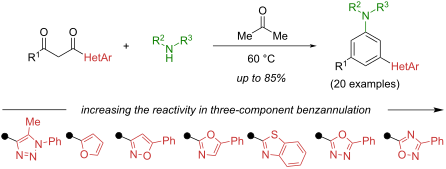
- ring formation via benzannulative inter- or intramolecular condensation of acyclic precursors [27][32][33][34][35][36][37]. Within the latter strategy, [3 + 3] condensations are gaining much attention due to the availability of starting materials and the straightforward installation of the aryl(hetaryl
- intramolecular addition of enamine I to the C3=O to form intermediate II, which dehydrates to cyclic carbinol III. Finally, dehydration of intermediate III yields anilines 3. Conclusion In summary, a method for the synthesis of substituted meta-hetarylanilines under mild conditions starting from 1,3-diketones


Natural resorcylic lactones derived from alternariol
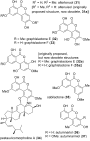
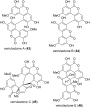
Beilstein J. Org. Chem. 2024, 20, 2171–2207, doi:10.3762/bjoc.20.187






Efficacy of radical reactions of isocyanides with heteroatom radicals in organic synthesis
Beilstein J. Org. Chem. 2024, 20, 2114–2128, doi:10.3762/bjoc.20.182
- imine 6’ (96%), which underwent [2 + 2] cycloaddition with methoxyketene to afford β-lactam derivative 7 (79%) (Scheme 4). Selective replacement of the PhSe group of 7 with a 3-butanonyl group (34%) and the subsequent intramolecular Horner–Emmons reaction successfully led to carbacephem skeleton 8 (96
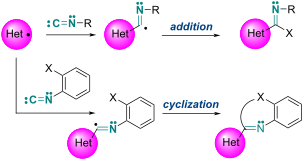
- compounds to isocyanides using imidoyl radicals as key intermediates. However, as the number of substituents on typical elements increases, intermolecular 1,1-addition reactions become more difficult due to the increase in steric hindrance. Therefore, it is expected that intramolecular cyclization of
- imidoyl radicals will be possible by introducing an unsaturated group at an appropriate position in the isocyanide molecule, since intramolecular reactions are generally 103 times faster than intermolecular reactions. This chapter discusses the intramolecular radical cyclization reactions of isocyanides


Computational toolbox for the analysis of protein–glycan interactions
Beilstein J. Org. Chem. 2024, 20, 2084–2107, doi:10.3762/bjoc.20.180
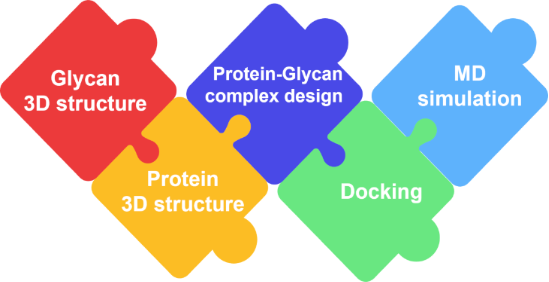
- ) sample the glycan conformational space; ii) investigate how the glycan behaves in a solution (if the MD is performed in explicit solvent), describing carbohydrate–water interactions; iii) monitoring the intramolecular interactions. Usually, this information has to be further validated by performing


Multicomponent syntheses of pyrazoles via (3 + 2)-cyclocondensation and (3 + 2)-cycloaddition key steps
Beilstein J. Org. Chem. 2024, 20, 2024–2077, doi:10.3762/bjoc.20.178

- formate (Scheme 8) [58]. Upon reaction with β-ketoesters, hydrazone 30 is formed, which reacts via intramolecular Knoevenagel condensation to give the corresponding pyrazoles 27. The method tolerates β-ketoesters with alkyl substituents and various ketoamides. In addition, an example could be synthesized


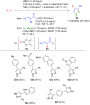


Diastereoselective synthesis of highly substituted cyclohexanones and tetrahydrochromene-4-ones via conjugate addition of curcumins to arylidenemalonates
Beilstein J. Org. Chem. 2024, 20, 2016–2023, doi:10.3762/bjoc.20.177
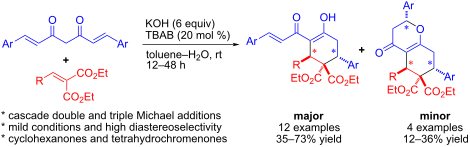
- Deepa Nair Abhishek Tiwari Banamali Laha Irishi N. N. Namboothiri Department of Chemistry, Indian Institute of Technology Bombay, Mumbai, 400 076, India 10.3762/bjoc.20.177 Abstract A cascade inter–intramolecular double Michael strategy for the synthesis of highly functionalized cyclohexanones
- –acceptor with nitroalkenes, resulting in multi-substituted cyclohexanones through a cascade inter–intramolecular double Michael addition process with high diastereoselectivity [26][27]. Subsequently, the enantioselective versions of the above reaction and a similar diastereoselective cascade Michael
- equilibrium with 1,3-dicarbonyl enolate I, but the former would be trapped via cyclization involving a diastereoselective 6-endo-trig intramolecular Michael addition to the enone moiety leading to highly substituted cyclohexanone 3. The formation of triple Michael adduct 4 can be attributed to the enolate 3





