


Search results
Search for "gold(III) complex" in Full Text gives 5 result(s) in Beilstein Journal of Organic Chemistry.
Controlled supramolecular assemblies of luminescent tridentate cyclometalated alkynylgold(III) amphiphiles in aqueous media
Beilstein J. Org. Chem. 2026, 22, 1097–1106, doi:10.3762/bjoc.22.88
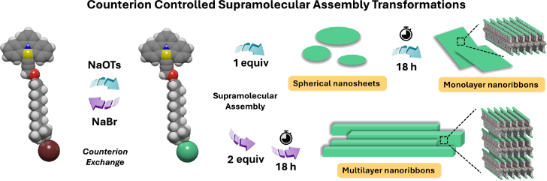
- from disordered nanosheets to well-ordered nanoribbons upon the additions of multiple equivalents of counterion, enabling a tunable pathway for controlled supramolecular transformation. Keywords: amphiphiles; gold(III) complex; luminescence; self-assembly; supramolecular chemistry; Introduction
- luminescent soft materials can be established towards biomedical and biomaterial applications. Results and Discussion Design and synthesis of GA The gold amphiphile was designed with a tridentate C^N^C cyclometalated gold(III) complex core, which is functionalized with a σ-donating alkynyl ligand. A propargyl
- cyclometalated gold(III) complex 2 was synthesized and further reacted with compound 1 in the presence of triethylamine and a catalytic amount of copper iodide to afford the amphiphile precursor 3. The nucleophilic substitution of compound 3 with trimethylamine enabled to afford GA. The chemical structures of


The trans-influence in gold chemistry from a catalytic perspective
Beilstein J. Org. Chem. 2026, 22, 838–856, doi:10.3762/bjoc.22.66
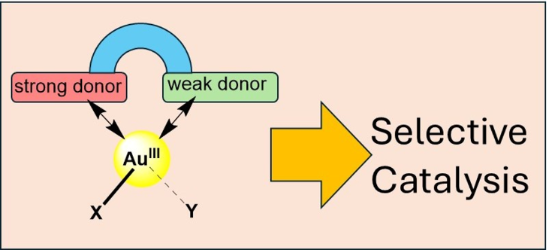
- intense blue on warming and appears to be the first case of a gold(III) complex emitting by a thermally activated delayed fluorescence (TADF) process, where excited singlet and triplet states are of comparable energy, which allows effective triplet harvesting and high quantum yields. Luminescence
- -complexes stabilised by C^N^C and C^N chelate ligands [28][29][30][31][32] and an example of a gold(III) complex targeting oestrogen-receptor positive (ER+) breast cancer cells [11][33][34][35][36]. Gold(III) C^C chelate complexes. Gold hydride complexes supported by tridentate pincer ligands and


Hypervalent iodine-mediated intramolecular alkene halocyclisation
Beilstein J. Org. Chem. 2024, 20, 3113–3133, doi:10.3762/bjoc.20.258
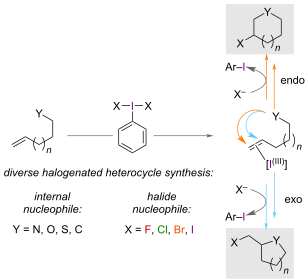
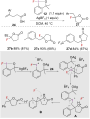
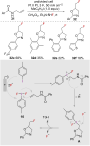
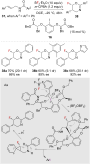
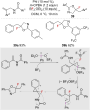
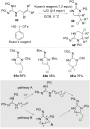
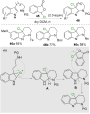
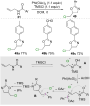
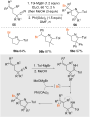
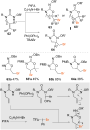
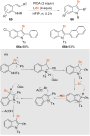
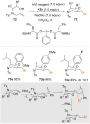
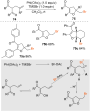
- instead proceeded with addition of dichloro(pyridine-2-carboxylato)gold(III) complex in combination with silver triflimide, AgNTf2. A range of β-fluoroazepanes 7 were successfully synthesised with high enantiomeric purity in good yields. A mechanism for the synthesis of β-fluorinated piperidines was



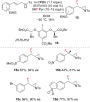
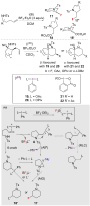
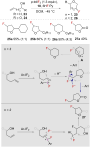

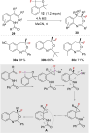















Pyridylidene ligand facilitates gold-catalyzed oxidative C–H arylation of heterocycles
Beilstein J. Org. Chem. 2015, 11, 2737–2746, doi:10.3762/bjoc.11.295
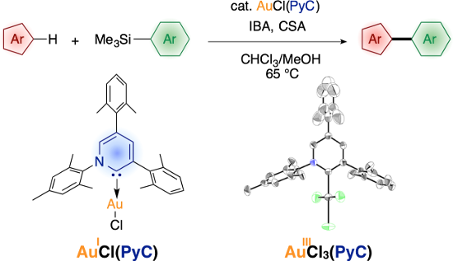
- confirmed that the esterification of 2-iodobenzoic acid takes place to give 5 under the reaction conditions; 2-iodobenzoic acid was smoothly converted to 5 in chloroform/methanol solution at 65 °C. Transmetalation of gold(III) complex B with arylsilane 2 affords monoarylated gold(III) intermediate C. The
- and isolation of PyC-gold(III) complex To verify our hypothesis that PyC accelerates the gold(I)-to-gold(III) oxidation, we attempted the direct observation and the isolation of the PyC-gold(III) complex. First of all, the gold(III) complex AuCl3(PyC) was newly synthesized by treating AuCl(PyC) with
- coordinates to a gold center and promotes the gold(I)-to-gold(III) oxidation by stabilizing a gold(III) species without dissociation. An IPr-gold(III) complex is known to be stable, but the lower electron-donation ability of IPr than that of PyC seems to result in the inefficient oxidation of AuCl(IPr). DFT




The chemistry of amine radical cations produced by visible light photoredox catalysis
Beilstein J. Org. Chem. 2013, 9, 1977–2001, doi:10.3762/bjoc.9.234
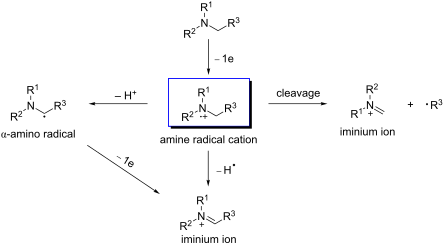
- were realized with slower formation of the iminium ions. This was achieved by use of [Ru(bpy)3](PF6)2 in conjunction with a weak light source (5 W fluorescence bulb). The Che group synthesized a photoactive gold(III) complex that was shown to catalyze α-cyanation of N-aryltetrahydroisoquinolines [75
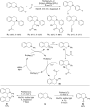
- ]. Very recently, Zhu and coworkers used an analogous gold(III) complex to catalyze the reactions similar to those reported by the Rueping group (Scheme 9) [76]. A 5 W blue LED was used as the light source. One advantage of using the gold complex over [Ru(bpy)3](PF6)2 is that long-chain aliphatic ketones




Other Beilstein-Institut Open Science Activities



