


Search results
Search for "macrocyclic ligands" in Full Text gives 9 result(s) in Beilstein Journal of Organic Chemistry.
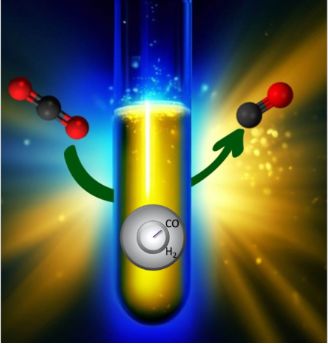
Selectivity control towards CO versus H2 for photo-driven CO2 reduction with a novel Co(II) catalyst
- Lisa-Lou Gracia,
- Philip Henkel,
- Olaf Fuhr and
- Claudia Bizzarri
Beilstein J. Org. Chem. 2023, 19, 1766–1775, doi:10.3762/bjoc.19.129
- advantages for tailoring new catalysts to specific reactions and optimize selectivity [22][27]. Cobalt catalysts successfully employed in CO2 reduction are mainly based on macrocyclic ligands, such as tetraazacyclodecene and its derivatives [3][28][29], porphyrins [30][31][32][33][34], or phthalocyanines [35

Graphical Abstract

Figure 1: Chemical structures of the molecular components used in this work: Co(II) complex 1 as the novel ca...

Figure 2: ORTEP drawing of crystal polymorph 1a (left) and 1b (right), shown at the 50% probability level. Hy...

Figure 3: UV–vis absorbance of complex 1 in DMA. Inset: zoom-in of the 500–800 nm range to visualize the low-...

Figure 4: Cyclic voltammetry of complex 1 in 0.1 M TBAPF6 solution of (a) DMA and (b) DMA/TEOA 5:1 (v/v). Bla...

Figure 5: Time evolution of CO (blue squares) and H2 (red triangles) with the power functional fitting (blue ...

Scheme 1: Proposed mechanism for the photoinduced reduction of carbon dioxide with the system presented in th...
Tying a knot between crown ethers and porphyrins
- Maksym Matviyishyn and
- Bartosz Szyszko
Beilstein J. Org. Chem. 2023, 19, 1630–1650, doi:10.3762/bjoc.19.120
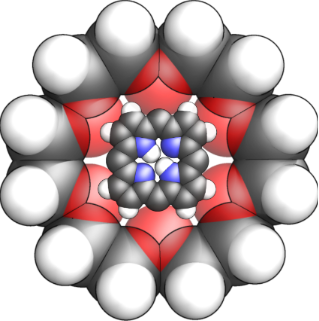
- /electrostatic interactions [18][19][20]. Replacing oxygen atoms with other elements, such as nitrogen, sulfur, etc., alters the crown ethers' affinity toward cations, extending their role as macrocyclic ligands to transition metals [21]. One can say that in many aspects, porphyrins and crown ethers are
- laid the ground for a whole new research area of hybrid imine-porphyrinoids [52][53][54]. Bowman-James' work provided an exciting insight into accordion porphyrins' coordination chemistry, demonstrating the tremendous potential of iminoporphyrinoids as macrocyclic ligands. Independently the Sessler
- flexibility of macrocyclic ligands, as demonstrated by X-ray molecular structures. The helicates consisted of two metal centres, namely cobalt, manganese, or iron, each coordinated by two nitrogens and oxygen donors of the ligand. The metal centres adopted distorted octahedral geometries with slight

Graphical Abstract

Figure 1: Porphyrin and crown ether.

Figure 2: Timeline demonstrating the contributions into the crown ether–porphyrin chemistry.

Figure 3: Tetra-crowned porphyrin 1 and dimer 2 formed upon K+ binding.

Figure 4: meso-Crowned 25-oxasmaragdyrins 3a–c and their boron(III) complexes (3a–c)-BF2.

Scheme 1: CsF ion-pair binding of 4. The molecular structure of 4-CsF is shown on the right [101].

Figure 5: CsF ion pair binding by 5. The molecular structure of 5-CsF is shown on the right [102].

Scheme 2: Ion-pair binding by 6. The molecular structure of (6-CsCl)2 is shown on the right [103].

Scheme 3: Hydrated fluoride binding by 7 [104].
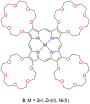
Figure 6: β-Crowned porphyrin 8.
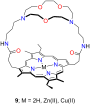
Figure 7: Crown ether-capped porphyrins 9.

Figure 8: The capped porphyrin 10 and complex [10-PQ](PF6)2.
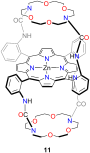
Figure 9: The double-capped porphyrin 11.

Figure 10: Selected examples of iminoporphyrinoids [58,122].

Scheme 4: The synthesis of 13.

Scheme 5: Tripyrrane-based crown ether-embedding porphyrinoid 15.

Figure 11: Macrocycles 16–19 and their coordination compounds.

Scheme 6: The flexibility of 16-Co [66].

Figure 12: Hexagonal wheel composed of six 16-Co(III) monomers [66].

Scheme 7: The synthesis of 16-V [67].

Figure 13: The molecular structure of dimers [16-Mn]2 [67].
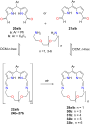
Scheme 8: Synthesis of crownphyrins 28–33. Compounds 23a/b and 29a/b were obtained from 4,7,10-trioxa-1,13-tr...

Figure 14: The molecular structures of 22a, 34a·(HCl)2, and 29b [69].

Figure 15: Molecular structures of 22a-Pb and (29b)2-Zn [69].

Scheme 9: Reactivity of 29a/b.

Scheme 10: Synthesis of 36 and 37 [131].

Scheme 11: Synthesis of 40–45.

Figure 16: Potential applications of porphyrin-crown ether hybrids.
Self-assembled coordination thioether silver(I) macrocyclic complexes for homogeneous catalysis
- Zhen Cao,
- Aline Lacoudre,
- Cybille Rossy and
- Brigitte Bibal
Beilstein J. Org. Chem. 2019, 15, 2465–2472, doi:10.3762/bjoc.15.239
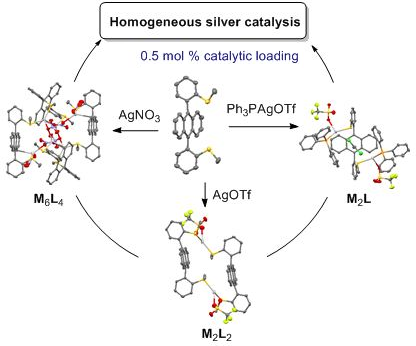
- silver(I) catalysts based on sulfur ligands were reported so far, although alkyl thioethers are soft σ-donor ligands such as crown thioethers that were largely developed as macrocyclic ligands for silver(I) [35][36][37][38][39][40][41][42][43]. Interestingly, depending on their design, these known silver

Graphical Abstract

Scheme 1: Synthesis of ligand 1, as its syn-atropisomer.

Figure 1: X-ray structures of complex 1a, as two diastereoisomeric macrocycles (R,S-1)2·(AgOTf)2 with ligands...

Figure 2: X-ray structure of complex 1c, as a (R,S-1)4·(AgNO3)6 cage with three nitrate anions as coordinatin...

Figure 3: X-ray structure of complex 1d, as a racemic mixture of (R,R)- and (S,S)-(syn-1)·(PPh3AgOTf)2.

Figure 4: Variable temperature 1H NMR of complex 1a in CDCl3 (7 mM) from −30 °C to 60 °C.
Coordination chemistry and photoswitching of dinuclear macrocyclic cadmium-, nickel-, and zinc complexes containing azobenzene carboxylato co-ligands
- Jennifer Klose,
- Tobias Severin,
- Peter Hahn,
- Alexander Jeremies,
- Jens Bergmann,
- Daniel Fuhrmann,
- Jan Griebel,
- Bernd Abel and
- Berthold Kersting
Beilstein J. Org. Chem. 2019, 15, 840–851, doi:10.3762/bjoc.15.81
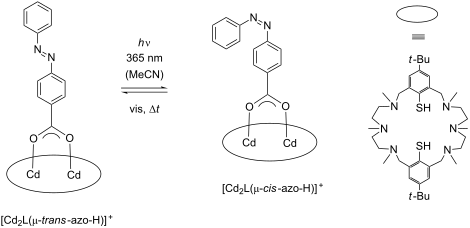
- with λ = 365 nm reveals a photoisomerization of the co-ligand from the trans to the cis form. Keywords: azobenzene carboxylates; cadmium; complexes; macrocyclic ligands; nickel; zinc; Introduction The macrocyclic N6S2 donor ligand H2L is an effective dinucleating ligand that supports a large number

Graphical Abstract

Figure 1: Left: Mixed ligand complexes of the type [M2L(μ-L')]n+ supported by the macrocyclic ligand H2L (M =...

Figure 2: Synthesized compounds and their labels.

Scheme 1: Synthesis of complexes 1–9.

Figure 3: 1H NMR spectrum of 6 in CD3CN at 295 K (1.0–8.0 ppm). The resonances and assignments are listed in Table 2...
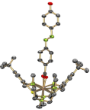
Figure 4: Structure of the [Zn2L(μ-azo-OH)]+ cation in crystals of [Zn2L(μ-azo-OH)][Zn2L(μ-azo-O)]·4MeCN·3H2O...

Figure 5: Space filling representation of the packing of two symmetry-related [Zn2L(μ-azo-NMe2)]+ cations in ...
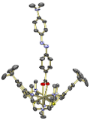
Figure 6: Structure of the [Cd2L(μ-azo-NMe2)]+ cation in crystals of [Cd2L(μ-azo-NMe2)]ClO4·0.5MeOH (6·0.5MeO...

Figure 7: Space filling representation of the packing of four [Cd2L(μ-azo-NMe2)]+ cations in crystals of 6·0....

Figure 8: Structures of the two crystallographically independent [Ni2L(μ-azo-NMe2)]+ cations A (left) and B (...

Figure 9: Left: ORTEP representation of the molecular structure of the [Cd2L(μ-azo-CO2Me)]+ cation in crystal...

Figure 10: Plots of the effective magnetic moment μeff for 2 (open circles), 4 (open squares), and 7 (open tri...

Figure 11: UV–vis spectra of Hazo-H (red line), [Cd2L(μ-Cl)](ClO4) (black line) and [Cd2L(μ-azo-H)]ClO4 (1, bl...

Figure 12: UV–vis spectra of Hazo-NMe2 (red line), [Ni2L(μ-Cl)](ClO4) (black line) and [Ni2L(μ-azo-NMe2)]ClO4 (...

Figure 13: UV–vis spectra of solutions of [Cd2L(μ-azo-H)]ClO4 (1) in acetonitrile irradiated with a UV LED lam...

Scheme 2: Cis/trans isomerization process of the bound azo-carboxylato co-ligand in [Cd2L(μ-azo-H)]ClO4 (1) i...
Binding abilities of polyaminocyclodextrins: polarimetric investigations and biological assays
- Marco Russo,
- Daniele La Corte,
- Annalisa Pisciotta,
- Serena Riela,
- Rosa Alduina and
- Paolo Lo Meo
Beilstein J. Org. Chem. 2017, 13, 2751–2763, doi:10.3762/bjoc.13.271
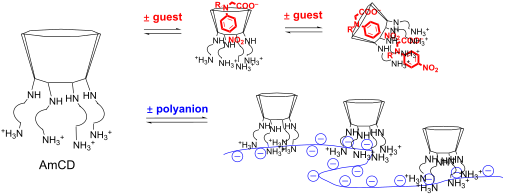
- of a polynucleotide (interacting with the polycationic branches) and a further bioactive/drug molecule (included into the host cavity). The critical examination of the available literature suggests that one main drawback of this approach is the fact that the syntheses of the tailored macrocyclic
- ligands (as pure chemical species) reported so far are lengthy and expensive, affording low overall yields. Thus, a cheaper, more straightforward alternative route would be highly desirable. Recently, we have prepared useful polyaminocyclodextrin materials (AmCDs) in high overall yields (> 90%) by simply

Graphical Abstract
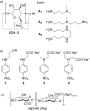
Figure 1: Structures of: a) AmCDs CD1–3; b) p-nitroaniline guests 1–4; c) sodium alginate (Alg).

Figure 2: Trends of the molar optical rotation Θ of AmCDs CD1–3 vs pH.

Figure 3: Trends of the molar optical rotation Θ of AmCDs vs χH+.

Figure 4: Polarimetric data trends for the inclusion of 4 in CD1 at different pH values.

Figure 5: Possible association of AmCDs with guests 2–4.

Figure 6: Polarimetric data trends for the CD1–Alg interaction (with buffer).

Figure 7: nr Values for the AmCD–Alg interaction as a function of <nH+>.

Figure 8: Electrophoretic mobility shift assays of pDNA in the presence of AmCDs at different N/P ratios, as ...
Easy access to heterobimetallic complexes for medical imaging applications via microwave-enhanced cycloaddition
- Nicolas Desbois,
- Sandrine Pacquelet,
- Adrien Dubois,
- Clément Michelin and
- Claude P. Gros
Beilstein J. Org. Chem. 2015, 11, 2202–2208, doi:10.3762/bjoc.11.239
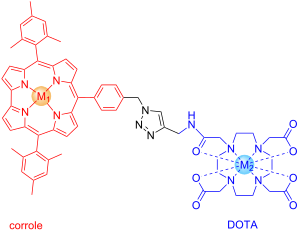
- [16][17] and porphyrins as PET probes. Cu–NOTA is significantly more inert in acidic conditions compared to Cu–DOTA, which usually decomplexed within few minutes. 64Cu2+-NOTA is considered as better PET agent, with regard to its in vivo stability [18]. Porphyrins are also excellent macrocyclic ligands

Graphical Abstract

Figure 1: Selected ligands for the copper(I)-catalyzed Huisgen cycloaddition.

Scheme 1: Structure of different bimetallic complexes 5–7.

Scheme 2: Synthesis of 8a,b and 9a–d. (i) for 8a: THF, N2, Cu(OAc)2·H2O, rt 15 min; for 8b: GaCl3 0.114 M in ...

Scheme 3: Synthesis of 10a,b and 12a,b. (i) For 10a: Milli-Q water, Gd(NO3)3·5H2O, 50 °C, 17 h, pH 8.0; for 1...
Selected synthetic strategies to cyclophanes
- Sambasivarao Kotha,
- Mukesh E. Shirbhate and
- Gopalkrushna T. Waghule
Beilstein J. Org. Chem. 2015, 11, 1274–1331, doi:10.3762/bjoc.11.142

Graphical Abstract

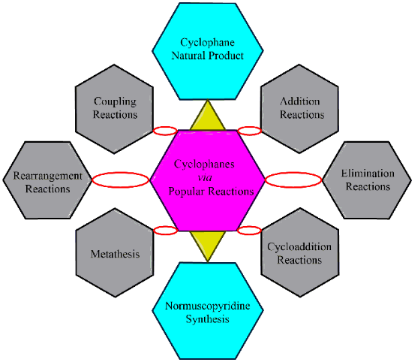
Figure 1: General representation of cyclophanes.

Figure 2: cyclophanes one or more with heteroatom.

Figure 3: Metathesis catalysts 12–17 and C–C coupling catalyst 18.

Figure 4: Natural products containing the cyclophane skeleton.

Figure 5: Turriane family of natural products.

Scheme 1: Synthesis of [3]ferrocenophanes through Mannich reaction. Reagents and conditions: (i) excess HNMe2...

Scheme 2: Synthesis of cyclophanes through Michael addition. Reagents and conditions: (i) xylylene dibromide,...

Scheme 3: Synthesis of normuscopyridine analogue 37 through an oxymercuration–oxidation strategy. Reagents an...

Scheme 4: Synthesis of tribenzocyclotriyne 39 through Castro–Stephens coupling reaction. Reagents and conditi...

Scheme 5: Synthesis of cyclophane 43 through Glaser–Eglinton coupling. Reagents and conditions: (i) 9,10-bis(...

Scheme 6: Synthesis of the macrocyclic C-glycosyl cyclophane through Glaser coupling. Reagents and conditions...

Scheme 7: Synthesis of cyclophane-containing complex 49 through Glaser–Eglinton coupling reaction. Reagents a...

Scheme 8: Synthesis of cyclophane 53 through Glaser–Eglinton coupling. Reagents and conditions: (i) K2CO3, ac...

Figure 6: Cyclophanes 54–56 that have been synthesized through Glaser–Eglinton coupling.

Figure 7: Synthesis of tetrasubstituted [2.2]paracyclophane 57 and chiral cyclophyne 58 through Eglinton coup...

Scheme 9: Synthesis of cyclophane through Glaser–Hay coupling reaction. Reagents and conditions: (i) CuCl2 (1...

Scheme 10: Synthesis of seco-C/D ring analogs of ergot alkaloids through intramolecular Heck reaction. Reagent...

Scheme 11: Synthesis of muscopyridine 73 via Kumada coupling. Reagents and conditions: (i) 72, THF, ether, 20 ...

Scheme 12: Synthesis of the cyclophane 79 via McMurry coupling. Reagents and conditions: (i) 75, decaline, ref...

Scheme 13: Synthesis of stilbenophane 81 via McMurry coupling. Reagents and conditions: (i) TiCl4, Zn, pyridin...

Scheme 14: Synthesis of stilbenophane 85 via McMurry coupling. Reagents and conditions: (i) NBS (2 equiv), ben...
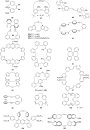
Figure 8: List of cyclophanes prepared via McMurry coupling reaction as a key step.

Scheme 15: Synthesis of paracyclophane by cross coupling involving Pd(0) catalyst. Reagents and conditions: (i...

Scheme 16: Synthesis of the cyclophane 112 via the pinacol coupling and 113 by RCM. Reagents and conditions: (...

Scheme 17: Synthesis of cyclophane derivatives 122a–c via Sonogoshira coupling. Reagents and conditions: (i) C...

Scheme 18: Synthesis of cyclophane 130 via Suzuki–Miyaura reaction as a key step. Reagents and conditions: (i)...

Scheme 19: Synthesis of the mycocyclosin via Suzuki–Miyaura cross coupling. Reagents and conditions: (i) benzy...

Scheme 20: Synthesis of cyclophanes via Wurtz coupling reaction Reagents and conditions: (i) PhLi, Et2O, C6H6,...

Scheme 21: Synthesis of non-natural glycophanes using alkyne metathesis. Reagents and conditions: (i) G-I (12)...

Figure 9: Synthesis of cyclophanes via ring-closing alkyne metathesis.

Scheme 22: Synthesis of crownophanes by cross-enyne metathesis. Reagents and conditions: (i) G-II (13), 5 mol ...

Scheme 23: Synthesis of (−)-cylindrocyclophanes A (156) and (−)-cylindrocyclophanes F (155). Reagents and cond...

Scheme 24: Synthesis of cyclophane 159 derivatives via SM cross-coupling and RCM. Reagents and conditions: (i)...

Scheme 25: Sexithiophene synthesis via cross metathesis. Reagents and conditions: (i) 161, Pd(PPh3)4, K2CO3, T...

Scheme 26: Synthesis of pyrrole-based cyclophane using enyne metathesis. Reagents and conditions: (i) Se, chlo...

Scheme 27: Synthesis of macrocyclic derivatives by RCM. Reagents and conditions: (i) G-I/G-II, CH2Cl2, 0.005 M...

Scheme 28: Synthesis of enantiopure β-lactam-based dienyl bis(dihydrofuran) 179. Reagents and conditions: (i) ...

Scheme 29: Synthesis of a [1.1.6]metaparacyclophane derivative 183 via SM cross coupling. Reagents and conditi...

Scheme 30: Synthesis of a [1.1.6]metaparacyclophane derivative 190 via SM cross coupling. Reagents and conditi...

Scheme 31: Template-promoted synthesis of cyclophanes involving RCM. Reagents and conditions: (i) acenaphthene...

Scheme 32: Synthesis of [3.4]cyclophane derivatives 200 via SM cross coupling and RCM. Reagents and conditions...
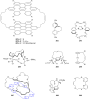
Figure 10: Examples for cyclophanes synthesized by RCM.

Scheme 33: Synthesis of the longithorone C framework assisted by fluorinated auxiliaries. Reagents and conditi...

Scheme 34: Synthesis of the longithorone framework via RCM. Reagents and conditions: (i) 213, NaH, THF, rt, 10...

Scheme 35: Synthesis of floresolide B via RCM as a key step. Reagents and conditions: (i) G-II (13, 0.1 equiv)...

Scheme 36: Synthesis of normuscopyridine (223) by the RCM strategy. Reagents and condition: (i) Mg, THF, hexen...

Scheme 37: Synthesis of muscopyridine (73) via RCM. Reagents and conditions: (i) 225, NaH, THF, 0 °C to rt, 1....

Scheme 38: Synthesis of muscopyridine (73) via RCM strategy. Reagents and conditions: (i) NaH, n-BuLi, 5-bromo...

Scheme 39: Synthesis of pyridinophane derivatives 223 and 245. Reagents and conditions: (i) PhSO2Na, TBAB, CH3...

Scheme 40: Synthesis of metacyclophane derivatives 251 and 253. Reagents and conditions: (i) 240, NaH, THF, rt...

Scheme 41: Synthesis of normuscopyridine and its higher analogues. Reagents and conditions: (i) alkenyl bromid...

Scheme 42: Synthesis of fluorinated ferrocenophane 263 via a [2 + 2] cycloaddition. Reagents and conditions: (...

Scheme 43: Synthesis of [2.n]metacyclophanes 270 via a [2 + 2] cycloaddition. Reagents and conditions: (i) Ac2...

Scheme 44: Synthesis of metacyclophane 273 by a [2 + 2 + 2] co-trimerization. Reagents and conditions: (i) [Rh...

Scheme 45: Synthesis of paracyclophane 276 via a [2 + 2 + 2] cycloaddition reaction. Reagents and conditions: ...

Scheme 46: Synthesis of cyclophane 278 via a [2 + 2 + 2] cycloaddition reaction. Reagents and conditions: (i) ...

Scheme 47: Synthesis of cyclophane 280 via a [2 + 2 + 2] cycloaddition. Reagents and conditions: (i) [(Rh(cod)(...

Scheme 48: Synthesis of taxane framework by a [2 + 2 + 2] cycloaddition. Reagents and conditions: (i) Cp(CO)2 ...

Scheme 49: Synthesis of cyclophane 284 and 285 via a [2 + 2 + 2] cycloaddition reaction. Reagents and conditio...

Scheme 50: Synthesis of pyridinophanes 293a,b and 294a,b via a [2 + 2 + 2] cycloaddition. Reagents and conditi...

Scheme 51: Synthesis of pyridinophanes 296 and 297 via a [2 + 2 + 2] cycloaddition. Reagents and conditions: (...

Scheme 52: Synthesis of triazolophane by a 1,3-dipolar cycloaddition. Reagents and conditions: (i) propargyl b...

Scheme 53: Synthesis of glycotriazolophane 309 by a click reaction. Reagents and conditions: (i) LiOH, H2O, Me...

Figure 11: Cyclophanes 310 and 311 prepared via click chemistry.

Scheme 54: Synthesis of cyclophane via the Dötz benzannulation. Reagents and conditions: (i) THF, 100 °C, 12 h...

Scheme 55: Synthesis of [6,6]metacyclophane by a Dötz benzannulation. Reagents and conditions: (i) THF, 100 °C...

Scheme 56: Synthesis of cyclophanes by a Dötz benzannulation. Reagents and conditions: (i) THF, 65 °C, 3 h; (i...

Scheme 57: Synthesis of muscopyridine (73) via an intramolecular DA reaction of ketene. Reagents and condition...

Scheme 58: Synthesis of bis[10]paracyclophane 336 via Diels–Alder reaction. Reagents and conditions: (i) DMAD,...

Scheme 59: Synthesis of [8]paracyclophane via DA reaction. Reagents and conditions: (i) maleic anhydride, 3–5 ...

Scheme 60: Biomimetic synthesis of (−)-longithorone A. Reagents and conditions: (i) Me2AlCl, CH2Cl2, −20 °C, 7...

Scheme 61: Synthesis of sporolide B (349) via a [4 + 2] cycloaddition reaction. Reagents and conditions: (i) P...

Scheme 62: Synthesis of the framework of (+)-cavicularin (352) via a [4 + 2] cycloaddition. Reagents and condi...

Scheme 63: Synthesis of oxazole-containing cyclophane 354 via Beckmann rearrangement. Reagents and conditions:...

Scheme 64: Synthesis of cyclophanes 360a–c via benzidine rearrangement. Reagents and conditions: (i) 356a–d, K2...

Scheme 65: Synthesis of cyclophanes 365a–c via benzidine rearrangement. Reagents and conditions: (i) BocNHNH2,...

Scheme 66: Synthesis of metacyclophane 367 via Ciamician–Dennstedt rearrangement. Reagents and conditions: (i)...

Scheme 67: Synthesis of cyclophane by tandem Claisen rearrangement and RCM as key steps. Reagents and conditio...

Scheme 68: Synthesis of cyclophane derivative 380. Reagents and conditions: (i) K2CO3, CH3CN, allyl bromide, r...

Scheme 69: Synthesis of metacyclophane via Cope rearrangement. Reagents and conditions: (i) MeOH, NaBH4, rt, 1...

Scheme 70: Synthesis of cyclopropanophane via Favorskii rearrangement. Reagents and conditions: (i) Br2, CH2Cl2...

Scheme 71: Cyclophane 389 synthesis via photo-Fries rearrangement. Reagents and conditions: (i) DMAP, EDCl/CHCl...

Scheme 72: Synthesis of normuscopyridine (223) via Schmidt rearrangement. Reagents and conditions: (i) ethyl s...

Scheme 73: Synthesis of crownophanes by tandem Claisen rearrangement. Reagents and conditions: (i) diamine, Et3...

Scheme 74: Attempted synthesis of cyclophanes via tandem Claisen rearrangement and RCM. Reagents and condition...

Scheme 75: Synthesis of muscopyridine via alkylation with 2,6-dimethylpyridine anion. Reagents and conditions:...

Scheme 76: Synthesis of cyclophane via Friedel–Craft acylation. Reagents and conditions: (i) CS2, AlCl3, 7 d, ...

Scheme 77: Pyridinophane 418 synthesis via Friedel–Craft acylation. Reagents and conditions: (i) 416, AlCl3, CH...

Scheme 78: Cyclophane synthesis involving the Kotha–Schölkopf reagent 421. Reagents and conditions: (i) NBS, A...

Scheme 79: Cyclophane synthesis involving the Kotha–Schölkopf reagent 421. Reagents and conditions: (i) BEMP, ...

Scheme 80: Cyclophane synthesis by coupling with TosMIC. Reagents and conditions: (i) (a) ClCH2OCH3, TiCl4, CS2...

Scheme 81: Synthesis of diaza[32]cyclophanes and triaza[33]cyclophanes. Reagents and conditions: (i) DMF, NaH,...

Scheme 82: Synthesis of cyclophane 439 via acyloin condensation. Reagents and conditions: (i) Na, xylene, 75%;...

Scheme 83: Synthesis of multibridged binuclear cyclophane 442 by aldol condensation. Reagents and conditions: ...

Scheme 84: Synthesis of various macrolactones. Reagents and conditions: (i) iPr2EtN, DMF, 77–83%; (ii) TBDMSCl...

Scheme 85: Synthesis of muscone and muscopyridine via Yamaguchi esterification. Reagents and conditions: (i) 4...

Scheme 86: Synthesis of [5]metacyclophane via a double elimination reaction. Reagents and conditions: (i) LiBr...

Figure 12: Cyclophanes 466–472 synthesized via Hofmann elimination.

Scheme 87: Synthesis of cryptophane via Baylis–Hillman reaction. Reagents and conditions: (i) methyl acrylate,...

Scheme 88: Synthesis of cyclophane 479 via double Chichibabin reaction. Reagents and conditions: (i) excess 478...

Scheme 89: Synthesis of cyclophane 483 via double Chichibabin reaction. Reagents and conditions: (i) 481, OH−;...

Scheme 90: Synthesis of cyclopeptide via an intramolecular SNAr reaction. Reagents and conditions: (i) TBAF, T...

Scheme 91: Synthesis of muscopyridine (73) via C-zip ring enlargement reaction. Reagents and conditions: (i) H...

Figure 13: Mechanism of the formation of compound 494.

Scheme 92: Synthesis of indolophanetetraynes 501a,b using the Nicholas reaction as a key step. Reagents and co...

Scheme 93: Synthesis of cyclophane via radical cyclization. Reagents and conditions: (i) cyclododecanone, phen...

Scheme 94: Synthesis of (−)-cylindrocyclophanes A (156) and (−)-cylindrocyclophanes F (155). Reagents and cond...

Scheme 95: Cyclophane synthesis via Wittig reaction. Reagents and conditions: (i) LiOEt (2.1 equiv), THF, −78 ...

Figure 14: Representative examples of cyclophanes synthesized via Wittig reaction.

Scheme 96: Synthesis of the [6]paracyclophane via isomerization of Dewar benzene. Reagents and conditions: (i)...
Similarity analysis, synthesis, and bioassay of antibacterial cyclic peptidomimetics
- Workalemahu M. Berhanu,
- Mohamed A. Ibrahim,
- Girinath G. Pillai,
- Alexander A. Oliferenko,
- Levan Khelashvili,
- Farukh Jabeen,
- Bushra Mirza,
- Farzana Latif Ansari,
- Ihsan ul-Haq,
- Said A. El-Feky and
- Alan R. Katritzky
Beilstein J. Org. Chem. 2012, 8, 1146–1160, doi:10.3762/bjoc.8.128
- and also as important structural elements. Pyridine scaffolds possess important antiviral [15], anti-inflammatory [16][17], anticonvulsant [18], antibacterial [19], and antitumor pharmacological activities [20][21]. Chiral macrocyclic ligands have found wide application in asymmetric synthesis and

Graphical Abstract

Figure 1: Molecular-descriptor-based cluster analysis; single-linkage Euclidean distances. Clustering of comp...

Scheme 1: Preparation of dicarboxylic benzotriazole derivatives.

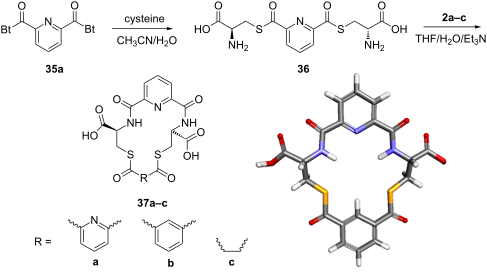
Scheme 2: Preparation of pyridine-based cysteine-containing macrocycles.

Scheme 3: Preparation of pyridine–cysteine-containing macrocycle 39.
Molecular recognition. 1. Crystal structures of hexaazamacrocyclic amines containing p-xylylene spacers and their adducts with acids
- Teresa Borowiak,
- Grzegorz Dutkiewicz,
- Maciej Kubicki,
- Marek Pietraszkiewicz,
- Agnieszka Gil and
- Rainer Mattes
Beilstein J. Org. Chem. 2005, 1, No. 16, doi:10.1186/1860-5397-1-16
- secondary amine with a lesser effect produced by the spacer. As the number of methylene units increases, the basicity of the macrocyclic ligands also increases because the amino-groups lie further apart from one another [2] in comparison with 1,4,7,16,19,22-hexaaza [9.9]-p-cyclophane (hereafter 2, Scheme 1

Graphical Abstract

Scheme 1: Formulas of macrocyclic amines, 1: 1,5,9,18,22,26-hexaaza [11.11]-p-cyclophane and 2: 1,4,7,16,19,2...

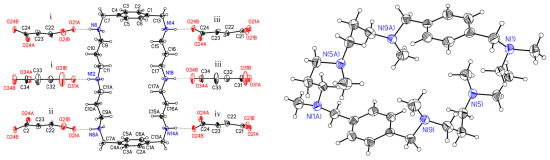
Figure 1: The ionic synthon of 1-FUM built from one macrocyclic hexa-protonated cation and six fumaric anions...

Figure 2: The structure of one sheet in 1-FUM – a projection perpendicular to the phenyl ring planes. Tapes o...

Figure 3: The arrangement of two sheets (after rotation by 90°). The height of one sheet corresponds to the h...

Figure 4: The molecular conformation of 1-N-Me, atom labeling scheme indicated. Displacement parameters are d...

Figure 5: The unit cell of 1-N-Me, stacks of molecules are indicated.



