


Search results
Search for "mitosis" in Full Text gives 9 result(s) in Beilstein Journal of Organic Chemistry.
Molecular tweezer–peptide conjugates disrupt the protein–protein interaction between survivin and histone H3 essential in mitosis
Beilstein J. Org. Chem. 2026, 22, 557–567, doi:10.3762/bjoc.22.41
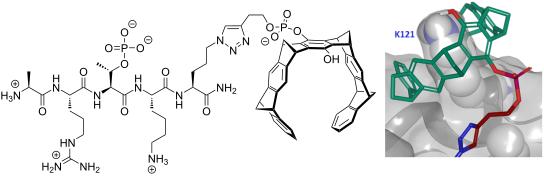
- ; protein–protein interaction; mitosis; X-ray crystallography; Introduction The fundamental process of mitosis is controlled by a very large protein complex called the kinetochore, formed by self-assembly from hundreds of single protein components [1]. For the intricate regulation of the various phases of
- centromere protein), and the kinase Aurora B. During mitosis, Aurora B phosphorylates important components of the kinetochore and thus exerts control over key events of the whole process. The other three proteins localize the CPC during the different mitotic phases [4]. Survivin, borealin and INCENP are
- crystallization experiments, competitive fluorescence titrations, and cell division assays. Conclusion This report introduces a new supramolecular attempt to interfere with the critical interaction between kinetochore and CPC during mitosis in cells. The concept builds on the discovery that a specific protein




Using UHPLC–MS profiling for the discovery of new sponge-derived metabolites and anthelmintic screening of the NatureBank bromotyrosine library
Beilstein J. Org. Chem. 2022, 18, 1544–1552, doi:10.3762/bjoc.18.164
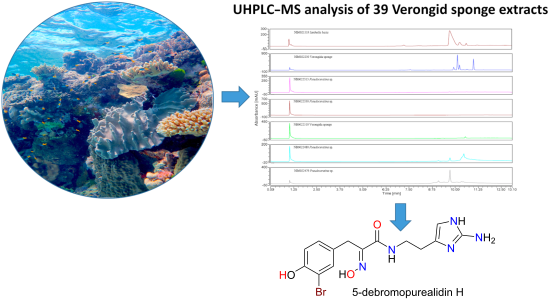
- , fragmentation of the mitochondrial tubular network, chromosome misalignment, and cell cycle arrest in mitosis in LNCaP prostate cancer cells [38]. The bastadin structure class is well-documented within the literature for their cytotoxic activity [37][39][40][41], with both bastadins 4 and 8 exhibiting in vitro


Potent hemithioindigo-based antimitotics photocontrol the microtubule cytoskeleton in cellulo
Beilstein J. Org. Chem. 2020, 16, 125–134, doi:10.3762/bjoc.16.14
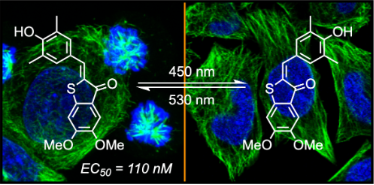
- microtubules (MTs), which play a pivotal role as a dynamic scaffold for a multitude of cellular processes. These include mechanostasis, the completion of mitosis, cell motility, and cargo trafficking in all cell types, as well as cell-type-specific roles, such as polarization, cargo sorting, and trafficking in
- cycle arrest in the G2/M phase by preventing the completion of mitosis [1]. We examined cell cycle repartition by quantification of cellular DNA content via propidium iodide (PI) incorporation, which was analysed by flow cytometry (Supporting Information File 1, Figure S7). HeLa cells were treated for




Synthesis of a tubugi-1-toxin conjugate by a modulizable disulfide linker system with a neuropeptide Y analogue showing selectivity for hY1R-overexpressing tumor cells
Beilstein J. Org. Chem. 2019, 15, 96–105, doi:10.3762/bjoc.15.11
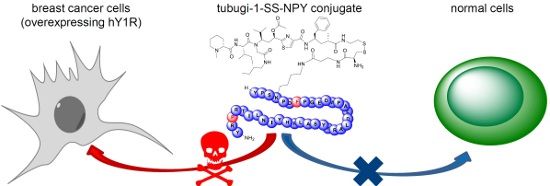
- (Figure 1) [44][45][46]. Tubulysins were originally discovered and isolated from myxobacteria [47][48], with picomolar in vitro activities [45][46][49][50][51][52][53][54], that are caused by a destabilization and degradation of the microtubuli network undermining its function in mitosis of eukaryotic




Stimuli-responsive oligonucleotides in prodrug-based approaches for gene silencing
Beilstein J. Org. Chem. 2018, 14, 436–469, doi:10.3762/bjoc.14.32
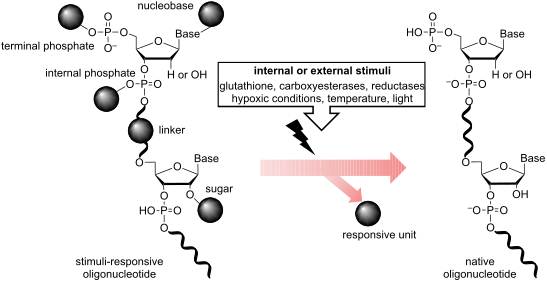
- , light activation of RNAi was confirmed in HeLa cells transfected with a GFP reporter gene but was also demonstrated with the silencing of the endogenous gene of the mitosis motor protein Eg5. In the same article, Deiters reported the study of siRNAs with caged nucleotides at the seed region of siRNA


SF002-96-1, a new drimane sesquiterpene lactone from an Aspergillus species, inhibits survivin expression
Beilstein J. Org. Chem. 2013, 9, 2866–2876, doi:10.3762/bjoc.9.323
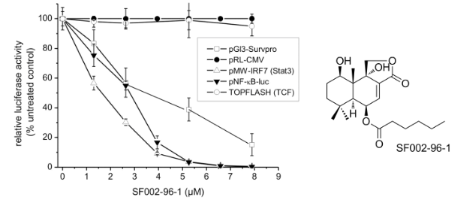
- controlling cell division. In normal differentiated tissues the expression of survivin is cell cycle-regulated with an expression maximum in G2/M phase [7]. During mitosis, survivin is associated in the chromosomal passenger complex (CPC), a multi-protein complex, including the proteins Aurora B kinase, inner
- centromere protein (INCENP) and Borealin/Dasra-B. In this complex, survivin promotes mitosis by mediating the segregation of sister chromatids, stabilization of microtubules in late mitosis and acting as an interphase between the centromere/central spindle and the CPC [8][9]. Furthermore, survivin shuttles




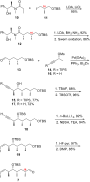
Efficient syntheses of 25,26-dihydrodictyostatin and 25,26-dihydro-6-epi-dictyostatin, two potent new microtubule-stabilizing agents
Beilstein J. Org. Chem. 2011, 7, 1372–1378, doi:10.3762/bjoc.7.161
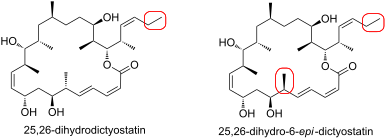
- ; microtubules; NHK; Introduction The discovery of compounds that function as anticancer agents by altering the dynamics of microtubules continues to be an important goal in medicinal chemistry. Such agents can force the cell to exit mitosis aberrantly, leading to apoptosis [1][2]. Important classes of




A two step synthesis of a key unit B precursor of cryptophycins by asymmetric hydrogenation
Beilstein J. Org. Chem. 2011, 7, 243–245, doi:10.3762/bjoc.7.32
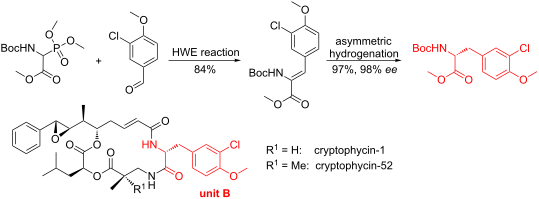
- enantioselectivity, and avoids hazardous reaction conditions. Keywords: amino acid; asymmetric hydrogenation; cryptophycin; DuPhos; Introduction Cryptophycins are macrocyclic depsipeptides, which show very high cytotoxicity even against multidrug-resistant cell lines. They inhibit mitosis of eukaryotic cells by


Colchitaxel, a coupled compound made from microtubule inhibitors colchicine and paclitaxel
Beilstein J. Org. Chem. 2006, 2, No. 13, doi:10.1186/1860-5397-2-13
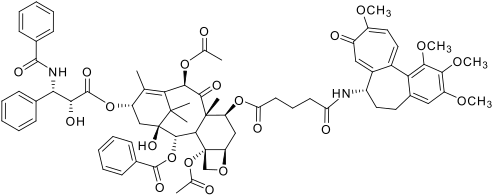
- that cells enter apoptosis shortly after paclitaxel exposure, suggesting that they are directed into a cell death pathway before entering the mitotic phase of the cell cycle [52][53]. Conversely, certain cells treated at high concentrations could pass through mitosis but still avoid apoptosis. This was
- particularly true of rodent cell lines. These cells escape mitosis and reconstitute a G1 population with a tetraploid chromosome complement when the spindle cannot be formed, whereas human cells tend to remain in mitotic arrest indefinitely [54][55]. Although the cure rates obtained with combinations were


Other Beilstein-Institut Open Science Activities



