


Search results
Search for "phosphate esters" in Full Text gives 12 result(s) in Beilstein Journal of Organic Chemistry.
Synthesis of diaryl phosphates using phytic acid as a phosphorus source
Beilstein J. Org. Chem. 2026, 22, 213–223, doi:10.3762/bjoc.22.15
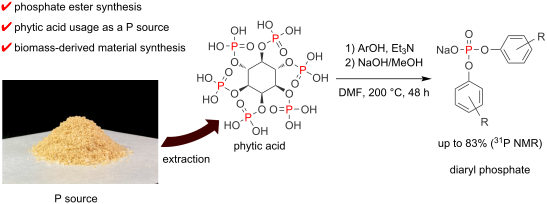
- soil. It can potentially serve as a phosphorus source in the syntheses of organic phosphates; however, this approach has not been utilized for the preparation of phosphate esters. In this study, we report the first successful synthesis of phosphate esters using phytic acid as a phosphorus source. Crude
- with a recovery of 4.2% and then conducted an esterification reaction using the extracted phytic acid and phenol. As a result, diphenyl phosphate with a yield of 44% was obtained. This work can facilitate the development of an environmentally friendly method for producing phosphate esters that does not
- rely on phosphate rock but instead uses biomass as a phosphorus source. Keywords: diaryl phosphates; phosphate esters; phosphate ester synthesis; phosphorus recovery; phytic acid; Introduction Phytic acid (myo-inositol-1,2,3,4,5,6-hexakisphosphate, Scheme 1) is a phosphorus-rich molecule, which is




Three-component N-alkenylation of azoles with alkynes and iodine(III) electrophile: synthesis of multisubstituted N-vinylazoles
Beilstein J. Org. Chem. 2024, 20, 891–897, doi:10.3762/bjoc.20.79
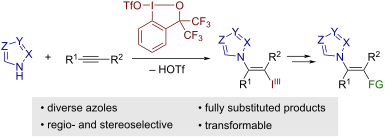
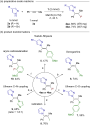
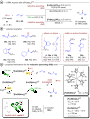
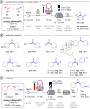
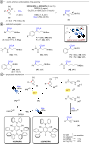
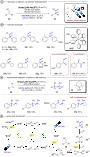
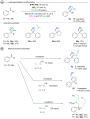
- difunctionalization of alkynes with various heteroatom and carbon nucleophiles [27][28][29][30][31][32][33][34]. Specifically, intermolecular trans-iodo(III)functionalization of alkynes has been achieved using oxygen nucleophiles such as alcohols [28][32], ethers [33], carboxylic acids [31], phosphate esters [31



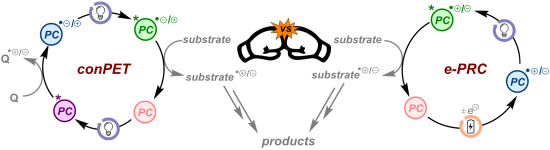
Photoredox catalysis harvesting multiple photon or electrochemical energies
Beilstein J. Org. Chem. 2023, 19, 1055–1145, doi:10.3762/bjoc.19.81

























Activated carbon as catalyst support: precursors, preparation, modification and characterization
Beilstein J. Org. Chem. 2020, 16, 1188–1202, doi:10.3762/bjoc.16.104
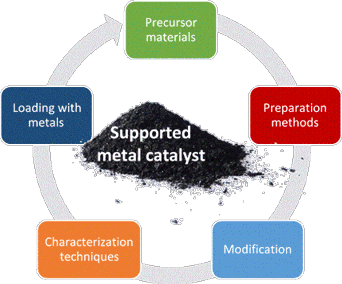
- structures in the carbon source [6]. Diamadopoulos and co-workers observed also the production of smaller surface areas by H3PO4 activation of bagasse and rice husk due to a reaction of the activating reagent with the carbon precursor. Thereby, phosphate esters or polymerization byproducts are formed, which
- forming phosphate esters or polymerization byproducts that bind on the solid carbon matrix [30]. Boehm titrations: Boehm titrations are used for the determination of acidic or basic surface oxygen functional groups of solid materials. The acidic character is caused by carboxyl groups (R–COOH), lactones (R


Syntheses and chemical properties of β-nicotinamide riboside and its analogues and derivatives
Beilstein J. Org. Chem. 2019, 15, 401–430, doi:10.3762/bjoc.15.36
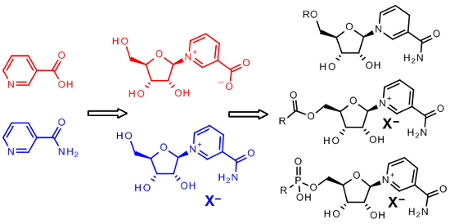
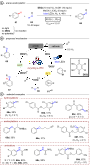
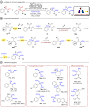
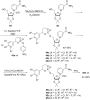
- compounds 44 (Scheme 21), subsequent phosphorylation of the alkoxide with electrophilic phosphate triesters yielded the phosphate esters 44 in ca. 40–50% yield, after purification by flash chromatography on silica gel (0–10% methanol in dichloromethane as an eluent). These products were then oxidized using






Synthesis of oligonucleotides on a soluble support
Beilstein J. Org. Chem. 2017, 13, 1368–1387, doi:10.3762/bjoc.13.134
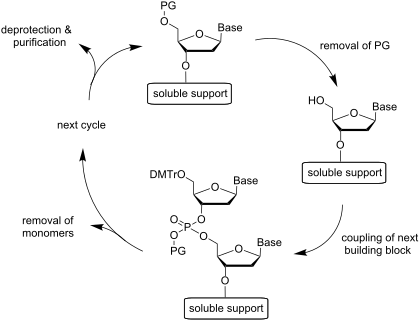
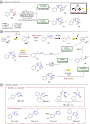
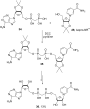
- -dicyanoimidazole (DCI, 1.5 equiv) as an activator. The resulting phosphite triesters were converted to phosphate esters by conventional aq iodine oxidation. Precipitation by dilution with MeOH removed all traces of reagents and monomeric nucleoside derivatives. As a proof of concept, a pentamer, d(5´-AGCCT-3






Synthesis of γ-hydroxypropyl P-chirogenic (±)-phosphorus oxide derivatives by regioselective ring-opening of oxaphospholane 2-oxide precursors
Beilstein J. Org. Chem. 2015, 11, 1332–1339, doi:10.3762/bjoc.11.143
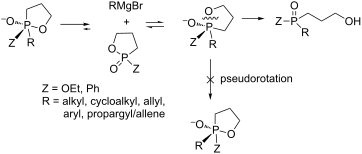
- of a P–C bond from phosphate esters using these reagents, is limited [13]. The reactions are not selective and compounds containing multiple P–C bonds are generally obtained [14]. In order to achieve better selectivity, a single alkyloxy substituent may be replaced by a halogen. This halogen will be


Photorelease of phosphates: Mild methods for protecting phosphate derivatives
Beilstein J. Org. Chem. 2014, 10, 2038–2054, doi:10.3762/bjoc.10.212
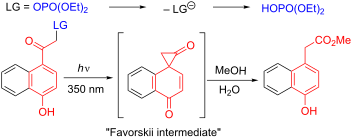
- studies substantiated the generality of the meta effect for phosphate leaving groups in heterolytic photoreactions. Over the past four decades, additional examples of phosphate esters attached to reactive chromophores other than phenyl and benzyl [6][7][8][9][10][11] have been investigated for their
- propensity to undergo heterolytic photosolvolysis reactions, most notably o-nitrobenzyl (o-NB) [12], benzyl phenyl ketone (benzoin) [13][14], coumarin-4-ylmethyl [15], and, more recently, p-hydroxyphenacyl (pHP) [15] phosphate esters (Figure 1). While these chromophores exhibit a range of photophysical
- optimally appending a hydroxy and carbonyl positioned for excited state interaction, in accord with the pHP motif 4a, invited serious examination. Results Synthesis of phosphate esters A series of diethyl phosphate (DEP) esters caged with extended 2-(6-hydroxynaphthalen-2-yl)-2-oxoethyl (2,6-HNA, 10), 2-(4


A chemist and biologist talk to each other about caged neurotransmitters
Beilstein J. Org. Chem. 2013, 9, 64–73, doi:10.3762/bjoc.9.8
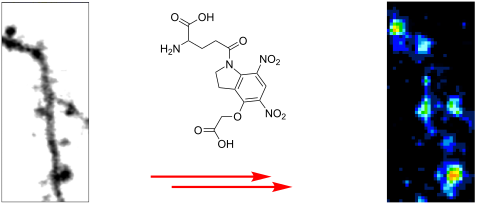
- series of phosphate esters made as membrane permeable pronucleotides. Thus, this optical probe arose out of the context of the already developed prodrugs that used thermal chemistry for release of their latent cargo. In contrast, the photolabile ATP molecule was synthesized in a physiology department for
- . However, more electron-rich molecules tend to be much more unstable. Phosphate esters are more stable than carboxylate esters, but they also suffer from instability. Thus, an electron-deficient NB-caged cAMP is very stable but an electron rich one (DMNB-cAMP) is not [4][54]. The opposite trend is true for


Thermodynamic and kinetic stabilization of divanadate in the monovanadate/divanadate equilibrium using a Zn-cyclene derivative: Towards a simple ATP synthase model
Beilstein J. Org. Chem. 2012, 8, 81–89, doi:10.3762/bjoc.8.8
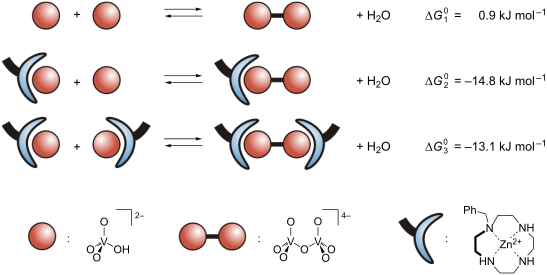
- hold for natural systems – particularly ATP synthase, phosphatases and kinases catalyzing the condensation, hydrolysis and phosphate transfer in phosphate esters and phosphate oligomers – which are unsymmetric with respect to metal complexation of the substrates. In the P–O bond forming/cleaving step




Synthesis of rigidified flavin–guanidinium ion conjugates and investigation of their photocatalytic properties
Beilstein J. Org. Chem. 2009, 5, No. 26, doi:10.3762/bjoc.5.26
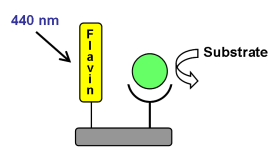
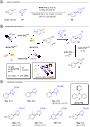
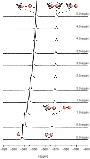
- riboflavin 3 or compound 8. Dibenzyl phosphate esters are oxidatively cleaved by blue light irradiation (440 nm) in the presence of compounds 1 and 2 (Scheme 3). The acceleration of the reaction in acetonitrile by 1 and 2, bearing a guanidinium ion binding site with phosphate affinity, is significantly




Synthesis of phosphorothioates using thiophosphate salts
Beilstein J. Org. Chem. 2006, 2, No. 4, doi:10.1186/1860-5397-2-4

- intermediates. [1] The synthesis of phosphate esters is an important objective in organic synthesis, since they have found use in the preparation of biologically active molecules, and also versatile intermediate in synthesis of amides and esters. [2][3][4] Among the phosphate esters, phosphorothioate





