


Search results
Search for "silicon-rhodamine" in Full Text gives 3 result(s) in Beilstein Journal of Organic Chemistry.
A practical CO2-mediated synthesis of 5,6-carboxylated silicon-rhodamines for targeted probe development
Beilstein J. Org. Chem. 2026, 22, 915–924, doi:10.3762/bjoc.22.72
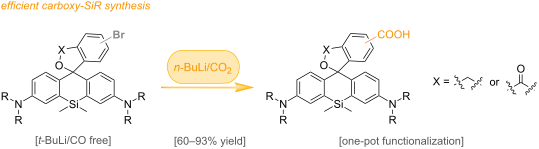
- .22.72 Abstract Silicon-rhodamine (SiR) dyes are among the most important fluorophores for super-resolution imaging owing to their far-red emission, high photostability, and tunable lactone–zwitterion equilibrium. However, their broader application in targeted probe development has been limited by the
- facilitates the rapid development of targeted SiR probes. Keywords: carboxylation; CO2; fluorescent probes; silicon-rhodamine; super-resolution imaging; Introduction Rhodamine dyes, which enable fluorescence imaging in living cells – a powerful technique for studying biological systems in vivo [1][2] – have
- functional derivatization of SiR dyes and the development of targeted probes. Results and Discussion Synthesis of carboxy-substituted silicon-rhodamine Inspired by Butkevich’s work [45], we envisioned that carboxylated SiRs might be accessed through brominated SiR intermediates, thereby avoiding the



A new approach to silicon rhodamines by Suzuki–Miyaura coupling – scope and limitations
Beilstein J. Org. Chem. 2019, 15, 2569–2576, doi:10.3762/bjoc.15.250
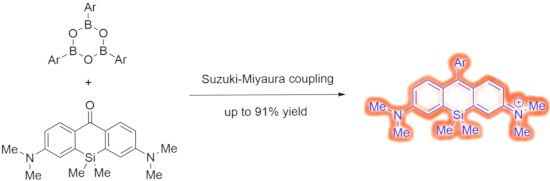
- pharmacokinetic or -dynamic properties of the tumor tracers, silicon rhodamines are relatively small and already examined as fluorophores for the optical imaging of tumors. Using silicon rhodamine SiR700 a more enhanced tumor-to-background ratio in optical imaging could be achieved compared to the cyanine based
- dyes Cy5.5 and Alexa Fluor® 680 [23]. Moreover, silicon rhodamines demonstrated in in vivo imaging experiments excellent fluorescence properties and biostabilities [23] as well as exhibited high quantum efficiencies with high tolerance to photobleaching [24]. A silicon rhodamine antibody conjugate
- could also be successfully applied for optical imaging of a xenograft tumor (human malignant meningioma) in a mouse model [24]. Again, in direct comparison with the cyanine dye Cy5.5, the silicon rhodamine conjugate showed no fading indicating that silicon rhodamine dyes are more suitable for long time


Synthesis of a dihalogenated pyridinyl silicon rhodamine for mitochondrial imaging by a halogen dance rearrangement
Beilstein J. Org. Chem. 2019, 15, 2333–2343, doi:10.3762/bjoc.15.226
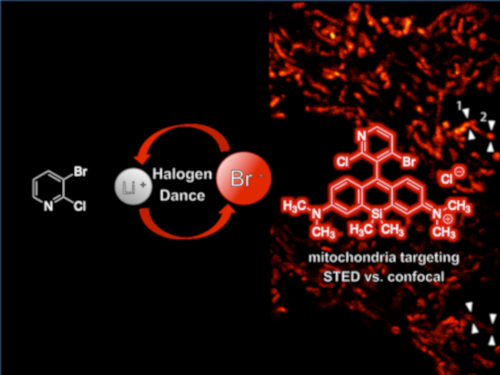
- .15.226 Abstract Background: Since their first synthesis, silicon xanthenes and the subsequently developed silicon rhodamines (SiR) gained a lot of attention as attractive fluorescence dyes offering a broad field of application. We aimed for the synthesis of a fluorinable pyridinyl silicon rhodamine for
- features with their optical properties and control the latter by rational dye design [15][24][25][26]. These investigations led to new silicon rhodamine dyes with enhanced and fine-tuned properties (quantum yield, lifetime, brightness, absorption and emission maxima). A recent review compared the
- imaging (OI)), we wanted to develop the pyridinyl-substituted silicon rhodamine 15, in which the 2-halopyridine moiety can easily be radiofluorinated to the PET-active dye 16 (Scheme 2, for examples on radiolabelling of 2-halopyridines see [36][37][38] and references therein). While the PET modality is



Other Beilstein-Institut Open Science Activities



